Chef Resume Examples: what a hiring manager reads first
Chef Resume and Chef Curriculum Vitae Examples for Every Kitchen
By Mustafa Tarabya, founder of CVBooster · Published · Updated
Chef resume, culinary resume and chef curriculum vitae examples from commis to head chef, with kitchen bullets, covers and the keywords owners look for.
Sample resumes for a chef
The same chef content laid out in three CVBooster templates, so you can see what the finished document looks like before you write a word.
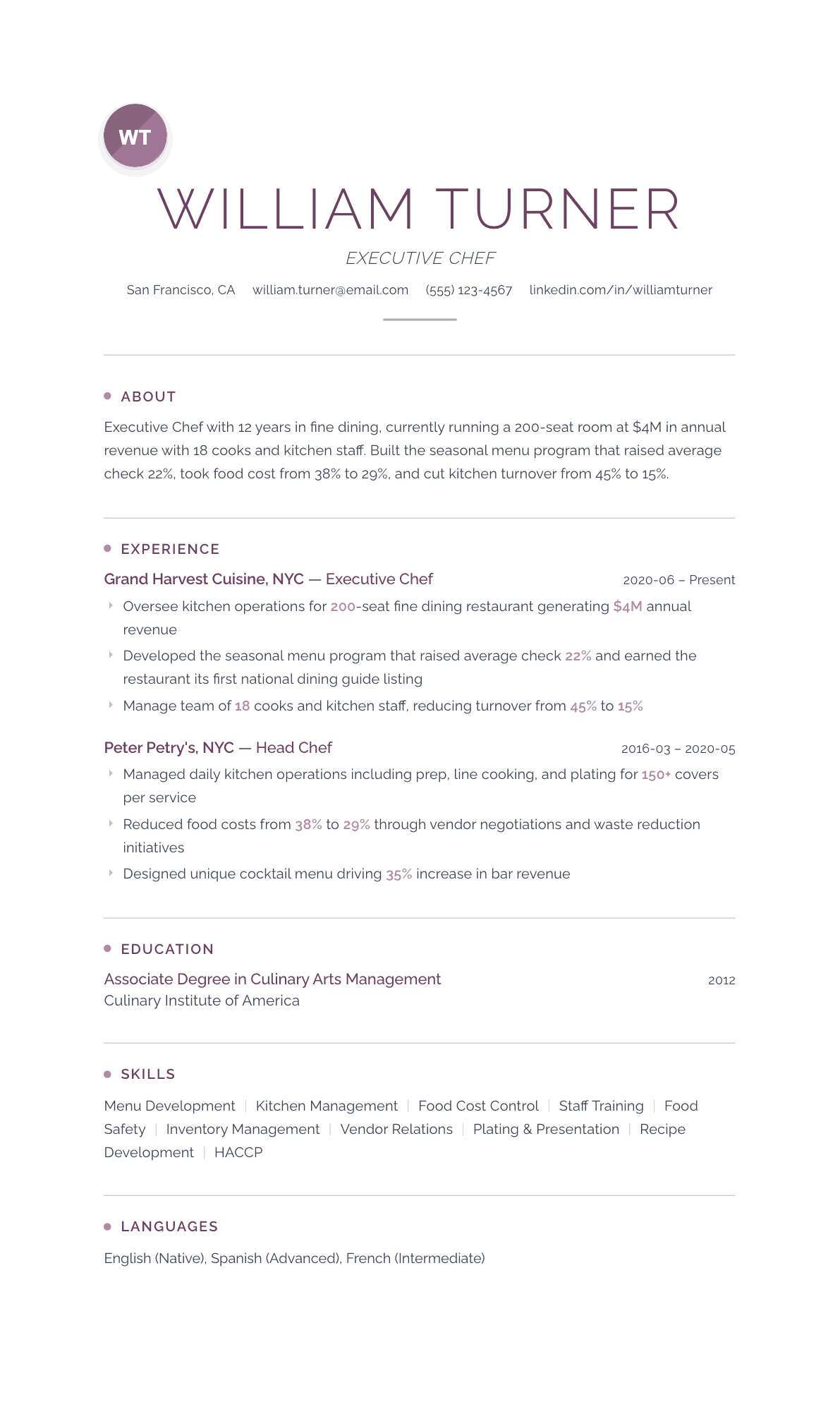
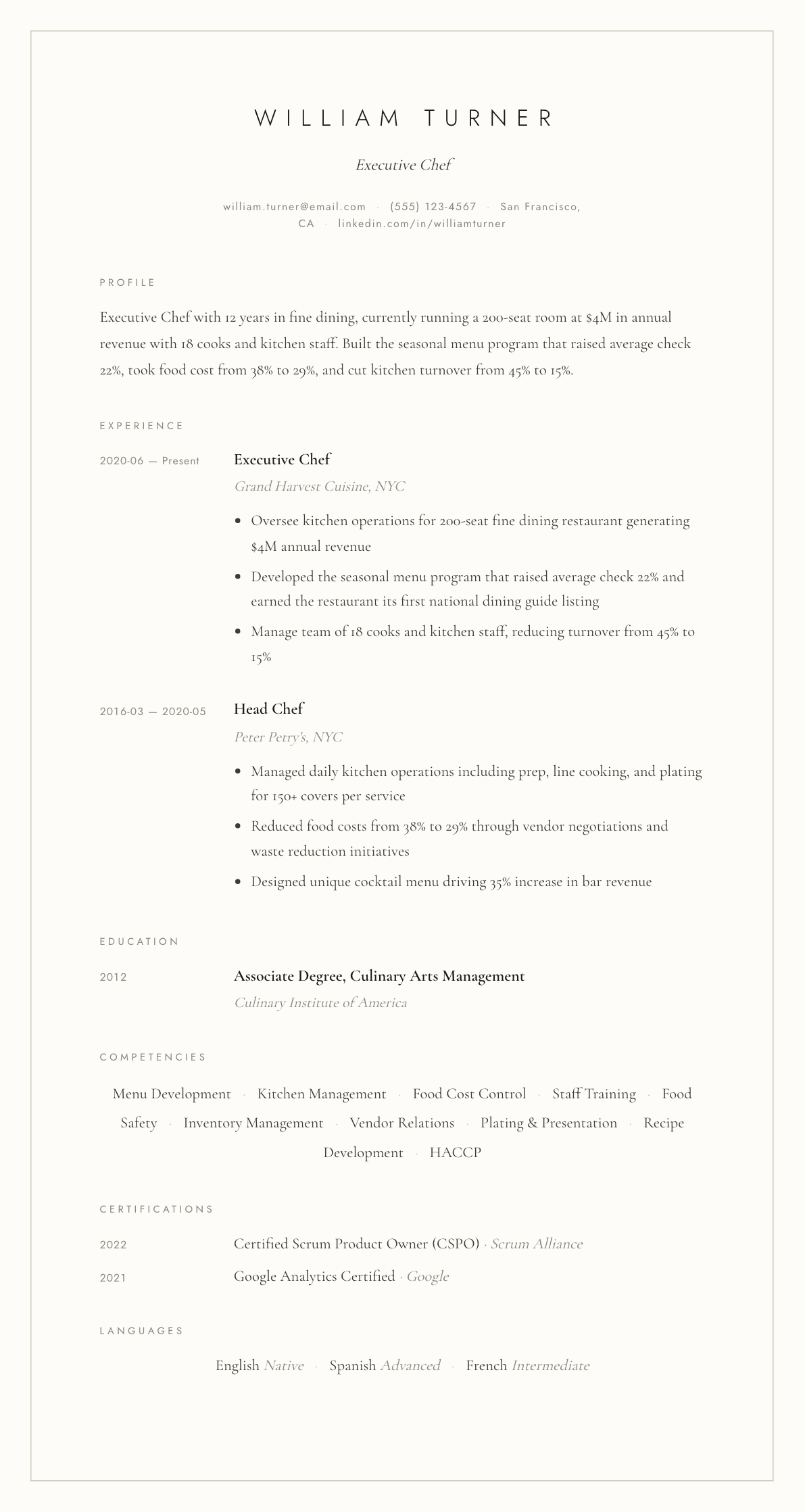
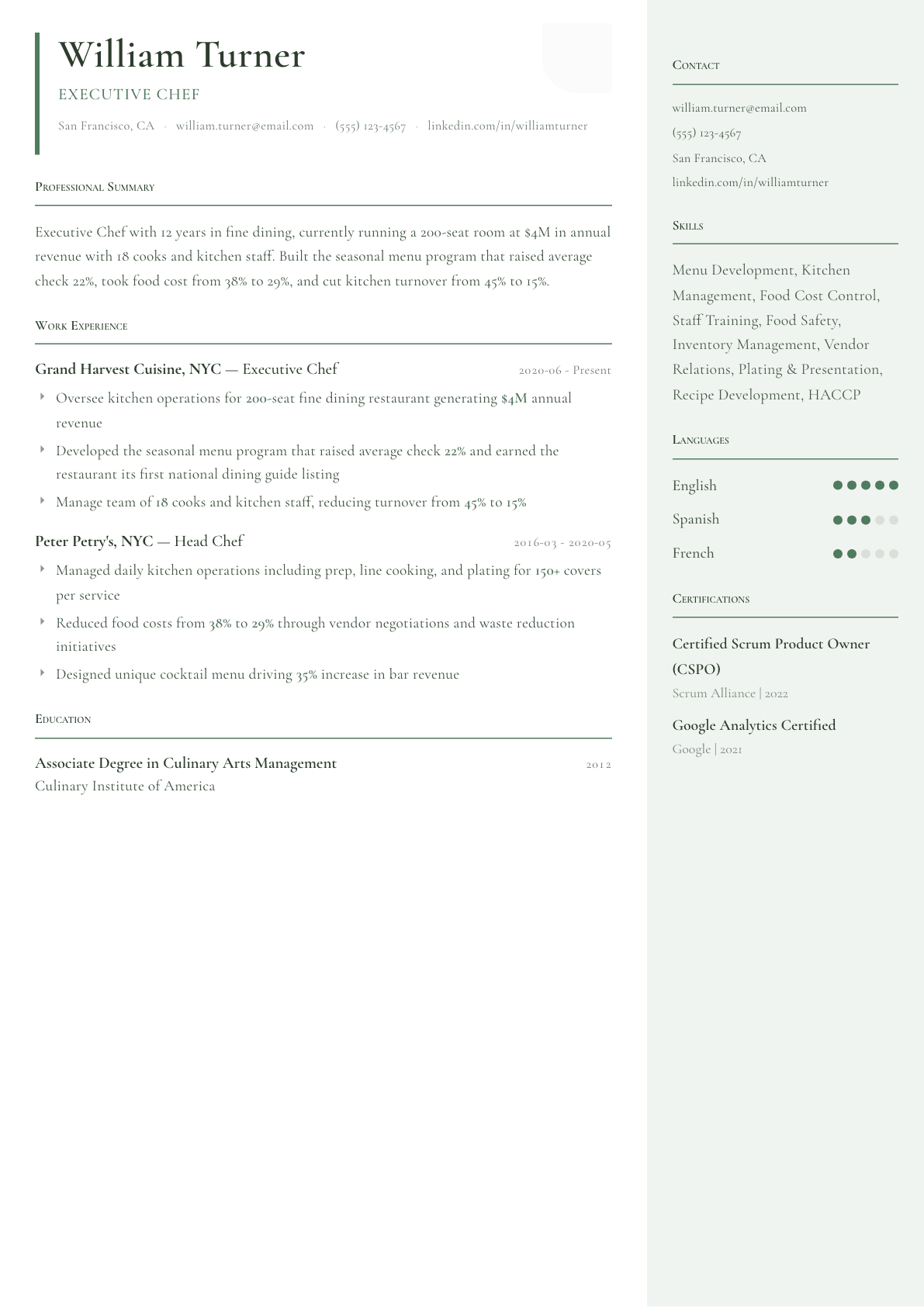
Example Chef summary
Executive chef, 12 years, 200 seats and $4M in annual sales with an 18-person brigade and full food cost responsibility. Menu development that lifted average check 22%, food cost down nine points through vendor work and waste control, and a kitchen that now keeps its cooks.
Skills to list on a Chef resume
- Menu Development
- Kitchen Management
- Food Cost Control
- Staff Training
- Food Safety
- Inventory Management
- Vendor Relations
- Plating & Presentation
- Recipe Development
- HACCP
What actually gets this resume read
- Highlight cuisine specialties and any awards or recognitions.
- Quantify: covers per service, food cost percentages, revenue impact.
- Show leadership: team sizes, turnover reduction, training programs.
- Include food safety certifications (ServSafe, HACCP).
- Mention menu innovation and seasonal program development.
How to write a chef resume
A chef resume is read by an owner, a chef de cuisine or a director of operations who will decide in about thirty seconds whether to call you in for a stage. What they are looking for is the shape of your kitchen life: the cuisines you have cooked, the volume you have cooked at, the stations you have owned, and whether the kitchens on your page are ones they respect.
The mistake almost every chef makes on paper is writing like a manager when the reader wants a cook. The reader wants covers per service, station, brigade position, and the food. They want to know whether you can hold saute on a 300-cover Saturday, whether you can butcher and break down whole product, and whether the menu you claim to have written was actually yours.
This guide covers how to lay out a working chef resume, with example summaries for a line cook stepping up, a sous chef and a chef de cuisine, before and after bullets that replace kitchen cliches with real numbers, and the questions cooks ask when they change cuisines, move cities, or apply above their current title. Culinary resume is the same document under a wider name, used by line cooks, pastry cooks and kitchen managers as well as chefs, so every example here also works as a culinary resume example.
Format: one page, kitchens first, no photographs of your food
One page for almost everyone below executive chef. Reverse chronological. Under each job give the restaurant, the cuisine, the seat count, the average covers per service, and the brigade position you held. That single line does more work than four bullets, because a reader who knows the industry can price a 90-seat modern American room at 220 covers immediately.
Keep the resume text-only. Send a link to your work separately if the posting asks, but a resume laid out like a menu or padded with plate photographs is harder to read in a hurry and often arrives broken. If you have stages, list them by restaurant and duration in their own short block, because where you staged says a lot about who trained you.
- Header: name, city, phone, email, food safety manager certification.
- Order: summary, kitchen experience, stages, certifications, culinary education.
- Never leave off the cuisine and the covers. Those two facts frame everything else.
Summary: cuisine, volume, station history, and what you cook well
Three lines. Name the cuisines you have genuinely cooked, the volume, the stations you have run, and the part of the craft you are strongest in. Butchery and whole animal fabrication, pasta and bread, garde manger and cold service, pastry, live fire, fermentation and preservation, or high volume banquet production all read differently to a hiring chef.
If you are changing cuisines, say it and name what transfers. Technique, mise en place discipline, timing and palate move between kitchens. The specific repertoire does not, and a hiring chef respects a candidate who says so plainly far more than one who overclaims and folds during a trial service.
Experience: covers, stations, product and the food you actually made
Write bullets a cook would recognize. Which stations you ran and on which nights. Covers per service and per shift at peak. What you fabricated: whole fish, primal cuts, poultry, charcuterie, stocks and sauces from scratch. What you produced daily: pasta extruded in house, bread baked in house, in-house cures and pickles. Prep lists you wrote and the mise en place you set for the line behind you.
Add the commercial side without pretending to be an accountant. Food cost percentage on your section or your menu and what moved it. Ordering, receiving and yield testing. Waste and cross-utilization between dishes. Inventory counts. A cook who understands that a special exists to move product is a cook an owner keeps.
Then the leadership, at whatever scale you have it. Cooks you trained and on which stations. Schedules you wrote. Expediting a service. Running a shift alone when the chef was off. Health inspection results on your watch. These bullets are the difference between a line cook resume and a sous chef application.
Culinary resume example, one experience entry written out: Sous Chef, a 90 seat neighborhood bistro, brigade of eight. Runs the pass on the chef's days off, writes the weekly prep list and ordering, and costs every new dish before it goes on the board. Wrote four dishes on the current menu, including the braised short rib that sells out on weekends. Trains new line cooks on the grill and saute stations until they can cook a Saturday unsupervised.
Menu work: prove it was yours
Everybody claims menu development. Make yours checkable by naming the scope: how many dishes, how often you changed them, whether you costed them, and what happened commercially. Wrote four dishes a quarter for the tasting menu and costed each against a target reads as true. Developed innovative seasonal menus reads as filler.
Sourcing detail carries weight. Naming farms, purveyors or a whole-animal program, describing a foraging or preservation program, or explaining how you built a menu around what a single supplier could actually deliver each week shows a chef who buys as well as cooks.
- Say how many dishes you wrote and how often the menu turned.
- Give the food cost target you cooked against and whether you hit it.
- Name the equipment you are trained on: combi oven, immersion circulator, wood fire, plancha, smoker.
Training, certification and the trial shift
Food protection manager certification is the practical requirement, and allergen training is increasingly expected. Culinary school matters early in a career and fades fast after it, so a graduate should list the program and any externship, while a cook with a decade behind them should give it one line and spend the space on kitchens.
Write the resume knowing the real interview is a trial shift. Everything you claim will be tested in a service within two weeks. That is a reason to be specific rather than a reason to be vague, because specific claims you can actually cook are what get you the stage in the first place.
Chef curriculum vitae: writing the UK CV version
A chef curriculum vitae is what a kitchen in the UK or Ireland asks for instead of a resume, and the content is the same with three changes. The page is called a CV, it opens with a short personal statement instead of a summary, and two pages are normal for a head chef or sous chef with a long kitchen history.
Use brigade titles the reader recognizes, commis, chef de partie, junior sous, sous chef and head chef, and put your food hygiene certificate level next to your training. The chef curriculum vitae examples below show the personal statement and the first two bullets at three levels.
- Commis chef sample: Commis chef with eighteen months in a busy gastropub kitchen, working the larder and pastry sections on a menu of around eighty covers a night. Holds a Level 2 food hygiene certificate and is working toward a Level 3 diploma in professional cookery.
- Commis chef sample, bullets: prepares mise en place for two sections before service; covers the fryer and grill on Sunday lunch when the kitchen runs at full capacity.
- Chef de partie sample: Chef de partie running the sauce section in a hotel restaurant with a weekly changing menu. Trains two commis chefs, places orders for the section and keeps the allergen sheets current for every dish.
- Chef de partie sample, bullets: built the prep list for the sauce section that cut end of night waste; led the section through a full environmental health inspection with no actions raised on it.
- Head chef sample: Head chef of a sixty seat independent restaurant for four years, writing seasonal menus, managing a brigade of seven and holding food cost to the target agreed with the owner.
- Head chef sample, bullets: wrote four seasonal menus a year and costed every dish before launch; hired and trained the current sous chef, who now runs the kitchen on the head chef's days off.
Chef resume summary examples
Line cook stepping up
Line cook with 3 years in a 90-seat modern American kitchen running saute and grill through 220-cover services. Breaks down whole fish and poultry daily, writes prep lists for two stations, and holds food protection manager certification. Ready for a lead line or junior sous position.
Sous chef
Sous chef in a 200-seat restaurant averaging 350 covers a night, running the pass on four services a week and supervising eight cooks. Wrote 12 dishes across two seasonal changes, held food cost at 29%, and rebuilt the prep system after a staffing change without a service interruption.
Chef de cuisine
Chef de cuisine leading a 20-cook kitchen in a fine dining room, accountable for the menu, ordering, scheduling and food cost. Turns the menu four times a year around a whole-animal program with three regional farms, and has passed three years of inspections with no critical violations.
Work experience bullets: before and after
Before: Worked as a cook on the line preparing dishes.
After: Ran saute and grill through 220-cover services in a 90-seat modern American kitchen, holding ticket times under 14 minutes on a four-station line.
Station, covers, room size and ticket time let a hiring chef picture you working, which no general description does.
Before: Helped develop new menu items.
After: Wrote 12 dishes across two seasonal menu changes, costed each against a 30% food cost target, and cross-utilized trim from the whole-animal program into three of them.
Counting the dishes, costing them and explaining the sourcing logic proves the menu work was really yours.
Before: Managed food costs in the kitchen.
After: Brought food cost from 34% to 29% over two quarters through weekly yield testing, a rebuilt par list and a Sunday special built entirely from the week's carryover product.
The tactics behind the movement show a cook who understands purchasing, not one who was told the number improved.
Before: Trained kitchen staff.
After: Trained six cooks onto garde manger and saute using written station cards and a sign-off before a solo service, cutting new-hire ramp time to two weeks.
A written standard and a sign-off gate is a system, and systems are what promote a cook into a sous chef role.
Before: Maintained kitchen cleanliness and safety.
After: Owned the sanitation program across five stations and the walk-in, running daily temperature logs and weekly deep cleans through three inspections with no critical violations.
The inspection result is the only sanitation claim that can be verified, so it is the one worth writing.
Hard skills
- Station cookery: saute, grill, garde manger
- Butchery and whole animal fabrication
- Stocks, sauces and mother sauce technique
- Menu development and dish costing
- Food cost and yield testing
- Ordering, receiving and inventory
- Prep list and mise en place systems
- Combi oven and sous vide
- Bread, pasta and in-house production
- HACCP and temperature control
- Allergen and dietary substitution
- Expediting and pass management
Soft skills
- Composure during a rush
- Clear call and response on the line
- Coaching younger cooks
- Palate and self-critique
- Consistency shift to shift
- Reliability in a short-staffed kitchen
Certifications worth listing
- ServSafe Food Protection Manager (National Restaurant Association)
- ServSafe Allergens (National Restaurant Association)
- Certified Culinarian (CC) (American Culinary Federation)
- Certified Sous Chef (CSC) (American Culinary Federation)
- Certified Chef de Cuisine (CCC) (American Culinary Federation)
- HACCP Manager Certification (International HACCP Alliance accredited program)
Mistakes that cost chef candidates the interview
- Omitting covers and seat count, which are the two numbers that tell a hiring chef what volume you can hold.
- Claiming menu development without saying how many dishes you wrote or whether you costed them.
- Writing manager language about overseeing operations when the reader wants stations, product and technique.
- Listing culinary school above ten years of kitchens, which pushes the interesting part of the page down.
- Sending a heavily designed resume with plate photographs that arrives unreadable in a kitchen inbox.
- Overclaiming a cuisine you have not cooked, when a trial shift will expose it inside one service.
Chef resume questions
How is a chef curriculum vitae different from a chef resume?
The content is the same: kitchens, brigade position, covers, cuisine and the food you cooked. A chef curriculum vitae, used in the UK and Ireland, opens with a personal statement, names the food hygiene certificate level, and can run to two pages for senior chefs. A US chef resume usually stays on one page with a summary.
Should I list stages on my resume?
Yes, in a short block with restaurant, city and duration. Stages show who trained you and how seriously you take the craft. Keep them separate from paid positions so nobody thinks you are inflating a two-week stage into a job.
How do I change cuisines as a chef?
Name what transfers, which is technique, timing, mise en place and palate, then say directly which repertoire you would be learning. Chefs hire trainable technique constantly. What they do not forgive is discovering during a trial that you overstated your familiarity.
What should a culinary resume include?
Each kitchen with its covers, seats and cuisine, your station or brigade position, the food you actually cooked or wrote, and any cost or inspection result you owned. Culinary school and the externship go under education, near the top for a first or second job and as one line once you have several years in real kitchens.
What numbers should a chef put on a resume?
Covers per service, seat count, brigade size, dishes written per menu change, food cost percentage and the movement in it, and inspection results. Those are the figures a chef or owner uses to judge whether you can hold their kitchen.
Related resume examples
- Restaurant Manager Resume example
- Bartender Resume example
- Baker Resume example
- Sushi Chef Resume example
- Head Chef Resume example
- Sous Chef Resume example