Bicycle Mechanic Resume Examples: the lines they read
Write a Bicycle Mechanic Resume That Shows Real Wrench Depth
By Mustafa Tarabya, founder of CVBooster · Published · Updated
Bicycle mechanic resume example, keywords and a writing guide on wheel building, suspension service, electric bike work and shop turnaround.
Sample resumes for a bicycle mechanic
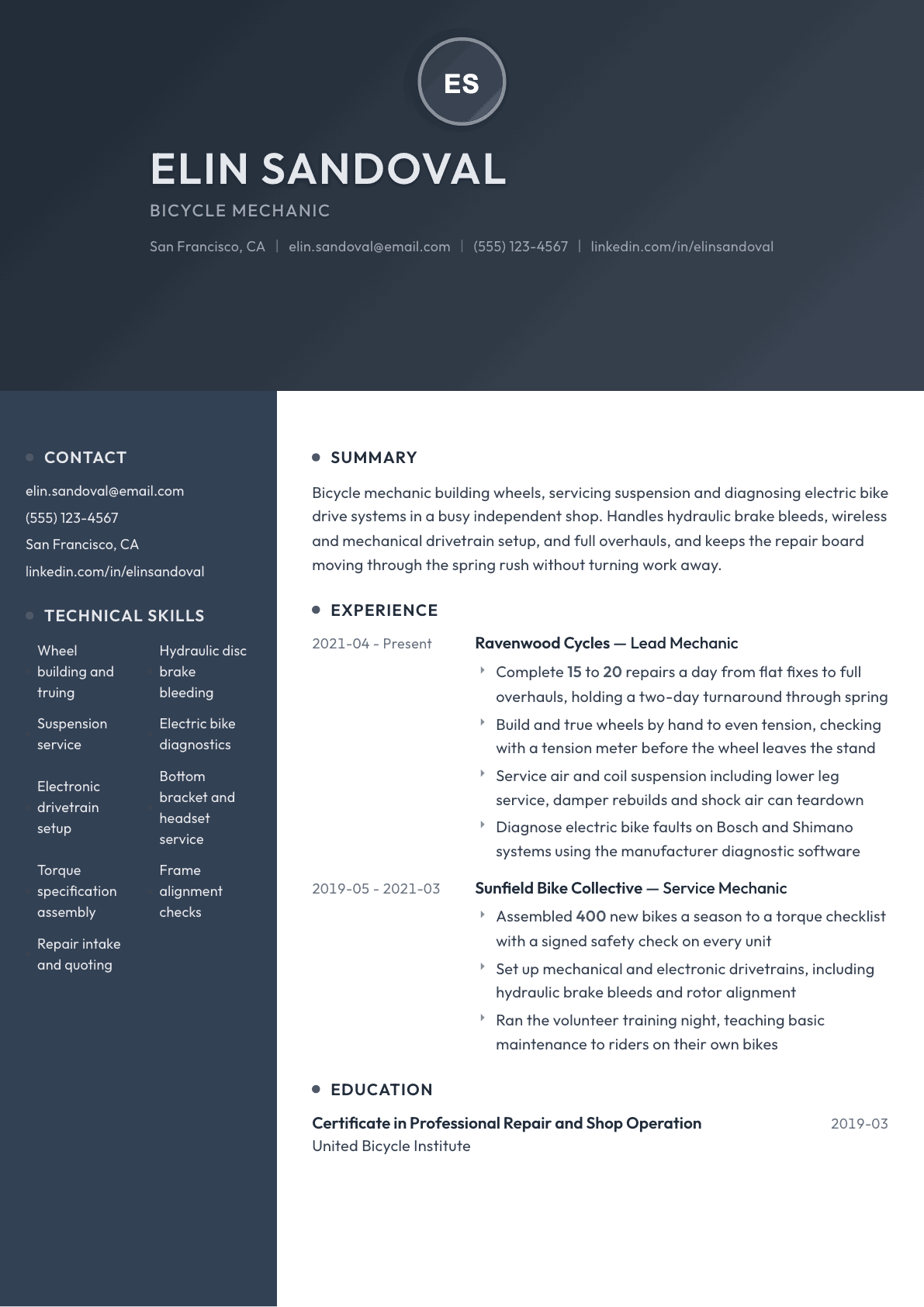
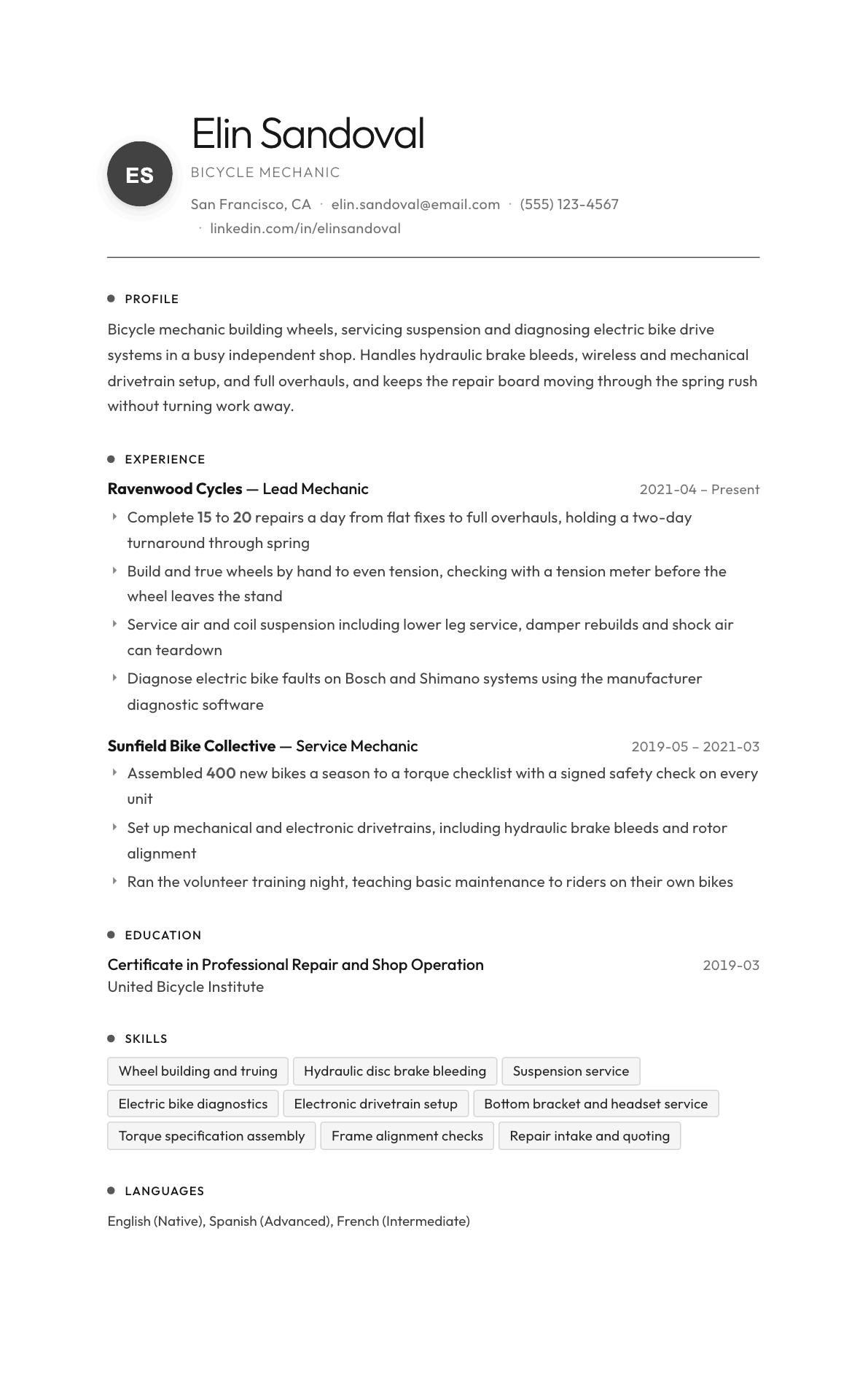
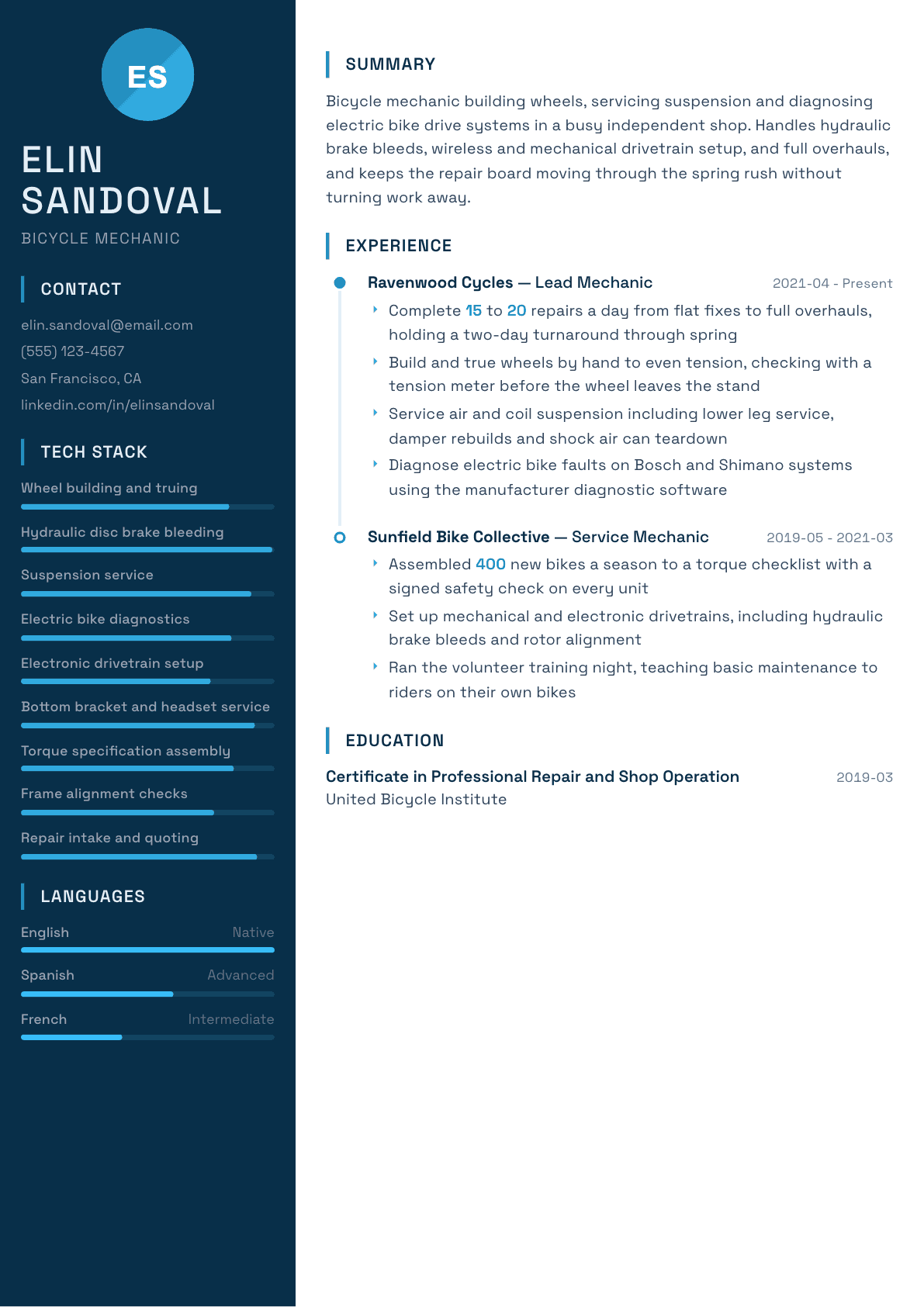
The same bicycle mechanic content laid out in three CVBooster templates, so you can see what the finished document looks like before you write a word.
Example Bicycle Mechanic summary
Bicycle mechanic with six years in independent shops covering hand-built wheels, suspension service, hydraulic brakes and electric bike diagnostics. Works from a torque checklist on every assembly, rebuilds dampers and air cans rather than sending them out, and reads manufacturer diagnostic software on Bosch and Shimano drive systems. Keeps a two-day repair turnaround through the spring rush and handles intake and quoting at the counter.
Skills to list on a Bicycle Mechanic resume
- Wheel building and truing
- Spoke tension measurement
- Hydraulic disc brake bleeding
- Air and coil suspension service
- Suspension damper rebuild
- Electric bike system diagnostics
- Electronic drivetrain configuration
- Mechanical drivetrain tuning
- Bottom bracket and headset service
- Bearing overhaul and press fitting
- Tubeless tire setup
- Frame and derailleur hanger alignment
- New bike assembly to torque specification
- Service intake and quoting
- Parts ordering and inventory
What actually gets this resume read
- Say whether you build wheels by hand, because that single skill separates shop mechanics from assemblers.
- Name the suspension brands you service and how deep you go, from lower legs to a full damper rebuild.
- Put electric bike diagnostics on the page with the systems you know, since shops are short on that skill.
- Give repairs per day and your turnaround time so an owner can judge you against a full repair board.
- List assembly volume separately from repair work, because seasonal build rates are a different job.
- Mention customer-facing work such as intake, quoting and fit advice, which decides who runs the counter.
How to write a bicycle mechanic resume
A shop owner hiring a bicycle mechanic is trying to work out how much of the repair board you can clear without help. Flat repairs and derailleur adjustments are not the question; every applicant can do those. The question is whether you can build a wheel, service a suspension fork, bleed hydraulic brakes on three different systems, and diagnose an electric bike that will not power up without sending it to a distributor.
Bicycle resumes tend to be short and vague because the trade is informal and much of the skill is learned at a bench rather than in a classroom. That informality is exactly why a specific resume stands out. A page that names the wheel building you do by hand, the suspension brands you service to which depth and the electric bike systems you can diagnose reads like a mechanic the owner has been trying to hire for a year.
This guide covers the sections a bike shop reads, with summaries for an assembler, a working service mechanic and a lead, before and after bullets that replace generic repair language with real capability, and the questions mechanics ask when moving between shops or into electric bike work.
Format: one page, capability grid before the job history
One page. Under the summary, build a short capability grid: wheel building, suspension service depth, hydraulic brake systems, electronic and mechanical drivetrains, electric bike systems, and frame work such as facing, chasing and hanger alignment.
Depth is what the grid must show. Suspension service, for example, means very different things at lower leg level, at damper rebuild level and at full air spring teardown. Say which level you work to, because an owner deciding whether to keep suspension work in house is reading for exactly that.
- Header: name, city and state, phone, email, and a line on whether you can cover weekends through the riding season.
- Capability grid: wheel building, suspension depth, brake systems, drivetrain types, electric bike diagnostics, frame preparation.
- Tools line: truing stand and tension meter, bleed kits by brand, suspension tooling, torque wrenches and diagnostic software.
- Then experience with repairs a day and turnaround, then training or certificates, then a skills list including counter work.
Summary: what you clear from the board, and how fast
Three lines. Give the years, the depth of work you handle alone, the repairs you complete a day and the turnaround you hold in the busy season. Turnaround is the number that decides whether customers stay with a shop, and few mechanics think to write it.
If you build wheels by hand, say it in the first line. Hand wheel building is the traditional dividing line between a mechanic and an assembler, and shops that still offer custom builds struggle to hire anyone who can do it to even tension.
Experience: repairs, builds and the seasonal rush
Open each job with the shop type and its scale: independent service focused shop, multi-store retailer, a cooperative, or a mobile operation, plus the repairs you personally completed a day. Then split the work into the categories a shop schedules separately.
Service work: overhauls, bearing replacement, hydraulic bleeds, drivetrain setup, wheel truing and building. Suspension: what you service, to what depth, and whether you keep the service intervals for customers. Electric bikes: which drive systems, whether you use the manufacturer diagnostic software, and what faults you resolve rather than escalate.
Assembly is a separate story with its own numbers. Say how many bikes you built in a season, whether you worked to a torque checklist, and whether a safety check was signed on each one. Shops carry real liability on assembly, and a mechanic who treats it as a documented process rather than a race is worth more than one who is simply fast.
Add the seasonal reality. Spring buries every shop, and the mechanic who keeps turnaround steady through it is the one an owner remembers. If you managed the repair board, triaged intake or set customer expectations during the rush, write that down.
Electric bikes: the skill shops are shortest on
Electric bike work is now the difference between a shop that captures repair revenue and one that turns customers away. Name the drive systems you have worked with, whether you can read the manufacturer diagnostic software, and what you handle: error codes, sensor and cable faults, display and controller issues, firmware updates, motor and battery replacement.
Be honest about the boundaries. Battery handling, damaged cell packs and warranty repairs have safety and legal limits, and a mechanic who describes where he stops and escalates reads as trained rather than reckless. An owner who has had a battery incident in the trade press on his mind will notice that line.
Counter work, keywords and the parts of the job beyond the bench
Most bike shop jobs include customer contact, so write the counter side: service intake, quoting a repair before the work starts, calling with a change in scope, fit adjustments and advising on parts. A mechanic who quotes accurately protects both the customer relationship and the shop margin.
The searchable terms are straightforward: wheel building, spoke tension, hydraulic brake bleed, suspension service, electric bike diagnostics, drivetrain setup, tubeless setup, bike assembly, service intake. Use them where the work is shown, and add parts ordering or inventory if you handled it, since small shops value a mechanic who can keep the service parts bin stocked.
Bicycle Mechanic resume summary examples
Assembler moving into service
Bike mechanic with a season of new bike assembly to a torque checklist and a signed safety check on every unit. Comfortable with flat repairs, derailleur and brake adjustment, tubeless setup and basic bearing service. Currently learning wheel truing and hydraulic bleeds and looking for a full service bench.
Three to five years at the bench
Bicycle mechanic completing 15 to 20 repairs a day from flat fixes to full overhauls, holding a two-day turnaround through the spring rush. Builds and trues wheels by hand to even tension with a tension meter, services air and coil suspension, and diagnoses electric bike faults with manufacturer software.
Lead mechanic
Lead mechanic running the service department in an independent shop, owning the repair board, the service parts bin and the quoting standard. Rebuilds suspension dampers in house, handles electric bike diagnostics across two drive systems, and has trained three mechanics through wheel building and hydraulic brake work.
Work experience bullets: before and after
Before: Repaired customer bikes in the shop.
After: Completed 15 to 20 repairs a day from flat fixes to full overhauls, holding a two-day turnaround through the spring rush without turning work away.
Daily volume and a turnaround figure tell an owner whether you can carry the repair board in the busy season.
Before: Built and trued wheels.
After: Built and trued wheels by hand to even spoke tension, checking with a tension meter and stress relieving before the wheel left the stand.
Tension measurement and stress relief are what separate a built wheel from a wheel that goes out of true in a month.
Before: Worked on suspension forks and shocks.
After: Serviced air and coil suspension to damper rebuild level, including lower leg service and air can teardown, keeping the work in house instead of sending it to a distributor.
The stated depth and the in-house decision tell an owner exactly how much suspension revenue you retain.
Before: Fixed electric bikes.
After: Diagnosed electric bike faults on two drive systems using the manufacturer diagnostic software, resolving sensor, cable and display failures and escalating only damaged battery packs.
Naming the tooling and the escalation boundary shows trained electric bike work rather than guesswork.
Before: Assembled new bikes for the sales floor.
After: Assembled 400 new bikes in a season to a torque checklist with a signed safety check on every unit before it reached the floor.
Volume plus documented safety checks addresses the liability an owner carries on every bike sold.
Hard skills
- Hand wheel building and truing
- Spoke tension measurement and stress relief
- Hydraulic disc brake bleeding across brands
- Air and coil suspension service
- Suspension damper and air can rebuild
- Electric bike diagnostics and firmware updates
- Electronic drivetrain configuration
- Mechanical drivetrain setup and cable routing
- Bottom bracket, headset and hub overhaul
- Bearing press fitting and removal
- Tubeless tire setup and sealant service
- Frame facing, chasing and hanger alignment
- New bike assembly to torque specification
- Service intake, quoting and parts ordering
Soft skills
- Quoting a repair honestly before the parts are opened
- Calling a customer when the job grows rather than after
- Keeping the board moving when every rider wants a bike by Saturday
- Teaching a rider basic maintenance without condescension
- Working a bench beside others without losing tools or torque settings
Certifications worth listing
- Professional Repair and Shop Operation Certificate (United Bicycle Institute)
- Certified Bicycle Technician (Barnett Bicycle Institute)
Mistakes that cost bicycle mechanic candidates the interview
- Writing that you can fix any bike, which tells an owner nothing about the depth he needs to fill.
- Leaving wheel building off the page when it is the clearest proof of bench skill in the trade.
- Describing suspension work without saying how deep you go, so the shop assumes lower leg service only.
- Ignoring electric bikes, which is the fastest growing part of the repair board in most shops.
- Skipping repairs a day and turnaround, the two numbers that show you can survive the spring rush.
- Treating assembly as filler instead of a documented safety process the shop is liable for.
Bicycle Mechanic resume questions
Do I need formal training to be a bicycle mechanic?
No, and many strong mechanics learned entirely at a bench. Formal certificates still help when you have no shop reference, because they prove you were taught procedure and torque discipline rather than picking up habits from whoever trained you.
How important is electric bike experience now?
It is often the deciding factor between two similar candidates. Shops sell these bikes and must service them, and mechanics who can read manufacturer diagnostic software and resolve faults without escalating everything are genuinely hard to find.
Should I list the brands I have worked on?
List drivetrain, brake and suspension brands, plus electric drive systems, since those determine which tools and procedures you already know. Skip a long list of bike brands, which tells an owner far less than the component knowledge behind them.
What if my experience is mostly volunteer or cooperative work?
Count it as experience and write it with the same specifics: repairs completed, the range of work, whether you trained others and how you handled intake. A cooperative bench often gives broader repair exposure than a retail floor does.
How do I show speed without sounding careless?
Pair volume with a quality habit in the same bullet. Repairs a day next to a torque checklist, or a turnaround figure next to a safety check on every bike, tells an owner you move quickly through work you are also finishing properly.
Related resume examples
- Small Engine Mechanic Resume example
- Motorcycle Mechanic Resume example
- Maintenance Technician Resume example
- Auto Mechanic Resume example
- Fleet Mechanic Resume example
- Tire Technician Resume example