Tire Technician Resume Examples: the lines they read
Write a Tire Technician Resume Around Safety and Bay Speed
By Mustafa Tarabya, founder of CVBooster · Published · Updated
Tire technician resume example with keywords and a writing guide on mounting, balancing, TPMS, alignment support and torque procedure.
Sample resumes for a tire technician
The same tire technician content laid out in three CVBooster templates, so you can see what the finished document looks like before you write a word.
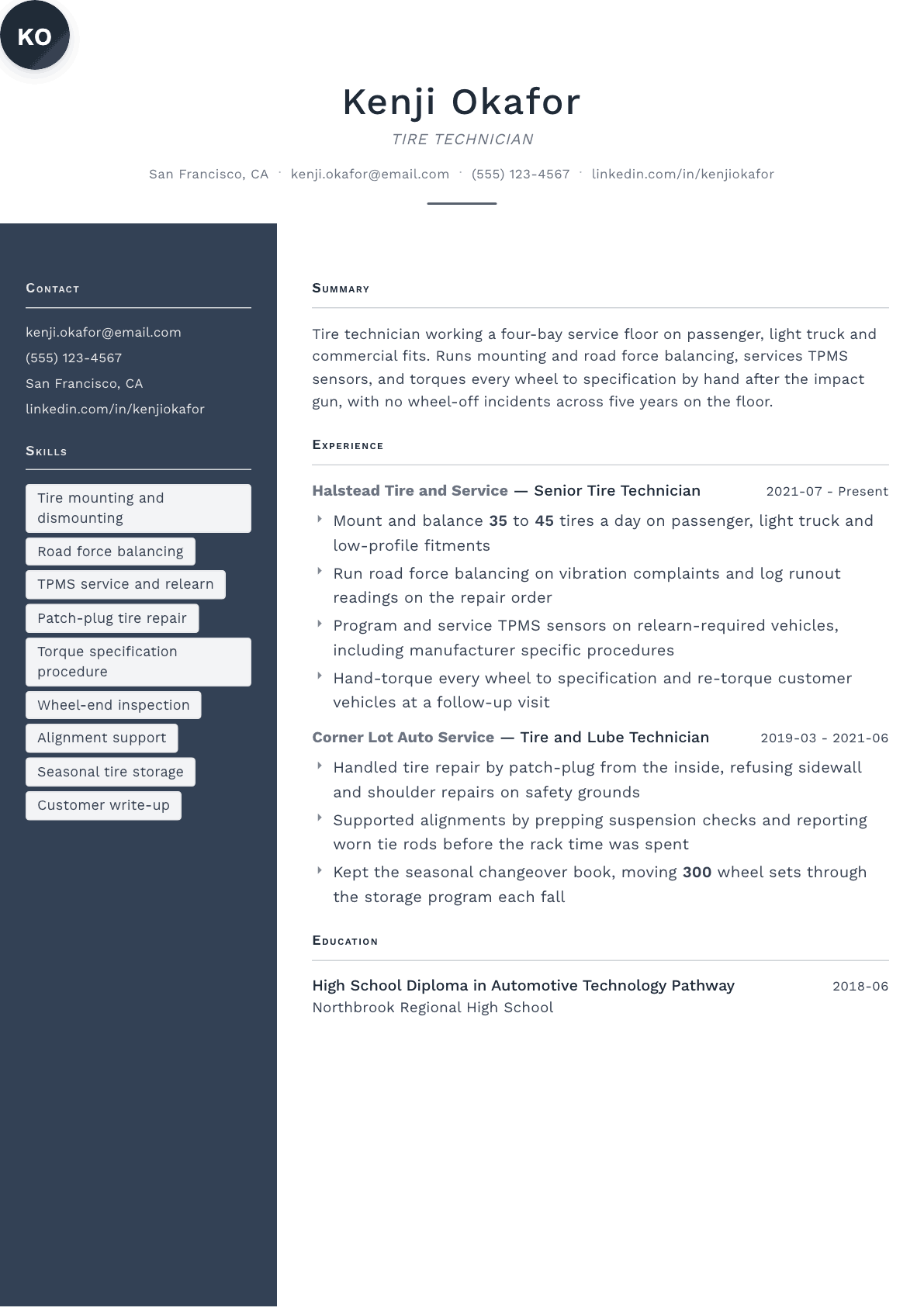
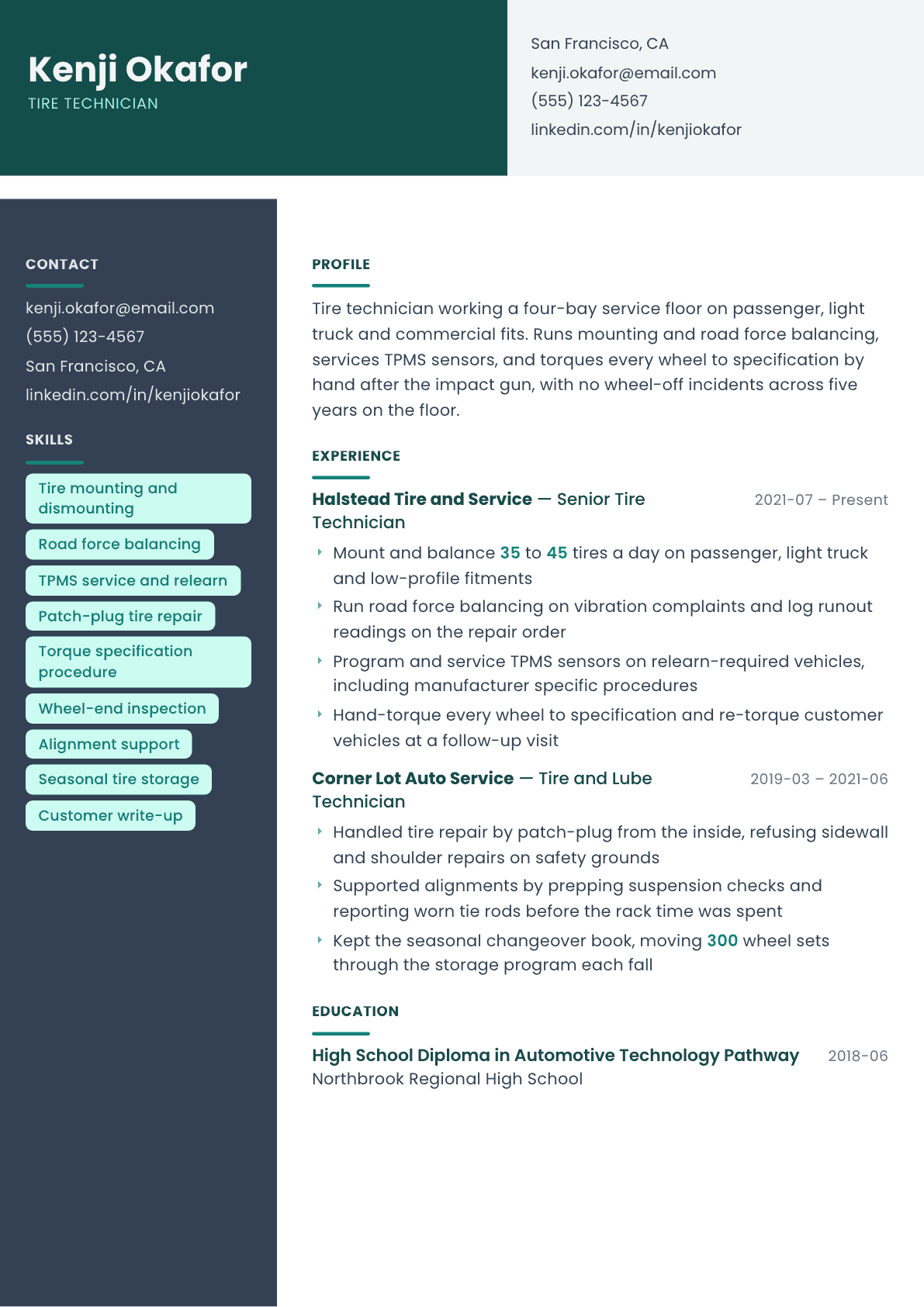
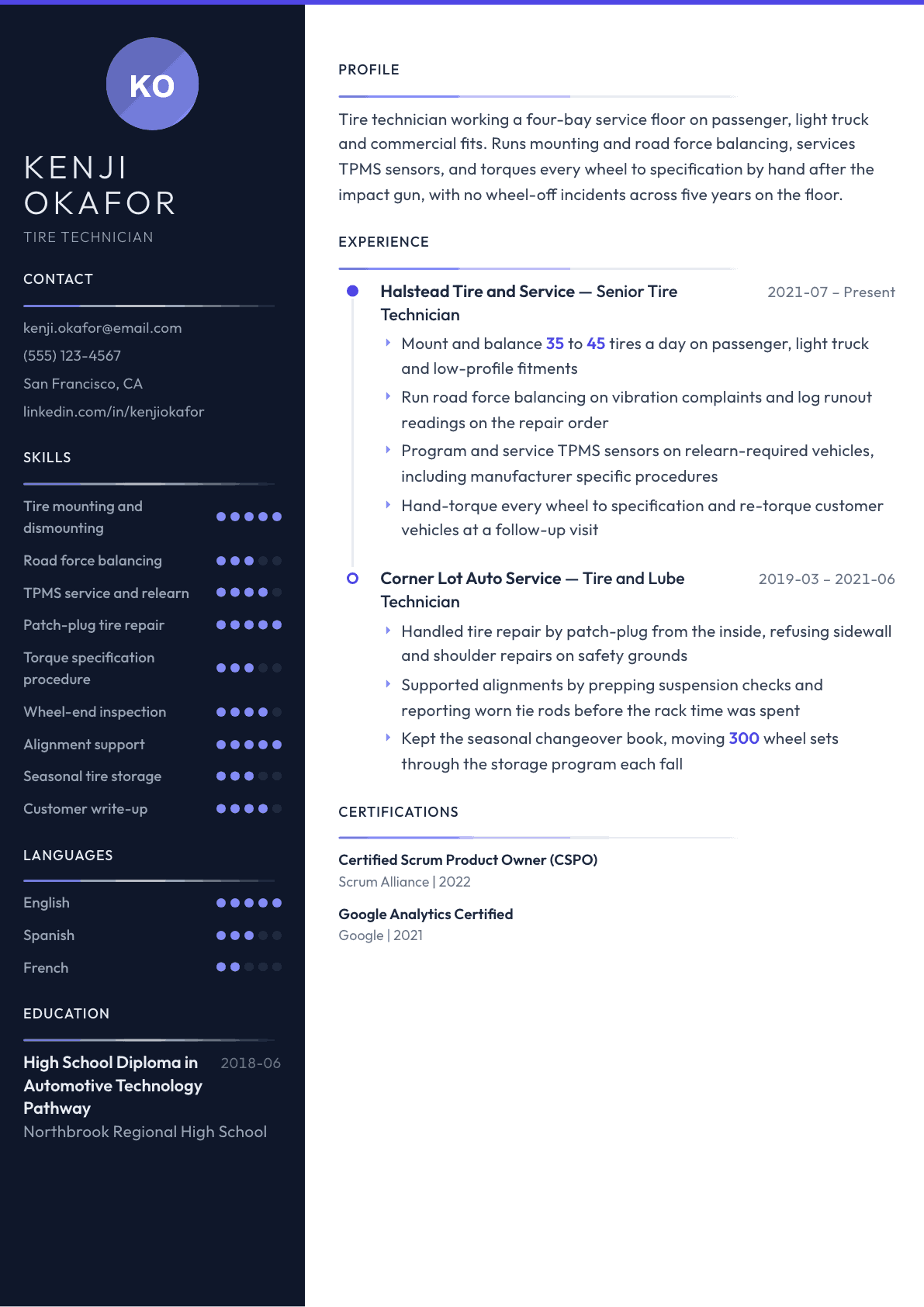
Example Tire Technician summary
Tire technician with five years on a busy service floor covering passenger, light truck and commercial fitments. Mounts and balances at volume, resolves vibration complaints with road force readings rather than guesswork, and services TPMS sensors including manufacturer relearn procedures. Torques every wheel by hand to specification and reports brake and suspension wear that turns a tire visit into a full repair order.
Skills to list on a Tire Technician resume
- Tire mounting and demounting
- Static and road force balancing
- TPMS sensor service and relearn
- Internal patch-plug repair
- Torque specification and re-torque
- Wheel-end and hub inspection
- Brake and suspension inspection
- Alignment preparation
- Run-flat and low-profile fitment
- Commercial truck tire service
- Seasonal changeover and storage
- Inventory and tire lookup systems
- Point of sale write-up
- Shop safety procedure
What actually gets this resume read
- Give the tires per day you mount, since bay speed is the first number a service manager asks about.
- Name the machines you have run, because touchless mounters and road force balancers are not the same skill.
- Put TPMS service on the page with the relearn procedures, as many technicians still avoid that work.
- Say plainly that you torque by specification, which is a safety habit shops screen for after a wheel-off.
- List commercial or agricultural fitments separately, since those bays pay differently from passenger work.
- Mention inspections you report on, such as brake wear and worn tie rods, because that drives shop revenue.
How to write a tire technician resume
A tire technician resume is read by a service manager who has two anxieties. The first is speed, because his bays only earn while wheels are turning and a slow technician backs up the whole floor. The second is a wheel coming off a customer vehicle, which is the kind of event that ends careers and closes shops. Your resume has to answer both, and most resumes answer neither.
The technicians who get called write about volume and about procedure in the same breath. Tires mounted a day, the machines they run, road force balancing on vibration complaints, sensor service and relearn procedures, and a plain statement that every wheel is torqued to specification by hand and re-torqued at a follow-up visit. That combination reads as fast and safe, which is exactly the pair a manager is trying to hire.
This guide covers the sections a tire and service shop reads, with summaries for a new technician, a settled floor technician and a senior lead, before and after bullets, and the questions technicians ask when they move from a discount chain into a dealership or a commercial truck bay.
Format: one page, volume and equipment stated plainly
One page, reverse chronological, no graphics. Under the summary, give a short capability block: fitment types you handle, the equipment you have run and the related services you perform such as alignments, brakes or basic maintenance.
Fitment types matter more than most technicians realize. Passenger, light truck, low profile, run-flat, commercial truck, agricultural and trailer work all use different equipment and different procedures, and a shop hiring for commercial service will not assume your passenger experience carries across.
- Header: name, city and state, phone, email, and a note on whether you hold a driver license class the shop requires.
- Capability block: fitment types, mounting and balancing equipment, TPMS tooling and any alignment rack you have operated.
- Related services line: rotations, brake inspection, suspension inspection, fluid checks and anything else you already sell time on.
- Then experience with tires per day, then certification and training, then a skills list with safety procedures included.
Summary: bay speed, fitment range and torque discipline
Three lines that carry the daily volume, the fitment range and one safety habit. Say the number of tires you mount and balance in a day, name the fitments and equipment, and state your torque procedure directly rather than hoping it is assumed.
If you have a record with no wheel-off incidents across a long stretch of work, that sentence belongs in the summary. It is the single most reassuring line a tire technician can write, and very few of them think to include it.
Experience: volume, vibration and the work you find
Open each job with the shop type and its bay count, then give volume. Tires a day, wheel sets in a seasonal changeover, or commercial service calls a week. Volume is the number a manager converts into staffing, so it should never be missing.
Then move into the technical bullets. Vibration complaints are the ones that show skill: road force balancing, runout measurement, match mounting and knowing when the problem is not the tire at all. A technician who documents runout readings on the repair order is telling a manager that comeback vibration jobs get solved rather than rebalanced twice.
TPMS work deserves a bullet of its own. Sensor service kits, programmable sensors, and the manufacturer specific relearn procedures that many technicians avoid are all revenue a shop is currently losing or sending elsewhere. Say which tooling you use and which brands you have handled.
Finally, write the inspection work. A tire technician sees brakes, suspension, wheel bearings and fluid leaks on every vehicle that comes up on the lift, and the ones who report those findings clearly are the ones a service manager protects, because that is where the repair orders come from.
Safety: the section that gets you hired over someone faster
Write the safety practices as procedure, not as attitude. Hand torque to specification with a calibrated wrench after the impact gun, torque sequence followed, re-torque invitation given to the customer, cage used when inflating truck tires, sidewall and shoulder repairs refused, and a proper inside patch-plug used rather than a plug from outside.
Those lines cost you a few words and buy a great deal of trust. A manager who has been through a wheel-off investigation or a zipper failure on a commercial tire reads that block far more closely than the volume figures above it.
Skills, certification and keywords shops filter on
The terms that repeat in postings are straightforward: tire mounting, balancing, road force, TPMS, torque specification, tire repair, rotation, alignment, wheel end inspection, commercial tire service. Use each where the work is shown, and keep passenger and commercial terminology visibly separate.
Industry certification carries real weight in this trade, more than many technicians expect. Automotive and commercial tire service programs give a manager an outside check that you were trained on procedure rather than by watching someone in the next bay, and they are worth listing with the issuing body named.
Tire Technician resume summary examples
First shop job
Tire technician with a year on a four-bay service floor mounting and balancing passenger and light truck fitments, performing rotations and setting pressures. Trained on torque procedure and inside patch-plug repair, and currently working through automotive tire service certification while learning TPMS relearn procedures.
Three to five years
Tire technician mounting and balancing 35 to 45 tires a day across passenger, light truck and low-profile fitments. Resolves vibration complaints with road force readings logged on the repair order, services TPMS sensors including manufacturer relearns, and has completed five years on the floor with no wheel-off incidents.
Senior technician and bay lead
Senior tire technician leading a three-bay floor covering passenger, light truck and commercial fitments. Runs the seasonal changeover and storage program, trains new technicians on torque procedure and safe inflation, and reports brake and suspension findings that turn routine tire visits into full repair orders.
Work experience bullets: before and after
Before: Mounted and balanced tires for customers.
After: Mounted and balanced 35 to 45 tires a day across passenger, light truck and low-profile fitments on a touchless machine, holding the bay through weekend volume.
Daily volume, fitment range and the machine type let a manager judge your pace against his floor.
Before: Fixed vibration issues on vehicles.
After: Diagnosed vibration complaints with road force balancing, logging runout readings on the repair order and match mounting where the tire and wheel could be brought into tolerance.
Naming the measurement and the corrective step shows diagnosis rather than repeated rebalancing.
Before: Worked with tire pressure sensors.
After: Serviced and programmed TPMS sensors including manufacturer specific relearn procedures, replacing service kits at every mount so sensors were not lost to corroded stems.
The relearn procedures and the service kit habit prove real sensor work rather than resetting a warning light.
Before: Made sure wheels were tightened properly.
After: Hand torqued every wheel to specification with a calibrated wrench in the correct sequence after seating with the gun, and invited customers back for a re-torque check.
The sequence, the calibrated tool and the follow-up describe a procedure a manager can trust on paper.
Before: Told the advisor about other problems on the car.
After: Reported brake wear, worn tie rods and leaking shocks found during wheel-off inspection with measurements attached, giving the advisor evidence to quote from.
It shows inspection findings feeding the shop revenue, which is why managers keep good tire technicians.
Hard skills
- Tire mounting and demounting
- Static, dynamic and road force balancing
- Runout measurement and match mounting
- TPMS sensor service and relearn procedures
- Internal patch-plug tire repair
- Torque specification and re-torque procedure
- Wheel end and hub inspection
- Brake and suspension inspection
- Alignment preparation and rack support
- Run-flat and low-profile fitment
- Commercial truck tire service and cage inflation
- Seasonal changeover and wheel storage
- Tire lookup and inventory systems
- Point of sale write-up
Soft skills
- Holding pace through a full waiting room without skipping a step
- Refusing an unsafe repair and explaining why in plain words
- Handing an advisor findings he can sell without a second trip to the bay
- Keeping a clean bay so tools and torque wrenches stay where they belong
- Teaching a new technician the safety habits before the speed
Certifications worth listing
- Automotive Tire Service Certification (Tire Industry Association)
- Commercial Tire Service Certification (Tire Industry Association)
- Suspension and Steering (A4) (National Institute for Automotive Service Excellence)
Mistakes that cost tire technician candidates the interview
- Leaving out tires per day, the first figure a service manager uses to compare two technicians.
- Writing nothing about torque procedure, which is the safety habit shops screen for hardest after an incident.
- Treating TPMS as a checkbox instead of naming the tooling and the relearn procedures you can perform.
- Mixing commercial truck work into passenger experience, so a commercial bay cannot see what you can actually do.
- Skipping the inspection findings you report, which is how a tire visit becomes a profitable repair order.
- Listing tire repair generally without saying that you repair from the inside and refuse sidewall damage.
Tire Technician resume questions
Is tire technician an entry-level job?
It is often an entry point, but it does not stay one. Road force balancing, sensor relearns, commercial fitments and wheel end inspection are skilled work, and a technician who documents those on a resume is applying for a different pay grade than someone who only lists mounting.
Does certification help a tire technician get hired?
Yes, more than in many trades. Industry certification tells a manager you were trained on inflation safety, repair limits and torque procedure rather than picking them up informally, and commercial shops in particular treat it as close to a requirement.
How do I move into full automotive repair from a tire bay?
Build the brake, suspension and inspection side of your resume, then add any maintenance work you already perform such as fluid service and battery testing. Name any certification you are studying toward, since shops promote from the tire bay when they can see a direction.
What should I say about commercial truck tire experience?
Give the fitments, whether you worked in the shop or on the road, and how you handled inflation safety including cage use and restraint procedures. Commercial work carries different hazards, and managers want evidence you were trained for them specifically.
Should I include seasonal changeover work?
Definitely, because it shows you can hold quality under the heaviest volume of the year. Give the number of wheel sets you moved through the program, how storage was tracked and how you kept the correct set matched to each customer vehicle.
Related resume examples
- Auto Mechanic Resume example
- Lube Technician Resume example
- Automotive Technician Resume example
- Auto Detailer Resume example
- Fleet Mechanic Resume example
- Bicycle Mechanic Resume example