Small Engine Mechanic Resume Examples: read this first
Write a Small Engine Mechanic Resume for the Busy Season
By Mustafa Tarabya, founder of CVBooster · Published · Updated
Small engine mechanic resume example with mower, chainsaw and generator keywords, plus a guide to writing turnaround times and warranty work.
Sample resumes for a small engine mechanic
The same small engine mechanic content laid out in three CVBooster templates, so you can see what the finished document looks like before you write a word.
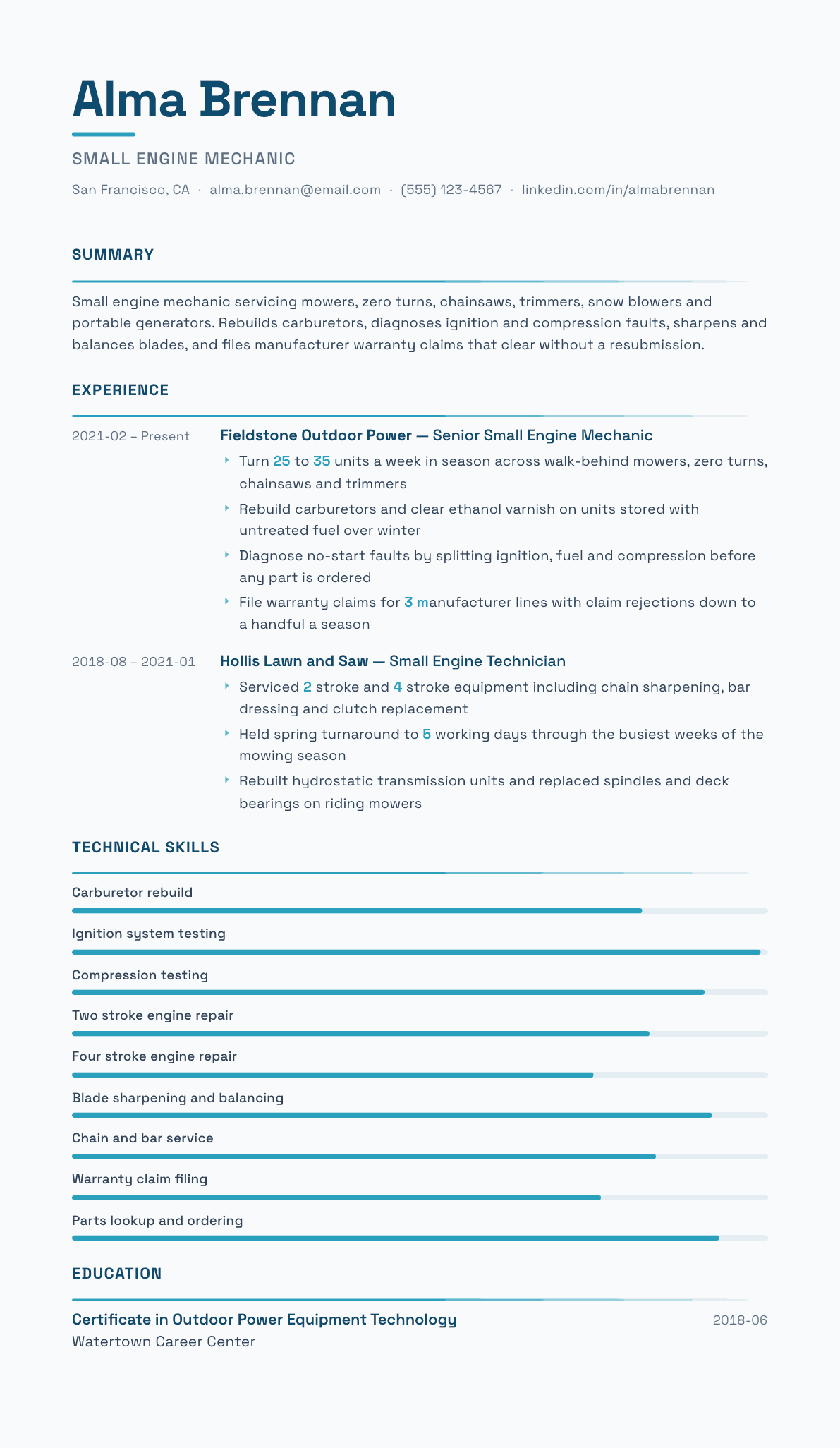
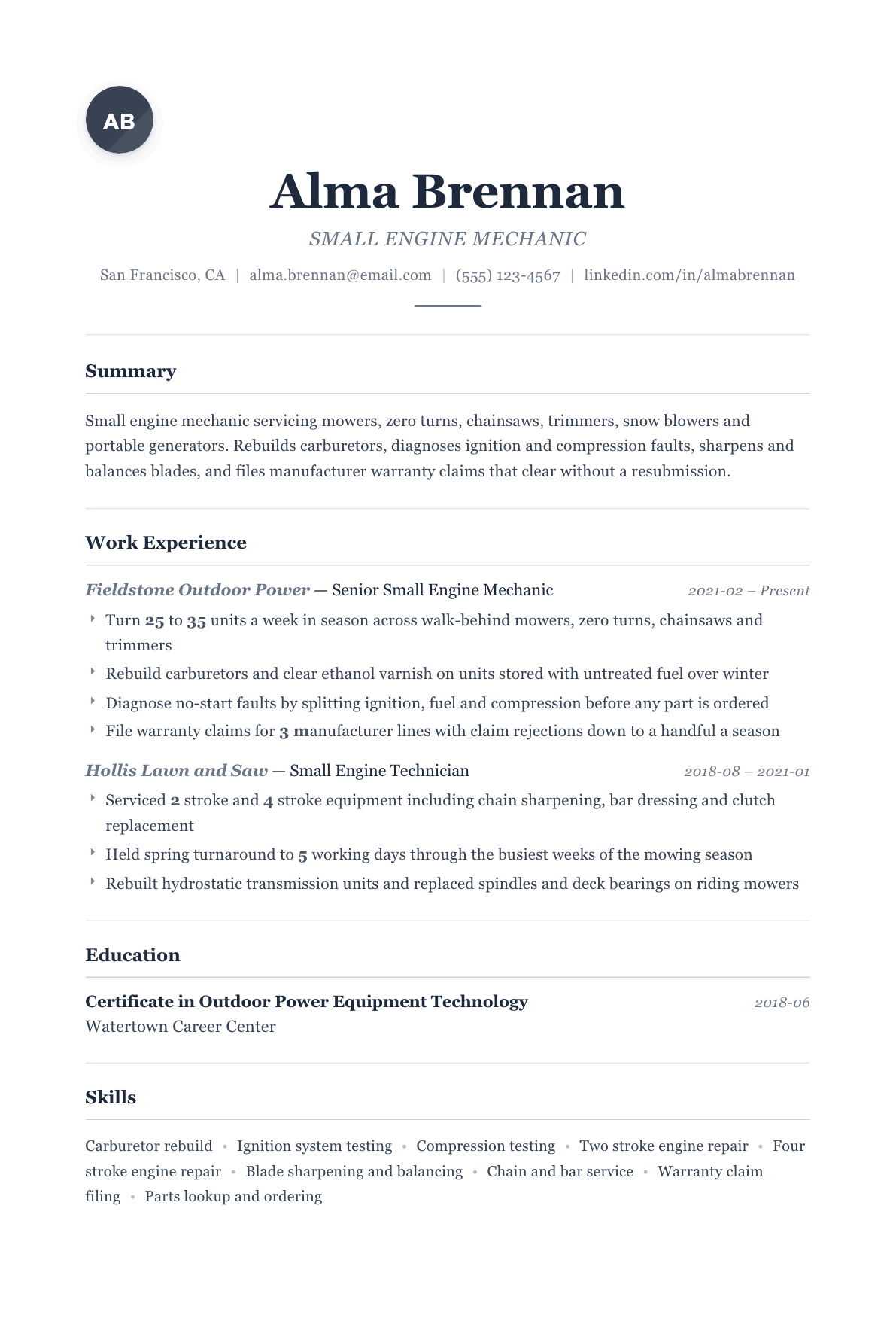
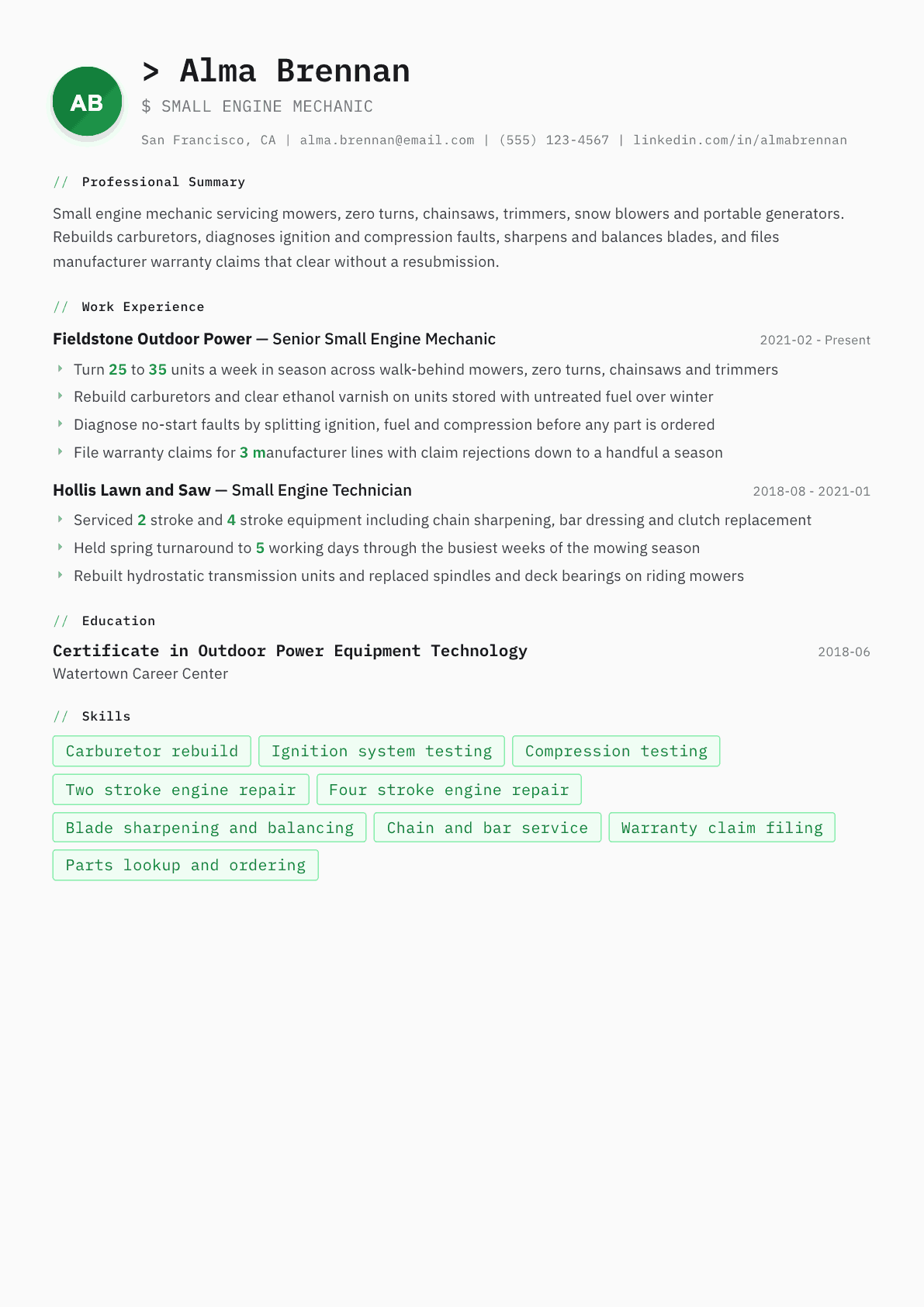
Example Small Engine Mechanic summary
Small engine mechanic servicing walk-behind mowers, zero turns, chainsaws, trimmers, snow blowers and portable generators through the full seasonal swing. Rebuilds carburetors, clears ethanol varnish, and splits no-start faults into ignition, fuel and compression before ordering a part. Turns twenty five to thirty five units a week in season, holds spring turnaround to about a working week, and files warranty claims for three manufacturer lines with few rejections.
Skills to list on a Small Engine Mechanic resume
- Two stroke engine repair
- Four stroke engine repair
- Carburetor rebuild and adjustment
- Ethanol varnish and fuel system cleaning
- Ignition coil and flywheel key testing
- Compression and leak down testing
- Valve adjustment on overhead valve engines
- Hydrostatic transmission service
- Deck, spindle and belt replacement
- Blade sharpening and balancing
- Chainsaw chain and bar service
- Generator service and load testing
- Warranty claim submission
- Parts diagram lookup
- Seasonal storage preparation
What actually gets this resume read
- List the equipment families you service by name: mowers, zero turns, chainsaws, trimmers, blowers, generators.
- Split two stroke and four stroke experience, because a saw shop and a mower shop hire for different hands.
- Give units turned per week in season, since a small engine shop is judged entirely on the busy weeks.
- State your turnaround time in working days, because customers choose a shop on that number alone.
- Say which manufacturer warranty portals you file in and how often claims clear on first submission.
- Mention hydrostatic transmission, deck and spindle work, which is the riding mower revenue most shops chase.
How to write a small engine mechanic resume
An outdoor power equipment shop lives and dies on turnaround. A homeowner whose mower quit in June will drive past three dealers to reach the one that promised a week. A landscaping crew whose trimmer is down loses a day of billing. The owner reading a small engine mechanic resume is asking how many units a week you can turn without the quality slipping.
The second question is breadth. A shop takes in walk-behind mowers, zero turns, chainsaws, trimmers, blowers, snow equipment and portable generators, sometimes all in one morning. Two stroke and four stroke, carbureted and increasingly fuel injected, hydrostatic drives and simple belt drives. The mechanic who covers most of that keeps the shop from turning work away.
This guide covers how to build the page for a dealer or independent shop, how to write engine diagnosis so it shows method, how to present warranty work and seasonality, with summaries at three stages and rewritten bullets you can borrow the shape of.
Format: equipment families first, engine skill second, throughput third
One page, reverse chronological. The first block lists the equipment families you service by name, because a saw shop and a riding mower dealer are different businesses with different tooling and they screen on that line alone.
The second block is engine capability split into two stroke and four stroke, then the specific work: carburetor rebuild, ignition testing, compression and leak down, valve adjustment on overhead valve engines. The third block is throughput: units a week in season and turnaround in working days.
- Equipment line naming mowers, zero turns, chainsaws, trimmers, blowers, snow equipment and generators.
- Engine block split by two stroke and four stroke rather than merged into small engine repair.
- Drive and deck block for riding equipment: hydrostatic units, spindles, deck bearings, belts and blades.
- Warranty line naming the manufacturer portals you file in and how your claims usually land.
Summary: families, faults, and how fast the bench moves
Three or four lines. Equipment families, the engine work you own, units turned per week in season, and turnaround in working days. Those four facts are what a shop owner needs before he decides whether to call, and almost nobody writes all four.
Add a line on how you diagnose a no-start, because that is the single most common ticket in the trade. Splitting the fault into ignition, fuel and compression before ordering anything is the difference between a bench that clears and a bench that fills with half finished units.
Experience: units, ethanol and the busy weeks
Lead each job with the shop type and what it carried, then use bullets for the work. Carburetor rebuilds and the varnish that comes from untreated fuel over a stored winter, ignition coil and flywheel key testing, compression and leak down, valve lash on overhead valve engines, and recoil and clutch work on saws.
Riding equipment needs its own bullet. Hydrostatic transmission service, spindle and deck bearing replacement, belt routing, blade sharpening and balancing, and steering and linkage work. This is where the higher ticket values live, and a shop needs to know whether you can handle a machine that will not fit on a bench.
Then say what happened in the busiest weeks. Units turned per week in season and the turnaround you held. If you improved either one, name the change: pre-picking parts, calling for approval before teardown, staging units by fault type instead of arrival order.
Warranty, parts lookup and the paperwork that pays
Warranty is where a small shop quietly loses money. A claim that gets rejected turns a paid repair into an unpaid one, and the labor is already spent. If you file claims, say which manufacturer lines and how often they clear at first submission, because a mechanic who writes claims properly is protecting the shop bank account.
Parts lookup belongs on the page too. Reading an exploded diagram, matching a model and serial number to the right revision, and knowing when a superseded part number changes the fit. Ordering the wrong part costs a shop two days and a customer phone call, and the owner has felt that many times.
Skills and the vocabulary shops search
Outdoor power adverts recycle a narrow vocabulary: two cycle, four cycle, carburetor, ignition coil, flywheel key, compression test, valve lash, hydrostatic, spindle, deck belt, blade balancing, chain and bar, recoil, warranty claim, seasonal storage. Match the advert and skip what you cannot back up.
Add the practical points shops screen on: whether you can lift and move a riding mower alone or with a jack, whether you have your own hand tools, whether you can run a chain grinder properly, and whether you are available through the season including weekends when the queue is deepest.
Small Engine Mechanic resume summary examples
First shop job
Outdoor power equipment graduate in a first season, servicing walk-behind mowers, trimmers and blowers through carburetor cleaning, blade sharpening, oil service and spark plug replacement. Comfortable running compression tests, owns a basic hand tool set, and is learning riding mower deck and spindle work on the bench.
Four years in
Small engine mechanic servicing walk-behind mowers, zero turns, chainsaws, trimmers, snow equipment and portable generators. Rebuilds carburetors, clears ethanol varnish, tests ignition coils and flywheel keys, and splits every no-start into ignition, fuel and compression before ordering a single part.
Senior technician
Senior small engine mechanic turning twenty five to thirty five units a week through the mowing season while holding turnaround to about a working week. Rebuilds hydrostatic transmissions and deck assemblies on riding equipment, files warranty claims for three manufacturer lines, and trains seasonal hires on diagnosis order.
Work experience bullets: before and after
Before: Repaired lawn mowers and other equipment.
After: Turned twenty five to thirty five units a week in season across walk-behind mowers, zero turns, chainsaws and trimmers.
Weekly throughput across named families tells a shop owner whether his summer queue will clear.
Before: Cleaned and rebuilt carburetors.
After: Rebuilt carburetors and cleared ethanol varnish on units stored over winter with untreated fuel, replacing diaphragms and setting mixture screws to specification.
Naming the cause and the exact rebuild steps proves the repair rather than a soak and reassemble.
Before: Figured out why engines would not start.
After: Diagnosed no-start faults by testing ignition, fuel delivery and compression in order, so parts were ordered only after the failed system was confirmed.
A named diagnostic order is the method a shop owner trusts, because it stops speculative parts orders.
Before: Worked on riding mowers.
After: Rebuilt hydrostatic transmission units and replaced spindles, deck bearings and belts on riding equipment, then balanced blades before return.
Riding equipment carries the higher tickets, and the component list shows you can take the whole job.
Before: Handled warranty paperwork.
After: Filed warranty claims for three manufacturer lines, cutting rejections to a handful across a full season by matching model and serial numbers to the correct revision.
The rejection outcome plus the cause of rejections shows you protect the labor the shop already spent.
Hard skills
- Two stroke engine repair
- Four stroke engine repair
- Carburetor rebuild and adjustment
- Ethanol varnish and fuel system cleaning
- Ignition coil and flywheel key testing
- Compression and leak down testing
- Valve lash adjustment on overhead valve engines
- Hydrostatic transmission service
- Deck, spindle, bearing and belt replacement
- Blade sharpening and balancing
- Chainsaw chain grinding and bar dressing
- Generator service and load testing
- Warranty claim submission and parts lookup
Soft skills
- Holding turnaround promises through the peak weeks
- Calling a customer for approval before teardown goes further
- Telling an owner honestly when a machine is not worth repairing
- Keeping a crowded bench organized so nothing is lost
- Training a seasonal hire quickly without slowing your own units
Certifications worth listing
- Two-Stroke Engine Technician Certification (Equipment and Engine Training Council)
- Four-Stroke Engine Technician Certification (Equipment and Engine Training Council)
- Master Service Technician (Briggs and Stratton)
Mistakes that cost small engine mechanic candidates the interview
- Writing small engine repair without naming the equipment families, which is the line dealers filter on first.
- Merging two stroke and four stroke work when saw shops and mower dealers hire for different hands.
- Leaving out units per week and turnaround, the two numbers that describe an outdoor power business entirely.
- Skipping riding equipment work, so the higher ticket hydrostatic and deck jobs never appear on the page.
- Saying nothing about warranty claims, when a rejected claim turns paid labor into a loss the owner absorbs.
- Describing no-start work as troubleshooting rather than showing the ignition, fuel and compression order you follow.
Small Engine Mechanic resume questions
Is small engine work seasonal, and how do I show that on a resume?
Most shops swing hard between spring and winter, so label seasonal roles clearly and give in season throughput rather than an annual average. Add snow equipment or generator work if you have it, since that is what keeps a mechanic busy through the quiet months.
Do I need formal training for a small engine job?
A certificate helps but many mechanics come in from automotive, powersports or agricultural work. Show the engine fundamentals you already have, name the equipment families you have not touched, and mention any manufacturer training you have completed online.
How should I describe warranty experience?
Name the manufacturer lines you file for and say how your claims usually land. Shop owners have all lost money on rejected claims, so a mechanic who documents model and serial detail correctly is solving a problem they feel every month.
What about newer fuel injected and battery equipment?
Say what you have worked on honestly. Electronic fuel injection is spreading on larger equipment and battery platforms are taking a share of handheld tools, so any exposure to either is worth listing even if most of your work is still carbureted.
How do I prove I am fast without exaggerating?
Give a weekly unit range for the busy season and the turnaround you held, then let those two numbers stand together. A range with a turnaround attached is credible, while claiming to be efficient without a figure reads as filler to any shop owner.
Related resume examples
- Mechanic Resume example
- Maintenance Mechanic Resume example
- Motorcycle Mechanic Resume example
- Marine Mechanic Resume example
- Generator Technician Resume example
- Auto Mechanic Resume example