Bid Manager Resume Examples: free ATS score and gap list
Create a Bid Manager Resume Built on Win Rates and Deadlines
By Mustafa Tarabya, founder of CVBooster · Published · Updated
Bid Manager resume example and guide: tender governance, win rates, bid and proposal process, compliance checks, ATS keywords and a summary you can adapt.
Sample resumes for a bid manager
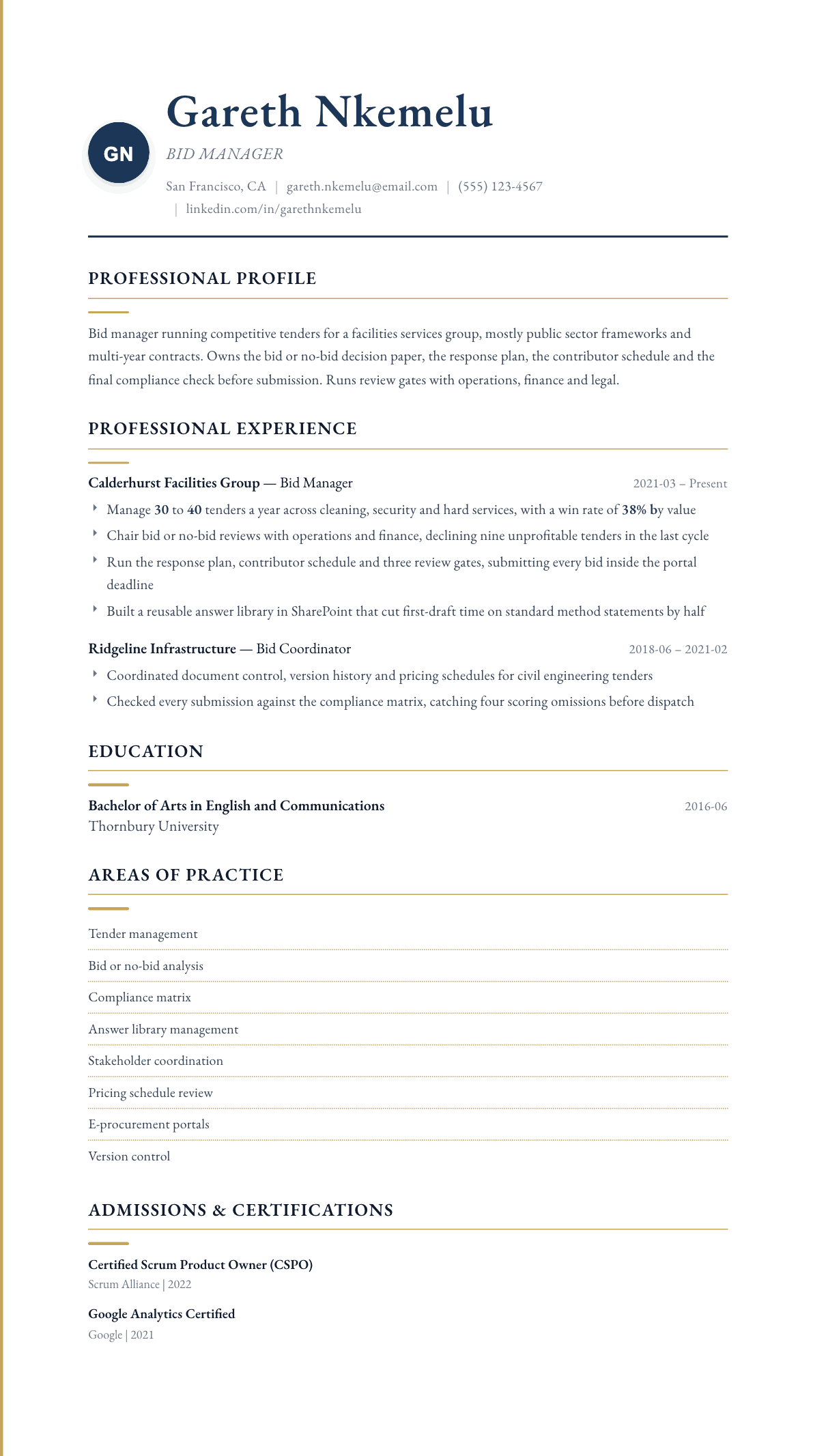
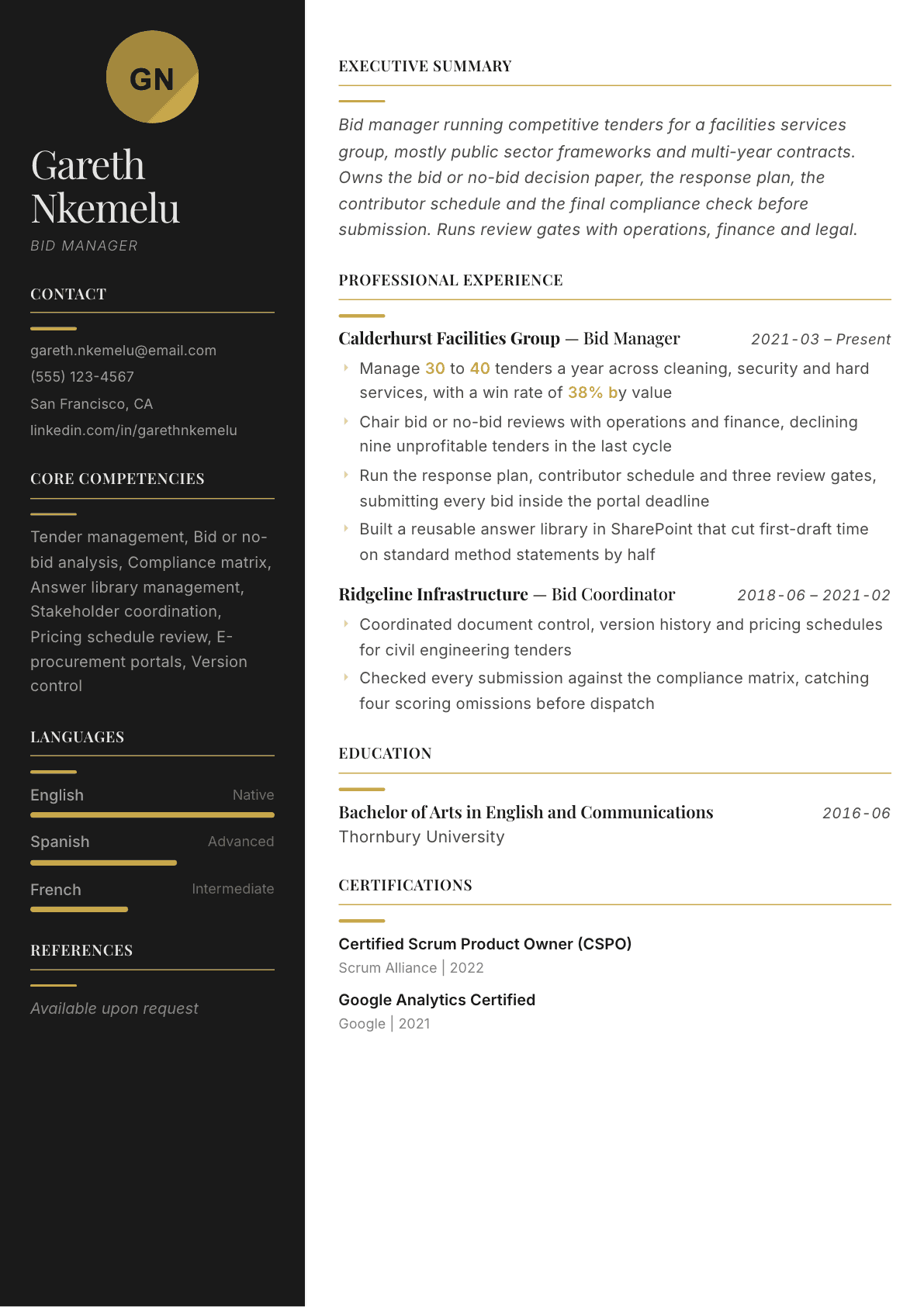
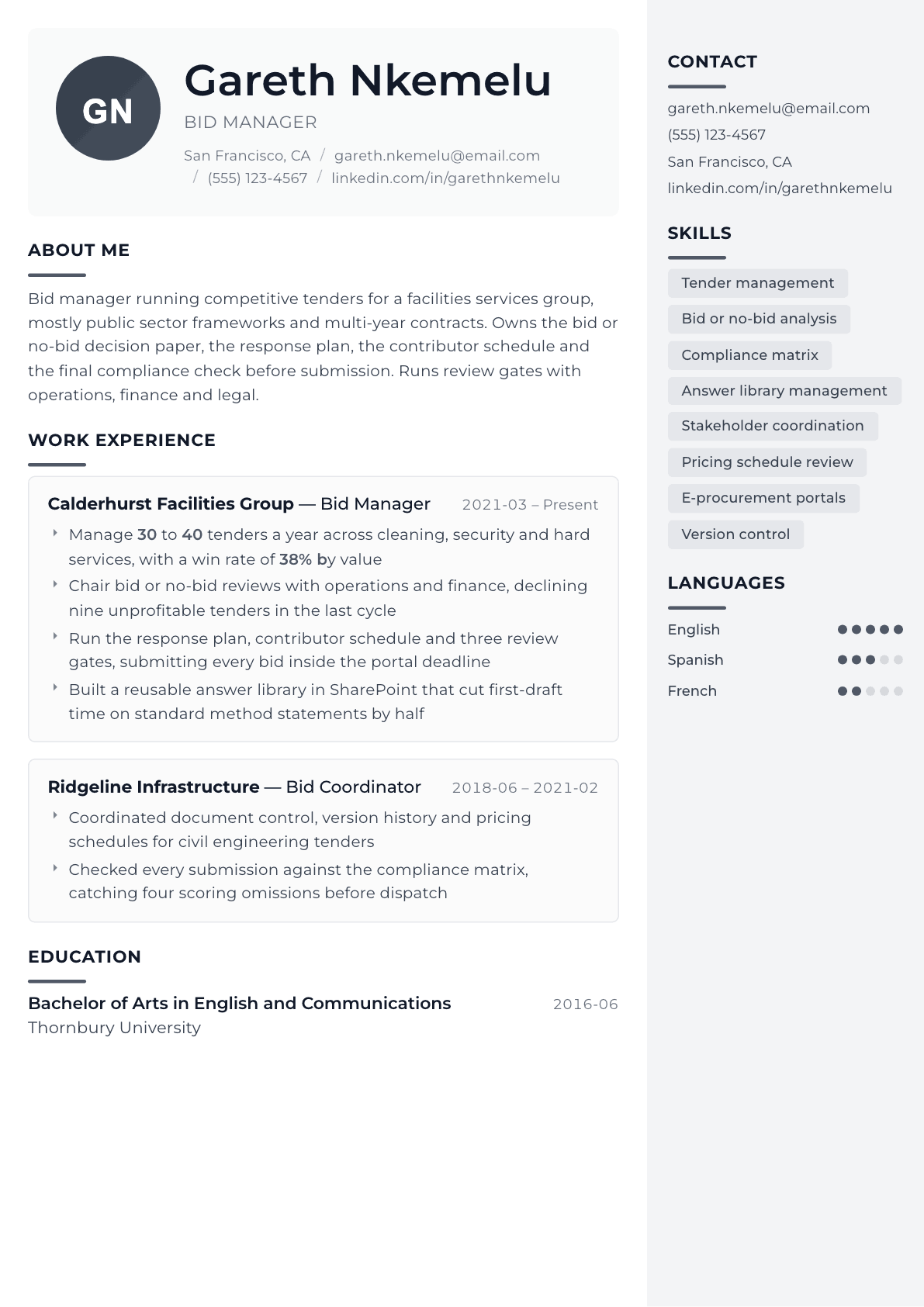
The same bid manager content laid out in three CVBooster templates, so you can see what the finished document looks like before you write a word.
Example Bid Manager summary
Bid manager with seven years in facilities and infrastructure tendering, currently managing up to 40 competitive bids a year at a 38% win rate by value. Chairs bid or no-bid reviews, runs a three-gate response process with operations, finance and legal, and has never missed a portal deadline. Built a reusable answer library that halved first-draft time. Seeking a bid role on larger public sector frameworks.
Skills to list on a Bid Manager resume
- Tender and bid management
- Bid or no-bid decision analysis
- Compliance matrix development
- Proposal writing
- Answer library management
- Pricing schedule coordination
- Stakeholder management
- E-procurement portals
- Public sector frameworks
- Document and version control
- Review gate facilitation
- Deadline planning
- Win and loss review
- Contract terms review
What actually gets this resume read
- Give volume and value: tenders managed per year, average contract length, and the win rate you achieved.
- Report win rate by value as well as by count, since one large framework outweighs a dozen small awards.
- Show the governance you run: bid or no-bid papers, review gates, and who sits in each one.
- Name the e-procurement portals you have submitted through, because employers filter for that experience.
- Prove compliance discipline with an example of a scoring requirement or exclusion you caught before submission.
- Mention the answer library or knowledge base you built and what it did to drafting time.
How to write a bid manager resume
A bid manager resume is read by a commercial director who has watched good tenders lost to a missed word count, a wrong pricing schedule or a portal upload that failed at four in the afternoon. They are hiring for process control under a fixed deadline, and everything on your page should be read against that.
Two numbers decide most shortlists for this role: how many tenders you handle in a year and what proportion you win. Everything else on the resume exists to explain those two figures. Governance, review gates, answer libraries and compliance matrices are the mechanism, and win rate is the result.
This guide covers the format, how to state volume and win rate credibly, the governance evidence hiring managers test in interviews, three summaries across the career, before-and-after bullets, and the questions bid professionals ask when they move from coordination into full bid ownership.
Format: two pages, tender volume stated per employer
Two pages is normal once you have run tenders for more than a few years, because the sectors, contract types and portals all need naming. Reverse chronological. Under each employer add a volume line: tenders per year, typical contract value band and duration, the buyer type and the sectors.
Public sector and private sector bidding are different disciplines, so make the split obvious. A candidate who has only responded to open public frameworks will struggle on a private negotiated bid, and the reverse is equally true.
- Header: name, city, phone, email, professional profile link.
- Section order: summary, bid experience with volume lines, governance and process work, systems, education and training.
- Volume line: tenders per year, value band, contract length, buyer type, sector.
Summary: volume, win rate, sectors and the governance you run
Four lines. State the annual tender volume, the win rate by value, the sectors and buyer types, and the governance you own. Win rate by value belongs alongside win rate by count, because a single multi-year framework can outweigh a dozen small awards and a commercial director knows it.
Say whether you own the bid or no-bid decision. That is the boundary between a bid coordinator and a bid manager, and it is the first thing an experienced reader looks for.
Experience: governance, deadlines and the answer library
Describe the process you run rather than the documents you produce. A strong bid function has a qualification stage, a written response plan with owners and dates, at least two review gates, a compliance check against the scoring criteria, and a rehearsed submission window that closes well before the portal deadline. Naming your version of that proves you have run bids rather than assembled them.
Bid or no-bid work deserves a bullet of its own. Declining unprofitable or unwinnable tenders protects margin and frees the team for bids they can win, and it takes more authority than writing. Give the number of tenders you declined and the reasoning framework you used.
The answer library is the other lasting artifact. Say how many answers it holds, how often it is reviewed, who owns each section and what it did to first-draft time. Employers care because the library survives you.
- Tenders managed per year and the win rate, by count and by value.
- Bid or no-bid decisions taken and the criteria applied.
- Review gates run, and who attends each one.
- Submission record against portal deadlines.
Compliance, pricing and the portals
Compliance is where tenders are silently lost. Show that you build a compliance matrix that maps every requirement, word count, attachment and certificate to an owner, and give one example of a scoring requirement or mandatory exclusion you caught before submission. That single anecdote is often what persuades a hiring manager.
Pricing coordination should also appear. You are rarely the person setting the price, but you own the schedules, the rate cards, the assumptions log and the version that goes into the envelope. Say so, and name the finance interface.
List the e-procurement portals you have submitted through. Employers filter on portal familiarity because the upload rules, file limits and clarification workflows differ and a mistake there is unrecoverable.
Keywords buyers and recruiters search for
The vocabulary is narrow and worth using exactly: tender, invitation to tender, request for proposal, pre-qualification questionnaire, selection questionnaire, framework agreement, lot, compliance matrix, method statement, social value, clarification question, standstill, evaluation criteria and post-tender negotiation.
Add your sectors. Facilities management, construction, defense, health, education, transport and technology tenders each carry their own standards, and a bid manager who already knows the buyer's regime is worth more from the first week.
Bid Manager resume summary examples
Bid coordinator
Bid coordinator with two years supporting civil engineering tenders, owning document control, version history and the compliance matrix. Checked every submission against the scoring criteria and caught four omissions before dispatch in 2023. Looking to take ownership of full bids and the response plan.
Bid manager running the process
Bid manager handling 30 to 40 competitive tenders a year across cleaning, security and hard services, at a 38% win rate by value. Chairs bid or no-bid reviews with operations and finance, runs three review gates per bid, and has submitted every tender inside the portal deadline.
Senior bid manager
Senior bid manager with eleven years in facilities and infrastructure, leading a team of three writers and a graphic designer on multi-lot public framework bids. Owns the qualification policy, the answer library and post-tender negotiation support, and rebuilt the review gate model now used across three divisions.
Work experience bullets: before and after
Before: Managed tenders from start to finish.
After: Manage 30 to 40 competitive tenders a year from qualification through submission, running a response plan with named owners, three review gates and a compliance check against the published evaluation criteria.
Volume plus the named stages shows a governed process rather than a general claim of ownership.
Before: Achieved a good win rate on bids.
After: Delivered a 38% win rate by value across three service lines, including two multi-year public framework awards that lifted the division's contracted revenue for four years.
Win rate by value with the awards behind it is far harder to dispute than an unqualified success claim.
Before: Decided which opportunities to bid for.
After: Chair bid or no-bid reviews with operations and finance against a scored qualification framework covering incumbency, margin, delivery capability and strategic fit, declining nine unprofitable tenders in the last cycle.
The criteria and the count of declines prove real authority over the pipeline rather than administrative filtering.
Before: Made sure bids were compliant.
After: Build a compliance matrix mapping every requirement, word limit, attachment and certificate to a named owner, which caught a missing insurance certificate and a mandatory sustainability policy before two submissions went out.
A concrete catch shows the matrix is used in anger, not maintained as a formality.
Before: Created a library of standard answers.
After: Built a reusable answer library in SharePoint covering method statements, mobilization plans and social value responses, with quarterly owner reviews, which halved first-draft time on standard questions.
Scope, ownership, review cadence and time saved turn a document store into a managed asset.
Hard skills
- Tender and bid management
- Bid or no-bid qualification
- Compliance matrix development
- Response planning and scheduling
- Method statement writing and editing
- Pricing schedule coordination
- E-procurement portal submission
- Public sector framework bidding
- Answer library management
- Document and version control
- Clarification question handling
- Win and loss review
Soft skills
- Holding subject experts to a deadline
- Chairing a review with senior stakeholders
- Calm under a fixed submission clock
- Editing other people's writing without friction
- Judgment on when to walk away
- Attention to instruction detail
Certifications worth listing
- APMP Foundation (Association of Proposal Management Professionals)
- APMP Practitioner (Association of Proposal Management Professionals)
- APMP Professional (Association of Proposal Management Professionals)
Mistakes that cost bid manager candidates the interview
- Giving a win rate with no volume or value basis, which an experienced commercial reader immediately discounts.
- Describing writing work only, when the role is judged on governance, qualification and deadline control.
- Leaving out the e-procurement portals, which employers filter on because upload rules differ and mistakes are final.
- Failing to separate public sector and private sector bidding, which require different disciplines and evidence.
- Claiming bid ownership while never mentioning the bid or no-bid decision that defines the role.
- Ignoring win and loss reviews, so the reader cannot tell whether you learn from the tenders you lose.
Bid Manager resume questions
What win rate should I put on a bid manager resume?
Whatever is true, expressed both by count and by value, with the volume that produced it. Winning close to two tenders in five across forty attempts is a serious record. A high rate across four bids tells the reader nothing, so give the denominator every time.
What is the difference between a bid manager and a proposal writer?
A bid manager owns the process: qualification, planning, contributors, governance, compliance and submission. A proposal writer owns the words. Many people do both, so state which parts you led and which you contributed to at each employer.
Do I need an APMP qualification?
It is not usually mandatory, but it is the recognized credential in the field and it signals shared vocabulary for review gates, qualification and storyboarding. Foundation is achievable early in a career and worth listing near the top of the resume.
How do I show value when the bids I ran were lost?
Show the process results that are within your control: submission record against deadlines, compliance pass rate, feedback scores from the buyer, and improvements you made after a debrief. A well-run losing bid with a strong evaluation score is credible evidence.
Should I name the clients and contracts I bid for?
Name the buyer type and sector rather than confidential contract detail: a regional health authority, a metropolitan transport body, a national retailer. That gives the reader scale and regime familiarity without breaching a confidentiality clause in your contract.