Proposal Writer Resume Examples: the lines they read
Write a Proposal Writer Resume That Wins the Interview
By Mustafa Tarabya, founder of CVBooster · Published · Updated
Proposal Writer resume example and guide: RFP response work, win themes, evaluator scoring, content libraries, keywords and a summary you can adapt.
Sample resumes for a proposal writer
The same proposal writer content laid out in three CVBooster templates, so you can see what the finished document looks like before you write a word.
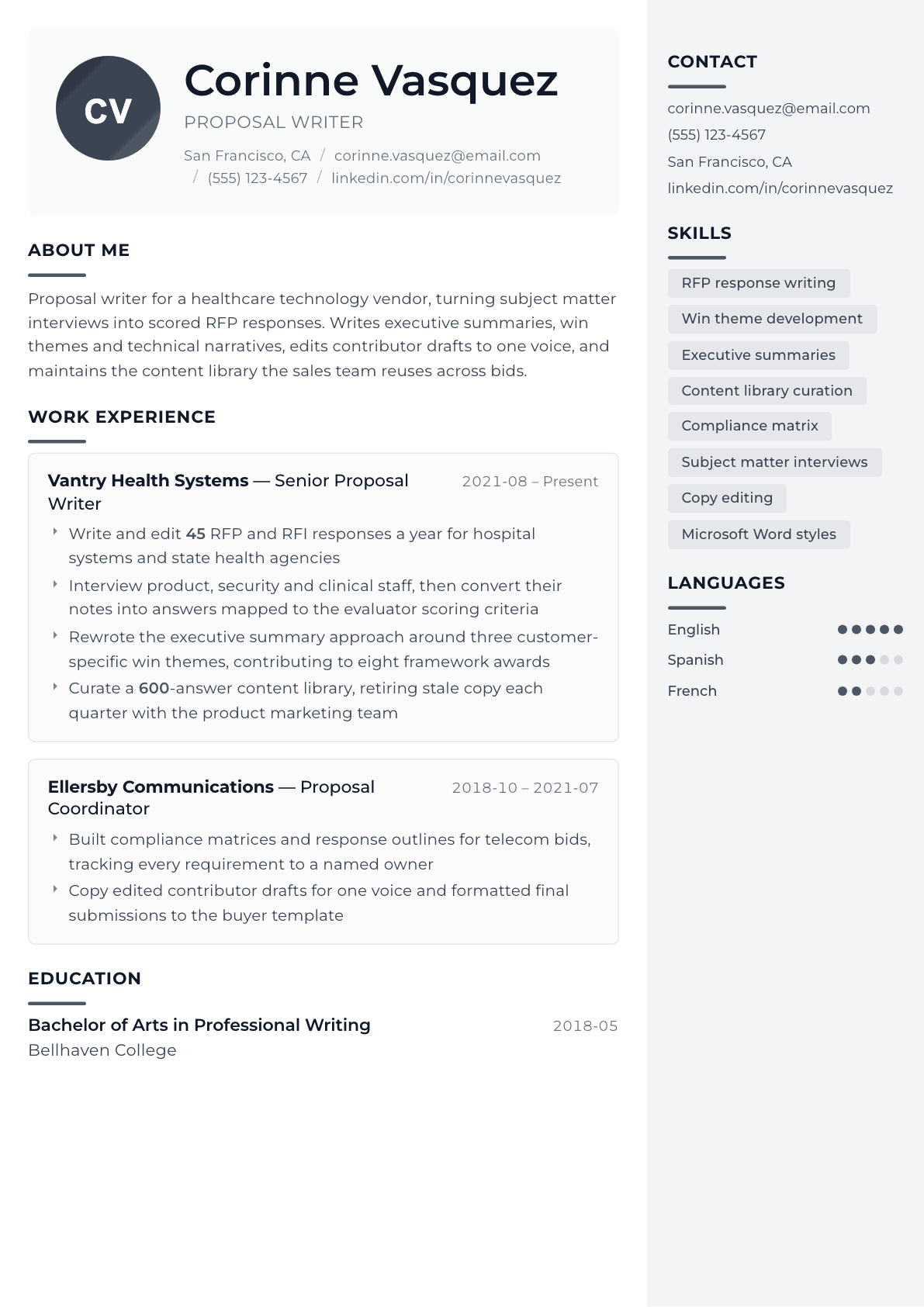
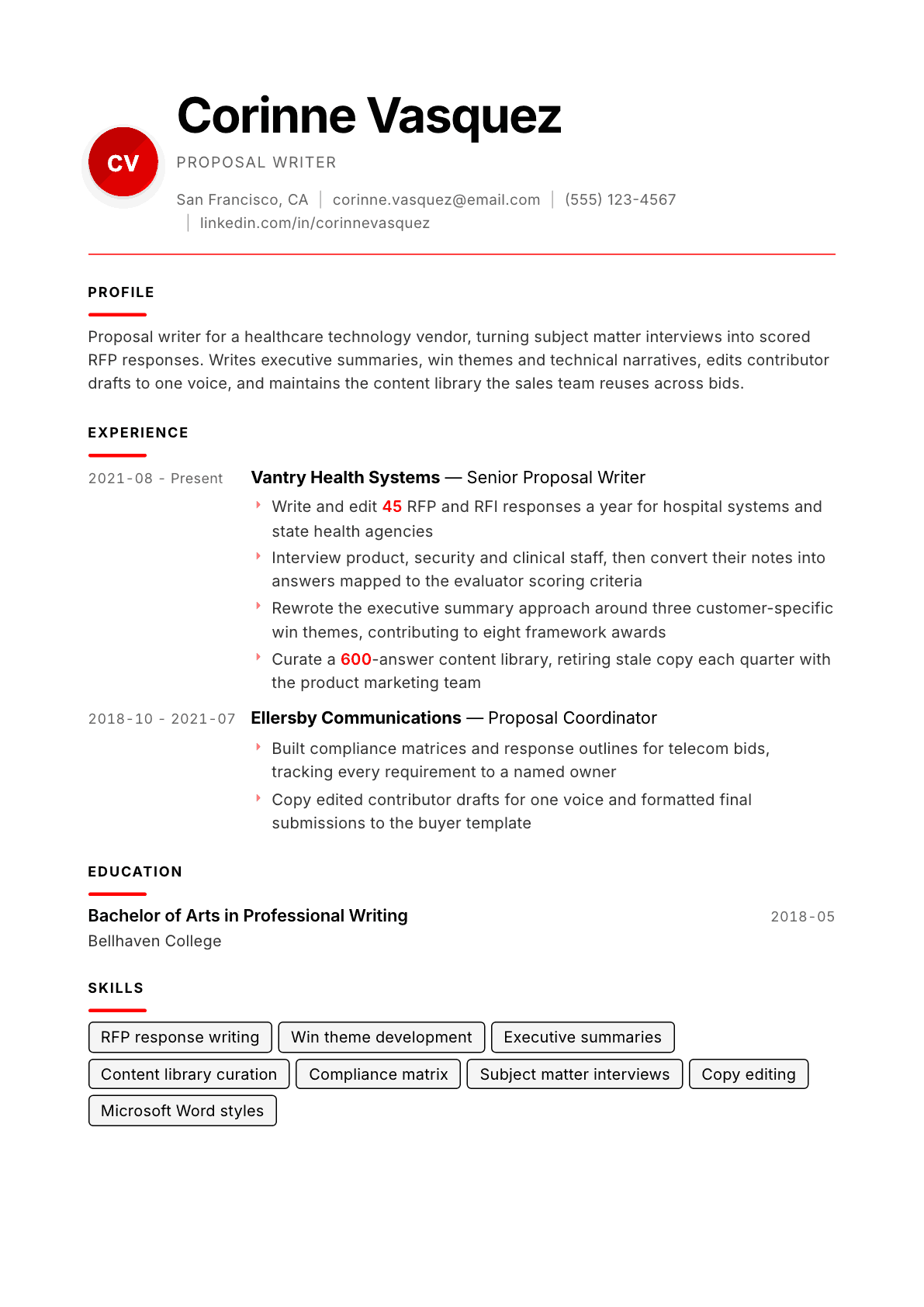
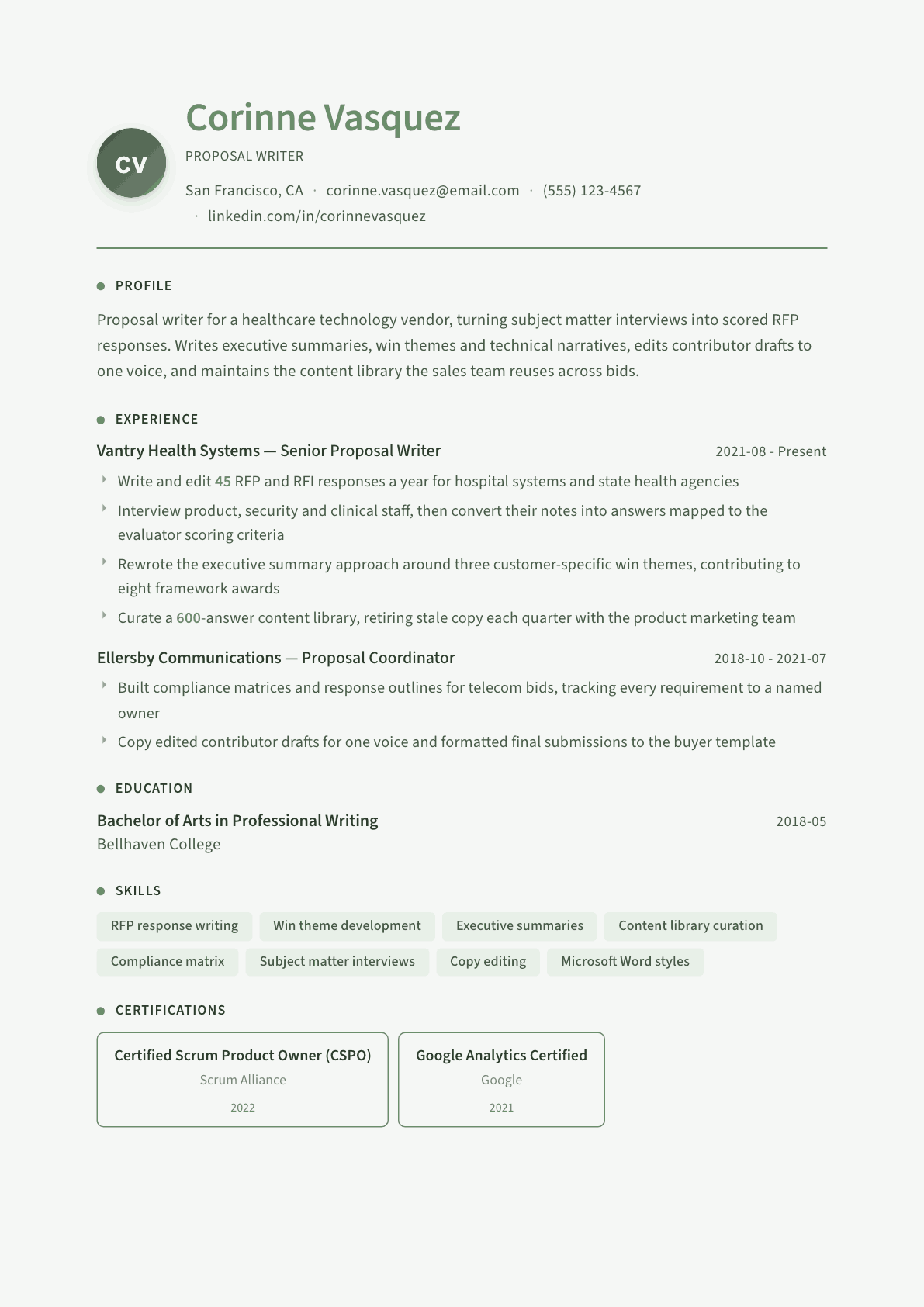
Example Proposal Writer summary
Proposal writer with seven years responding to healthcare and telecom procurement, currently producing 45 scored RFP and RFI responses a year. Interviews clinical, security and product experts and converts their answers into narrative mapped directly to evaluator criteria. Rebuilt the executive summary approach around customer-specific win themes and curates a 600-answer content library. Looking for a senior proposal role on larger public bids.
Skills to list on a Proposal Writer resume
- RFP and RFI response writing
- Win theme development
- Executive summary writing
- Compliance matrix mapping
- Content library management
- Subject matter expert interviews
- Technical editing
- Style guide adherence
- Proposal graphics briefing
- Version control
- Deadline management
- Public sector procurement language
- Microsoft Word advanced formatting
- Review and red team facilitation
What actually gets this resume read
- Count your output: responses written per year, average page or answer count, and the buyer types you write for.
- Show that you write to the scoring criteria, not just to the question, because that is the skill being hired.
- Name the industries you have written in, since domain vocabulary is what makes a proposal writer productive fast.
- Include win themes and executive summary work, the two sections evaluators remember and reviewers argue about.
- Mention content library ownership: size, review cadence, and how you keep answers current.
- Add the tools: proposal software, document templates, style guides and the review workflow you run in.
How to write a proposal writer resume
A proposal writer resume has an awkward requirement: it is a writing sample as well as an application. The hiring manager is reading your sentences to decide whether you can write theirs. Vague phrasing, a stray typo or an unsupported claim on your own document is treated as a prediction of what your first draft will look like.
The second thing they check is whether you write to the scoring criteria or merely answer the question. Evaluators award points against published criteria, and a writer who structures an answer so a scorer can find each point without hunting is worth more than a stylish one who does not.
This guide sets out the format, how to count and describe your output, the win theme and executive summary work that distinguishes senior writers, three summaries across the career, before-and-after bullets, and the questions writers ask when they move from marketing copy into proposals.
Format: one or two pages, written to your own standard
One page early in your career and two after about six years. Reverse chronological, plain layout, no design flourishes: proposal teams work in document templates and a heavily styled resume suggests you will fight the buyer template rather than follow it.
Under each employer add an output line: responses written per year, average length or answer count, buyer type and sector. That line lets a proposal manager judge your throughput immediately, which is what their capacity planning depends on.
- Header: name, city, phone, email, and a portfolio note if you can share sanitized samples.
- Section order: summary, proposal experience with output lines, tools and libraries, other writing, education.
- Output line: responses per year, typical length, buyer type, sector.
Summary: output, sectors, and what you do beyond drafting
Three or four lines. Number of responses a year, the sectors and buyer types, whether you write to public evaluation criteria, and the higher-value work you do: win themes, executive summaries, storyboarding, red team reviews or library ownership.
Name the domain vocabulary you have. A writer who already understands clinical workflows, security frameworks or rolling stock maintenance produces a usable first draft in half the time, and hiring managers pay attention to that far more than to years of experience.
Experience: interviews, structure and the scoring criteria
The real craft in this job is extraction. You interview a solution architect, a nurse manager or an operations lead who has fifteen minutes and no interest in the tender, and you leave with enough to write a scored answer. Describe that process: how you prepare, how you record, and how you turn technical notes into buyer-facing narrative.
Then describe structure. A strong proposal answer opens with the direct response, states the approach, gives evidence, and closes with the benefit to that specific buyer. Saying you write to that shape, and that you map each paragraph to a scoring sub-criterion, tells a proposal manager you will not need heavy editing.
Win themes and executive summaries deserve their own bullets if you own them. These are the sections a senior evaluator reads properly, and being the person who develops customer-specific themes rather than reciting company strengths is what moves a writer from mid to senior.
- Responses written and edited per year, with buyer type.
- Subject expert interviews conducted, and how the notes become drafts.
- Answers mapped to published evaluation criteria and word limits.
- Executive summaries and win themes owned, and the awards they supported.
Content libraries, editing and version control
Library ownership is a distinct skill: sizing the library, retiring stale answers, keeping product claims accurate with product marketing, and tagging content so it is findable during a live bid. Give the library size and the review cadence, because a neglected library actively harms bid quality.
Editing other people's writing to one voice is the other underrated duty. Say how many contributors you edit for, what your style standard is, and how you handle a subject expert who rejects the edit. That last point comes up in every interview for this job.
Keywords procurement teams and recruiters use
Use the standard terms where they are true: request for proposal, request for information, request for quotation, pre-qualification questionnaire, evaluation criteria, compliance matrix, win theme, executive summary, storyboard, red team review, pink team review, clarification response and past performance narrative.
Add the writing tools you work in: advanced document styles, template control, collaborative review workflows and any proposal management platform your employer used.
Proposal Writer resume summary examples
First proposal role
Communications graduate with two years writing marketing copy and case studies for a technology reseller, including support on six tender responses in 2024. Comfortable interviewing technical staff and editing to a house style guide. Looking for a dedicated proposal writing role in the public sector market.
Proposal writer with a portfolio
Proposal writer producing 45 scored RFP and RFI responses a year for hospital systems and state health agencies. Interviews clinical, security and product staff, then writes answers mapped directly to published evaluation criteria, and curates a 600-answer content library reviewed each quarter.
Senior proposal writer
Senior proposal writer with ten years in regulated markets, owning executive summaries and win themes on multi-lot bids and facilitating red team reviews. Rebuilt the executive summary approach around three customer-specific themes per bid, contributing to eight framework awards over two years.
Work experience bullets: before and after
Before: Wrote responses to RFPs for the sales team.
After: Write and edit 45 RFP and RFI responses a year for hospital systems and state health agencies, working to published evaluation criteria, word limits and buyer templates.
Volume, buyer type and the constraints you write inside show throughput and discipline in one line.
Before: Gathered information from internal experts.
After: Interview product, security and clinical staff in structured 30-minute sessions with a prepared question set, then convert their notes into scored answers without a second round of clarification.
The interview format and the no-rework outcome show the extraction skill this job actually turns on.
Before: Improved the quality of our executive summaries.
After: Rewrote the executive summary approach around three customer-specific win themes per bid, each tied to a stated buyer priority and supported by a named reference, contributing to eight framework awards.
The structure of the change and the awards behind it prove the rewrite was strategic rather than stylistic.
Before: Maintained the proposal content library.
After: Curate a 600-answer content library, tagging by product, buyer type and question theme, and retiring stale copy each quarter in a joint review with product marketing.
Size, tagging and a named review partner turn library maintenance into a managed content operation.
Before: Edited drafts from other contributors.
After: Edit drafts from up to twelve contributors per bid into one voice against a documented style standard, returning each with tracked changes and a short note on what the evaluator would have missed.
Contributor count, a written standard and an explanation of each edit show editing as a repeatable service.
Hard skills
- RFP and RFI response writing
- Evaluation criteria mapping
- Win theme development
- Executive summary writing
- Subject matter expert interviewing
- Content library curation
- Technical editing and proofreading
- Storyboarding and outline development
- Compliance matrix support
- Advanced document styles and templates
- Red team and pink team review
- Past performance and reference writing
Soft skills
- Extracting detail from busy experts
- Writing to a hard deadline
- Accepting and giving edits gracefully
- Curiosity about unfamiliar domains
- Precision with instructions
- Working across sales, legal and delivery
Certifications worth listing
- APMP Foundation (Association of Proposal Management Professionals)
- APMP Practitioner (Association of Proposal Management Professionals)
Mistakes that cost proposal writer candidates the interview
- Submitting a resume with loose or padded sentences, when the document is itself the writing sample being judged.
- Counting responses without naming the buyer type, so the reader cannot tell commercial pitches from scored public bids.
- Describing writing only, and omitting the interviews, structure and criteria mapping that make the writing usable.
- Leaving out the domain vocabulary you already have, which is the strongest predictor of how fast you become productive.
- Claiming to own win themes when you only assembled boilerplate, a gap an interviewer exposes in two questions.
- Ignoring library and version control work, which is a large part of a proposal writer's week between live bids.
Proposal Writer resume questions
How many proposals should a writer produce in a year?
It varies enormously with response length and sector. What matters is stating your number alongside the typical size, such as 45 responses a year averaging twenty scored answers each. A reader can then judge throughput fairly against their own volumes.
Can I include proposal samples with my application?
Rarely in full, because most responses are confidential. Prepare a sanitized sample with client names, pricing and identifying detail removed, and offer it on request. A short redacted executive summary is usually enough to demonstrate structure and voice.
How do I move from copywriting into proposal writing?
Emphasize the parts that transfer: interviewing experts, writing to a brief, editing to a style guide and hitting deadlines. Then show any tender work you supported, even partially, and learn the vocabulary of evaluation criteria and compliance so your resume speaks the field's language.
Do proposal writers need industry knowledge?
It helps more than almost anything else. Hiring managers prefer a competent writer who already understands their domain over a brilliant generalist, because domain fluency removes rounds of clarification with subject experts and shortens the first draft cycle considerably.
What should the skills section include for this role?
Split it into writing craft, process and tools: response writing and editing, criteria mapping and win themes, then document styles, review workflows and library systems. Keep soft skills out of the list and demonstrate them in the experience bullets instead.