Grocery Store Clerk Resume Examples: what gets the call
Grocery Store Resume Examples, From a First Grocery Resume to Clerk
By Mustafa Tarabya, founder of CVBooster · Published · Updated
Grocery resume and grocery store resume examples for clerks, stockers, cashiers and deli staff, plus a first job sample and the food safety keywords.
Sample resumes for a grocery store clerk
The same grocery store clerk content laid out in three CVBooster templates, so you can see what the finished document looks like before you write a word.
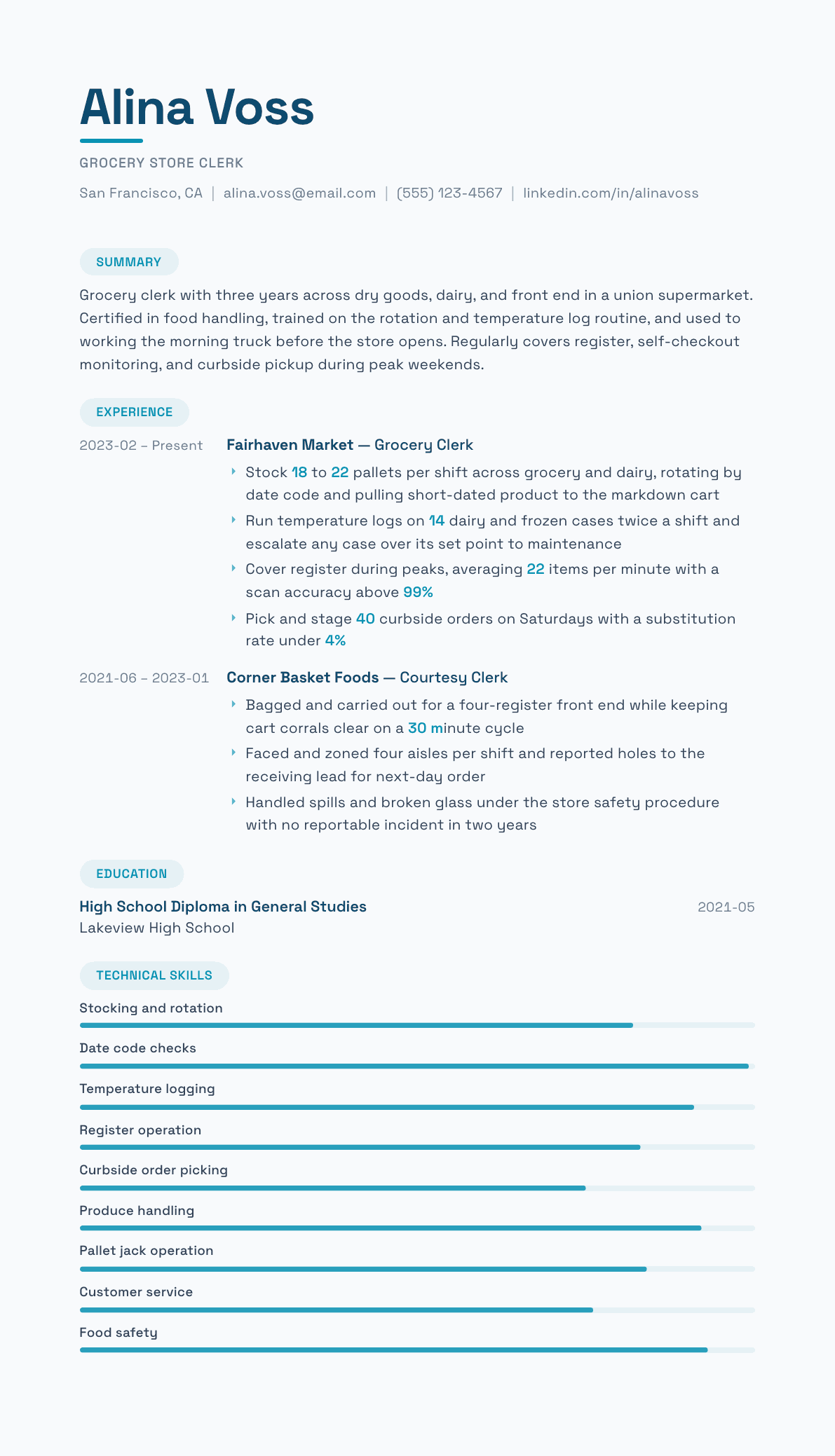
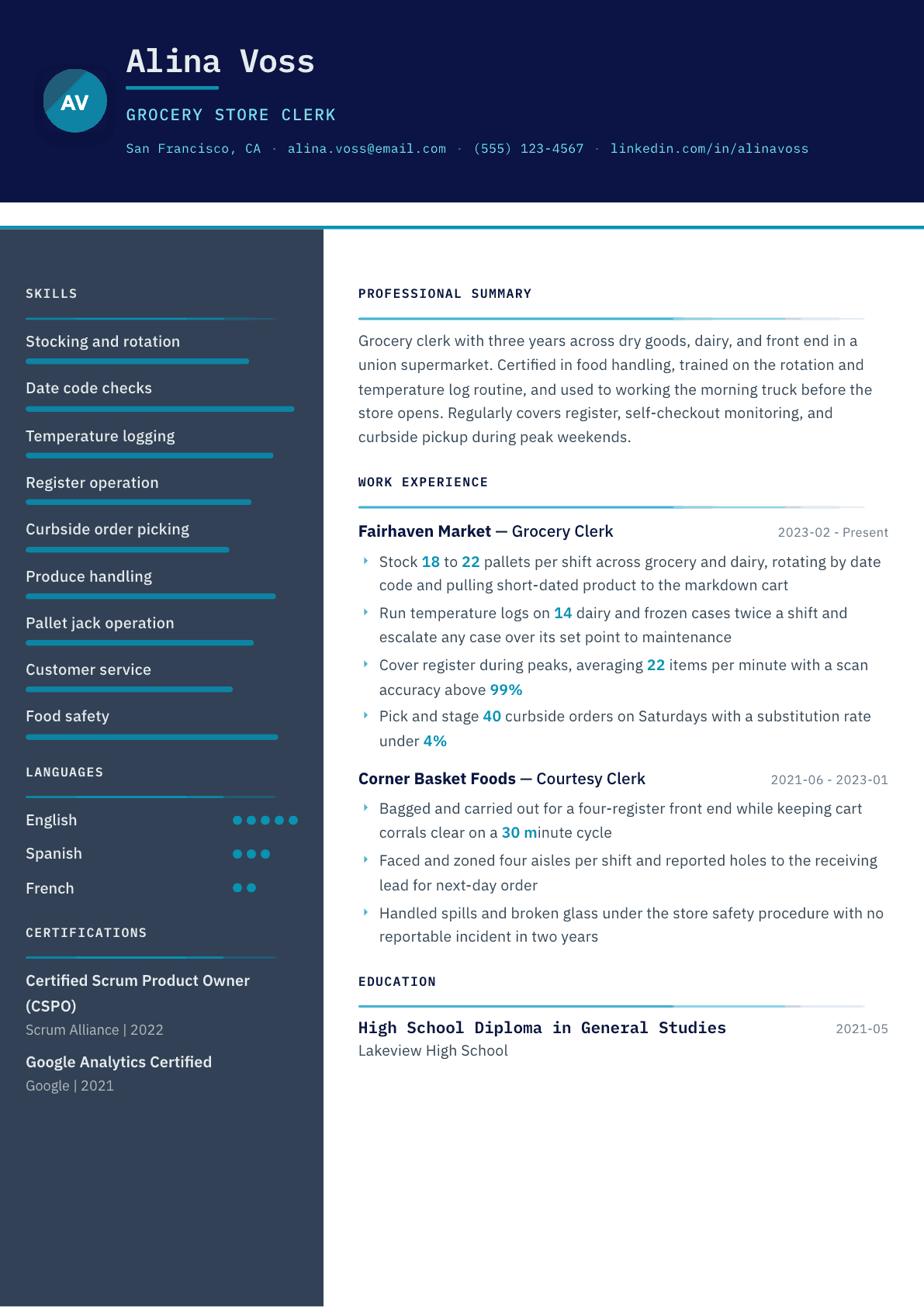
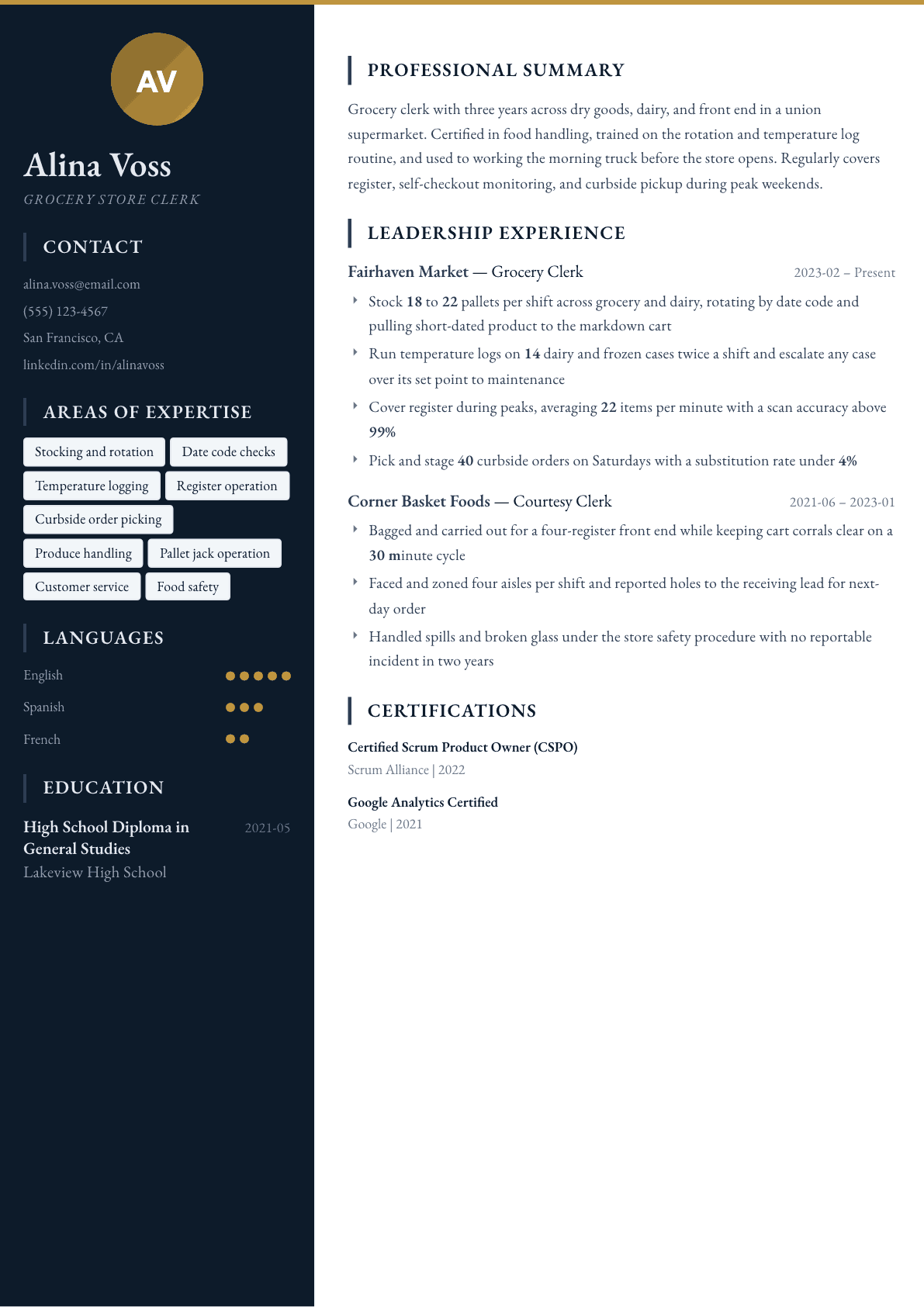
Example Grocery Store Clerk summary
Grocery clerk with three years in a union supermarket, working dry grocery, dairy, and the front end. Stocks 18 to 22 pallets a shift with strict date rotation, keeps temperature logs on 14 cases, and covers register at 22 items per minute. Food handler certified, open to overnight and weekend shifts.
Skills to list on a Grocery Store Clerk resume
- Stocking and replenishment
- Product rotation
- Date code auditing
- Temperature monitoring
- Food safety handling
- Cash register operation
- Pallet jack operation
- Backroom organization
- Curbside order picking
- Price and tag changes
- Aisle facing and zoning
- Customer assistance
- Spill and safety response
What actually gets this resume read
- Name the departments you worked, since dairy, produce, and dry grocery each carry different handling rules.
- Put your food handler card in its own line near the top, with the issuing body and the state.
- Give pallet counts, case counts, or truck size so a manager can picture your pace on the floor.
- Mention every shift you can work, including overnight and weekends, because availability decides many grocery hires.
- Show rotation and date code discipline explicitly, since spoilage is the number a grocery manager watches.
- Add curbside or online order picking if you have done it, as most chains now staff that from the grocery team.
How to write a grocery store clerk resume
A grocery store resume, whether the posting says clerk, stocker, courtesy clerk or grocery associate, is read in under a minute by a department manager who is short of people and needs to know three things: which shifts you can work, whether you have handled food safely before, and how fast you move product to the shelf. Everything else is decoration. Chains often auto-screen the application first, so the words on the page have to match the posting before a human ever sees them.
Applicants lose interviews by writing a duties list that could belong to any store on any street. Stocked shelves and assisted customers tells a grocery manager nothing about pallets per shift, date rotation, temperature logs, or whether you can be trusted alone in dairy at five in the morning.
This guide sets out how to structure the page, what to write when this is your first job, three summary examples from courtesy clerk to a clerk running a department, before and after bullets, and the questions supermarket applicants ask most often.
Format: one page, availability near the top
One page, reverse chronological, plain single column. Grocery chains use application portals that parse text badly when it sits in tables or graphics, so keep the layout simple and use standard headings. If you have no work history yet, the education section moves above experience and a short availability line goes directly under your contact details.
State availability in specific terms rather than as flexible. Weeknights after four, weekends open, and overnight all describe crews a manager is actively trying to fill, and matching an open shift is often what decides the first callback in a grocery store.
- Header: name, city and state, phone, email, and one line of shift availability.
- Put your food handler card, with the issuing authority and state, in its own line near the top.
- Section order with experience: summary, experience, certifications, education, skills.
Summary: departments, pace, and certification
Two or three lines. Name the departments you have worked, because dairy, produce, dry grocery, frozen, and front end each carry different handling rules and a manager is hiring for one of them. Add your pace in pallets or cases, then the certification and the shifts you can cover.
A career changer coming in from warehouse, restaurant, or hospitality work should name the transferable half in this same space: heavy lifting, rotation discipline, temperature control, or serving customers through a rush.
Experience: pallets, rotation, temperature, register
Lead each job with volume. Pallets or cases worked per shift, the number of aisles or cases you own, and whether you work the truck before doors open give a grocery manager a picture of your speed that no adjective can. Follow with rotation and date code discipline, since spoilage and out of code product are the losses a department manager answers for every week.
Add the cold chain work if you have it. Temperature logs on dairy and frozen cases, escalating a case over its set point, and pulling product during a compressor failure are small details that mark a trained clerk. Then cover the cross training: register, self-checkout support, curbside picking, backroom organization, and price and tag changes.
Leave out generic service lines. Provided excellent customer service appears on every application in the folder, and it takes the place of a bullet about the 40 curbside orders you picked with almost no substitutions.
No experience yet: what a grocery manager will accept instead
A first job resume can carry school, sports, and volunteer work as long as it is written in the same language as the job. Restocking a food pantry, unloading a delivery for a school event, or handling cash at a fundraiser all map onto the tasks in a grocery aisle, and they answer the reliability question the manager is really asking.
Get the food handler card before you apply if your state or county requires one. It is inexpensive, it takes a couple of hours online, and it removes the delay that makes a manager hire the other applicant who already has it.
Here is a first grocery resume written out for an invented high school student applying to be a courtesy clerk. Copy the order and replace every detail with your own.
- Header: Jordan Ellis, city and state, phone, email. Availability: weekdays after 3:30 pm, weekends any shift, full time in summer.
- Summary: High school junior with two years of volunteer shifts at a community food pantry. Comfortable lifting cases, rotating dated stock and helping shoppers find items, and available for weekend and holiday shifts.
- Volunteer, community food pantry, two years: unloads the weekly delivery, checks dates and rotates stock oldest first, and packs orders for about 30 families each Saturday.
- Cashier, school booster club concession stand, two seasons: handles cash and card payments, counts the drawer at close with the club treasurer.
- Skills and certificates: food handler card, cash handling, stock rotation, helping shoppers find items, conversational Spanish.
Skills and keywords the application portal scans
Use the exact nouns from the posting: stocking, rotation, date code, temperature log, pallet jack, backroom, replenishment, facing and zoning, price changes, cash register, and curbside pickup. List equipment separately from tasks so the manager can see what you are cleared to operate without further training.
Keep soft skills out of the list and put them into bullets where they are visible. Reliability is proved by an attendance record or by covering a holiday week, not by the word reliable sitting between two nouns.
Grocery store resume examples by department
Supermarkets hire by department, so the best grocery store resume example is the one written for the counter or aisle you are applying to. The complete sample on this page is a general grocery clerk; the lines below show how the summary and first bullet shift for each department while the layout stays the same.
Whichever version you use, keep availability and any food handler card under your name, then let the first bullet carry the department proof a manager would check on a trial shift.
- Stocker or overnight crew: Unloads and works the truck with a pallet jack, fills a stated number of aisles per shift, rotates dated product front to back.
- Produce clerk: Culls and rotates produce every morning, builds displays to the weekly ad, records shrink and keeps cooler temperature logs.
- Deli or bakery clerk: Slices to order, labels and dates prepared food, follows sanitation schedules and holds a current food handler card.
- Cashier or front end: Runs a register with accurate cash counts, processes payment and benefit cards, bags to store standards and covers self checkout.
- Online order or curbside picker: Picks orders against the clock with a handheld scanner, chooses substitutions shoppers accept, loads cars at pickup.
Grocery Store Clerk resume summary examples
First job
Recent high school graduate with a current food handler card, seeking a grocery clerk position with open weekend and evening availability. Handled stock and cash at a school store and a weekly food pantry distribution, lifting cases and keeping product rotated by date without supervision.
Three years in the aisles
Grocery clerk with three years across dry goods, dairy, and front end in a union supermarket. Works 18 to 22 pallets a shift with strict date rotation, keeps temperature logs on 14 refrigerated cases, and covers register at 22 items per minute during peak weekends. Available for overnight and weekend shifts.
Lead clerk
Lead grocery clerk responsible for the dairy and frozen sets in a store serving 9K weekly customers. Writes the daily order, trains new clerks on rotation and cold chain checks, and held out of code product below the district benchmark through four consecutive audits.
Work experience bullets: before and after
Before: Stocked shelves and kept the store clean.
After: Stocked 18 to 22 pallets per shift across grocery and dairy, facing and zoning four aisles before the store opened.
Pallet counts and named departments give the manager a pace and a place instead of a general activity.
Before: Made sure products were fresh.
After: Rotated by date code on every case worked and pulled short-dated product to the markdown cart daily, cutting out of code write-offs in the dairy set.
Rotation, markdown, and write-offs are the exact vocabulary a grocery manager uses when reviewing losses.
Before: Checked the coolers and freezers.
After: Logged temperatures on 14 dairy and frozen cases twice per shift and escalated any case above its set point to maintenance the same hour.
The log count, frequency, and escalation step show a trained cold chain habit rather than a glance at a thermometer.
Before: Worked the register when it got busy.
After: Covered register during peak hours at 22 items per minute with scan accuracy above 99%, and supported two self-checkout terminals.
A speed and accuracy pair proves cross training that lets a manager schedule you anywhere on the floor.
Before: Helped with online orders.
After: Picked and staged 40 curbside orders each Saturday with a substitution rate under 4% by checking backroom stock before marking an item unavailable.
Substitution rate is the measured outcome for online picking and the method explains how you achieved it.
Hard skills
- Stocking and replenishment
- Product rotation and date code checks
- Temperature logging and cold chain
- Pallet jack operation
- Backroom and back stock organization
- Cash register operation
- Self-checkout support
- Curbside and online order picking
- Price and shelf tag changes
- Aisle facing and zoning
- Damaged and salvage processing
- Food safety and sanitation
Soft skills
- Reliable attendance
- Working at pace
- Clear handoffs between shifts
- Helpfulness with shoppers
- Attention to detail on dates
- Teamwork on a truck crew
Certifications worth listing
- ServSafe Food Handler (National Restaurant Association)
- Food Handler Card (State or county health department)
- RISE Up Retail Industry Fundamentals (National Retail Federation Foundation)
Mistakes that cost grocery store clerk candidates the interview
- Listing duties that fit any store, so a produce manager and a front end manager both read the resume and see nothing they need.
- Hiding availability at the bottom or writing flexible, when naming the open shift is the fastest route to a callback.
- Skipping the food handler card even though the county requires one before the first scheduled shift.
- Never mentioning date rotation, which is the single habit a grocery department manager checks in a new clerk's first week.
- Writing a paragraph about customer service instead of one line about picking online orders with almost no substitutions.
- Using a decorative template with columns and icons that the chain application portal turns into scrambled text.
Grocery Store Clerk resume questions
Do I need a food handler card to apply for a grocery clerk job?
Many counties require one before your first shift, especially for deli, produce, bakery, and any department that handles unpackaged food. Getting it in advance costs little, takes a couple of hours online, and removes a reason for the manager to hire someone else first.
What should I put on a grocery resume with no work experience?
Use school, sports, volunteer, and family business work written in store language: lifting and moving cases, keeping stock rotated, handling cash, and turning up on time for a set schedule. Add your availability and any food handler card directly under your contact details.
Should I list which department I want to work in?
Yes. Managers hire per department and the requirements differ, so name your preference and any experience in produce, dairy, frozen, bakery, deli, or front end. If you are open to any department, say that instead, since flexibility is genuinely useful to a scheduler.
How do I show I am reliable rather than just saying it?
Give evidence a manager can check: a clean attendance record over a stated period, covering holiday weeks, closing alone, or being the person called first for extra shifts. Concrete coverage history answers the reliability question better than any adjective in a skills list.
What is a good grocery store resume example to follow?
One written for the department you want: a stocker example leads with truck and pallet work, a deli example with food safety and labeling, a cashier example with register accuracy. Keep availability under your name and copy the structure, then replace every detail with your own shifts and tasks.