Presentation Designer Resume Examples: read this first
Craft a Presentation Designer Resume Built on Slides That Land
By Mustafa Tarabya, founder of CVBooster · Published · Updated
Presentation designer resume example covering decks, data slides, template systems, keywords and a complete writing guide.
Sample resumes for a presentation designer
The same presentation designer content laid out in three CVBooster templates, so you can see what the finished document looks like before you write a word.
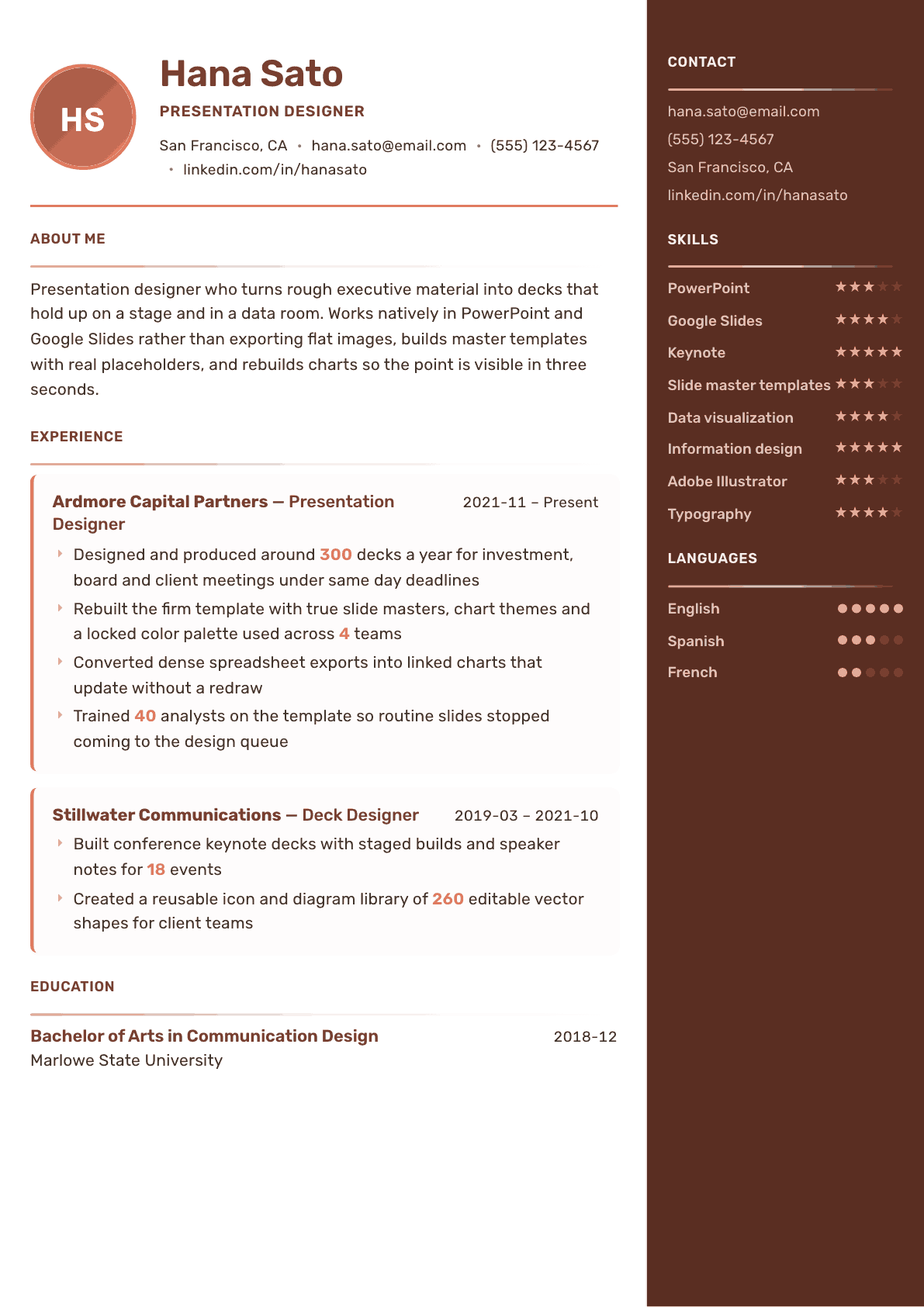
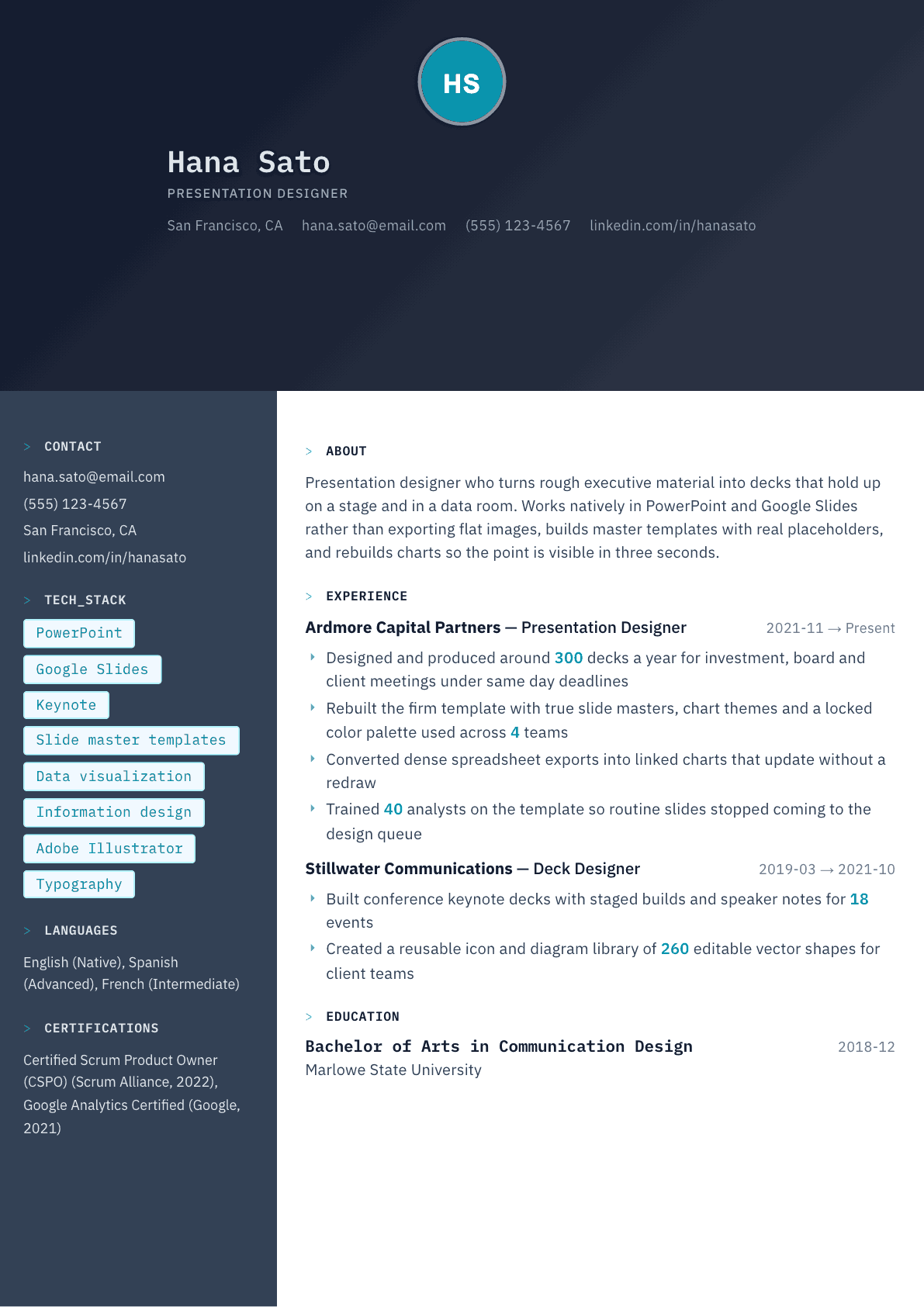
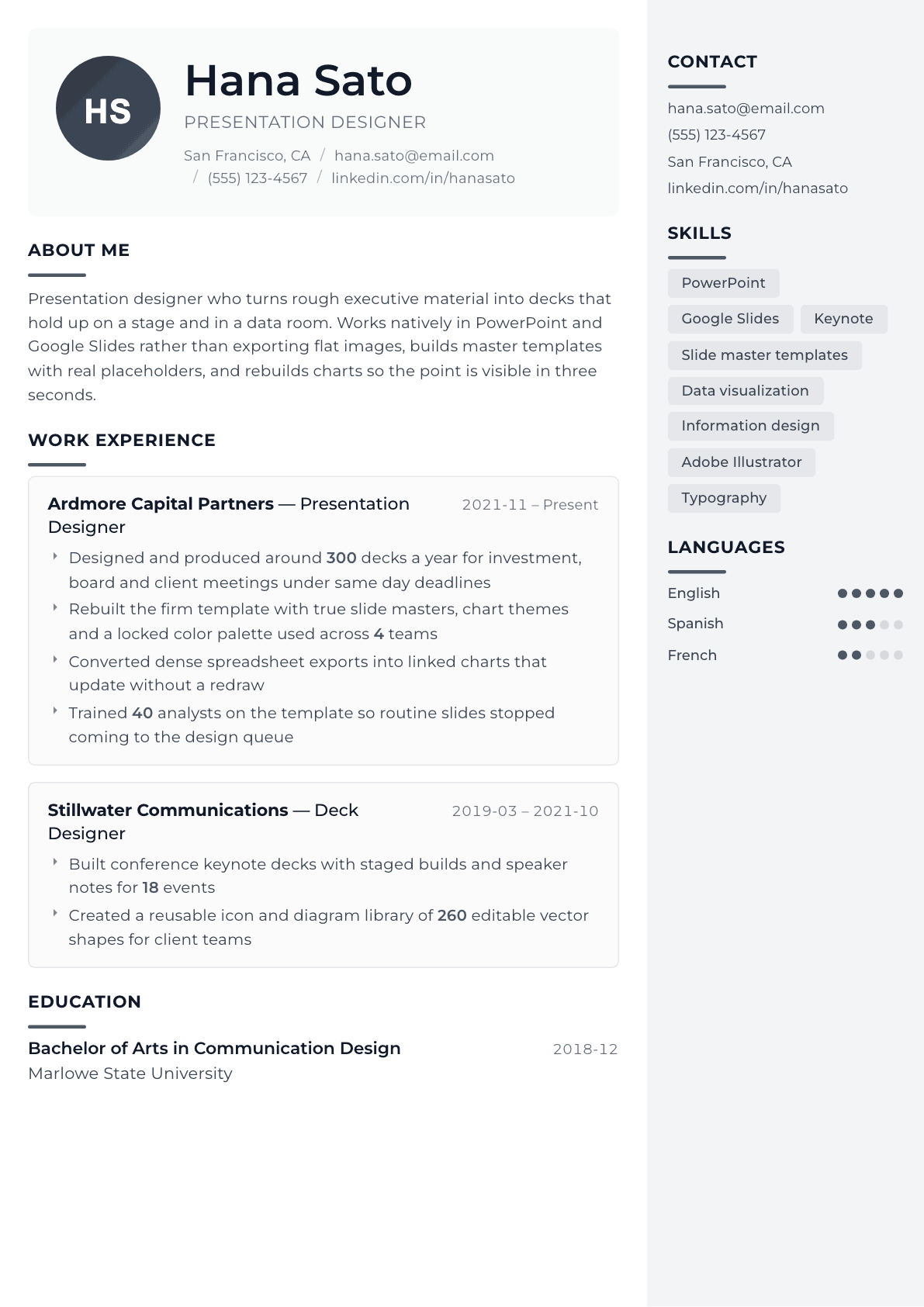
Example Presentation Designer summary
Presentation designer with six years turning raw executive material into decks for boards, investors and conference stages. Works natively in PowerPoint and Google Slides with real slide masters, theme colors and linked charts, so files stay editable after handoff. Rebuilds dense data slides around a single readable takeaway. Seeking a role supporting a leadership team that presents often and expects a high standard.
Skills to list on a Presentation Designer resume
- Microsoft PowerPoint
- Google Slides
- Apple Keynote
- Slide master design
- Template systems
- Data visualization
- Chart design
- Information design
- Typography
- Adobe Illustrator
- Diagram and icon design
- Animation and slide builds
- Executive communication
- Brand compliance
What actually gets this resume read
- Say how many decks you produce and under what deadlines, because volume and speed define this job.
- Prove native tool skill: slide masters, theme colors, linked charts and editable shapes, not pasted images.
- Show data work by describing how you rebuilt a chart so the takeaway reads without a spoken explanation.
- Name the audiences you design for, such as board meetings, investor decks, sales pitches or conference keynotes.
- Mention template systems you built and whether other people were trained to use them without you.
- Keep confidential content out of the portfolio by rebuilding one deck with invented numbers and saying so.
How to write a presentation designer resume
Presentation design is judged on two things almost nobody puts on a resume: whether you work natively in the tool, and whether you can turn a mess of executive material into a story under a same day deadline. A candidate who designs beautiful slides in a design application and exports flat images is useless to a firm whose analysts need to edit a chart at eleven at night. A candidate who builds real slide masters, theme colors and linked charts is the one that gets hired.
The people reviewing this resume are usually a design lead inside a consulting firm, a bank, a communications agency or a corporate brand team. They know exactly how long a hundred slide deck takes, how often a deadline moves, and how much of the job is rebuilding someone else's material rather than inventing from a blank page. Speed and structure are the qualities being screened.
This guide covers how to state volume and deadline conditions, how to prove native tool skill in writing, how to describe data slide work without overclaiming analysis, and how to build a portfolio when most of your best work is confidential.
Format: one page, tool depth stated, deadline reality visible
One page, reverse chronological, and use the resume itself to show restraint. A presentation designer whose resume is dense, cluttered and over decorated has argued against their own case. Clear hierarchy, generous space and tabular figures for dates say more about your instincts than a skills bar ever will.
Include the working conditions in the experience section, because they are part of the skill. Same day turnarounds, overnight cycles, decks that change an hour before a board meeting, and multiple requesters at once. Firms that need this role need it under exactly those conditions and screen for people who have survived them.
- Header: name, title, city, email, portfolio address or a link to a rebuilt sample deck.
- Sections: summary, experience, tools and template systems, skills, education.
- State the audiences you design for: board, investor, sales, internal, conference stage.
Summary: volume, audience, and native tool work
Say how many decks you produce and for whom. A designer producing hundreds of decks a year for investment, board and client meetings is describing a completely different job from someone who polishes a quarterly all hands. Volume plus audience is the fastest way to place yourself accurately.
Then commit to the native tool point directly. Working in PowerPoint and Google Slides with true slide masters, theme colors and linked charts, rather than exporting flat images, is the sentence that separates you from most applicants. Say it plainly, because it is the thing hiring managers most often complain they cannot find.
Prove native skill: masters, themes, linked charts, editable shapes
Name the mechanics. Real slide masters and layouts with working placeholders, theme color sets so brand changes propagate, chart themes so every graph matches without manual restyling, editable vector shapes rather than pasted images, and staged builds with speaker notes for stage presentations.
Describe what happens after you hand a file over. A deck that stays editable for the analyst who inherits it is worth more than a deck that looks better and cannot be touched. If you have trained teams on a template so routine slides stopped reaching the design queue, that is one of the strongest bullets available in this role.
Data slides: rebuild the chart around the takeaway
The core craft of a data slide is deciding what the audience should understand in about three seconds, then removing everything that competes with it. Describe how you work: reading the underlying numbers, choosing the chart form, cutting gridlines and legends where a direct label works better, and writing an action title that states the finding rather than naming the axis.
Be careful with the boundary. You are designing the presentation of an analysis, not producing the analysis. Say that you rebuild spreadsheet exports into linked charts that update without a redraw, and that you flag inconsistencies you notice, without claiming to be the analyst.
- Chart forms, direct labeling, action titles and consistent axis treatment.
- Linked charts and pasted data ranges that update when the source workbook changes.
- Diagram and icon libraries built as editable vector shapes for reuse across teams.
Portfolio: rebuild a deck with invented numbers and say so
Most of the best work in this field is confidential, which stops many candidates from having a portfolio at all. The accepted solution is to rebuild one deck end to end using invented data and a fictional company, state clearly that it is a rebuild with substituted numbers, and show the before and after of two or three slides.
Include a template system as a portfolio piece too: the master layouts, the theme colors, the chart styles and a page of the usage guidance you wrote. Design leads in this field understand template work as the highest value output, and few applicants show it.
Presentation Designer resume summary examples
First presentation design role
Graphic designer moving into presentation work, with 2 years producing conference decks with staged builds and speaker notes for 18 events. Built a reusable library of 260 editable vector icons and diagrams for client teams. Works natively in PowerPoint and Google Slides rather than exporting flat artwork.
Six years in
Presentation designer with 6 years producing around 300 decks a year for investment, board and client meetings under same day deadlines. Rebuilt a firm template with true slide masters, chart themes and a locked palette used across 4 teams, and converts dense spreadsheet exports into linked charts that update without a redraw.
Lead or manager
Lead presentation designer with 11 years supporting executive and investor communication at a professional services firm. Owns the template system, sets the visual standard for data slides, manages a queue across two designers, and trained 40 analysts so routine slides stopped reaching the design team.
Work experience bullets: before and after
Before: Designed presentations for senior leadership.
After: Produced around 300 decks a year for investment, board and client meetings, most on same day turnaround with content still arriving during the build.
Volume and deadline conditions describe the actual working environment this role is hired for.
Before: Created a company PowerPoint template.
After: Rebuilt the firm template with true slide masters, working placeholders, chart themes and a locked color palette, adopted by 4 teams across the practice.
Naming the template mechanics proves native tool skill rather than a designed cover slide.
Before: Improved charts and data slides.
After: Rebuilt dense spreadsheet exports as linked charts with direct labeling and action titles, so each slide stated its finding without a spoken explanation.
The design method and the reader outcome show information design judgment, not decoration.
Before: Trained colleagues on the template.
After: Trained 40 analysts on the template and wrote a short usage guide, which removed routine formatting requests from the design queue and freed capacity for client work.
Training with a measurable effect on the request queue is leverage a design lead immediately values.
Before: Built decks for conferences.
After: Designed keynote decks for 18 events with staged builds, presenter notes and a large format version checked on the venue screen ratio before rehearsal.
Stage specific details show you understand the difference between a read deck and a presented one.
Hard skills
- Microsoft PowerPoint
- Google Slides
- Apple Keynote
- Slide master and layout design
- Template systems and theme colors
- Chart design and linked data
- Data visualization
- Information design
- Typography for projection
- Adobe Illustrator
- Diagram and icon libraries
- Slide builds and transitions
- Brand compliance
- Document accessibility basics
Soft skills
- Working under same day deadlines
- Interpreting rough executive input
- Discretion with confidential material
- Calm under late changes
- Explaining design choices to non designers
Certifications worth listing
- Microsoft Office Specialist: PowerPoint Associate (Microsoft)
- Microsoft Office Specialist: Excel Associate (Microsoft)
- Adobe Certified Professional: Graphic Design & Illustration (Illustrator) (Adobe)
Mistakes that cost presentation designer candidates the interview
- Designing in a graphics application and exporting flat slides that nobody can edit afterward.
- Leaving out deck volume and deadline conditions, which are the real qualifications for this role.
- Publishing confidential client decks in a portfolio instead of rebuilding one with invented data.
- Claiming analysis ownership for charts you presented rather than produced.
- Never mentioning template systems or training, which is where the highest value work sits.
- Sending a cluttered resume, which contradicts the visual restraint the job is about.
Presentation Designer resume questions
Do I need a portfolio if my best decks are confidential?
Yes, and the standard solution is a rebuild. Recreate one deck with a fictional company and invented numbers, state clearly that the data is substituted, and show two or three before and after slides alongside a template system you designed.
Which tools should a presentation designer list first?
PowerPoint and Google Slides, because that is where the work lives and gets edited. Add Keynote if you use it, then Illustrator for vector artwork and a spreadsheet application for handling chart data cleanly.
How do I describe data slide work without sounding like an analyst?
Say you design the presentation of the analysis. Describe choosing chart forms, direct labeling, action titles and removing visual noise, and mention that you flag inconsistencies you notice. Keep ownership of the numbers with the person who produced them.
Is presentation design a career or a stepping stone?
It is a career in consulting, finance, communications agencies and large corporate brand teams, where senior specialists own template systems and executive communication standards. Framing the resume around systems and training rather than slide count supports that path.
How long should a presentation designer resume be?
One page in almost every case. The work is judged on the portfolio and a practical exercise, so use the page for volume, audiences, template systems and tool depth rather than a long list of every deck you have touched.