Junior Graphic Designer Resume Examples: free ATS score
Write a Junior Graphic Designer Resume With a Thin Work History
By Mustafa Tarabya, founder of CVBooster · Published · Updated
Junior graphic designer resume examples that turn coursework, internships and freelance jobs into hireable bullets, with keywords and a guide.
Sample resumes for a junior graphic designer
The same junior graphic designer content laid out in three CVBooster templates, so you can see what the finished document looks like before you write a word.
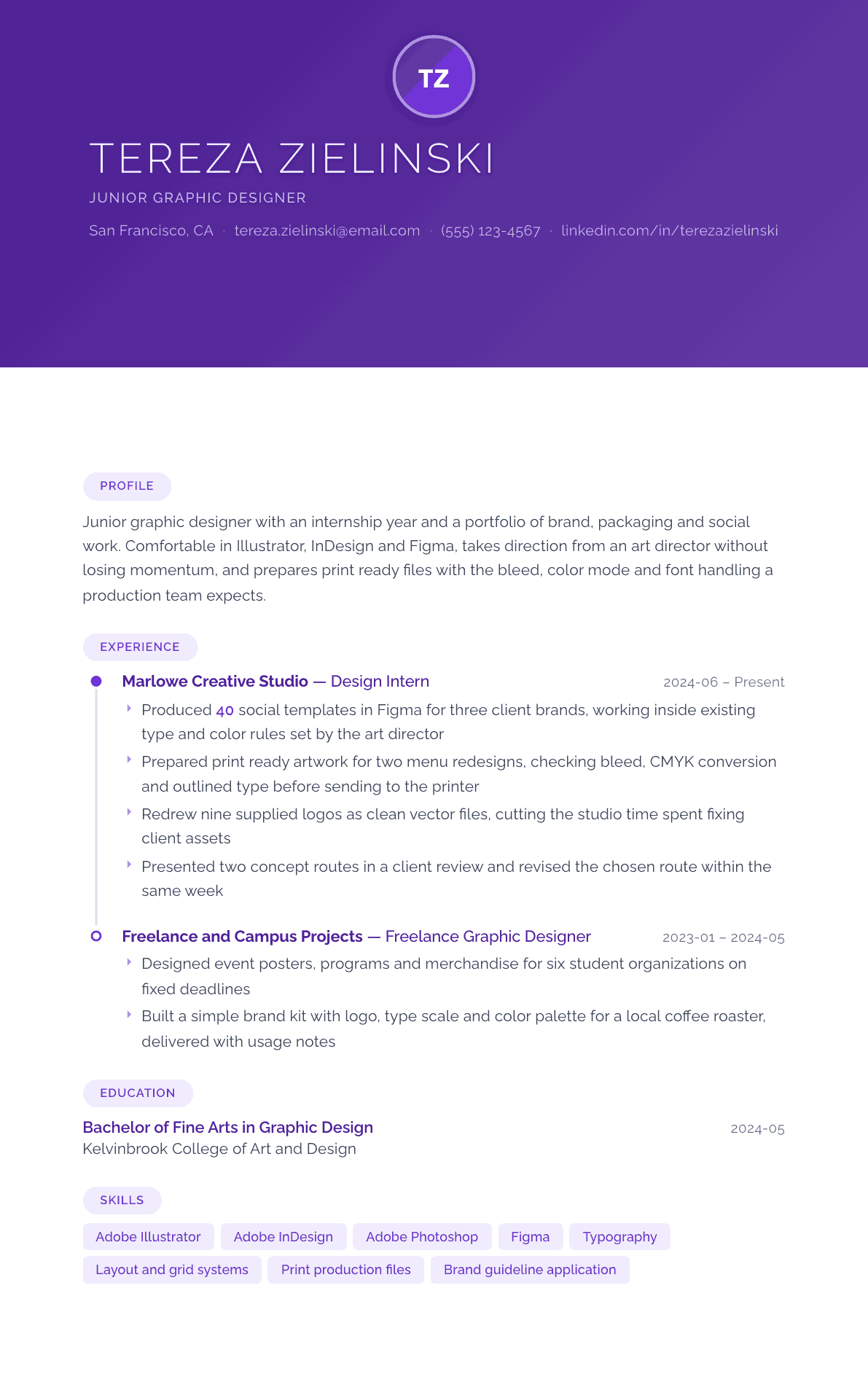
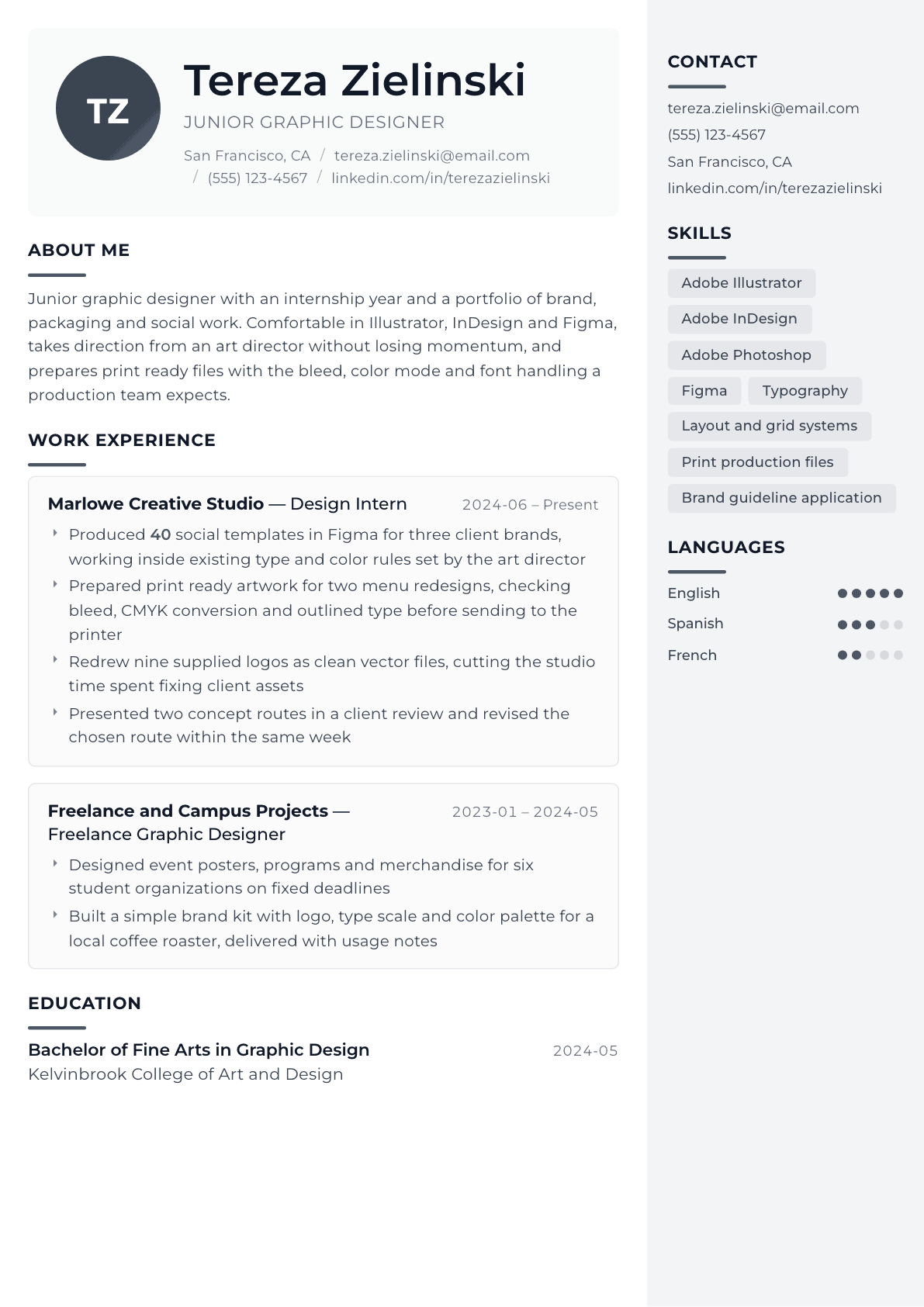
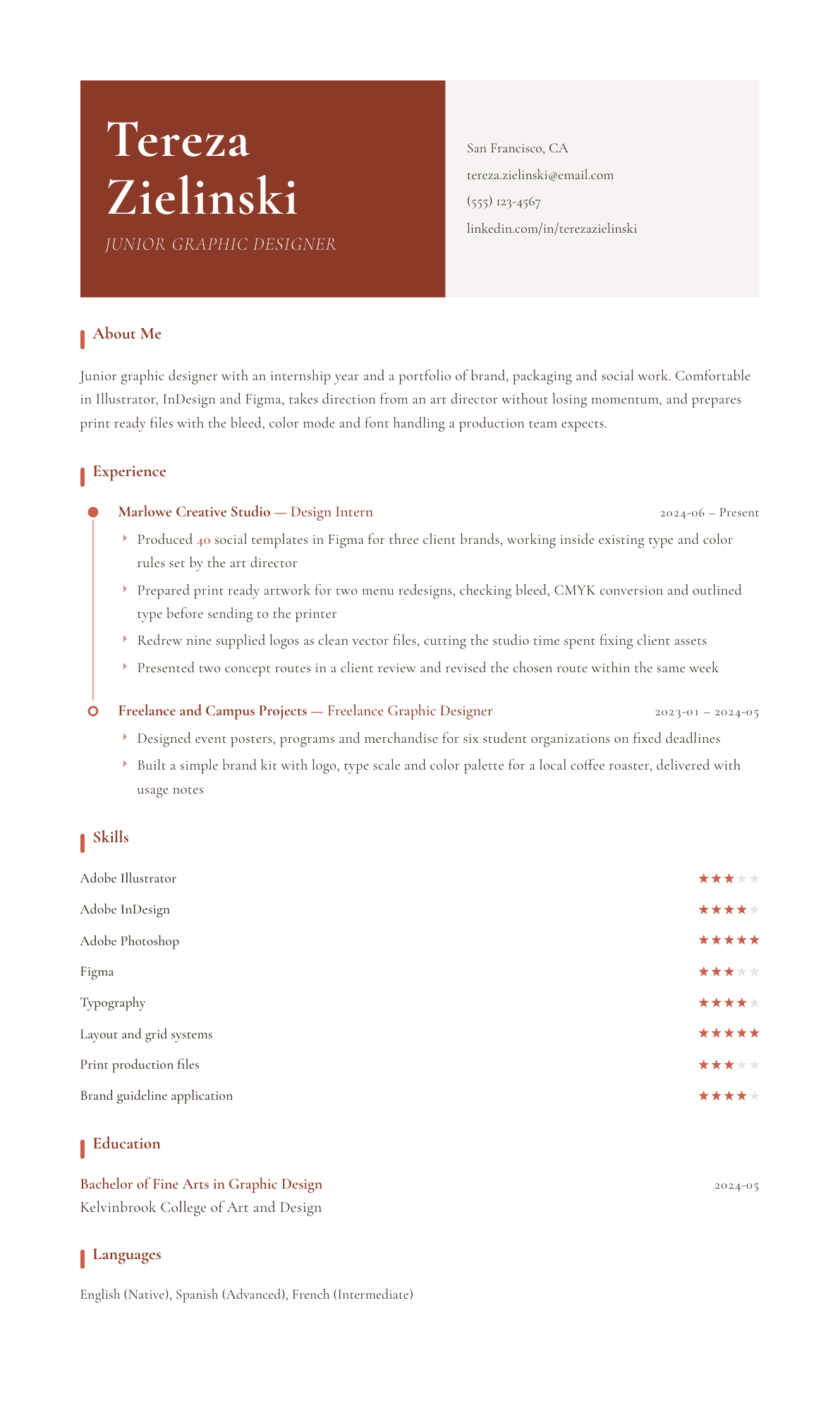
Example Junior Graphic Designer summary
Junior graphic designer with a design degree, an agency internship and freelance work for local brands. Builds social systems in Figma, sets type and layout in InDesign, and delivers print ready files with bleed and color mode handled correctly. Redrew a set of supplied client logos as clean vectors and cut the studio cleanup time. Looking for a studio or in house team where a junior gets real briefs and direct art direction.
Skills to list on a Junior Graphic Designer resume
- Adobe Illustrator
- Adobe InDesign
- Adobe Photoshop
- Figma
- Typography
- Layout and grid systems
- Color theory
- Logo and mark drawing
- Social media asset design
- Print production and prepress
- Brand guideline application
- Packaging basics
- Concept development
- File organization and handoff
What actually gets this resume read
- Put the portfolio link in the header, because no junior design resume is read without the work behind it.
- Treat internships, freelance jobs and real class briefs as experience entries with a client, a deliverable and a deadline.
- Show production literacy: bleed, CMYK, outlined type and file handoff, since studios lose money on bad files.
- Name the software honestly and separate what you use daily from what you have touched once or twice.
- Describe how you take feedback, because juniors are hired on revision speed as much as on taste.
- Keep it to one page and let the layout itself demonstrate your typography and spacing judgment.
How to write a junior graphic designer resume
A junior graphic designer resume is never read on its own. It is read next to a portfolio link, usually for about twenty seconds, by a design lead who has forty other applications open. If the link is missing, hard to find, or leads to a site that asks for a password, the application is over before your experience section matters at all.
The second thing that lead is testing is whether you can be handed a brief without supervision on the basics. Juniors are not hired for original vision. They are hired for revision speed, for staying inside an existing type and color system, and for delivering files a production team does not have to rebuild. Every part of the resume should serve one of those three arguments.
This guide covers how to turn an internship, freelance jobs and real class briefs into experience entries, what production literacy looks like on paper, how to describe taking art direction, and the questions new designers ask when their work history is genuinely thin.
Format: one page, and let the layout do half the talking
One page, always, at this stage. The resume itself is a design sample, so the spacing, the type scale and the alignment are being read whether you intend them to be. Set a real grid, use two weights of one family rather than four families, and keep the margins consistent. A designer who cannot set their own resume type will not be trusted with a client system.
Resist heavy decoration. Skill rating bars, icon rows and dense color blocks are the marks of a template rather than a designer, and they also break the parser at agencies that use one. Restraint reads as confidence.
- Header: name, city, phone, email and the portfolio link written in full.
- Sections in this order: summary, experience, education, software, skills.
- Add a selected projects block if your internship and freelance work do not fill the page honestly.
Summary: what you can be handed on day one
Three lines. Say what you have actually produced, the software you work in daily, and the kind of team you want to join. A junior summary that promises passion and creativity says nothing a portfolio does not already say better.
Name the work types instead. Social templates, packaging, menus, event collateral, brand kits and print production files are concrete deliverables, and a studio lead reads them as a list of tasks he could hand over immediately.
Experience: treat internships, freelance and real briefs as jobs
Anything with a client, a deliverable and a deadline belongs in the experience section, including freelance work for a local business and a class project that a real organization actually used. Give each entry a role title, the organization, the dates and two or three bullets, exactly as you would for a staff job.
Write the bullets around volume, constraint and outcome. How many assets you produced, what system you worked inside, what changed because you did it. Producing forty social templates inside an art director's existing type and color rules is a stronger sentence than designing engaging social media content, because the first one proves you can follow a system.
Keep purely speculative rebrands out of the experience section. They belong in the portfolio, where the reader knows to judge them as exercises rather than as work someone paid for and approved.
Production literacy: the argument juniors usually forget
Studios lose money on bad files, and a junior who understands prepress is immediately more useful than one who does not. Say plainly that you set bleed and slug, convert to the right color mode, outline or package fonts, check image resolution, and hand off with linked assets organized. A single bullet about preparing print ready artwork that a printer accepted without a query does more for you than three adjectives.
The same logic applies to digital work. Named layers, components rather than copied frames, consistent naming, and export settings a developer can use are all evidence that your files can be picked up by someone else. That is what a junior is really being hired for.
- Print: bleed, color conversion, outlined type, resolution checks, packaged files.
- Digital: component libraries, layer naming, export presets, handoff notes.
- Brand: working inside supplied guidelines rather than around them.
- Revision: version naming and a clean record of what changed between rounds.
Software and skills, listed honestly
Split the software list into daily and familiar. A junior who claims expert level across an entire creative suite is not believed, while one who says daily in three applications and learning a fourth is credible and easy to plan around. Name the interface design tool you use for screens as well as the layout and vector applications.
Keep the skills line to things a lead would actually assign: typography, layout and grids, color, mark drawing, packaging basics, social asset systems and file organization. Put teamwork and creativity into the bullets where they are demonstrated, not into a list where they are only asserted.
Junior Graphic Designer resume summary examples
Still studying
Design student in a final year with freelance posters, programs and merchandise delivered for six student organizations on fixed deadlines. Works daily in a vector application and a layout application, and prepares print ready files with bleed and color mode handled. Seeking a summer studio internship.
First year out
Junior graphic designer with a design degree and an agency internship year covering brand, packaging and social work. Produced 40 social templates inside an art director's type and color rules, prepared print ready menu artwork, and redrew nine supplied client logos as clean vector files.
Two years in, ready for the next step
Graphic designer two years into studio work, handling social systems, print collateral and packaging revisions for three retained accounts. Takes a brief from an art director, presents two routes, and turns revisions inside a day. Comfortable owning production files from concept through printer handoff.
Work experience bullets: before and after
Before: Created social media graphics for clients.
After: Produced 40 social templates for three client brands inside the type, color and spacing rules set by the art director, delivered as reusable components.
Volume, brand count and working inside an existing system prove you can be handed a live account.
Before: Prepared files for printing.
After: Prepared print ready artwork for two menu redesigns, setting bleed, converting to the correct color mode, outlining type and packaging linked assets before the printer handoff.
Naming each production step shows literacy that saves a studio real money on reprints.
Before: Fixed client logo files.
After: Redrew nine supplied client logos as clean vector files with consistent stroke weights and correct anchor placement, cutting the time the studio spent repairing incoming assets.
The craft detail and the time saved turn cleanup work into evidence of technical care.
Before: Presented ideas to clients.
After: Presented two concept routes in a client review with the reasoning behind each, then revised the chosen route and delivered final files within the same week.
Turnaround and the ability to explain a choice are exactly what a junior is judged on.
Before: Made a brand for a small business.
After: Built a brand kit for a local coffee roaster with a primary mark, a type scale, a three color palette and one page of usage notes the owner could apply without a designer.
Listing what the deliverable contained shows systems thinking rather than a single logo drawing.
Hard skills
- Vector illustration and mark drawing
- Page layout and grid systems
- Image editing and retouching basics
- Interface and social asset design in a component based tool
- Typography and type pairing
- Color systems and palette application
- Print production and prepress
- Packaging layout basics
- Brand guideline application
- File naming, versioning and handoff
- Concept development and route presentation
Soft skills
- Taking art direction without stalling
- Fast revision turnaround
- Asking clarifying questions early
- Deadline discipline
- Receiving critique in a group review
Certifications worth listing
- Adobe Certified Professional in Visual Design (Adobe)
- Adobe Certified Professional in Graphic Design and Illustration (Adobe)
Mistakes that cost junior graphic designer candidates the interview
- Leaving the portfolio link off the header or hiding it behind a password, which ends the application immediately.
- Filling a thin resume with adjectives instead of adding the freelance and class briefs that would have filled it honestly.
- Adding skill rating bars, which tell a lead nothing and mark the document as a downloaded template.
- Claiming expert level across an entire software suite, a claim no lead believes from a junior.
- Ignoring production entirely, when file competence is the main practical reason a studio hires at this level.
- Using four typefaces on a resume that is itself being judged as a typography sample.
- Listing speculative rebrands as work experience rather than keeping them in the portfolio where they belong.
Junior Graphic Designer resume questions
Can class projects go on a junior designer resume?
Yes, when the brief was real or the outcome was used by an actual organization. Give it a client, a deliverable and a deadline exactly as you would a paid job. Purely hypothetical exercises are better placed in the portfolio, where a reviewer expects them.
How long should a junior graphic designer resume be?
One page without exception at this stage. A second page signals that you have padded rather than edited, and editing is a design skill the reader is already assessing while looking at your margins and type hierarchy.
Should the resume itself be heavily designed?
It should be well set, not decorated. Show typographic judgment through a clear hierarchy, consistent alignment and generous spacing. Heavy graphics and multi column layouts risk both a parsing failure and the impression that you cannot solve a problem quietly.
What if I have no internship at all?
Build the experience section from freelance jobs, volunteer design for local organizations, campus work and real briefs from class. Three entries with a client, a deliverable and a deadline each will read as a working history, which is what the reader is looking for.
Do I need a certification to get a first design job?
No. Design hiring runs on the portfolio and on how you talk about the work. A software certification can add a small credibility signal on a thin resume, but no lead will choose it over one strong piece with a clear explanation of the brief behind it.