Tile Setter Resume Examples: free ATS score and gap list
Create a Tile Setter Resume That Proves Craft and Speed
By Mustafa Tarabya, founder of CVBooster · Published · Updated
A tile setter resume sample with waterproofing, large-format and substrate keywords, plus a guide to writing bullets a tile contractor trusts.
Sample resumes for a tile setter
The same tile setter content laid out in three CVBooster templates, so you can see what the finished document looks like before you write a word.
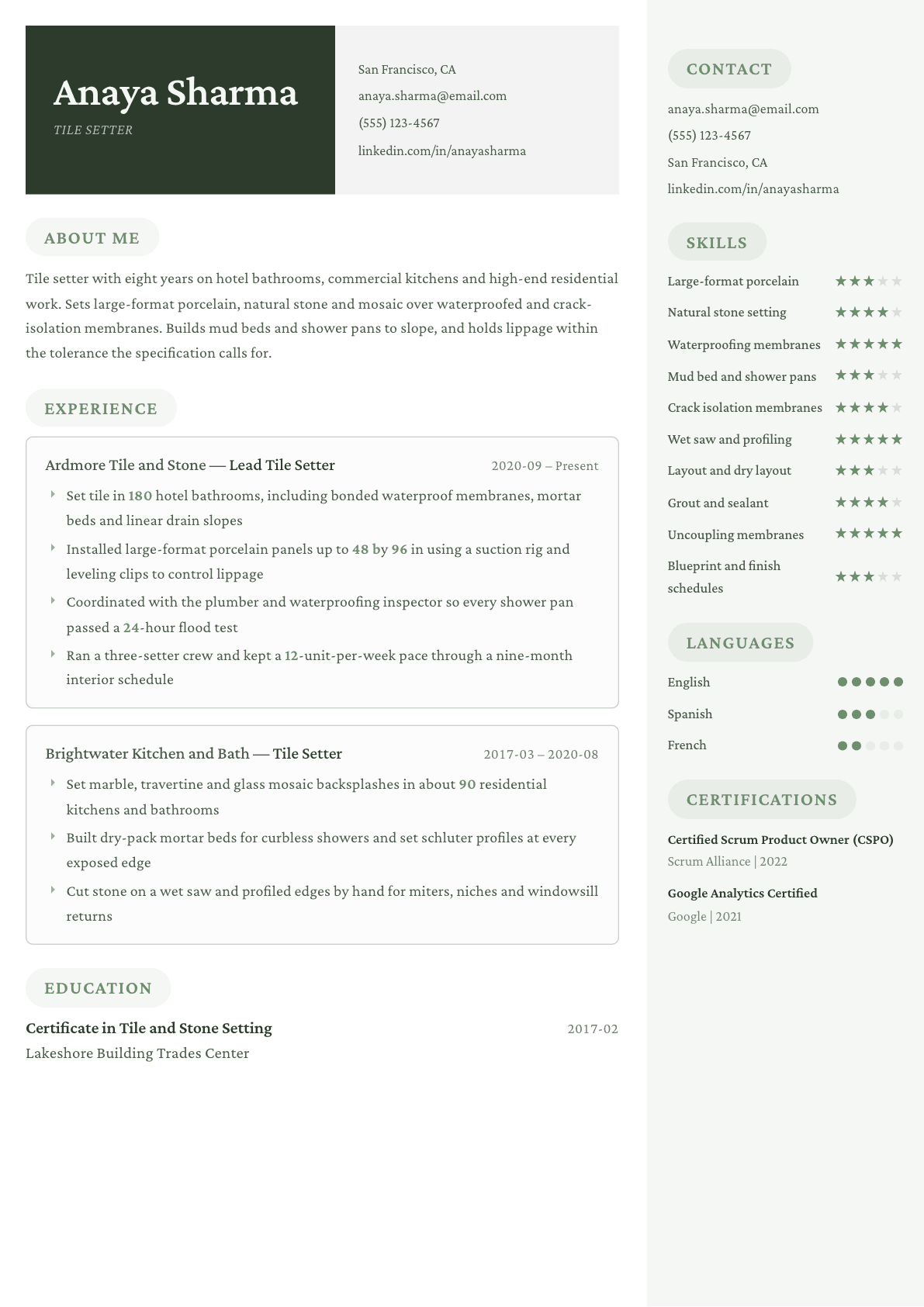
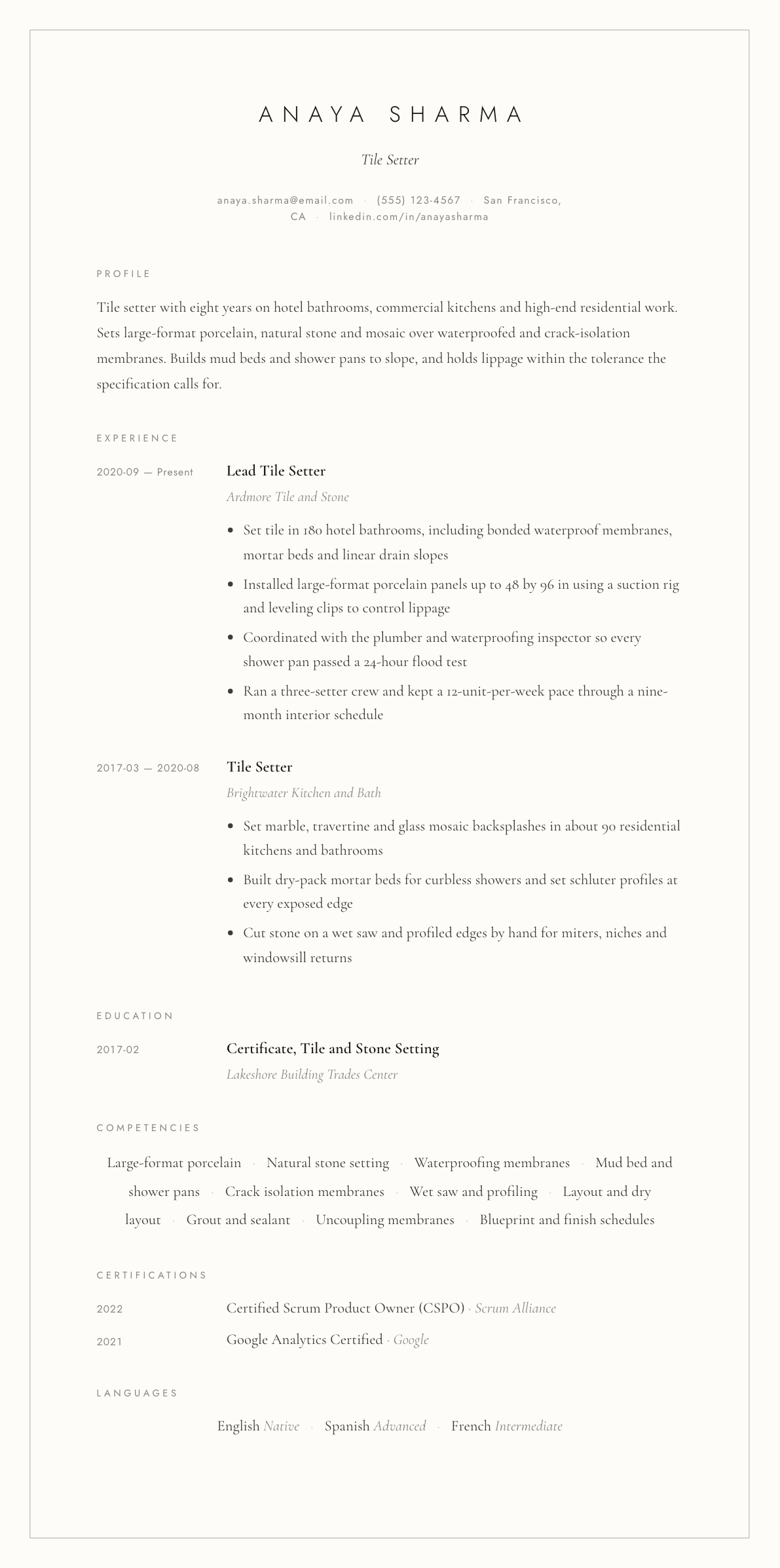
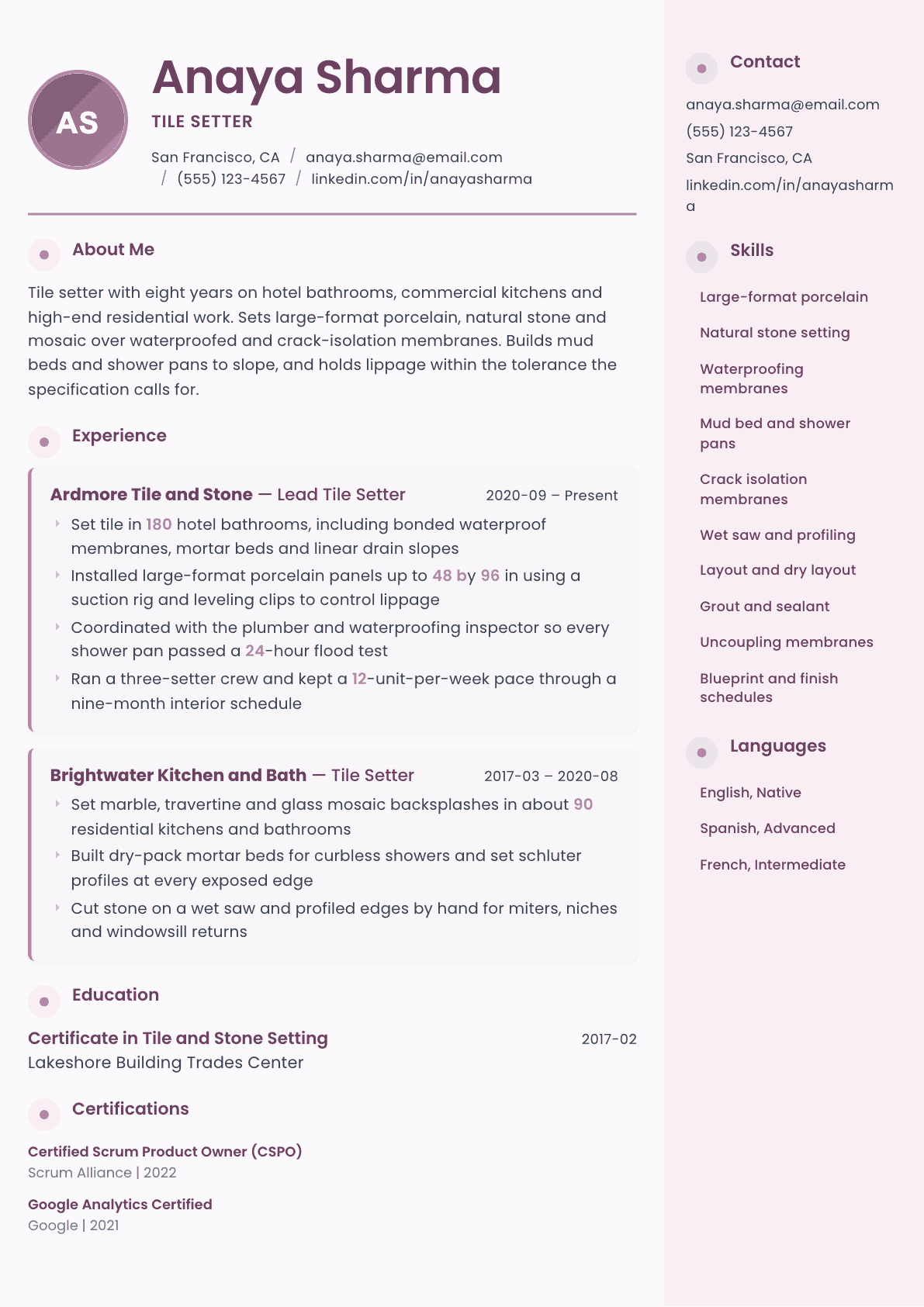
Example Tile Setter summary
Tile setter with eight years on hotel, commercial kitchen and high-end residential work, setting large-format porcelain, marble and mosaic over bonded waterproof membranes. Builds dry-pack mortar beds and sloped shower pans that pass flood testing, and keeps lippage inside specification with leveling systems. Runs a small crew and holds a steady unit pace on long interior schedules.
Skills to list on a Tile Setter resume
- Tile layout and dry layout
- Large-format tile installation
- Natural stone setting
- Waterproof membrane application
- Crack isolation membranes
- Dry-pack mortar beds
- Shower pan and slope
- Thinset and mortar selection
- Grouting and caulking
- Wet saw cutting and miters
- Schluter profile installation
- Uncoupling membranes
- Substrate flatness correction
- Backsplash and mosaic work
- Finish schedule reading
What actually gets this resume read
- Name the substrates and membranes you work over, because waterproofing failures drive most callbacks in tile work.
- Say whether you set large-format tile and panels, since the tools, crew size and lippage tolerances are different.
- List the materials you have set: porcelain, ceramic, marble, travertine, glass mosaic and terrazzo panels.
- Show unit counts on hotel or multifamily jobs so a superintendent can judge your pace against the schedule.
- Mention flood tests, mockups and inspection walks, since commercial specifications require all three in wet areas.
- Include mortar bed and shower pan work, because dry-pack skill separates a setter from an installer of prefabricated pans.
How to write a tile setter resume
A tile setter is hired on two things that pull against each other: how good the work looks and how fast it goes down. The estimator wants units per week. The superintendent wants a shower that passes a flood test and a lobby floor with no lippage a client can catch with a shoe. Your resume has to answer both without making either sound like an afterthought.
What convinces a tile contractor is specificity about systems. Which membrane, over which substrate, under which tile, set with which mortar, and who inspected the assembly before it was covered. Setters who can talk that way are rare in a resume stack, and the ones who can get called first.
This guide works through each section, gives three summaries for a helper, a working setter and a lead, rewrites the bullets most setters write badly, and answers the questions that come up when you try to put fifteen years of tile on one page.
Format: one page, and let the projects carry it
Reverse-chronological, single page, no columns. A tile setter resume lives or dies on its project list, so give each employer two or three named jobs by building type rather than a paragraph of duties. Hotel, hospital, commercial kitchen, high-end residential and multifamily are the categories a contractor sorts by.
Photographs do not belong in the file. Put a line under your contact details pointing to a portfolio you can show on a phone, and keep the resume itself parseable by whatever software the contractor uses.
- Header: name, trade, city and state, phone, email, and whether you own tools and a wet saw.
- Order: summary, work history with named projects, systems and materials, tools, certifications.
- Helpers list the training program and the setters they worked under, since references carry weight early.
Summary: materials, formats and wet areas
Say what you set and where. Large-format porcelain, natural stone, glass mosaic and gauged panels each demand different handling, and a contractor bidding a stone lobby needs to know before he calls you. Add whether you build wet areas from scratch, because dry-pack mortar beds and sloped pans are the skill that most separates setters.
Then the setting. Hotel bathrooms on a repeating unit schedule, hospital work under infection control protocols, and custom residential with a designer walking the job each week are three different working lives, and hiring managers read for the one that matches.
Experience: units, formats and the assembly underneath
Each entry needs the contractor, the building, and bullets with numbers. Unit counts on hotel and multifamily work, square footage on lobbies and commercial floors, and the pace you held over the run of the job. Pace matters because tile is usually near the end of an interior schedule and every delay above you lands on the setter.
Then describe the assembly. Bonded waterproof membrane over cement board, crack isolation over a slab with control joints honored through the tile, uncoupling membrane under large format on a wood subfloor, dry-pack bed with a linear drain. A setter who writes this way is telling a superintendent that his showers do not leak, which is the expensive question.
Avoid bullets like installed tile in bathrooms and kitchens. That is the job title again. The reader already knows you installed tile.
- Unit or area counts with the schedule you held them to.
- Tile format and material, including the largest panel you have set and how you handled it.
- The waterproofing and crack isolation systems used, and any flood test or mockup that followed.
- Layout decisions you made: grid origin, cuts at doorways, pattern centering, niche and curb detail.
Tools, layout and quality control
List the equipment you run: wet saws and rail saws, ring saws, angle grinders with profile wheels, mixing stations, laser levels, leveling clip systems, vacuum suction rigs for panels, and miter jigs for stone edges. Panel setting in particular is a two-person rig job, and saying you have done it tells a contractor you can be sent to a job most crews decline.
Add the checks you make: flatness of the substrate before you start, mortar coverage checked by pulling a tile, lippage measured against the specification, movement joints placed where the plan calls for them. Quality control described concretely reads as craft. Described in adjectives it reads as filler.
Keywords a tile contractor searches for
The vocabulary is narrow and worth mirroring exactly: thinset and medium bed mortar, large-format tile, gauged porcelain panels, uncoupling membrane, bonded waterproof membrane, crack isolation, dry-pack mortar bed, curbless shower, linear drain, movement joints, lippage, epoxy grout, natural stone, honing and polishing. Use each once in a place where it is true.
Tile Setter resume summary examples
Tile helper
Tile helper with two years mixing mortar, cutting on a wet saw and setting backsplash and floor field tile under a lead setter. Trained on layout lines, backbuttering and grout timing, and comfortable with substrate prep and cement board installation on residential remodels.
Working setter, six years
Tile setter with six years on hotel and multifamily interiors, setting porcelain, marble and mosaic over bonded waterproof membranes. Builds dry-pack beds and sloped pans, sets large-format tile with leveling clips, and held a twelve-unit weekly pace through a nine-month hotel schedule.
Lead setter and foreman
Lead tile setter with fifteen years and a Certified Tile Installer credential, running crews of five on hospitals, commercial kitchens and custom residential. Owns layout, mockups and flood testing, sets gauged porcelain panels with vacuum rigs, and resolves substrate problems before they reach the schedule.
Work experience bullets: before and after
Before: Installed tile in hotel bathrooms.
After: Set floor and wall tile in 180 hotel bathrooms, building bonded waterproof membranes, mortar beds and linear drain slopes to the specified assembly.
The unit count and the assembly detail tell a superintendent both your pace and whether your wet areas will pass inspection.
Before: Worked with large tiles.
After: Installed gauged porcelain panels up to 48 by 96 in using a suction rig and a two-setter lift procedure, holding lippage inside the specified tolerance.
Panel work is a distinct skill with real risk, so the size, the rig and the tolerance make the claim credible.
Before: Made sure showers did not leak.
After: Coordinated pan slope and drain height with the plumber, then passed a 24-hour flood test on every shower before tile was set over the membrane.
Describing the coordination and the test turns a vague promise into a repeatable process a contractor can rely on.
Before: Did stone work in kitchens and bathrooms.
After: Set marble and travertine with hand-profiled miters at countertops, niches and windowsill returns, dry laying each run for vein matching before setting.
Vein matching and hand miters are the details a custom builder pays for, and naming them shows the level you work at.
Before: Kept the job on schedule.
After: Sequenced three setters and a helper across two floors so waterproofing cured overnight and tile went down each morning without idle crew time.
Explaining how you protected the schedule is more convincing than claiming the schedule was met.
Hard skills
- Tile layout and dry layout
- Large-format and gauged panel installation
- Natural stone setting and miters
- Bonded waterproof membrane application
- Crack isolation and uncoupling membranes
- Dry-pack mortar beds and sloped pans
- Curbless shower and linear drain detail
- Thinset and medium bed mortar selection
- Epoxy and cement grouting
- Wet saw, rail saw and ring saw cutting
- Metal profile and trim installation
- Substrate flatness correction
- Movement joint placement
- Flood testing and mockups
Soft skills
- Patience with layout decisions
- Coordination with plumbers and waterproofers
- Working to a designer brief
- Crew sequencing
- Steady pace over long schedules
Certifications worth listing
- Certified Tile Installer (Ceramic Tile Education Foundation)
- Advanced Certifications for Tile Installers (Ceramic Tile Education Foundation)
- OSHA 10-Hour Construction (OSHA Outreach Training Program)
Mistakes that cost tile setter candidates the interview
- Describing tile work in adjectives such as precise and high quality instead of naming formats, membranes and tolerances.
- Leaving out wet area construction, when shower pans and waterproofing are the highest-risk part of the scope.
- Failing to say whether you set large-format tile and panels, which changes the crew size a contractor has to assign.
- Listing residential remodels with no size or duration, so a commercial contractor cannot judge production at all.
- Skipping layout work entirely, even though where the grid starts is the decision a client notices for years.
- Putting photographs inside the resume file, which breaks parsing and buries the project details a reader needs.
Tile Setter resume questions
Is certification worth it for a tile setter?
A recognized installer credential is one of the few verifiable signals in this trade, and commercial contractors bidding specified work increasingly ask for it. It will not replace a strong project list, but on two otherwise equal resumes it is usually the tiebreaker.
How do I show quality of work on a resume without photos?
Describe the details a client sees: vein matching, miters instead of bullnose, pattern centering, niche construction and cuts at doorways. Then add the checks you run for coverage and lippage. Keep the photographs for a portfolio link or your phone at the interview.
What should a tile helper with two years put on a resume?
Lead with substrate prep, cutting, mixing and the field tile you set independently, then name the lead setters and contractors you worked under. Early in the trade your references and your willingness to handle prep are the strongest things you have.
Should I mention flood tests and inspections?
Yes, because they prove your wet areas were verified rather than assumed. Mentioning the test, the inspector or the envelope consultant, and the fact that you passed tells a superintendent his biggest tile risk was handled on your last job.
How do I move from residential remodeling into commercial tile work?
Highlight anything with a schedule and an inspection attached: multifamily units, bathrooms built to a repeating detail, cement board and membrane assemblies, and any work under a general contractor. Then add a safety card so site access is not a reason to skip you.
Related resume examples
- Masonry Worker Resume example
- Carpenter Resume example
- Flooring Installer Resume example
- Bricklayer Resume example
- Plumber Apprentice Resume example
- Glazier Resume example