Appliance Repair Technician Resume Examples: free score
Fix Your Career Path with an Appliance Repair Technician Resume
By Mustafa Tarabya, founder of CVBooster · Published · Updated
Create an appliance repair technician resume highlighting your diagnostic skills, customer service, and manufacturer certifications.
Sample resumes for a appliance repair technician
The same appliance repair technician content laid out in three CVBooster templates, so you can see what the finished document looks like before you write a word.
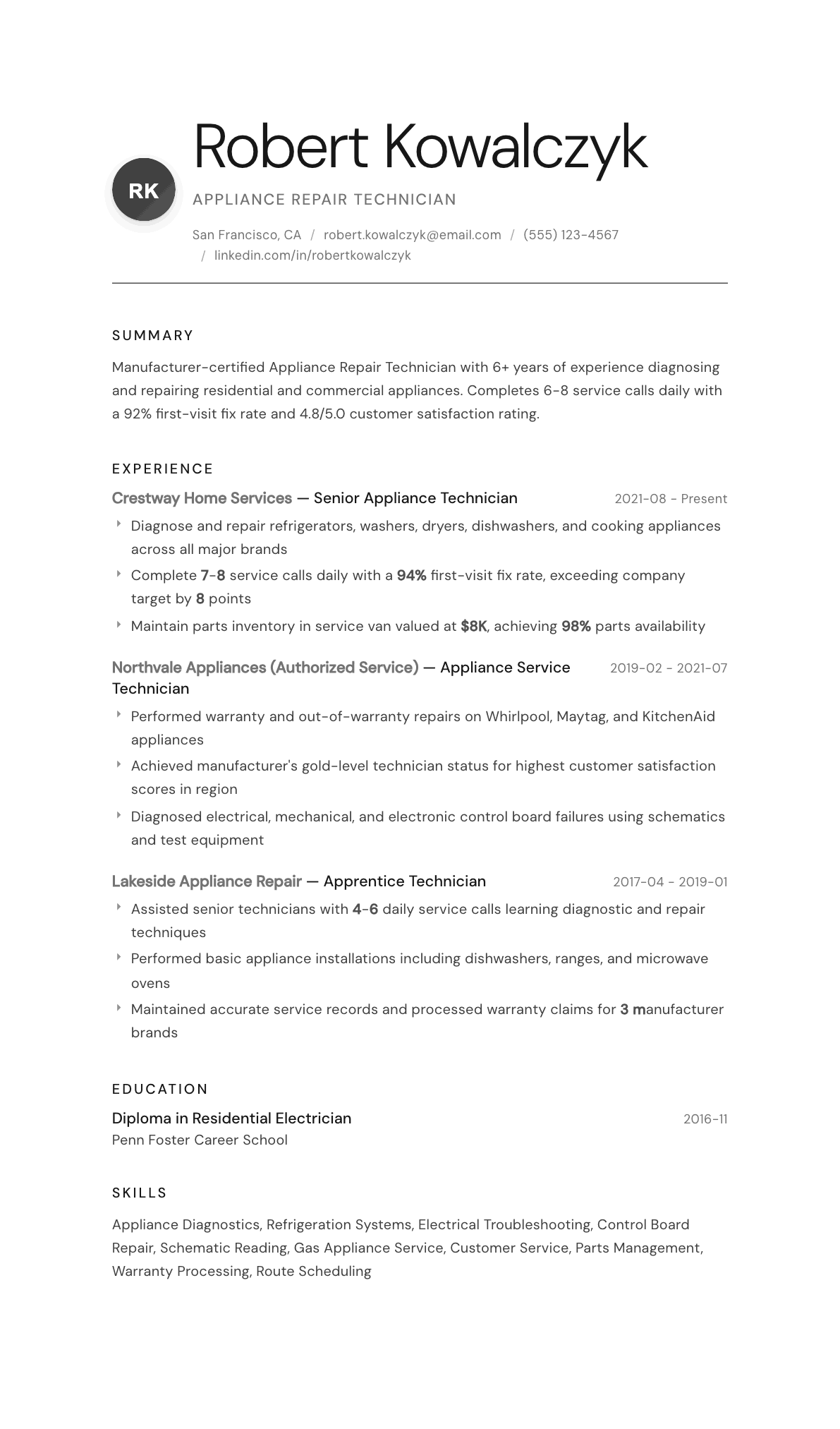
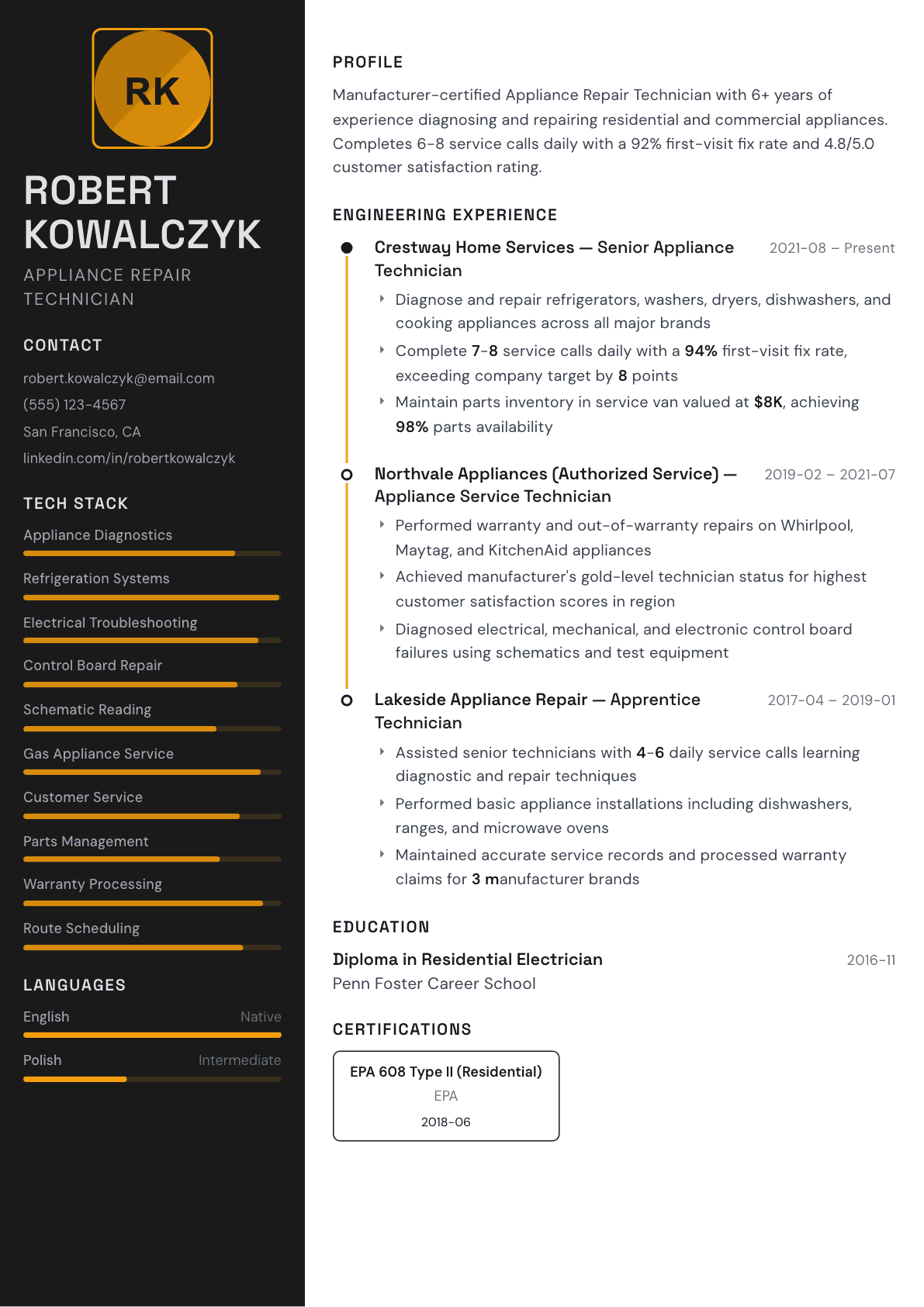
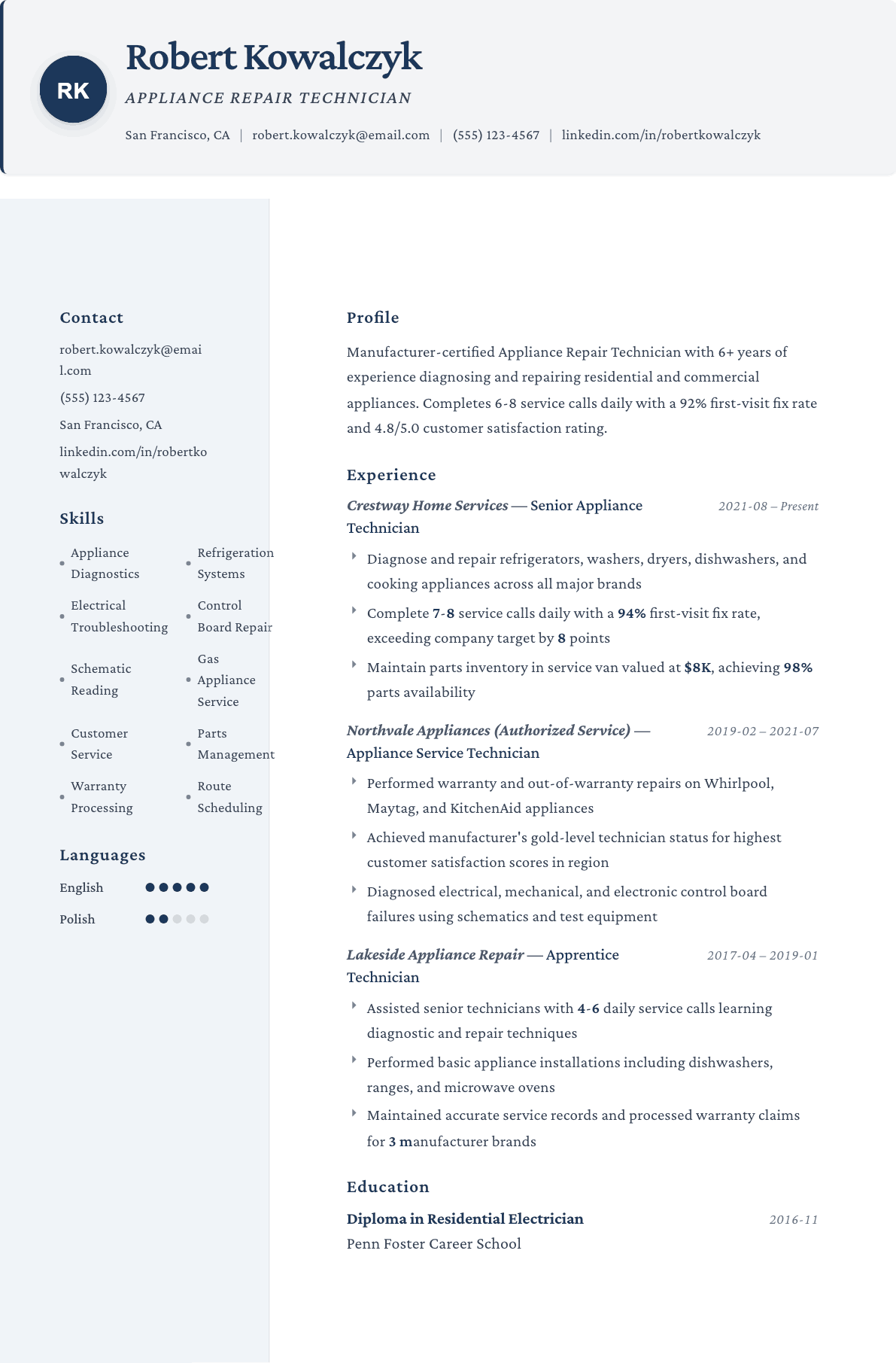
Example Appliance Repair Technician summary
Manufacturer-certified Appliance Repair Technician with 6 years of experience and a 94% first-visit fix rate. Expert in diagnosing and repairing all major appliance brands with a 4.8/5.0 customer satisfaction rating. Seeking a senior technician or service manager role.
Skills to list on a Appliance Repair Technician resume
- Appliance Diagnostics
- Refrigeration Systems
- Electrical Troubleshooting
- Gas Appliance Repair
- Control Board Repair
- Schematic / Wiring Diagrams
- Customer Service
- Parts Inventory Management
- Warranty Claims Processing
- Installation
- EPA 608 Compliance
- Service Van Management
- Route Optimization
- Safety Procedures
What actually gets this resume read
- Highlight your first-visit fix rate and customer satisfaction scores.
- List manufacturer certifications: Whirlpool, GE, Samsung, LG, Sub-Zero, Bosch.
- Quantify daily service call volume and the brands/appliance types you work on.
- Include EPA 608 certification for refrigerant-handling appliances.
- Mention gas appliance experience if you have it. This is a differentiator.
How to write a appliance repair technician resume
Appliance repair is one of the few trades where the customer watches you work. A service manager hiring a technician is therefore buying two things at once: the diagnostic ability to find the fault without swapping three boards, and the presence to stand in someone kitchen, explain what failed and quote the repair without the homeowner calling the office afterward.
The metric that governs the whole business is whether the job is finished on the first visit. Every return trip costs a truck roll, a lost slot on the schedule and a customer who now doubts the company. So the resume that gets read is the one that shows the brands you know, the parts you carry, the systems you can diagnose and the habits that keep you from coming back a second time.
This guide covers the layout service companies expect, how to present brand certifications and refrigerant credentials, three career-stage summaries, and the rewrites that turn generic repair language into evidence of a technician who closes calls.
Format: certifications and brands where a dispatcher can see them
One page. Reverse-chronological, single column, plain font. Put a certifications and brand authorizations block directly under the summary, because factory authorization is what lets a company bill warranty work, and a technician who is already authorized on the brands the company serves is worth money on day one.
The Environmental Protection Agency Section 608 certification for refrigerant handling is close to mandatory if you touch sealed systems. State the type you hold. If you work gas appliances, state whatever gas qualification your state or municipality requires, since a company that installs and services gas dryers and ranges cannot use you without it.
- Header: name, city and service area, phone, email, valid driver license and clean driving record.
- Section order: summary, certifications and brand authorizations, appliance and system experience, work history, technical skills, education and training.
- New technicians lead with the trade program or manufacturer training, then any electrical, HVAC or general maintenance work that shows diagnostic ability.
Summary: the appliances, the brands, the call volume
Name the appliance categories you can actually work: refrigeration including sealed system repair, laundry, cooking including gas and induction, dishwashers, built-in and high-end units, and small commercial equipment if you have it. Built-in refrigeration and high-end brands are a separate skill level and worth calling out because those calls bill higher and need trust.
Then the volume and the setting. Whether you run residential in-home calls, warranty work for a manufacturer, service for a retailer, or a mix, and how many calls a day you complete. A service manager is building a route, and your daily throughput is what he schedules against.
Experience: diagnosis first, parts second
Write bullets that show how you find a fault rather than what you replaced. Reading error codes and running service mode diagnostics, testing components with a meter, checking sealed system pressures and temperatures, tracing wiring to a schematic, verifying water inlet and drain function, and confirming a control board failure before ordering one rather than after.
Then the repair work itself: compressor and evaporator replacement, brazing and recovery on sealed systems, motor and pump replacement, door seal and hinge work, gas valve and igniter replacement with a leak check afterward, and control board and interface repairs. Add installation if you do it, including venting and gas connections, because many companies run both.
Show the business side of a route. Managing truck stock and common parts, ordering with correct model and serial numbers, submitting warranty claims that pass on the first submission, quoting repairs against replacement cost honestly, collecting payment and closing the call in the field software.
The first-visit fix and customer numbers
If your company measured completion on the first visit or customer satisfaction, give the figure with the period and the sample it came from. If nobody measured it, do not invent one. Instead describe the practices that produce it: confirming the model and symptom during the booking call, checking parts availability before the appointment, carrying the common failure parts for the brands on your route and testing the appliance through a full cycle before leaving.
Callbacks are the other side of the same coin. A technician who can talk about how he reduced repeat visits on a particular failure, or who verifies a repair under load before packing up, is describing exactly the behavior a service manager is hiring for.
Training, tools and the terms in the posting
List factory training by brand and the year-free description of what it covered, since manufacturers run authorization programs and a company gains billing rights through your certification. Add the field service software you have used for dispatch, parts ordering and invoicing, because getting a technician productive in the system is a real onboarding cost.
Mirror the posting vocabulary: appliance diagnostics, refrigeration and sealed systems, electrical troubleshooting, gas appliance repair, control board repair, warranty service, in-home service, preventive maintenance, and customer service. Add the practical eligibility items companies filter on: clean driving record, ability to lift heavy appliances safely with the right equipment, background check and a flexible schedule.
Appliance Repair Technician resume summary examples
New technician
Appliance repair technician with a completed trade program in electrical fundamentals and refrigeration, holding EPA Section 608 certification. Completed a six month apprenticeship running laundry and dishwasher calls alongside a senior technician, and factory trained on two major laundry brands.
Five years in
In-home appliance repair technician completing 10 to 12 calls a day across refrigeration, laundry, cooking and dishwashers, with factory authorization on four brands and sealed system repair experience. Maintains truck stock for common failures on the route and completes 88% of jobs on the first visit.
Lead technician
Lead appliance technician with twelve years covering built-in and high-end refrigeration, commercial laundry and gas cooking equipment. Handles escalated callbacks other technicians could not resolve, trains new hires on diagnostic procedure and warranty submission, and manages parts forecasting for a six truck team.
Work experience bullets: before and after
Before: Repaired refrigerators, washers, dryers and dishwashers.
After: Completed 10 to 12 in-home service calls a day across refrigeration, laundry, cooking and dishwashers, covering both warranty and customer pay work on five manufacturer brands.
Daily call volume, work type and brand coverage tell a service manager how you fit the route he needs filled.
Before: Diagnosed appliance problems and replaced parts.
After: Diagnosed faults using service mode error codes, meter testing and wiring schematics, confirming component failure before ordering parts rather than replacing control boards on suspicion.
The diagnostic sequence shows you protect the parts budget, which is the difference a service manager pays for.
Before: Worked on sealed refrigeration systems.
After: Performed sealed system repairs including compressor and evaporator replacement, recovery, brazing and evacuation, then verified performance against manufacturer pressure and temperature specifications before leaving.
Naming the full procedure and the verification step proves genuine sealed system competence rather than exposure.
Before: Provided good customer service on service calls.
After: Explained the failure and the repair cost to homeowners before starting work, presented repair against replacement honestly on aging units, and confirmed a full operating cycle with the customer before closing the call.
Concrete customer practices show trust building, while good customer service is a claim nobody can evaluate.
Before: Kept parts on the truck and handled warranty paperwork.
After: Managed truck stock of common failure parts for the brands on my route and submitted warranty claims with correct model, serial and failure codes, keeping first-submission acceptance consistently high.
Stocking strategy and clean warranty submissions are revenue work that most technician resumes leave out entirely.
Hard skills
- Appliance diagnostics and error code interpretation
- Sealed system refrigeration repair
- Refrigerant recovery, brazing and evacuation
- Electrical troubleshooting with multimeter
- Wiring schematic interpretation
- Gas appliance repair and leak testing
- Control board and interface diagnosis
- Motor, pump and drive component replacement
- Appliance installation and venting
- Warranty claim submission
- Truck stock and parts forecasting
- Field service software and invoicing
Soft skills
- In-home professionalism
- Explaining faults in plain language
- Route time management
- Honest repair versus replace advice
- Patience with frustrated customers
- Working unsupervised
Certifications worth listing
- EPA Section 608 Technician Certification (United States Environmental Protection Agency approved certifying organizations)
- Certified Appliance Professional (CAP) (Professional Service Association)
- Professional Service Association technician certification (Professional Service Association)
- Manufacturer factory service authorization (Appliance manufacturer training programs)
Mistakes that cost appliance repair technician candidates the interview
- Leaving EPA Section 608 certification off the resume, which disqualifies you from any call involving a sealed system.
- Listing appliance types without naming brands, when factory authorization is what lets the company bill warranty work.
- Describing repairs as replaced parts without the diagnosis, which reads as a technician who guesses at the customer expense.
- Inventing a first-visit completion rate nobody tracked, when describing your preparation habits would have been more convincing.
- Omitting daily call volume, the number a service manager uses to work out whether you can hold a full route.
- Skipping the practical items, driving record, lifting ability and schedule flexibility, which are screening filters on almost every posting.
Appliance Repair Technician resume questions
Do I need EPA certification to be an appliance repair technician?
You need EPA Section 608 certification to open a sealed refrigeration system or handle refrigerant, which covers refrigerators, freezers and some ice machines. Without it you are limited to laundry, cooking and dishwasher work, so most employers expect it.
How important are manufacturer certifications?
Very, because factory authorization is what allows a service company to perform and bill warranty repairs on that brand. A technician already authorized on the brands a company serves starts producing revenue immediately, which is a strong hiring argument.
Should I put my first-visit fix rate on the resume?
Only if your employer actually measured it, and then give the period it covers. If it was never tracked, describe what you do to achieve it instead: model confirmation at booking, parts checked before the visit and full cycle testing before you leave.
How do I move into appliance repair from another trade?
Lead with the diagnostic and electrical work you already do, since meter testing and schematic reading transfer directly. Then add EPA Section 608 certification and any manufacturer training you can complete, which closes most of the remaining gap quickly.
What do service companies check besides technical skill?
Driving record, background check, ability to lift and move heavy appliances safely, comfort working alone in customer homes and schedule flexibility for evening or weekend calls. Stating these plainly saves a screening round.
Related resume examples
- Maintenance Technician Resume example
- Mechanic Resume example
- Building Maintenance Worker Resume example
- Cell Phone Repair Technician Resume example
- Refrigeration Technician Resume example
- HVAC Service Technician Resume example