Calibration Technician Resume Examples: read this first
Write a Calibration Technician Resume Built on Traceability
By Mustafa Tarabya, founder of CVBooster · Published · Updated
Calibration technician resume example, keyword list and guide covering standards, uncertainty, traceability, lab accreditation and recall systems.
Sample resumes for a calibration technician
The same calibration technician content laid out in three CVBooster templates, so you can see what the finished document looks like before you write a word.
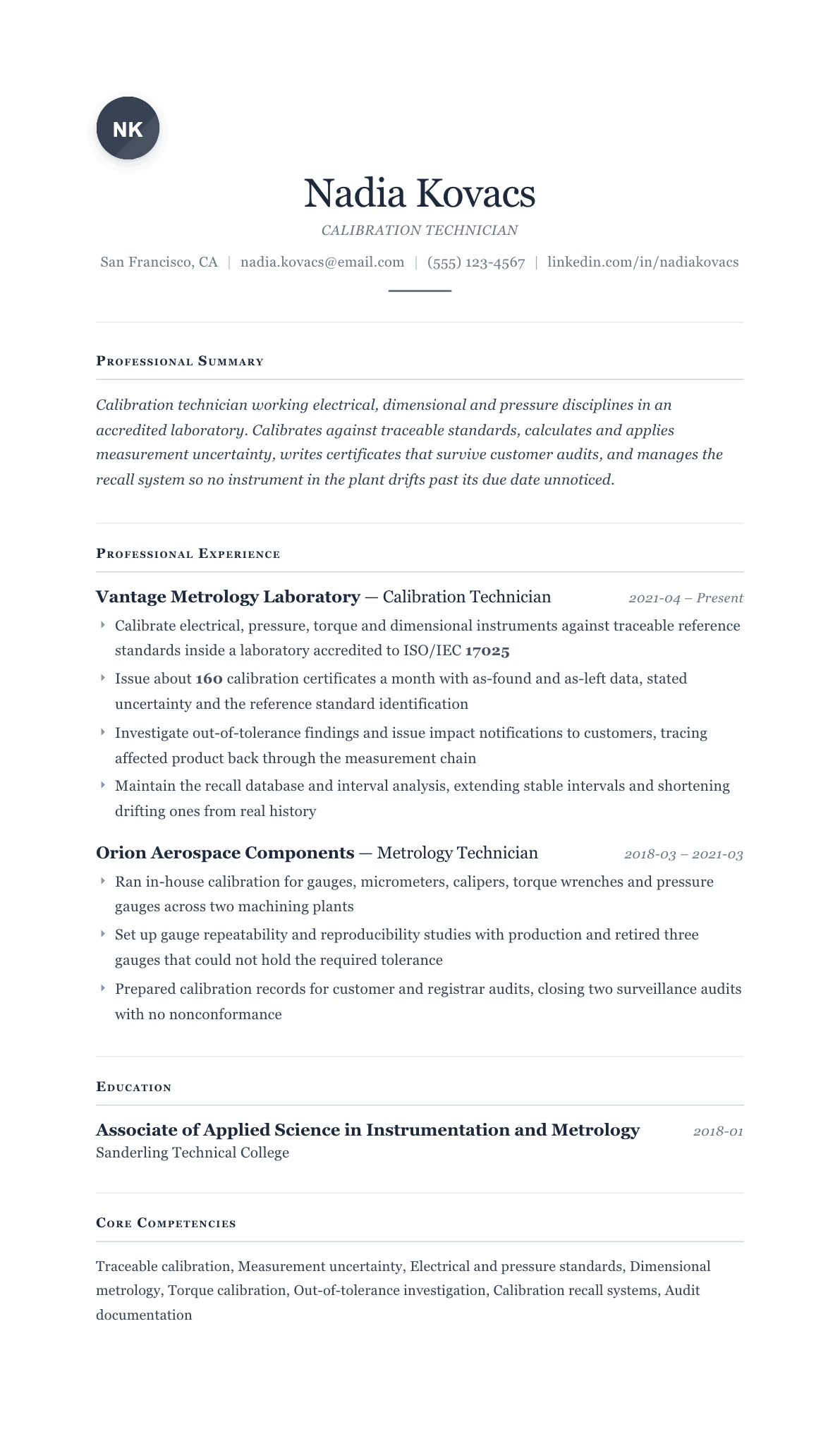
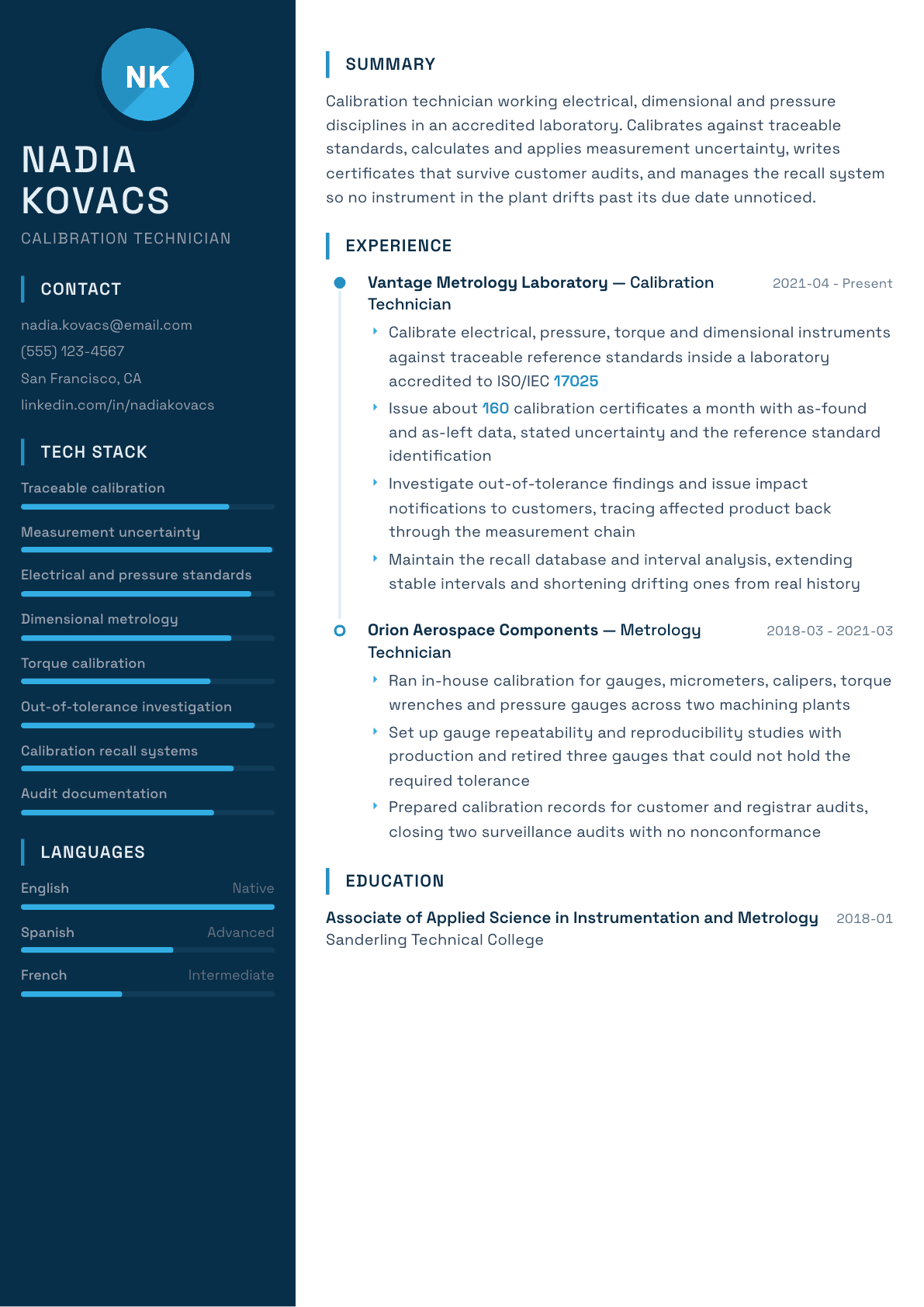
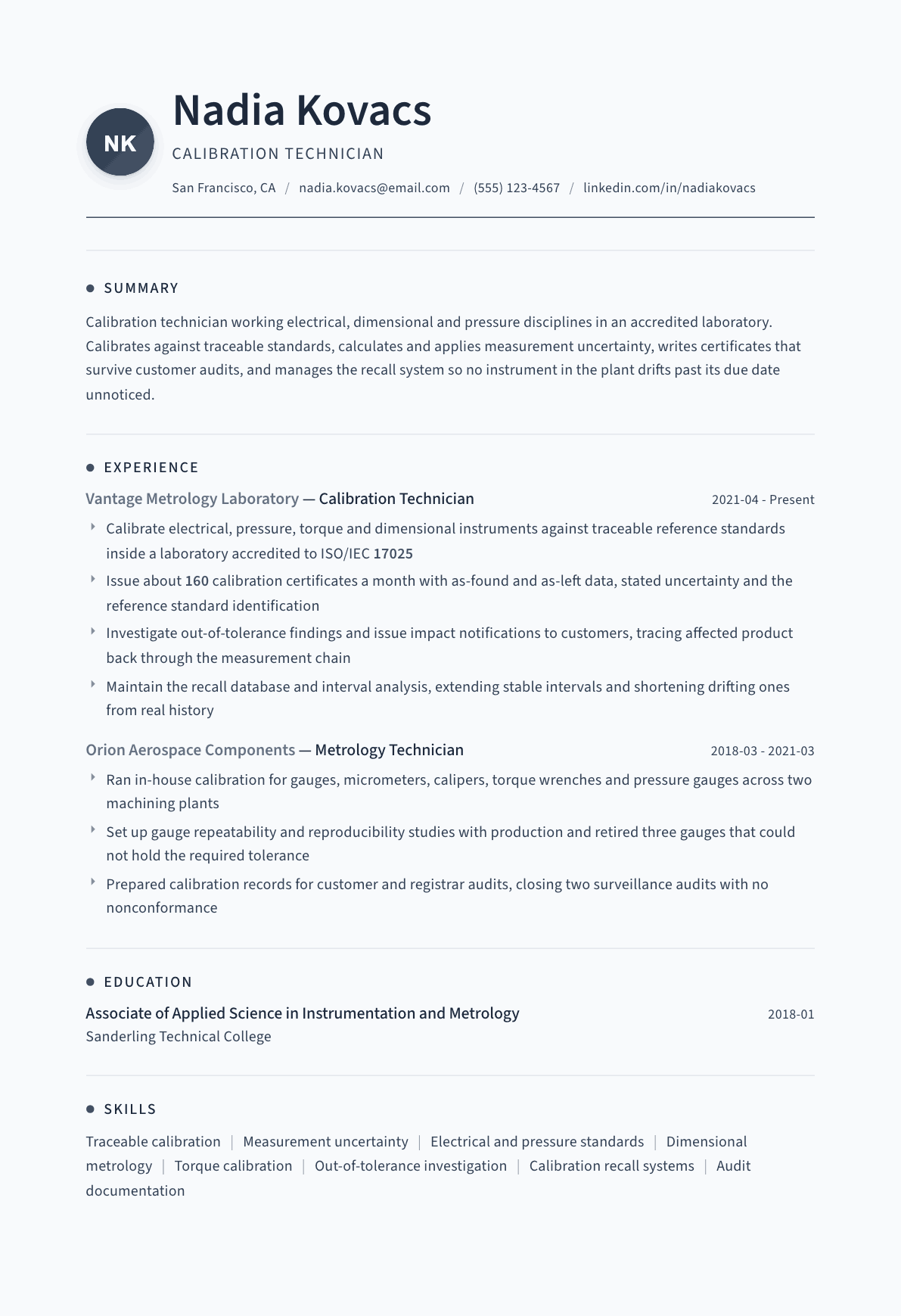
Example Calibration Technician summary
Calibration technician working electrical, pressure, torque and dimensional disciplines in a laboratory accredited to ISO/IEC 17025. Calibrates against traceable reference standards, calculates and reports measurement uncertainty, and issues certificates with full as-found and as-left data. Investigates out-of-tolerance findings back through the measurement chain, runs interval analysis from real drift history, and supports customer and registrar audits.
Skills to list on a Calibration Technician resume
- Traceable calibration to national standards
- Measurement uncertainty calculation
- Multifunction electrical calibrators
- Pressure comparators and deadweight testers
- Dimensional metrology and gauge blocks
- Micrometers, calipers and height gauges
- Torque calibration
- Temperature baths and dry blocks
- As-found and as-left reporting
- Out-of-tolerance investigation
- Calibration interval analysis
- Recall and asset databases
- Gauge repeatability and reproducibility studies
- Laboratory quality documentation
- Audit preparation and support
- Environmental condition monitoring
What actually gets this resume read
- Name the disciplines you calibrate: electrical, dimensional, pressure, temperature, torque, mass, flow, and your depth in each.
- State the standards your laboratory works to and whether it holds accreditation, since that shapes every process you follow.
- Show that you calculate and report measurement uncertainty, because that separates a technician from a button pusher.
- Describe your out-of-tolerance handling including impact assessment, as auditors ask about that before anything else.
- Name the calibration management software you use, since recall and interval work runs inside a specific system.
- List the reference standards and equipment you operate by type, from multifunction calibrators to gauge blocks.
- Mention audit support you have given, with the audit type and the outcome, because labs live and die on audits.
How to write a calibration technician resume
Calibration is a documentation trade with an instrument attached. The measurement takes twenty minutes; the certificate that proves the measurement was traceable, competently performed and correctly bounded by uncertainty is what the customer actually bought. A laboratory manager reading resumes is hiring for that second half, and most applicants write only about the first.
He is checking three things. Whether you understand traceability as a chain rather than a sticker. Whether you can calculate and report measurement uncertainty rather than copying a number off a template. And whether you know what to do when an instrument comes in out of tolerance, because that single event can reach back through months of product and is where a laboratory either proves itself or loses a customer.
This guide covers what a metrology manager or a quality manager reads in order, with summaries for a technician entering the field, one working a discipline list and a senior, before and after bullets from real calibration work, and the questions technicians ask when they move between in-house calibration groups and accredited service laboratories.
Format: disciplines, standards, and the accreditation you worked under
Reverse chronological, one page under a decade. Beneath the header, list your disciplines the way a laboratory scope is written: electrical, dimensional, pressure, temperature, torque, mass, flow. Beside each, name the reference standards you operate and the range you cover, because a manager builds a workload from disciplines and ranges, not from job titles.
Then state the quality framework you worked under. Whether the laboratory held accreditation, which standard governed the work, and whether you were signatory on certificates. That sentence is the fastest way to tell a manager how disciplined your habits will be on his bench.
- Header: name, city and state, phone, email, and any quality or metrology credential you hold.
- Discipline block: each discipline with its reference standards, measurement ranges and typical instruments received.
- Quality line: the standard the laboratory worked to, accreditation status, and whether you signed certificates.
- Each job names the setting: accredited service laboratory, in-house calibration group, field calibration route, or a manufacturing metrology department.
Summary: disciplines, throughput, uncertainty, recall ownership
Three lines carrying four facts: the disciplines you calibrate, the certificate volume you produce, whether you calculate uncertainty yourself, and whether you own the recall system. Certificate volume is the productivity number a laboratory manager tracks, and uncertainty is the competence question he cannot ask directly at screening.
If your experience is in-house rather than in a service laboratory, say so and name what you owned. In-house technicians usually carry the recall database, interval analysis, gauge studies and audit preparation on top of the bench work. That breadth is genuinely valuable and it disappears if the resume only lists instruments calibrated.
Experience: traceability, as-found data and out-of-tolerance handling
Open each job with scope: the disciplines, the instrument population or certificate volume, and the framework. Then write bullets that show the parts of the work a manager cannot verify any other way: how you establish traceability, what your certificates contain, and what happens when a reading falls outside the limit.
Traceability bullets name the chain. The reference standard, where it is calibrated, its own uncertainty contribution, and how you keep it inside its interval. Certificate bullets name the content: as-found and as-left data at each test point, the stated uncertainty, the environmental conditions, and the identification of the standard used. Those details are exactly what an assessor reads.
Out-of-tolerance handling is the bullet that separates senior technicians from junior ones. Describe the sequence: quarantine, investigation, impact assessment on product measured since the last calibration, customer notification, and the record of it all. A manager reading that knows you understand what a calibration certificate is really for.
- Give certificate volume per month and the disciplines it spans.
- Name the reference standards you operate: multifunction calibrators, deadweight testers, gauge blocks, temperature baths, torque transducers.
- State whether you calculate uncertainty budgets yourself or apply established ones, and be exact about it.
- Include interval analysis: how intervals are set, what drift history you use, and any interval you extended or shortened with evidence.
Recall systems, gauge studies and audits
The recall database is the least glamorous and most consequential system in a calibration function. An instrument that drifts past its due date unnoticed can invalidate everything measured with it. If you have owned that database, say how many assets it held, how you handled instruments in production that never came back, and what the overdue rate looked like.
Gauge repeatability and reproducibility studies sit at the boundary between calibration and quality, and technicians who can run them are useful to both. Describe the study setup, the operators and parts involved, and what the result changed: a gauge retired, a measurement method revised, or a tolerance renegotiated with engineering. Then add your audit history with the audit type and the outcome, because audits are the recurring test a calibration function must pass.
Skills and keywords a metrology posting filters on
The vocabulary is precise and repeats: traceability, measurement uncertainty, as-found, as-left, out of tolerance, test uncertainty ratio, reference standard, calibration interval, recall, accreditation, scope, gauge study, environmental conditions. Mirror those words in your skills block and again inside a bullet where the work is visible.
Name the calibration management software you use. Recall scheduling, certificate generation, interval analysis and asset history all live inside a specific platform, and a laboratory running one will filter for that name. Say what you did inside it too: built asset records, generated certificates, ran overdue reports, or configured procedures.
Calibration Technician resume summary examples
Entering metrology
Instrumentation and metrology graduate with lab training in electrical, pressure and dimensional measurement. Calibrates multimeters, pressure gauges, calipers and micrometers against traceable standards, records as-found and as-left data, and understands traceability chains. Seeking a calibration technician seat in an accredited laboratory.
Four years on the bench
Calibration technician working electrical, pressure, torque and dimensional disciplines in a laboratory accredited to ISO/IEC 17025. Issues about 160 certificates a month with as-found and as-left data and stated uncertainty, and investigates out-of-tolerance findings back through the measurement chain to affected product.
Senior technician
Senior calibration technician with 10 years across an accredited laboratory and an aerospace manufacturing metrology group. Signs certificates across 4 disciplines, builds uncertainty budgets, owns the recall database and interval analysis, and has supported customer and registrar audits closing without nonconformance.
Work experience bullets: before and after
Before: Calibrated test equipment against standards.
After: Calibrated electrical, pressure, torque and dimensional instruments against traceable reference standards inside a laboratory accredited to ISO/IEC 17025, working to documented procedures for each discipline.
Naming the disciplines, the traceability and the accreditation framework tells a manager exactly how the work was controlled.
Before: Issued calibration certificates.
After: Issued about 160 calibration certificates a month carrying as-found and as-left data at every test point, stated measurement uncertainty, environmental conditions and the identification of the reference standard used.
Volume plus certificate content shows both productivity and the documentation discipline an assessor checks.
Before: Dealt with instruments that failed calibration.
After: Investigated out-of-tolerance findings by quarantining the instrument, assessing impact on product measured since the previous calibration, and issuing customer notifications with the full measurement history.
The sequence proves you understand that a failed calibration is a product problem, not a paperwork problem.
Before: Managed the calibration schedule.
After: Owned the recall database and interval analysis, extending intervals on stable instruments and shortening them on drifting ones using recorded as-found history rather than a default period.
Evidence-based interval setting is a senior skill and is invisible in a generic scheduling claim.
Before: Helped with quality audits.
After: Prepared calibration records and traceability evidence for customer and registrar audits, walked assessors through the measurement chain, and closed 2 surveillance audits with no nonconformance.
Naming the audit types, the preparation and the outcome makes audit experience concrete and verifiable.
Hard skills
- Traceable calibration to national measurement standards
- Measurement uncertainty budgets and reporting
- Multifunction electrical calibrators and reference meters
- Pressure comparators and deadweight testers
- Dimensional metrology with gauge blocks and comparators
- Micrometers, calipers, indicators and height gauges
- Torque transducer calibration
- Temperature baths, dry blocks and reference probes
- As-found and as-left certificate reporting
- Out-of-tolerance investigation and impact assessment
- Calibration interval analysis from drift history
- Recall and asset management databases
- Gauge repeatability and reproducibility studies
- Laboratory quality documentation and audit support
Soft skills
- Refusing to release a certificate that is not fully supported
- Explaining uncertainty to a customer who wants a simple pass or fail
- Chasing overdue instruments across a plant without making enemies
- Recording environmental conditions even when nobody would check
- Staying precise on the last certificate of a long day
Certifications worth listing
- Certified Calibration Technician (CCT) (American Society for Quality)
- Certified Quality Technician (CQT) (American Society for Quality)
- Certified Control Systems Technician (CCST) Level I (International Society of Automation)
Mistakes that cost calibration technician candidates the interview
- Listing instruments calibrated with no mention of traceability, uncertainty or the framework the work sat inside.
- Claiming uncertainty knowledge without saying whether you build budgets or apply established ones.
- Leaving out-of-tolerance handling off the page, when it is the event that tests a calibration function hardest.
- Reducing the recall database to scheduling, rather than naming the asset count and the overdue rate you held.
- Skipping certificate volume, the productivity figure a laboratory manager compares candidates on.
- Writing audit support vaguely instead of naming the audit type, your preparation role and the outcome.
Calibration Technician resume questions
Do I need to understand measurement uncertainty to get a calibration job?
For an entry seat you can start with applying established budgets, but you will stall quickly without understanding them. Say honestly where you are: applying existing budgets, contributing to them, or building them from scratch. Managers plan training around that answer and respect the precision.
How different is in-house calibration from an accredited service laboratory?
An accredited laboratory runs a defined scope with assessor scrutiny and tight procedure control. An in-house group usually covers wider equipment with less formality but owns recall, gauge studies and internal audits. Name which you have done, because the habits each builds are different and both are wanted.
What should I write if I have only used automated calibration software?
Say so and describe what the automation did and what you did. Setting up a procedure, verifying the connections, judging whether a result is credible and handling exceptions are all real skills. A technician who blindly accepts software output is the risk, not one who uses it deliberately.
How do I move from field calibration into a laboratory bench seat?
Foreground documentation and reference standard handling rather than travel and volume. Show your certificate quality, the environmental conditions you record on site, how you protect standards in transit, and any discipline where you already work to laboratory tolerances rather than field ones.
Should I list every instrument type I have calibrated?
List them by discipline and range rather than as a long inventory. A manager wants to know you can cover pressure to a stated range or dimensional to a stated resolution, not that you have once seen a particular model. Depth by discipline reads as competence, while a long list reads as padding.
Related resume examples
- Instrument Technician Resume example
- Quality Engineer Resume example
- Lab Technician Resume example
- Biomedical Technician Resume example
- Auto Technician Resume example
- Marine Mechanic Resume example