Biomedical Technician Resume Examples: read this first
Write a Biomedical Technician Resume for Clinical Engineering Teams
By Mustafa Tarabya, founder of CVBooster · Published · Updated
Biomedical technician resume example, keyword list and guide covering device modalities, safety testing, network-connected equipment and CBET.
Sample resumes for a biomedical technician
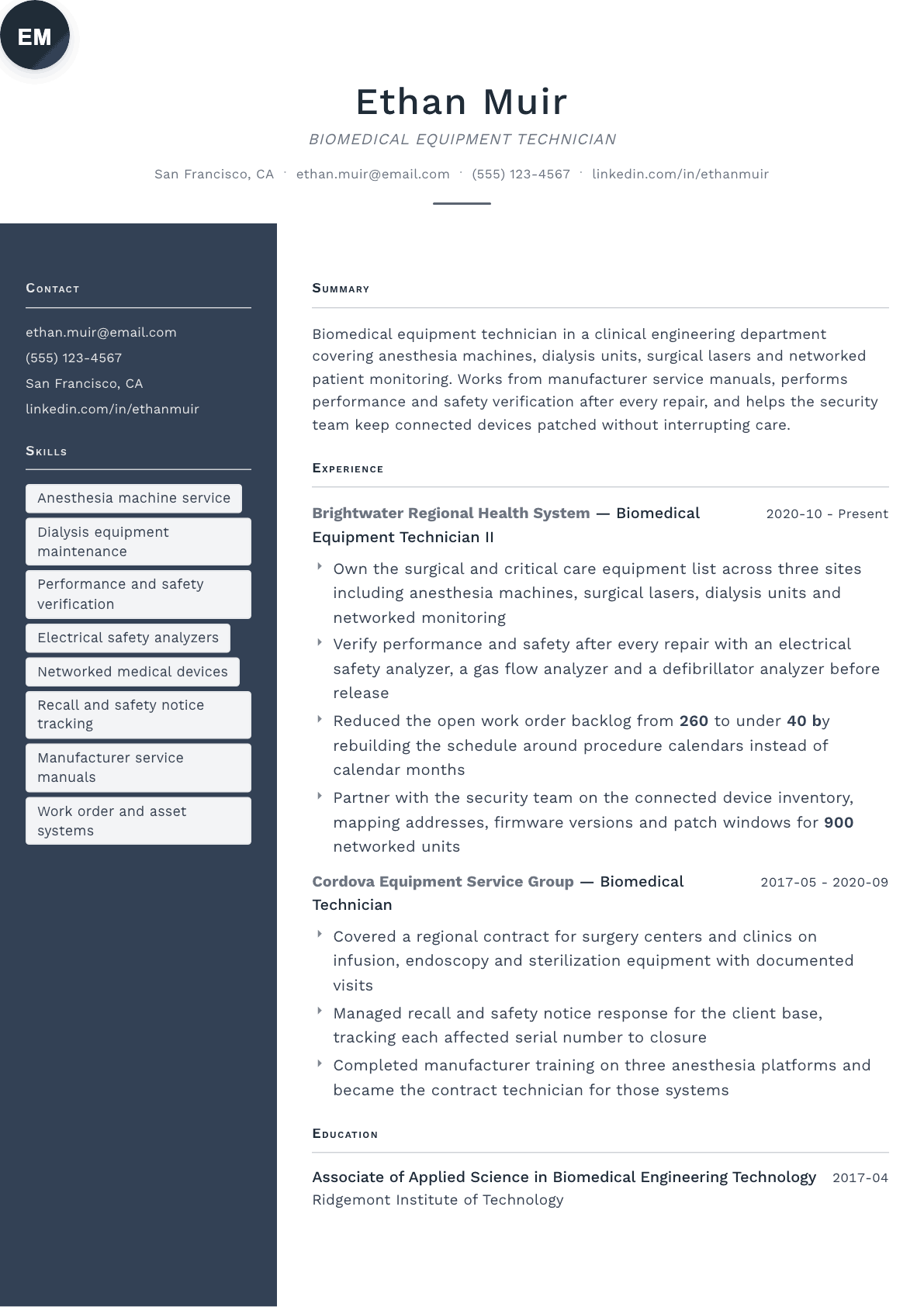
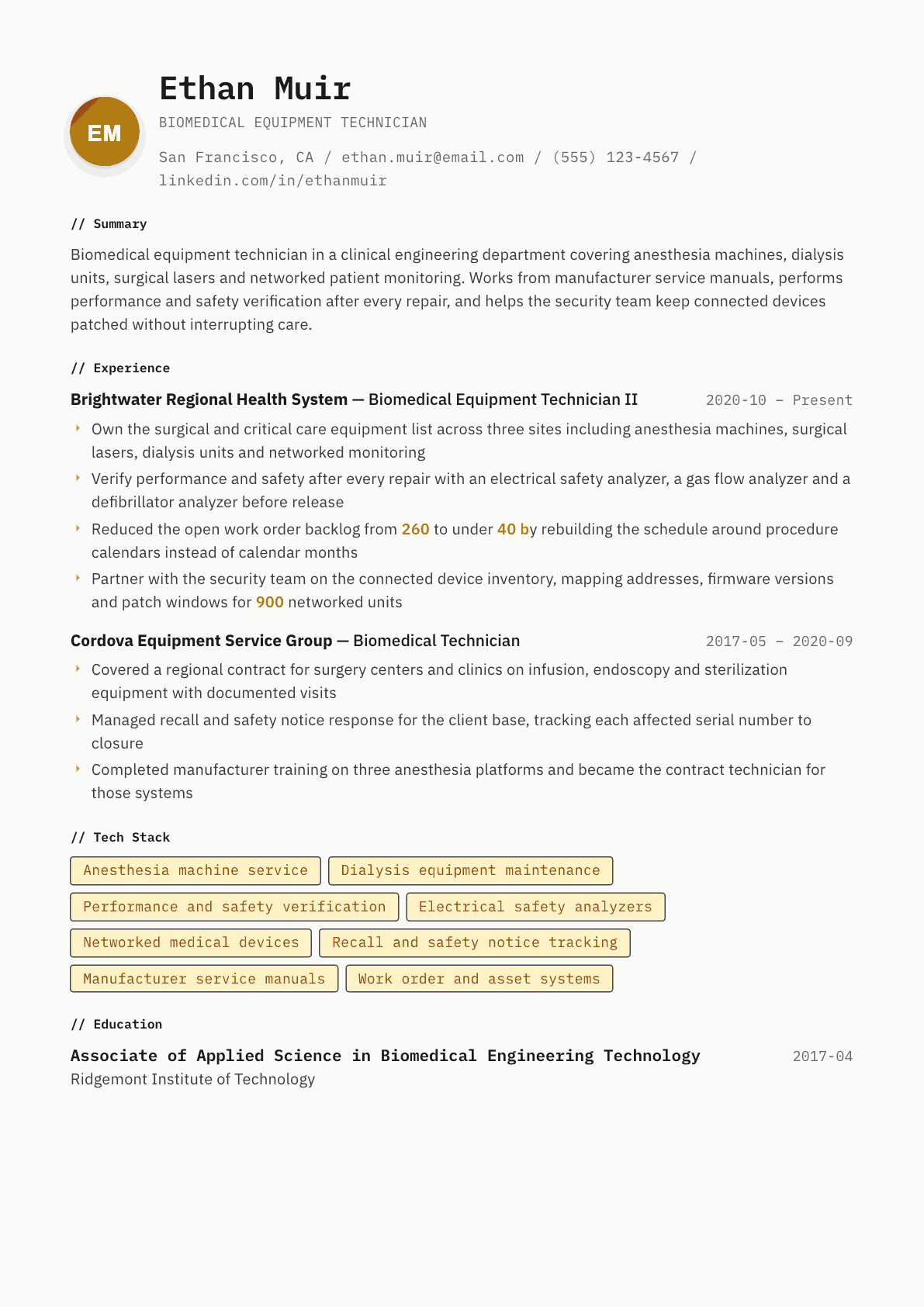
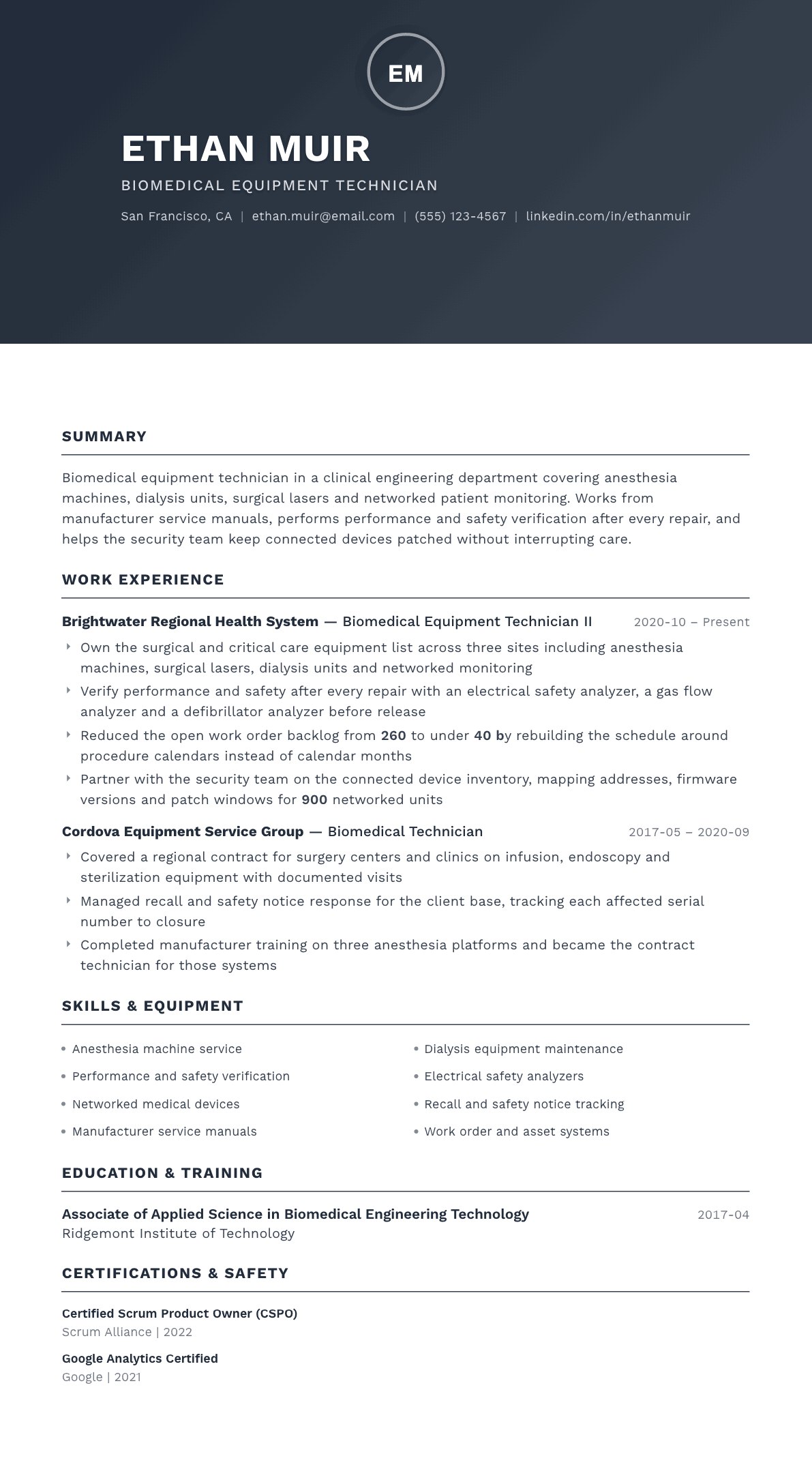
The same biomedical technician content laid out in three CVBooster templates, so you can see what the finished document looks like before you write a word.
Example Biomedical Technician summary
Biomedical equipment technician in clinical engineering covering anesthesia machines, dialysis units, surgical lasers and networked monitoring across three hospital sites. Verifies performance with electrical safety, gas flow and defibrillator analyzers after every repair, tracks recall notices to serial-level closure, and works with information security on firmware and patch windows for connected devices. Rebuilt the maintenance schedule around procedure calendars.
Skills to list on a Biomedical Technician resume
- Anesthesia machine service
- Dialysis equipment maintenance
- Surgical laser support
- Endoscopy and sterilization equipment
- Networked patient monitoring
- Electrical safety analyzers
- Gas flow and ventilator analyzers
- Defibrillator analyzers
- Performance verification protocols
- Recall and safety notice tracking
- Medical device cybersecurity coordination
- Manufacturer service manuals
- Work order and asset management systems
- Preventive maintenance planning
- Capital equipment acceptance testing
- Clinical department liaison
What actually gets this resume read
- Group your device modalities by area: surgical, critical care, imaging, dialysis, laboratory, so a manager can match your list to hers.
- Name the analyzers you test with, because a clinical engineering manager reads that as proof you verify rather than assume.
- Put CBET or a related credential in the header, since many hospital postings screen on it directly.
- Show your work order backlog and how you moved it, because backlog is the metric the department reports upward.
- Include connected device work such as firmware versions and patch coordination, which is now a hiring priority.
- Track recall and safety notice handling on the page, as that is a documented obligation the department owns.
- Say which manufacturer training courses you completed and which platforms they authorized you to service.
How to write a biomedical technician resume
Clinical engineering departments have changed. A biomedical technician used to be judged on how many devices he could keep running. Now he is judged on that plus a network inventory, firmware versions, recall closure, capital acceptance testing and a backlog figure that leadership watches. The resume that gets interviews in this field reflects that widening, and most do not.
The manager reading applications wants to know three things quickly: which modalities you can take responsibility for, whether you verify your own work with the right analyzers, and whether your documentation would hold if a surveyor pulled ten records at random. Everything else is negotiable. Those three are not.
This guide walks through the sections a clinical engineering manager reads, with summaries for a technician entering the field, one holding a modality list, and a senior who owns programs, before and after bullets from real device work, and the questions biomedical technicians ask when they move between hospitals, service groups and manufacturer roles.
Format: modality list, credentials, then program ownership
Reverse chronological, one page for under a decade and two once you carry modality depth plus program responsibility. Under the header, build a modality block organized the way a department is organized: surgical and anesthesia, critical care, dialysis, imaging support, laboratory, sterile processing. That structure alone signals that you have worked inside a real clinical engineering group.
Put your AAMI credential in the header line. Then list the analyzers you verify with, because a manager reads a technician who names his test equipment very differently from one who does not. Anyone can replace a board. Proving the device performs to specification afterward is the job.
- Header: name, credential, city and state, phone, email, and whether you hold a current driving record for multi-site coverage.
- Modality block grouped by department area, with the manufacturers and platforms you were trained on beside each.
- Analyzer list: electrical safety, gas flow, defibrillator, infusion, patient simulator, and any modality-specific test gear.
- Each job names the setting: health system with a site count, independent service organization, manufacturer field service, or a specialty contract.
Summary: modalities owned, sites covered, backlog handled
Three lines with four facts: the modalities you take responsibility for, how many sites or beds you covered, the verification you perform after repair, and one program you own. Program ownership is the thing that separates a technician from a senior technician, and it is usually missing from the page entirely.
If you are stronger in one area than the rest, lead with it. Anesthesia machines, dialysis, surgical lasers and sterilizers each carry their own hiring lane and their own training requirements. A technician who says he is the anesthesia platform owner at his site is far easier to place than one listing eleven modalities at equal weight.
Experience: verification, backlog and the connected inventory
Open each job with the equipment scope and the site count, then write bullets across three areas: scheduled and corrective work with verification, the backlog and how you moved it, and the connected device inventory. That third area is where modern clinical engineering resumes either stand out or fall behind.
Verification bullets carry the analyzers. Electrical safety analyzer readings, gas flow verification on an anesthesia machine, energy delivery checks on a defibrillator, flow accuracy on an infusion device. Say what you measured, what specification you compared it against and where the result was recorded. A manager reads that as audit-proof work.
Backlog is the number leadership sees. If you moved one, say what it was, what it became, and what you changed to make that happen. Rebuilding a schedule around procedure calendars, splitting a device group between two technicians, or retiring equipment that no longer justified a maintenance visit are all real answers and all more convincing than working harder.
- Give the site count, the modality scope and the approximate device population you were responsible for.
- Name every analyzer you use and the parameter it verifies, not just that testing was performed.
- Include recall and safety notice work traced to serial-level closure, which is a documented department obligation.
- Show connected device work: address inventory, firmware versions, patch coordination windows and who you worked with in information security.
Capital acceptance and the work before a device sees a patient
Acceptance testing on new capital equipment is one of the least written about and most valued parts of this role. Receiving inspection, safety and performance verification, network onboarding, asset creation, maintenance schedule assignment and clinical handover training all happen before a device is used once. A technician who has run that process end to end should say so with the equipment type and the quantity.
The same applies at the other end of the life cycle. Decommissioning, data sanitization on devices that store patient information, and removal from both the asset system and the network are tasks departments increasingly own. Naming them shows you understand the full custody chain rather than only the middle of it.
Skills and keywords a clinical engineering posting filters on
The recurring vocabulary is specific: modality, performance verification, electrical safety analyzer, scheduled maintenance, corrective maintenance, work order backlog, recall notice, acceptance testing, asset management system, medical device network, firmware, service manual, uptime. Use the posting words in your skills block and again inside a bullet where the work is shown.
Networking language matters now. If you can read an address assignment, understand a device subnet, coordinate a patch window and explain why a device cannot simply be rebooted during a case, say it in those terms. Departments are actively looking for biomedical technicians who speak that language, and comparatively few resumes do.
Biomedical Technician resume summary examples
Entering the field
Biomedical engineering technology graduate with 500 internship hours in a clinical engineering department covering patient monitors, infusion devices, suction and examination equipment. Trained on electrical safety analyzers and work order documentation. Seeking a biomedical technician seat in a health system with structured modality training.
Five years with a modality list
Biomedical equipment technician with 5 years covering critical care and surgical equipment across 2 hospital sites, including anesthesia machines, ventilators, dialysis units and networked monitoring. Verifies with electrical safety, gas flow and defibrillator analyzers after every repair, and tracks recall notices to serial-level closure.
Senior technician and program owner
Senior biomedical technician with 11 years in clinical engineering across 3 sites. Owns the anesthesia and dialysis platforms, runs capital acceptance testing, reduced the open work order backlog from 260 to under 40, and partners with information security on firmware and patch windows for 900 networked devices.
Work experience bullets: before and after
Before: Maintained a range of medical equipment in the hospital.
After: Owned the surgical and critical care equipment list across 3 sites including anesthesia machines, surgical lasers, dialysis units and networked patient monitoring, covering scheduled and corrective work.
Modality ownership across a named site count is what a clinical engineering manager is actually staffing for.
Before: Checked devices worked correctly after repair.
After: Verified every repair with an electrical safety analyzer, a gas flow analyzer and a defibrillator analyzer against the manufacturer specification, and recorded each reading in the work order before release.
Naming the analyzers and the reference specification turns a vague check into audit-ready verification.
Before: Helped reduce the work order backlog.
After: Reduced the open work order backlog from 260 to under 40 by rebuilding the schedule around procedure calendars rather than calendar months, so devices were pulled when their areas were quiet.
The before and after plus the specific change shows a method leadership can repeat elsewhere.
Before: Worked with IT on networked medical devices.
After: Built and maintained the connected device inventory for 900 networked units including addresses, firmware versions and agreed patch windows, and coordinated each update with the clinical area first.
The population, the fields tracked and the coordination step show real ownership of a growing department responsibility.
Before: Handled recalls when they came in.
After: Managed recall and safety notice response for a multi-site inventory, tracing every affected serial number through inspection, correction and documented closure with the manufacturer.
Serial-level tracing to closure is the standard a surveyor applies, and it is far stronger than handling recalls.
Hard skills
- Anesthesia machine service and gas flow verification
- Dialysis equipment maintenance and water quality checks
- Surgical laser support and safety interlocks
- Networked patient monitoring systems
- Electrical safety analyzers
- Defibrillator and infusion device analyzers
- Performance verification against manufacturer specification
- Capital equipment acceptance testing
- Recall and safety notice closure
- Medical device network inventory and firmware tracking
- Asset and work order management systems
- Scheduled maintenance program design
- Sterile processing equipment support
- Device decommissioning and data sanitization
Soft skills
- Negotiating access to equipment around a surgical schedule
- Translating between clinical staff and information security
- Holding a device out of service under pressure to release it
- Training clinical users without sounding condescending
- Documenting so a colleague can defend the record without you
Certifications worth listing
- Certified Biomedical Equipment Technician (CBET) (AAMI Credentials Institute)
- Certified Radiology Equipment Specialist (CRES) (AAMI Credentials Institute)
- Certified Laboratory Equipment Specialist (CLES) (AAMI Credentials Institute)
- Certified Healthcare Technology Manager (CHTM) (AAMI Credentials Institute)
Mistakes that cost biomedical technician candidates the interview
- Listing eleven modalities at equal weight instead of naming the two or three you would take responsibility for.
- Describing repairs with no analyzer, no specification and no recorded reading behind the verification.
- Leaving the work order backlog off the page when it is the figure department leadership watches most closely.
- Ignoring networked device work, which is now a hiring priority and appears in very few technician resumes.
- Treating recalls as incoming paperwork rather than a serial-level obligation traced to documented closure.
- Skipping capital acceptance testing, one of the highest value tasks a clinical engineering group performs.
Biomedical Technician resume questions
How do I move from general biomedical work into a modality specialty?
Volunteer for the platform nobody wants and document everything you learn on it. Then rewrite the resume so that modality leads: the manufacturer training, the verification you perform, the failures you have seen and the clinical area you support. Specialists are hired on depth, not on breadth.
Does imaging experience belong on a biomedical technician resume?
Yes, but describe it accurately. First-line imaging support such as table motion, positioning aids, network connectivity and safety testing is different from tube and generator work. Say which side you have done, and name any radiology equipment credential you hold or are working toward.
How much networking and cybersecurity should I claim?
Claim what you have done unsupervised: maintaining a device address inventory, tracking firmware versions, coordinating patch windows, escalating a vulnerability notice. Departments want a technician who bridges to information security, not one who claims to be a security engineer.
Is an independent service organization a step down from a hospital seat?
No, and the resume should not treat it that way. Service organizations expose you to more manufacturers, more sites and tighter documentation discipline than many in-house roles. Present it as breadth and contract accountability, then name the modality depth you built inside it.
What if my hospital never tracked a backlog number?
Describe the workload another way. Give the device population per technician, the number of scheduled events due each month, or the outstanding work you cleared during a specific period. A manager can read those and will trust an honest description more than a figure that was never measured.
Related resume examples
- Medical Equipment Technician Resume example
- Biomedical Engineer Resume example
- Lab Technician Resume example
- Calibration Technician Resume example
- Maintenance Supervisor Resume example
- Building Maintenance Worker Resume example