Instrument Technician Resume Examples: read this first
Write an Instrument Technician Resume That Speaks Loop Language
By Mustafa Tarabya, founder of CVBooster · Published · Updated
Instrument technician resume example, keywords and a guide covering loop calibration, HART devices, control valves, DCS work and turnaround jobs.
Sample resumes for a instrument technician
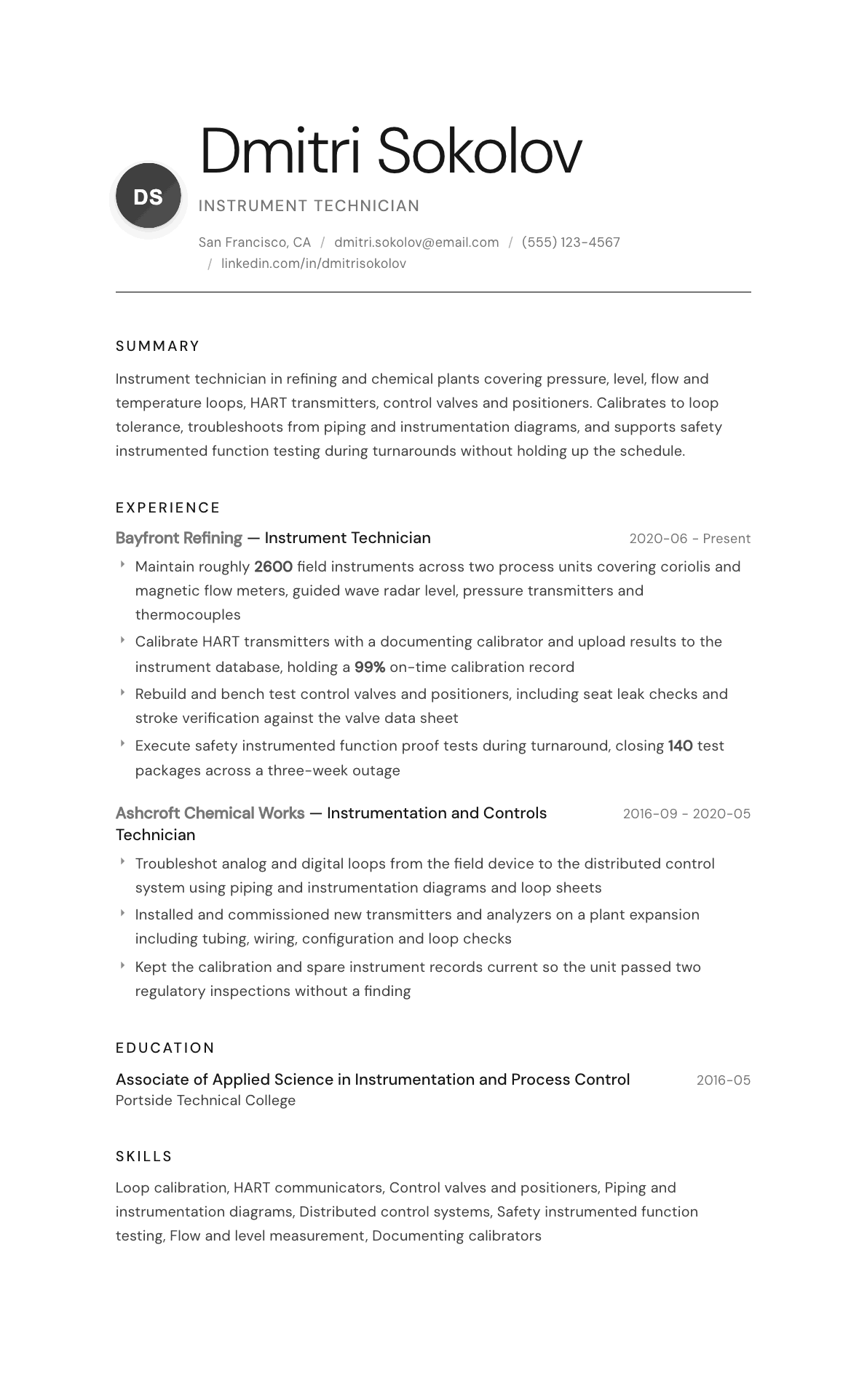
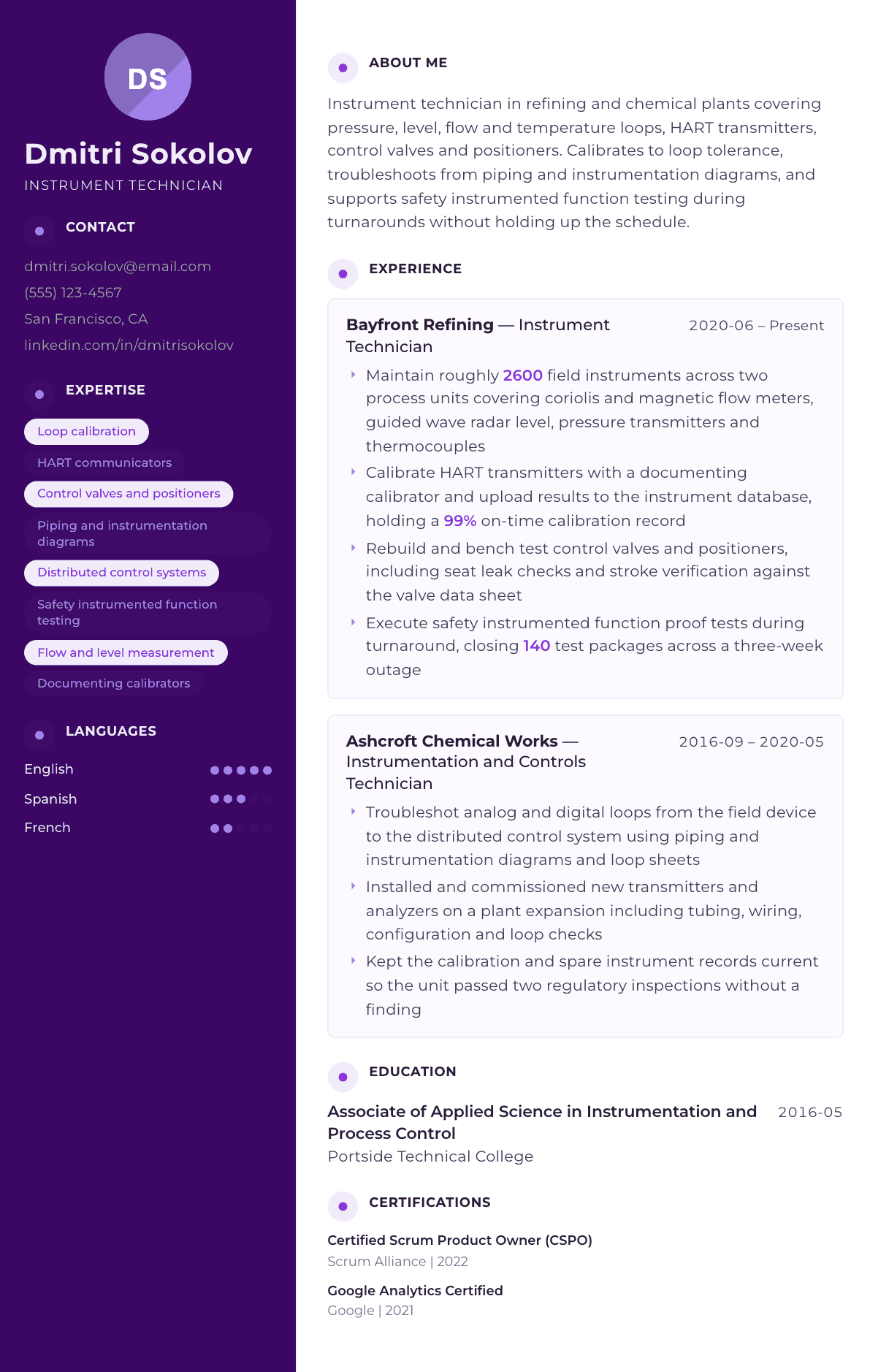
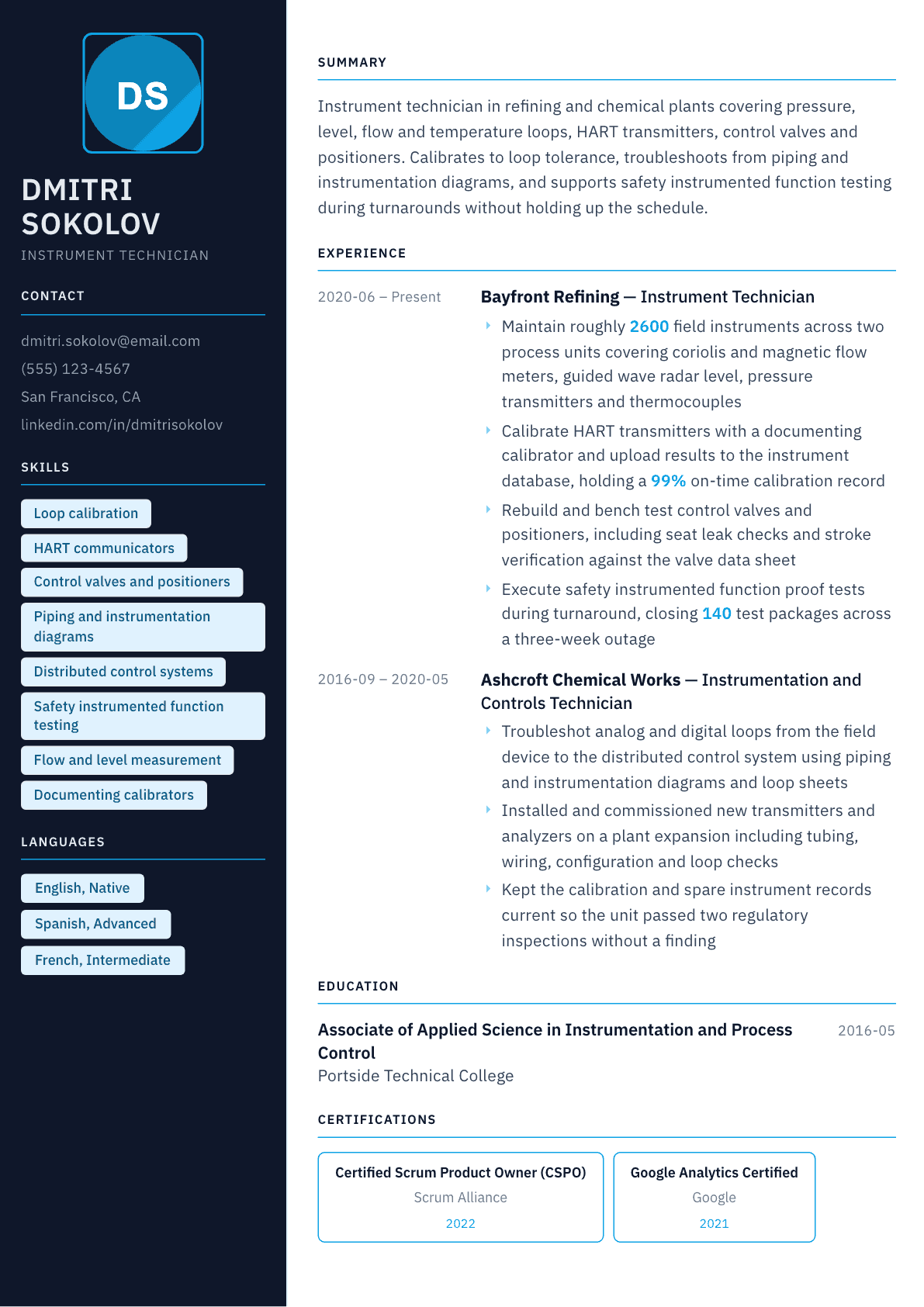
The same instrument technician content laid out in three CVBooster templates, so you can see what the finished document looks like before you write a word.
Example Instrument Technician summary
Instrument technician with eight years in refining and chemical plants covering pressure, level, flow and temperature loops, HART transmitters, control valves and positioners. Calibrates with a documenting calibrator and uploads results to the instrument database, troubleshoots from loop sheets and process diagrams, and executes safety instrumented function proof tests during turnarounds. Holds a near perfect on-time calibration record across thousands of field devices.
Skills to list on a Instrument Technician resume
- Loop calibration to tolerance
- HART communicators and documenting calibrators
- Pressure and differential pressure transmitters
- Guided wave and ultrasonic level
- Coriolis and magnetic flow meters
- Thermocouples and RTDs
- Control valves and positioners
- Valve stroke and seat leak testing
- Piping and instrumentation diagrams
- Loop sheets and wiring diagrams
- Distributed control systems
- Safety instrumented function proof testing
- Analyzer maintenance
- Instrument installation and commissioning
- Hazardous area classification practice
- Turnaround package execution
What actually gets this resume read
- Name the measurement types you own: pressure, level, flow, temperature and analytical, because plants staff by loop type.
- List instrument brands and protocols you configure, from HART and Foundation Fieldbus to Profibus, since standards vary by site.
- Give calibration volume and on-time record, as that is the number a reliability engineer pulls from the database.
- Say whether you have executed safety instrumented function proof tests, which is a different hiring bracket.
- Include turnaround work with package counts and outage length, because contractors staff around that experience.
- Show that you troubleshoot from loop sheets and process diagrams rather than by replacing transmitters.
- Add hazardous area practice, hot work permits and confined space entry, all of which gate plant access.
How to write a instrument technician resume
In a process plant, the instrument technician is the person who decides whether the control room is looking at reality. A level indication that reads six inches low, a flow meter drifting after a coating builds inside it, a control valve that no longer strokes to its commanded position: each of those quietly corrupts every decision made downstream of it. The people hiring know this, which is why they hire on evidence rather than on titles.
The evidence they look for is narrow and specific. Which measurement types you own. Which protocols you configure. Whether you calibrate to a loop tolerance or just replace transmitters. Whether you can walk a loop from the field device through the junction box and marshalling cabinet to the control system without needing anyone to hold the drawing for you. And whether you have executed proof tests on safety instrumented functions.
This guide covers what a maintenance or reliability supervisor in a refinery, chemical plant, power station or water treatment site reads first, with summaries for an apprentice, a working technician and a senior, before and after bullets from calibration and valve work, and the questions technicians ask when they move between plant seats and turnaround contracting.
Format: measurement types, protocols, then plant context
Reverse chronological, one page under ten years, two if you carry safety system work and multiple plant types. Beneath the header, build a measurement block: pressure, level, flow, temperature, analytical, and beside each the technologies you have actually worked. Guided wave radar is not the same skill as differential pressure level, and a reliability supervisor knows it.
Follow with protocols and systems. The communicator and documenting calibrator you use, the field protocols you configure, and the control platform you work into. A plant standardized on one distributed control system will filter for it by name, and the technician who lists it precisely gets read while the one who writes DCS experience does not.
- Header: name, city and state, phone, email, and any control systems credential you hold.
- Measurement block by variable, with the technologies and manufacturers named under each.
- Systems line: control platform, field protocols, calibration software, and the maintenance management system used.
- Each job names the plant type, the number of process units covered and the approximate instrument population.
Summary: instrument count, calibration record, safety system work
Three lines, four facts: the instrument population you maintained, the measurement types you own, your calibration on-time record, and whether you have executed safety instrumented function proof tests. That last one moves you into a different hiring bracket, so it belongs high on the page if it is true.
Say what kind of plant you have worked. Refining, chemicals, power, pharmaceutical, food and water treatment all use the same instruments under very different rules, permit systems and documentation expectations. A supervisor who sees his own plant type named reads the rest of the page with a warmer eye.
Experience: loops, valves and the record you leave behind
Open each job with scope: the process units, the instrument count and the loop types. Then write bullets in three groups, because these are the three things the job is actually made of: calibration and configuration, valve work, and troubleshooting a loop end to end.
Calibration bullets need tolerance and record. State that you calibrate to loop tolerance rather than to instrument tolerance, name the documenting calibrator, and say where the as-found and as-left data lands. Instrument databases exist because regulators and insurers ask for that history, and a technician who feeds it properly is worth more than one who adjusts and moves on.
Valve bullets show mechanical depth. Bench setting a positioner, stroke checking against the data sheet, seat leak testing, packing replacement and diagnosing a sticking valve from a signature rather than by feel. Troubleshooting bullets show you follow the loop: field device, wiring, barrier, marshalling, input card, control strategy. Name where the fault actually was, because that detail is the proof.
- Give the instrument population and the number of process units for each employer.
- Name the documenting calibrator, communicator and the instrument database you upload results into.
- Include safety instrumented function proof test work with the package count and the outage length.
- State the permit systems you work under: hot work, confined space entry, energy isolation and hazardous area rules.
Turnaround and commissioning work
Turnarounds are how many instrument technicians build a career, and they are hired for specifically. Contractors staffing an outage want to know how many test packages you have closed, how you handle punch lists, whether you can work a night shift on a shutdown, and whether your paperwork closes cleanly at handover. Give package counts and outage durations rather than saying you supported turnarounds.
Commissioning is the other side. New installation work covers tubing runs, impulse line slope, transmitter mounting, wiring, configuration, loop checks with the control room and the signed loop check sheet. If you have taken instruments from crate to control room, describe that sequence, because it proves you understand the whole chain rather than only the maintenance end of it.
Skills and keywords an instrumentation posting filters on
The vocabulary is consistent across plants: loop calibration, HART, transmitter, guided wave radar, coriolis, orifice, thermocouple, RTD, control valve, positioner, stroke test, piping and instrumentation diagram, loop sheet, distributed control system, safety instrumented system, proof test, hazardous area. Mirror the posting words in your skills block and again inside a bullet.
Be careful about how much control system programming you claim. Many instrument technicians monitor a loop, force an output under a work permit, check scaling and read alarm history without configuring control strategies. Say exactly what you do inside the system, because a supervisor who expects a configuration engineer and gets a field technician will notice on the first shift.
Instrument Technician resume summary examples
Apprentice
Instrumentation and process control graduate with 2 years as an apprentice on a water treatment site covering pressure and level transmitters, temperature loops and basic valve work. Calibrates with a HART communicator, reads loop sheets and process diagrams, and holds confined space and energy isolation training.
Five years in a plant
Instrument technician maintaining roughly 2600 field instruments across 2 process units, covering coriolis and magnetic flow, guided wave radar level, pressure transmitters and thermocouples. Calibrates to loop tolerance with a documenting calibrator, uploads results to the instrument database, and holds a 99% on-time calibration record.
Senior instrument technician
Senior instrument technician with 12 years in refining and chemicals. Owns control valve overhaul and positioner setup, executes safety instrumented function proof tests, closed 140 test packages across a 3-week turnaround, and mentors apprentices on tracing a loop from the field device through to the control system.
Work experience bullets: before and after
Before: Calibrated instruments in the plant.
After: Calibrated HART transmitters to loop tolerance with a documenting calibrator, uploaded as-found and as-left data to the instrument database, and held a 99% on-time calibration record across 2600 devices.
Tolerance basis, tool, record destination and completion rate turn a routine claim into a defensible one.
Before: Repaired control valves.
After: Rebuilt and bench tested control valves and positioners including packing replacement, seat leak checks and stroke verification against the valve data sheet before returning each valve to service.
The named steps and the reference document show mechanical depth rather than a valve swap.
Before: Troubleshot instrument loops.
After: Traced an erratic level indication from the guided wave radar probe through the junction box and marshalling cabinet to a corroded input card terminal, and cleared a fault the unit had lived with for months.
Following the loop to the actual failure point is the clearest possible proof of instrumentation ability.
Before: Worked on safety systems.
After: Executed safety instrumented function proof tests during a plant turnaround, closing 140 test packages across a 3-week outage with full documentation accepted at handover.
Package count, outage length and clean handover show safety system work at the level auditors check.
Before: Installed new instruments during an expansion.
After: Installed and commissioned new transmitters and analyzers on a plant expansion covering tubing runs, impulse line slope, wiring, configuration and loop checks signed off with the control room.
The full sequence from mounting to signed loop check proves ownership of commissioning rather than assistance.
Hard skills
- Loop calibration to stated tolerance
- HART communicators and documenting calibrators
- Pressure and differential pressure transmitters
- Guided wave radar and ultrasonic level measurement
- Coriolis, magnetic and differential pressure flow
- Thermocouples, RTDs and temperature loops
- Control valve overhaul and positioner setup
- Valve stroke and seat leak testing
- Piping and instrumentation diagrams and loop sheets
- Distributed control system interfacing
- Safety instrumented function proof testing
- Process analyzer maintenance
- Instrument installation and commissioning
- Hazardous area classification practice
Soft skills
- Refusing to sign a loop check that has not actually passed
- Working a night shift on a turnaround without dropping paperwork
- Explaining a bad indication to a control room operator who trusts the screen
- Coordinating isolation with operations before touching a live loop
- Teaching an apprentice to follow the loop instead of guessing
Certifications worth listing
- Certified Control Systems Technician (CCST) Level I (International Society of Automation)
- Certified Control Systems Technician (CCST) Level II (International Society of Automation)
- NCCER Instrumentation Craft Certification (NCCER)
- OSHA 30-Hour General Industry (OSHA Training Institute)
Mistakes that cost instrument technician candidates the interview
- Writing instrumentation experience without naming the measurement types and technologies you have actually worked.
- Saying you calibrate without stating the tolerance basis, the calibrator used or where the results are recorded.
- Treating control valves as a footnote when valve work is half of what a plant instrument group actually does.
- Omitting safety instrumented function proof testing when you have done it, since it is a separate hiring bracket.
- Giving no turnaround package counts, the figure a contractor uses to judge outage productivity.
- Overstating control system configuration ability, which is exposed within a shift by a supervisor who expected an engineer.
Instrument Technician resume questions
Is an ISA certification worth holding as an instrument technician?
It helps most when you are moving between industries or applying without a long plant history, because it gives a supervisor a common reference point. It does not replace demonstrated loop work, so pair the credential with calibration volume, valve overhauls and troubleshooting stories on the page.
How do I present turnaround contracting alongside plant work?
Keep them as separate entries with the outage duration and the package count on each. Contractors want to see how much scope you close under time pressure, while plants want continuity. Presenting both honestly shows range rather than instability, provided the dates line up cleanly.
What if I have never worked a safety instrumented system?
Say nothing about it rather than implying exposure, and lead instead with calibration discipline, valve work and loop troubleshooting. Then name any related training you hold and note that you are prepared to work under a proof test procedure. Supervisors would rather train an honest technician than correct an overstated one.
How much electrical work should an instrument technician claim?
Claim the field wiring you genuinely do: terminations, cable runs, barriers, junction boxes, continuity and insulation checks on instrument circuits. Motor control and power distribution belong to an electrical technician unless you have really worked them, and blurring the two invites the wrong assignments.
Does water treatment or food plant experience transfer to refining?
The measurement fundamentals transfer completely, and the difference is in permits, hazardous area classification and documentation depth. Name the instruments and loop work you own, then state clearly which permit systems and area classification rules you have worked under so the supervisor can judge the gap himself.
Related resume examples
- Electrical Technician Resume example
- Calibration Technician Resume example
- Automation Engineer Resume example
- Industrial Maintenance Technician Resume example
- Avionics Technician Resume example
- Marine Mechanic Resume example