Marine Mechanic Resume Examples: the lines they read
Write a Marine Mechanic Resume for Dock and Yard Work
By Mustafa Tarabya, founder of CVBooster · Published · Updated
Marine mechanic resume example with outboard, sterndrive and diesel keywords, plus a guide to writing sea trials, ABYC training and haul-outs.
Sample resumes for a marine mechanic
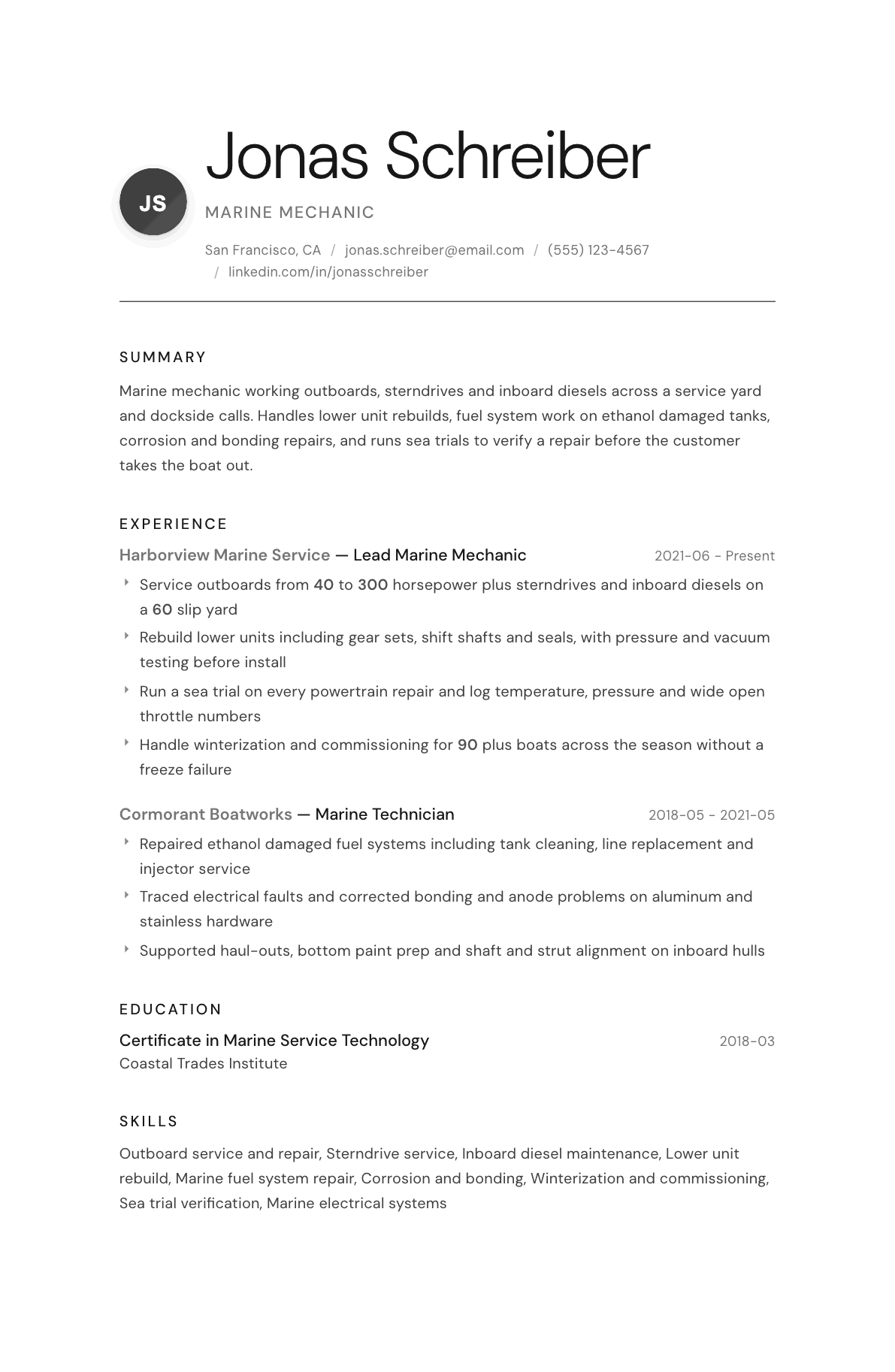
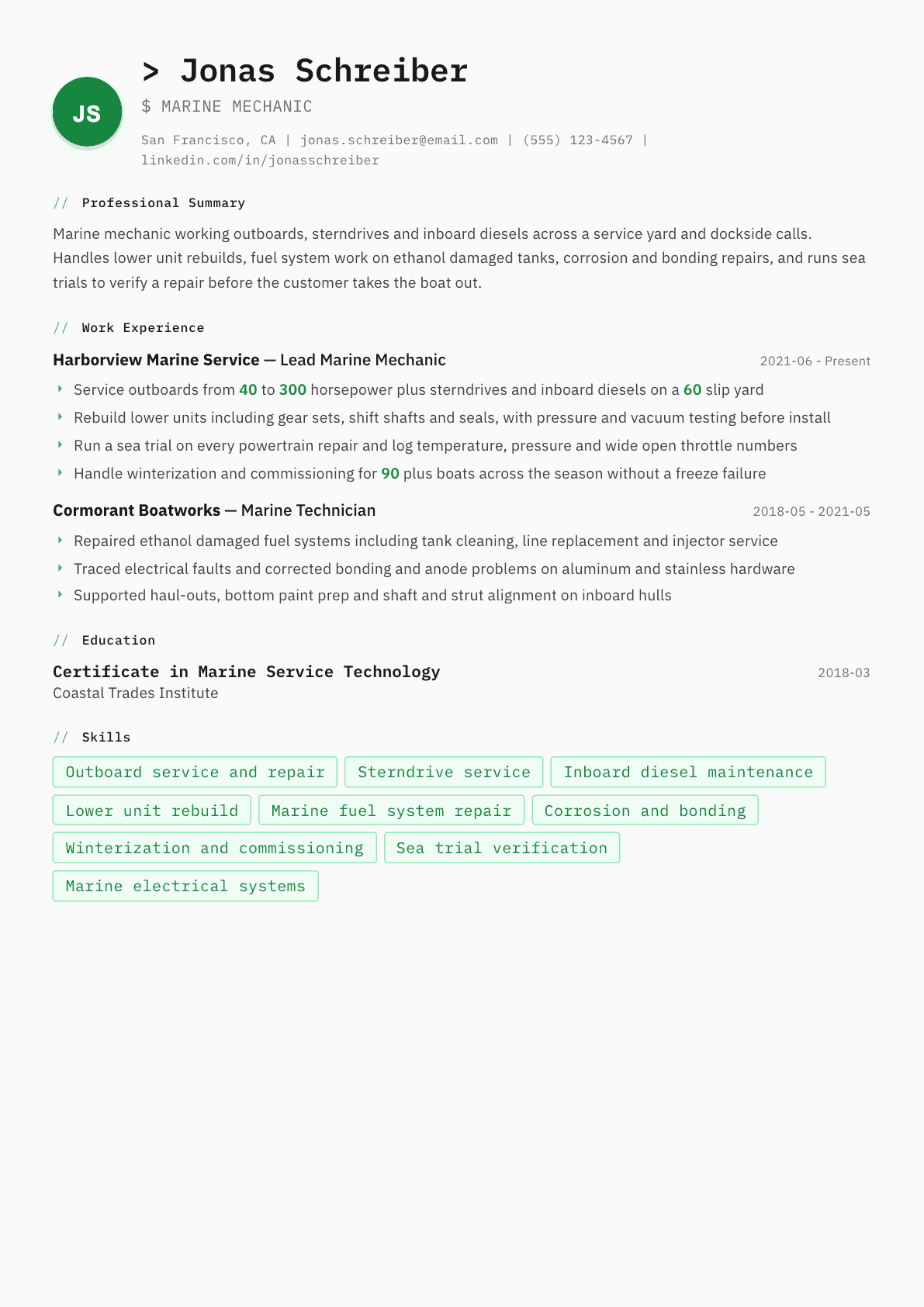
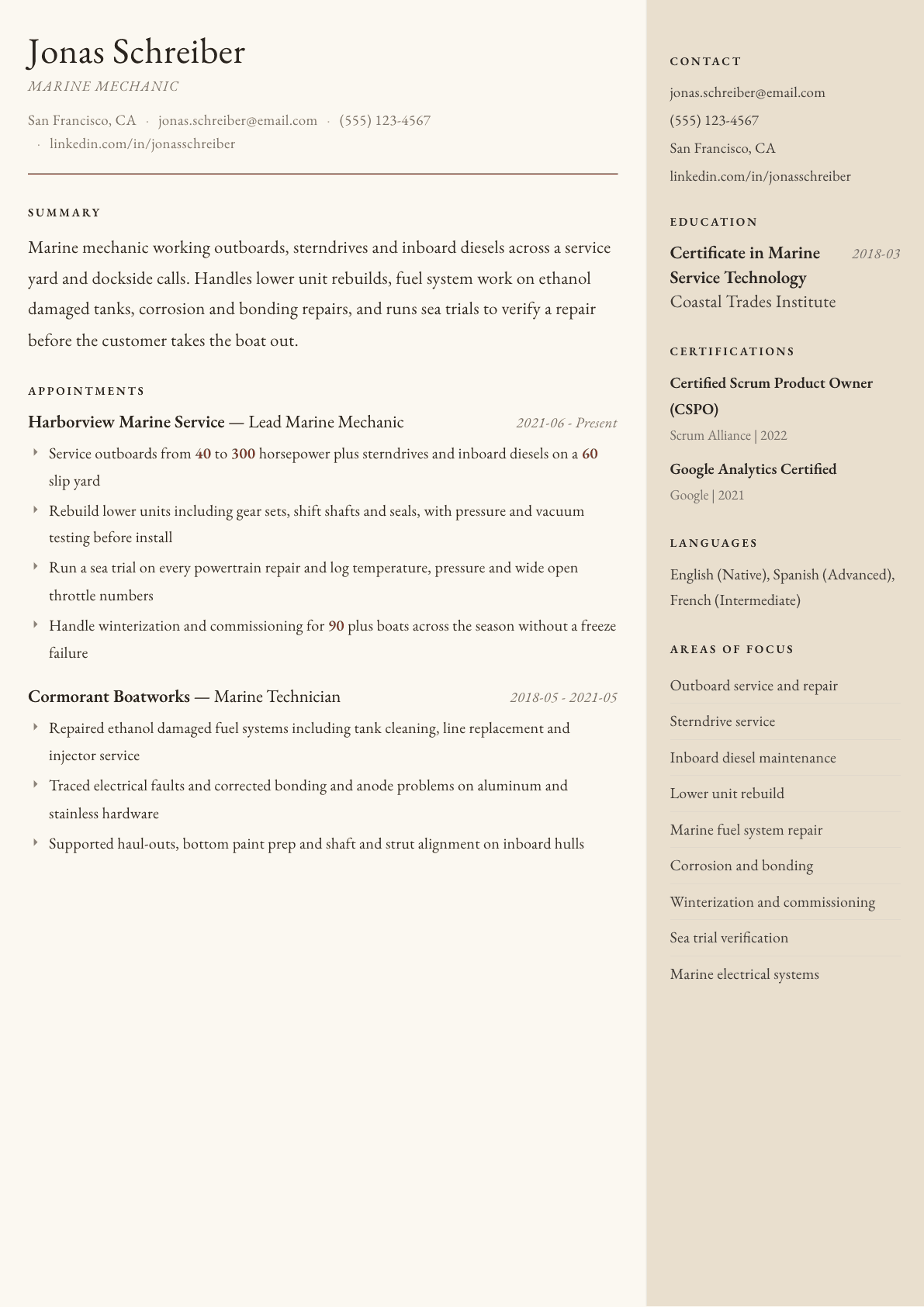
The same marine mechanic content laid out in three CVBooster templates, so you can see what the finished document looks like before you write a word.
Example Marine Mechanic summary
Marine mechanic with seven years across a service yard and dockside calls, covering outboards from small kickers to three hundred horsepower, sterndrives and inboard diesels. Rebuilds lower units with pressure and vacuum testing before install, repairs ethanol damaged fuel systems, and corrects corrosion and bonding faults on mixed metal hardware. Runs a sea trial on every powertrain repair and logs the numbers, and handles a full season of winterization and commissioning.
Skills to list on a Marine Mechanic resume
- Two stroke and four stroke outboard repair
- Sterndrive and transom assembly service
- Inboard diesel maintenance
- Lower unit and gearcase rebuild
- Propeller and shaft service
- Marine fuel system and ethanol damage repair
- Fuel injection and carburetor service
- Marine electrical and wiring
- Corrosion, bonding and anode replacement
- Steering and control cable service
- Winterization and spring commissioning
- Sea trial testing and logging
- Haul-out and bottom prep support
- Warranty and service documentation
What actually gets this resume read
- Separate outboard, sterndrive and inboard diesel experience, because a yard hires for one gap at a time.
- Give the horsepower range and engine brands you have worked on, since parts and tooling follow the brand.
- Say that you run sea trials and log the numbers, because verification is what stops a boat coming back on a trailer.
- Put winterization and commissioning counts on the page, as those seasons carry most of a yard revenue.
- Name your corrosion, bonding and anode work, which separates a marine mechanic from an automotive one.
- List ABYC training by area and mention whether you work dockside, in the yard, or on a service truck.
How to write a marine mechanic resume
Boats fail differently from cars. Salt eats hardware, ethanol destroys fuel systems that sat all winter, and a repair that is merely probably fine becomes a tow bill and an angry customer the moment the boat is a mile from the ramp. A service manager at a yard is hiring for the person who verifies before the customer leaves.
He is also hiring for a gap. Yards rarely need a generalist; they need outboard depth, or sterndrive depth, or someone who can keep inboard diesels running through a charter season. The resume that names its strongest area and shows the range around it gets read. The one that says marine repair and maintenance does not.
This guide covers how to lay out the page for a yard or dealership, how to write powertrain, fuel, electrical and corrosion work so it stands up, how to present sea trials, seasonal volume and training, plus summaries and rewritten bullets.
Format: power type first, then systems, then the season
One page, reverse chronological. The opening block names the power you have worked, split three ways: outboards with a horsepower range, sterndrives with the transom assembly work, and inboard engines with the fuel type. Every hiring conversation in this trade begins there.
The second block is systems: fuel, electrical, steering and controls, corrosion and bonding, and drive train. Marine work is systems work more than engine work, and a mechanic who can trace a bonding fault or a steering complaint is a different hire from one who only turns wrenches on a powerhead.
- Power line: outboard horsepower range, sterndrive families, inboard gasoline and diesel, and brands where you have training.
- Systems block: fuel and ethanol damage, electrical and charging, steering and controls, bonding and anodes.
- Setting line: yard bench work, dockside calls, service truck, or haul-out support, since each is a different job.
- Season line: winterization and commissioning counts, because those two periods carry most of a yard year.
Summary: power, systems, verification
Four lines. What you power you work, the systems you cover, the setting you work in, and the fact that you sea trial your own repairs. Verification is the line that makes a service manager stop, because a boat returning on a trailer is the failure mode he pays for.
If you hold marine industry training, name it here rather than at the bottom. Certification in this trade is uncommon enough that it carries real weight, especially for electrical and systems work where an untrained hand can create a corrosion or safety problem that shows up months later.
Experience: powertrain, fuel and the things salt water does
Open each job with the yard or dealership, its slip count or service volume, and the mix of boats you saw. Then write the technical bullets. Lower unit and gearcase rebuilds with pressure and vacuum testing before install, powerhead work, sterndrive bellows and gimbal service, and diesel maintenance including injector and cooling work.
Fuel deserves a bullet of its own. Tanks that sat with untreated fuel, varnished carburetors, failed hoses, water in the separator, injector cleaning and tank cleaning. This is a large share of what actually arrives at a yard each spring, and a mechanic who handles it quickly is protecting the whole schedule.
Then corrosion and bonding, which is where marine work separates from automotive entirely. Anode selection and replacement, stray current tracing, dissimilar metal problems around stainless and aluminum hardware, and wiring corrected to marine standard rather than automotive habit. Naming this is a strong signal of real yard experience.
Sea trials, winterization and commissioning
Write the sea trial as a procedure, not an outing. Temperature, oil pressure, charging output, wide open throttle reading against specification, steering and shift behavior, and a written log attached to the work order. That is verification a service manager can point at when a customer calls.
Winterization and commissioning are the two blocks of predictable work that fund a yard through the shoulder seasons. Give counts for both, and say plainly whether you had any freeze damage claims, because that is the exact risk the yard carries when it takes the work.
Skills, training and the words yards search for
Marine adverts recycle a compact vocabulary: outboard, sterndrive, inboard, gearcase, lower unit, powerhead, bellows, gimbal, impeller, anode, bonding, ethanol, water separator, sea trial, winterize, commission, haul-out, bottom paint. Use the ones in the advert once in a skills block and once in a bullet where you did the work.
Practical screens matter here too. Whether you can operate a boat, whether you hold a boating safety certificate, whether you are comfortable working over the water and on a lift, and whether you can drive a service truck to a customer dock. Yards ask all of that, so answer it on the page.
Marine Mechanic resume summary examples
First yard season
Marine service graduate through a first full yard season, covering impeller changes, oil and gear lube service, anode replacement and winterization under a lead mechanic. Comfortable working on a lift and around the water, holds a boating safety certificate, and is building toward independent lower unit work.
Five years in
Marine mechanic working outboards from small kickers to three hundred horsepower alongside sterndrives and inboard diesels. Rebuilds lower units with pressure and vacuum testing before installation, repairs ethanol damaged fuel systems, and corrects bonding and anode faults on mixed metal hardware around a busy service yard.
Lead mechanic
Lead marine mechanic covering a sixty slip yard and dockside service calls, taking the escalated electrical and diesel work. Runs a sea trial on every powertrain repair with logged temperature, pressure and throttle numbers, and carried a full season of winterization and commissioning with no freeze failure.
Work experience bullets: before and after
Before: Repaired boat engines at a marina.
After: Serviced outboards from forty to three hundred horsepower plus sterndrives and inboard diesels across a sixty slip yard and dockside calls.
Power range, drive types and setting are how a yard decides which gap on its bench you fill.
Before: Rebuilt lower units.
After: Rebuilt lower units including gear sets, shift shafts and seals, then pressure and vacuum tested each housing before installation.
The test step is what stops a rebuilt gearcase coming back full of water, and it proves procedure.
Before: Fixed fuel problems.
After: Repaired ethanol damaged fuel systems by cleaning tanks, replacing hoses and separators and servicing injectors, on boats stored with untreated fuel.
It names the actual failure and the full repair path rather than a symptom category.
Before: Dealt with corrosion issues.
After: Traced bonding faults and stray current, replaced anodes to the correct alloy, and corrected dissimilar metal contact on stainless and aluminum hardware.
Bonding, anode alloy and dissimilar metals are marine specific knowledge an automotive resume cannot fake.
Before: Test drove boats after repairs.
After: Ran a sea trial on every powertrain repair, logging temperature, oil pressure, charging output and wide open throttle against specification on the work order.
A logged trial with named readings turns a test ride into documented verification.
Hard skills
- Two stroke and four stroke outboard repair
- Sterndrive and transom assembly service
- Inboard gasoline and diesel maintenance
- Lower unit and gearcase rebuild
- Powerhead teardown and reassembly
- Propeller, shaft and strut service
- Marine fuel system and ethanol damage repair
- Carburetor and fuel injection service
- Marine electrical, charging and wiring
- Corrosion, bonding and anode replacement
- Steering and control cable service
- Winterization and spring commissioning
- Sea trial testing and documentation
Soft skills
- Verifying a repair before the customer is on the water
- Working safely over water and on a lift
- Explaining a corrosion problem the owner did not cause today
- Holding schedule through the launch rush
- Documenting a job so the next mechanic can pick it up
Certifications worth listing
- ABYC Marine Systems Certification (American Boat and Yacht Council)
- ABYC Marine Electrical Certification (American Boat and Yacht Council)
- ABYC Diesel Engine and Support Systems Certification (American Boat and Yacht Council)
Mistakes that cost marine mechanic candidates the interview
- Writing marine repair as one skill instead of splitting outboard, sterndrive and inboard work by power type.
- Leaving horsepower range and brands off the page, so a yard cannot judge whether its tooling matches your hands.
- Skipping corrosion, bonding and anode work, which is the clearest evidence of genuine marine experience.
- Never mentioning sea trials, when unverified repairs are the failure a service manager pays for most often.
- Giving no winterization or commissioning counts, and so hiding the two seasons the yard schedule is built on.
- Ignoring the practical questions: boat handling, working over water, and whether you can run a service truck.
Marine Mechanic resume questions
Can I move into marine work from automotive?
Yes, and yards hire that way regularly. Lead with engine, fuel and electrical fundamentals, then be explicit about what you have not done: gearcases, bonding, anodes and sea trials. Naming the gap honestly gets you further than implying marine experience you lack.
How important is ABYC training?
It carries real weight, particularly in electrical and systems work where mistakes cause corrosion or safety problems long after the invoice. Even one certification signals that you work to a published standard rather than to automotive habits carried onto a boat.
Should I mention winterization work on a resume?
Yes, with counts. Winterization and commissioning are large predictable revenue blocks for a yard and they carry real risk, so a mechanic who has handled a full season without a freeze claim is proving both throughput and care.
Do yards want diesel experience specifically?
Many do, because inboard diesel owners spend heavily and there are fewer technicians who can support them. If you have diesel time, separate it from gasoline work and name the maintenance and diagnosis you performed rather than folding it into general engine repair.
How do I handle seasonal layoffs on my resume?
Label them as seasonal, which every yard manager understands, and say what you did in the off months. Off season training, storage and rigging work, or a trade job all read as normal, while an unexplained winter gap invites a question you would rather answer once.
Related resume examples
- Marine Engineer Resume example
- Mechanic Resume example
- Diesel Technician Resume example
- Small Engine Mechanic Resume example
- Motorcycle Mechanic Resume example
- Calibration Technician Resume example