Camera Operator Resume Examples: the lines they read
Write a Camera Operator Resume for Studio and Field Work
By Mustafa Tarabya, founder of CVBooster · Published · Updated
Camera operator resume example with rig, format and live production detail, union and credit notes, keywords and a writing guide.
Sample resumes for a camera operator
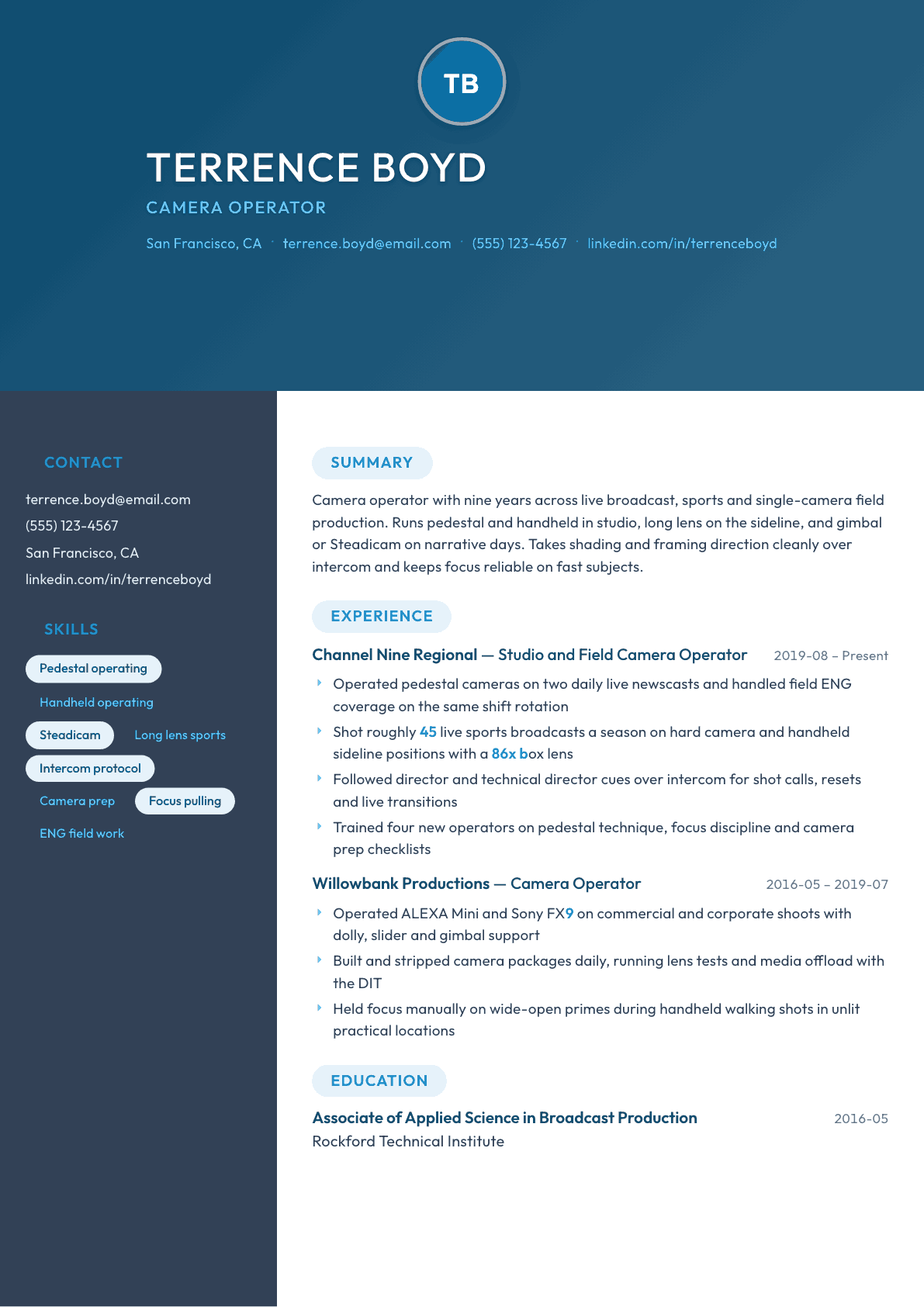
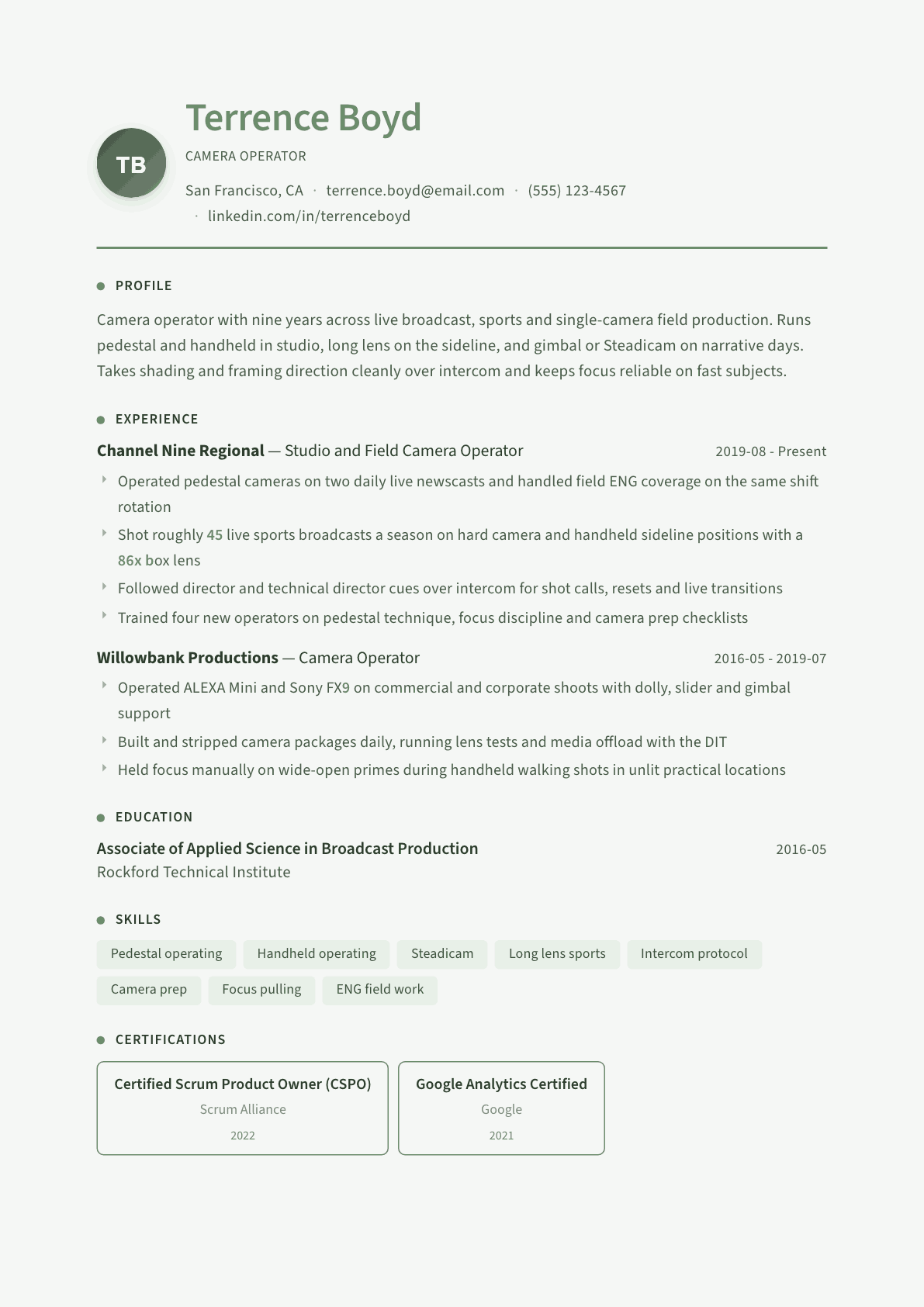
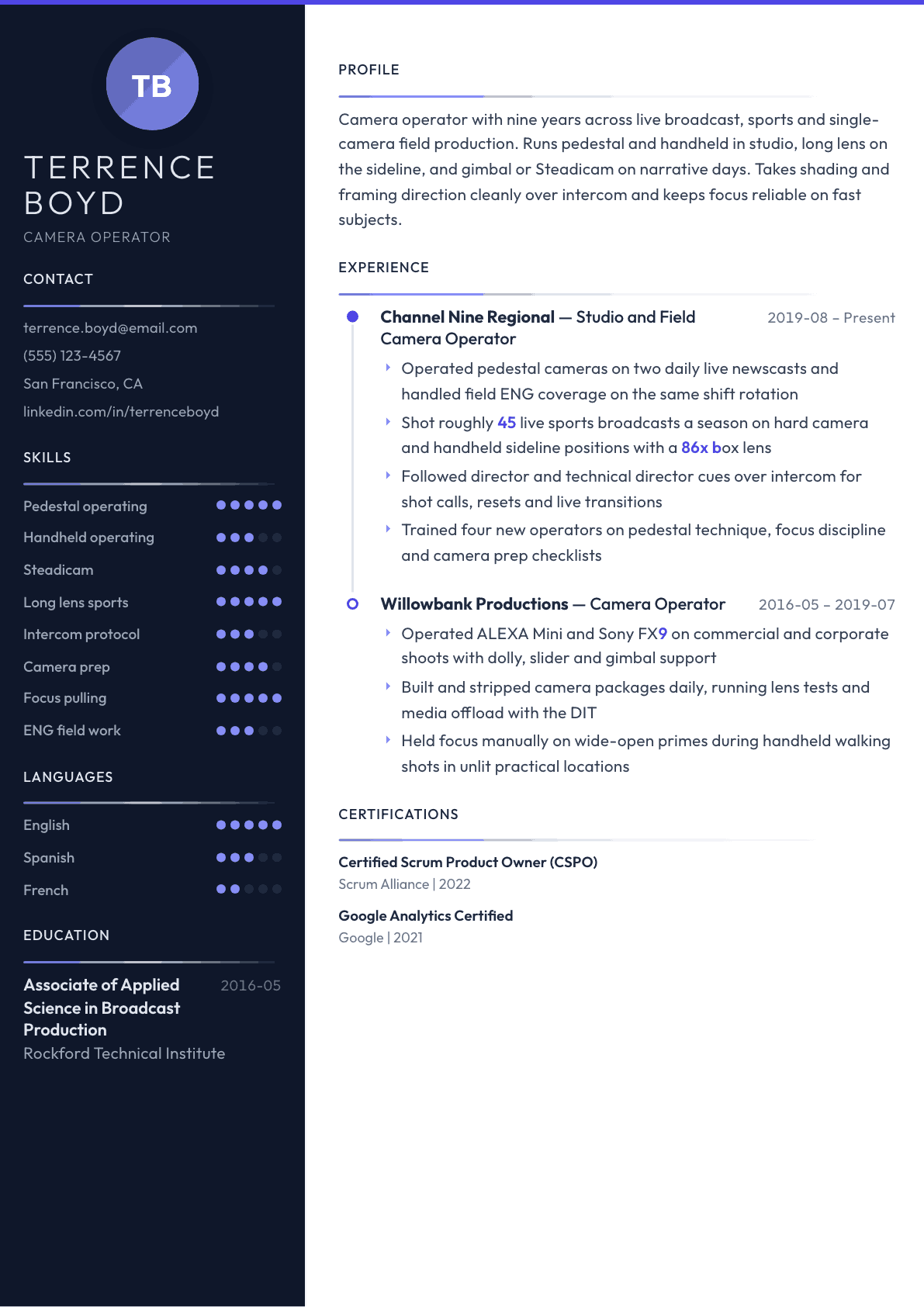
The same camera operator content laid out in three CVBooster templates, so you can see what the finished document looks like before you write a word.
Example Camera Operator summary
Camera operator with nine years split between live broadcast and single-camera field production. Runs pedestal on daily newscasts, long lens on the sideline for regional sports, and gimbal or Steadicam on narrative and commercial days. Takes framing and reset calls cleanly over intercom, preps and troubleshoots packages without a technician, and holds focus wide open in low light.
Skills to list on a Camera Operator resume
- Pedestal camera operating
- Handheld operating
- Steadicam and gimbal
- Long lens sports coverage
- Jib and dolly work
- Manual focus pulling
- Intercom and cue protocol
- Camera prep and troubleshooting
- ENG field production
- Multicamera live shows
- Media offload
- Lens testing
- Grip and support rigging
- Set safety
What actually gets this resume read
- State the rigs you operate by name: pedestal, jib, Steadicam, gimbal, handheld, long lens hard camera, remote head.
- Split live broadcast credits from single-camera film credits, because the two hiring paths look for different habits.
- Mention intercom discipline and how you take direction, since live shows hire on reliability under a director cue.
- Name the camera bodies and lens systems you have real hours on, and say which you can prep and troubleshoot alone.
- If you carry a union membership, list the local and status plainly, because it decides which productions can book you.
- Include your own kit and whether you travel, since owner-operator availability often decides a booking.
How to write a camera operator resume
Camera operating splits into two hiring paths that barely speak to each other. Live broadcast wants somebody who holds a frame, takes a director call cleanly over intercom and never misses a reset. Single camera film and commercial work wants somebody who can build a package, carry a shot through a move and hold focus wide open in a dark practical location. A resume that fails to say which path you come from makes both readers work.
What both share is a preference for verifiable hours on specific rigs. Pedestal, jib, long lens hard camera, remote head, handheld, Steadicam and gimbal are separate physical skills, and nobody believes an applicant who claims all of them without dates and productions attached.
This guide covers how to organize credits by path, which rigs and bodies to name, why intercom discipline belongs on the page, what union status changes, and how owner operator gear and travel affect a booking.
Format: one page, two credit blocks
Keep it to a page and split the experience into a live and multicamera block and a single camera block. Within each, list the production or facility, your position, the rigs you ran and the volume in shows or shooting days. A director of photography or a technical director scanning the page should find their own world within a few seconds.
Add a short technical section for camera bodies, lens systems and support, and a line on your own kit. If you carry a reel, keep it brief and use it for operating rather than for lighting or editing, since that is what is being judged.
- Header: name, city, phone, email, union local and status if applicable, travel availability.
- Sections: summary, live and multicamera experience, single camera experience, technical skills, owned kit, education.
- Say whether you hold a valid driver license and can transport gear, since many bookings depend on it.
Summary: rigs, genres, direction style
Name the rigs you actually run, the genres you run them in, and how you take direction. A summary that says you operate pedestal on daily newscasts, long lens on the sideline for regional sports and gimbal on narrative days tells a booker exactly which calls to make.
Add reliability under a cue. Live shows do not hire on artistry, they hire on the operator who resets fast, follows shot calls without hesitation and never leaves the director without a frame. Saying that plainly puts you ahead of applicants who only describe their eye.
Live and multicamera: volume, positions, protocol
Count shows, not months. Forty five live sports broadcasts a season on hard camera and handheld sideline positions is a claim a technical director can size instantly. Add the newscast rotation if you have one, since daily live television builds habits that occasional work does not.
Name the positions rather than the genre alone: hard camera, sideline handheld, high home, low slash, robotic and remote head. Then the lens class you have worked, because a long box lens on a sideline is a different discipline from a studio zoom.
Intercom discipline is worth a bullet of its own. Describe following the director and technical director on shot calls, resets and live transitions, taking shading notes from the video operator, and acknowledging cleanly without cluttering the channel. Live crews talk about this constantly and almost nobody writes it down.
Single camera: prep, movement, focus
For film and commercial work, give the bodies and lens sets, the support you ran, and whether you built and stripped the package yourself. Being able to prep a camera, run a lens test and troubleshoot without a technician is a real hiring advantage on small crews.
Then movement and focus. Steadicam and gimbal are separate skills with separate physical demands, and manual focus at a wide aperture during a handheld walking shot is a specific claim worth making because it is easy to verify on set and hard to fake.
Mention media handling with the data manager, because on smaller shoots the operator often carries part of that responsibility, and a lost card is remembered longer than a beautiful frame.
Union status, kit and availability
If you hold a union membership, list the local and your status plainly near the top. It decides which productions can book you and it is one of the first filters a production manager applies. If you are not a member, do not draw attention to it; simply present the work.
Then owned kit and travel. Owner operators get booked for jobs that would otherwise need a rental order, and stating a travel radius or a willingness to fly with gear turns you into a candidate for productions outside your market.
Camera Operator resume summary examples
Two years in a station
Camera operator with two years at a regional station running pedestal on a daily newscast and handling field coverage on the same shift rotation. Comfortable on intercom with director and technical director calls, preps and troubleshoots studio cameras, and has operated handheld on roughly 20 live high school sports broadcasts.
Five years, live and field
Camera operator with five years across live broadcast and single camera field production. Runs pedestal on daily newscasts, long lens hard camera on regional sports, and handheld or gimbal on commercial days. Builds and strips camera packages independently, runs lens tests, and holds focus manually on wide open primes.
Nine years, broadcast and narrative
Camera operator with nine years split between multicamera live broadcast and single camera work. Operates pedestal, long lens sideline and Steadicam, covers roughly 45 live sports broadcasts a season, and has run ALEXA Mini and Sony FX9 packages on commercial shoots. Trains new operators on pedestal technique and camera prep.
Work experience bullets: before and after
Before: Operated cameras for live television.
After: Operated pedestal cameras on two daily live newscasts and handled field coverage on the same shift rotation, working from a rundown and director cues.
Naming the show count, the rig and the rundown makes the daily reality of the job visible.
Before: Shot sports for the station.
After: Shot roughly 45 live sports broadcasts a season from hard camera and handheld sideline positions, working a long box lens with a shader on intercom.
Season volume plus the specific positions and lens class tells a technical director exactly what you can cover.
Before: Followed the director during live shows.
After: Followed director and technical director cues over intercom for shot calls, resets and live transitions, acknowledging cleanly without adding traffic to the channel.
Turning a generic obedience claim into a description of protocol shows you have actually worked a live crew.
Before: Used professional cinema cameras on shoots.
After: Operated ALEXA Mini and Sony FX9 on commercial and corporate shoots with dolly, slider and gimbal support, building and stripping the package daily.
Adding the support gear and the package responsibility shows you can work without a dedicated technician.
Before: Trained other camera operators.
After: Trained four new operators on pedestal technique, focus discipline and a camera prep checklist that cut pre show setup issues on the studio floor.
The named subjects and the operational result make the training claim concrete rather than incidental.
Hard skills
- Pedestal camera operating
- Handheld operating
- Steadicam and gimbal
- Long lens sports coverage
- Jib and dolly work
- Manual focus pulling
- Intercom and cue protocol
- Camera prep and troubleshooting
- Field production and electronic news gathering
- Multicamera live shows
- Media offload
- Lens testing
- Grip and support rigging
Soft skills
- Set safety awareness
- Composure on live air
- Taking direction without friction
- Physical stamina
- Punctuality
- Crew communication
Certifications worth listing
- Remote Pilot Certificate, Part 107 (Federal Aviation Administration)
- OSHA 10-Hour General Industry (Occupational Safety and Health Administration)
Mistakes that cost camera operator candidates the interview
- Merging live broadcast and single camera credits into one list, so neither hiring path can find its own evidence.
- Claiming every rig from remote head to Steadicam without any production or hours attached to the harder ones.
- Leaving out show or shooting day counts, which are the only units a booker uses to size an operator.
- Skipping intercom and cue protocol when live crews hire almost entirely on reliability under direction.
- Burying union local and status at the bottom when it is one of the first filters a production manager applies.
- Failing to say whether you own kit and travel, since owner operator availability frequently decides a booking.
- Submitting a reel that showcases editing and music rather than sustained operating within a take.
Camera Operator resume questions
Should live broadcast and film credits be on the same resume?
Yes, but in separate blocks with clear headings. The two hiring paths look for different habits, and a reader filling a studio rotation should not have to untangle commercial shooting days to find your newscast experience.
How do I prove Steadicam experience?
Attach it to productions and days rather than listing it as a skill. Name the rig class, the shooting days or shows you carried it on, and any specific sequences in your reel, because the physical demand makes false claims obvious very quickly on set.
Does union membership belong on a camera operator resume?
If you hold it, list the local and your status in the header. It determines which productions can book you at all. If you are not a member, present the work without commentary rather than explaining your status on the page.
How much gear detail should I include?
Enough to answer the booking question. Bodies and lens systems you have real hours on, the support you run, and which packages you can prep and troubleshoot alone. Then a separate line for kit you personally own and can bring.
What if I have no formal training in camera operating?
It matters far less than logged hours. List a technical or broadcast program if you completed one, then let show counts, shooting days, rigs and the productions that rehired you carry the argument, since this trade is judged mostly on repetition.