How Long Should a Resume Be? The Honest Answer
By Mustafa Tarabya, founder of CVBooster · Published · Updated
12 min read
One page if you have under about ten years of relevant experience, two pages if you have more. That is the working answer and it is right most of the time. But the page count is a result rather than a target, and the number of people who get it wrong by aiming at it directly is the reason this question keeps being asked.
What follows is the decision: what actually sets the length, how far back your history should run, and what your own page count should be. The mechanics of building a two-page document, where the break falls and what must never straddle it, are a separate job and they are in the two-page resume.
Should resumes only be one page? Where the rule came from
It is a convention, not a law, and knowing its origin tells you when it applies.
No. A resume should be one page only when one page holds everything that earns its place, which for most people means under about ten years of relevant work. The rule itself comes from an era when a resume was a physical object. Applications arrived by post and by fax, were photocopied for a panel, and were read as paper on a desk. In that world a second page was a genuine cost: it doubled the copying, it could be separated from the first page and lost, and a stack of two hundred applications was twice as heavy. One page was a courtesy with a physical justification behind it.
Every part of that justification has gone. Nothing is photocopied, nothing gets separated, and a reviewer scrolling a PDF experiences a page break as a faint horizontal line. Yet the rule survives, and it survives for a reason worth respecting: it is a good proxy for something else.
What it actually measures is editing discipline. A candidate who can compress a career onto one page has demonstrated that they can decide what matters, and deciding what matters is a large part of most jobs. That is why the advice persists among people who know it is not a rule. They are not counting pages. They are reading the page count as evidence about you, and a document that is one page because it was edited reads differently from a document that is one page because there was nothing to say.
This also tells you when the convention has no force at all. It is applied hardest in the United States, loosely in the UK and Ireland where two pages is the ordinary expectation, and not at all to an academic CV, where the document is a record rather than a pitch. Where the market's expectation is two pages, one page reads as thin rather than disciplined.
What actually determines the length?
Three things, and none of them is your seniority in the abstract.
- How much relevant material you have. Relevant is the operative word. Twenty years of experience in a field you are leaving generates less usable material than six years in the field you are entering.
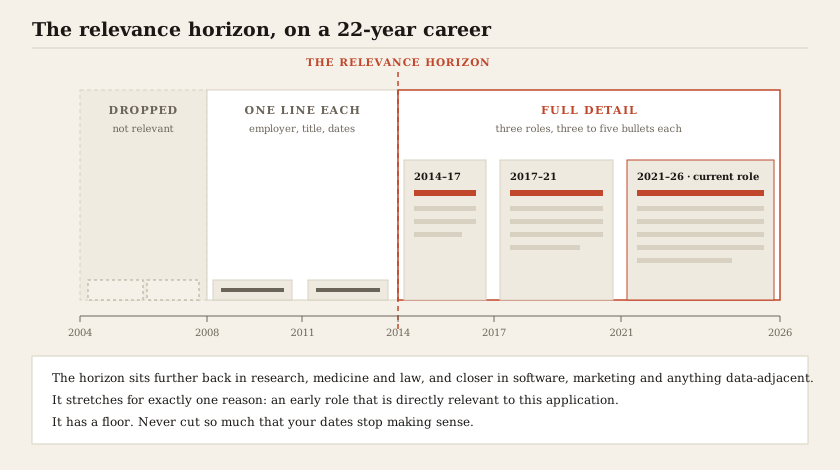
- How far back relevance runs. A career has a horizon beyond which the reader stops caring, and the position of that horizon varies by field. Everything past it gets compressed to a line or dropped, which is what actually controls the size of the document.
- What the destination expects. A posting that specifies a page limit overrides everything on this page. A public-sector or academic process that specifies a format overrides it twice.
Put those together and the length falls out on its own. You are not choosing two pages. You are establishing what is relevant, deciding how far back that runs, writing it properly, and then observing how long the result is. If the observation surprises you, the answer is nearly always in the first two variables rather than in the formatting.
How far back should a resume go?
Roughly the last ten to fifteen years in full detail, and this is the single most useful idea in the whole length question, because it is the thing that actually does the cutting.
Think of it as a relevance horizon. Inside it, roles get their own entry with bullets. Outside it, roles are still true and still yours, and they no longer earn individual bullets. They collapse into a short block: a heading such as Earlier career, then one line per role with employer, title and dates, and nothing else. Or, if a role is genuinely irrelevant and old, they go entirely.
The horizon is not a fixed number of years. It moves for real reasons:
- It sits further back in fields where deep continuity is the point, such as academic research, medicine, law and specialist engineering, where a decision made fifteen years ago may still be the most interesting thing about you.
- It sits closer in fields where the tooling turns over, such as software, marketing and anything data-adjacent, where a role that ended in 2011 describes a set of tools that no longer exist.
- It stretches for one specific reason: an early role that is directly relevant to this application. A five-year gap in your resume followed by "Ward Manager, 2006 to 2009" is worth keeping if you are applying back into nursing management, whatever the date says.
- It has a floor. Do not delete so much that your dates stop making sense. An unexplained hole is a worse problem than an old job, and gaps have their own handling in employment gaps.
How long, for your situation?
The general rule is easy to agree with and hard to apply to yourself, so here it is broken down. Everything about specific candidates below is invented as illustration.
A first resume
One page, and it should be a full one. The difficulty here is never too much material, it is a half-empty page that you are tempted to inflate with a hobbies line, an unfinished course and a list of eight software packages you have opened once.
The fix is not padding but scope. A university project, a summer job and a society role are all real entries with real bullets if you write them as work rather than as biography: what you did, at what scale, what came of it. A graduate with three properly written entries fills a page honestly. A graduate with nine thin ones does not. High school students applying to college follow the same one page rule on an activity resume.
Three to seven years
One page, still, and this is the range where compressing is genuinely correct rather than merely conventional. You have two or three roles, and two or three roles written well is a page. If your draft runs to a page and a quarter, the problem is almost always the oldest job carrying as many bullets as the newest one.
Eight to fifteen years
This is the genuine boundary, and it is decided by content rather than by the year count. Ask one question about your draft second page: would deleting it remove anything the employer is looking for?
If your last decade is three or four substantial roles with distinct evidence in each, two pages is correct and squeezing them into one costs the reader information. If it is one long role plus a couple of short ones, one page is correct and a second page will be padding. Two people with identical service can honestly end up at different lengths.
Fifteen years and beyond
Two pages, comfortably, and the work is at the far end rather than the near one. Everything before the horizon compresses into the earlier-career block. The instinct to give a twenty-year career twenty years of bullets is what produces three pages, and the reader's attention has run out long before page three.
One thing to protect: gating credentials. A registration number, a licence, a chartered status or a mandatory certification is something the reader is actively checking for, and it must be on page one even if the roles that earned it are on page two.
Academic, research and specified formats
No limit, and no attempt at one. An academic CV is a record measured against published criteria, and compressing it defeats its purpose. The same override applies wherever the employer specifies: a stated page limit, a required template or a structured application form outranks every general rule here. Read the instruction and follow it exactly, including when it contradicts this page.
Contract, agency and portfolio careers
The hardest case, because a genuine two-year period may contain nine short assignments and listing them individually consumes a page on its own while making you look unstable, which is the opposite of the truth.
Group them. One entry for the agency or the umbrella, with the full date span, and then the individual placements as a compact list of clients and durations underneath. Consultants and freelancers can do the same with a single Independent Consultant entry covering the whole period and three or four representative engagements beneath it. This is a compression that gains information rather than losing it, because the grouped version shows continuity that the fragmented version hides.
What does compressing to one page cost you?
More than people expect, and the cost is usually paid in the wrong currency.
When a document will not fit, the tempting fixes are all formatting: drop the font to nine point, narrow the margins to a centimetre, remove the space between sections, set the line height tighter. Each of those is invisible to you, because you have been staring at the layout, and highly visible to a reader meeting it cold. A wall of nine-point text with no margins does not read as a candidate who edited well. It reads as a candidate who could not let go, which is exactly the signal the one-page convention was supposed to reward you for avoiding.
The second cost is worse because it is silent. To make room, people delete the specifics: the number, the tool name, the scale, the outcome. What survives is the general statement, because general statements are shorter. You end up with a tidy one-page document in which nothing is checkable, having deleted the only parts a reader could have been persuaded by.
Tip: If your resume does not fit, cut a whole item rather than shaving every line. Deleting the weakest bullet from your third job is invisible. Taking a point off the font size is not, and it costs you the same amount of space.
What does padding to two pages cost you?
The mirror image, and it is more common than people admit because a second page feels like seniority.
A page and a quarter is the worst outcome available in this whole question. It has none of the discipline of one page and none of the substance of two, and the second page is visibly mostly white, which draws the eye to how little is on it. Either fill the second page properly or return to one.
The tell-tale contents of a padded second page are consistent: a references line, an interests section, an unfinished course, a software list that has grown to eleven items, and a job from 2009 with four bullets. Every one of those is a decision not made. What a reader takes from it is not that you have done a great deal. It is that you could not tell which parts mattered, which is a judgement about you rather than about the document.
Does anyone actually count the pages?
Almost nobody counts. What happens is faster and less deliberate than counting, and understanding it is what makes the rest of this page make sense.
A first pass through a stack of applications is a filtering exercise, and filtering happens on the first screen. The reader forms an impression from the top third of page one and then either keeps reading or stops. Length affects that only indirectly: a document that looks dense and cramped signals one thing, a document that looks airy and thin signals another, and both signals arrive before a single word is read.
Software does not care at all. A parser reads a continuous text stream and has no opinion about where the pages divide. This matters because it inverts the usual anxiety: the layout tricks people use to force a resume onto one page do far more damage to a parse than a second page ever could. The mechanism behind that is in ATS resumes in 2026.
So the practical consequence of length is not a rejection at page two. It is that everything on page two might not be read, which means the length question quietly becomes a placement question: what has to be on page one, given that page two is optional? The two-page resume answers that in detail.
Is length different for a CV?
Yes, and the difference is larger than the resume-versus-CV terminology suggests. Two pages is the ordinary expectation in the UK, Ireland and most of continental Europe rather than a concession, and a fifteen-year career compressed onto one page there reads as under-experienced. An academic CV has no ceiling at all. For UK applications with less experience, the 1 page CV examples show six complete one page CVs and when to move to two.
If you are applying across borders, the length convention travels with the market rather than with you, and it is one of four or five things that change. Which document to send is settled in CV vs resume, and what a good example looks like in each market is in CV examples.
The check before you send it
- Your page count is the result of writing what is relevant, not a target you formatted towards.
- Nothing older than your relevance horizon carries bullets, except where it is directly relevant to this application.
- Your dates still make sense after the cuts, with no unexplained hole.
- Any gating credential is on page one.
- No page is between one third and two thirds full. Fill it or lose it.
- The font size and margins are the ones you would have chosen if the document had fitted comfortably.
- If the posting states a length, that number wins, and it wins over everything above.
The whole question resolves to one sentence. Write everything that is relevant, cut everything that is not, and then look at how many pages you have, because that number was never yours to choose in the first place. If it came out at two, the two-page resume covers building it properly, and the resume review is the read-through to run before you send it.
Related articles
- Is a 2-Page Resume OK? When It Works, With a Sample
- Hard Skills for a Resume: How to List Them
- How to Use a Resume Example Without Copying It
- Resume Skills Section: Layout and Placement
More articles
- Bad Resume Examples: 10 Mistakes and the Fixed Version
- Objective Examples in a Resume: 12 Samples by Situation
- Resume Spelling: The Errors Spellcheck Misses
Looking for a worked example for your job title? Browse the resume examples by job title.