Videographer Resume Examples: free ATS score and gap list
Build a Videographer Resume for Shoot and Post Work
By Mustafa Tarabya, founder of CVBooster · Published · Updated
Videographer resume example and a videography resume template filled in: camera, audio and edit detail, delivery specs and equipment owned.
Sample resumes for a videographer
The same videographer content laid out in three CVBooster templates, so you can see what the finished document looks like before you write a word.
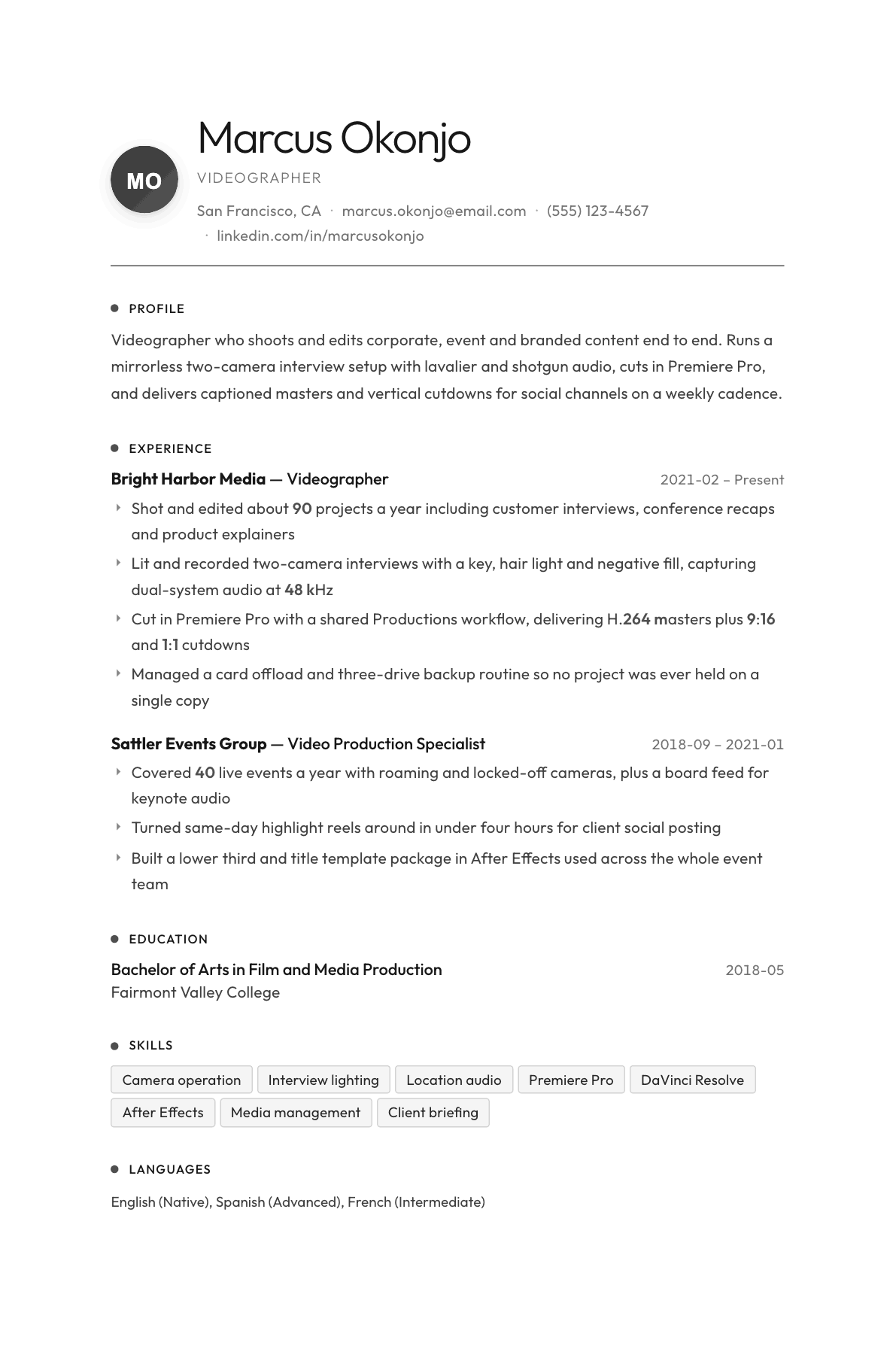
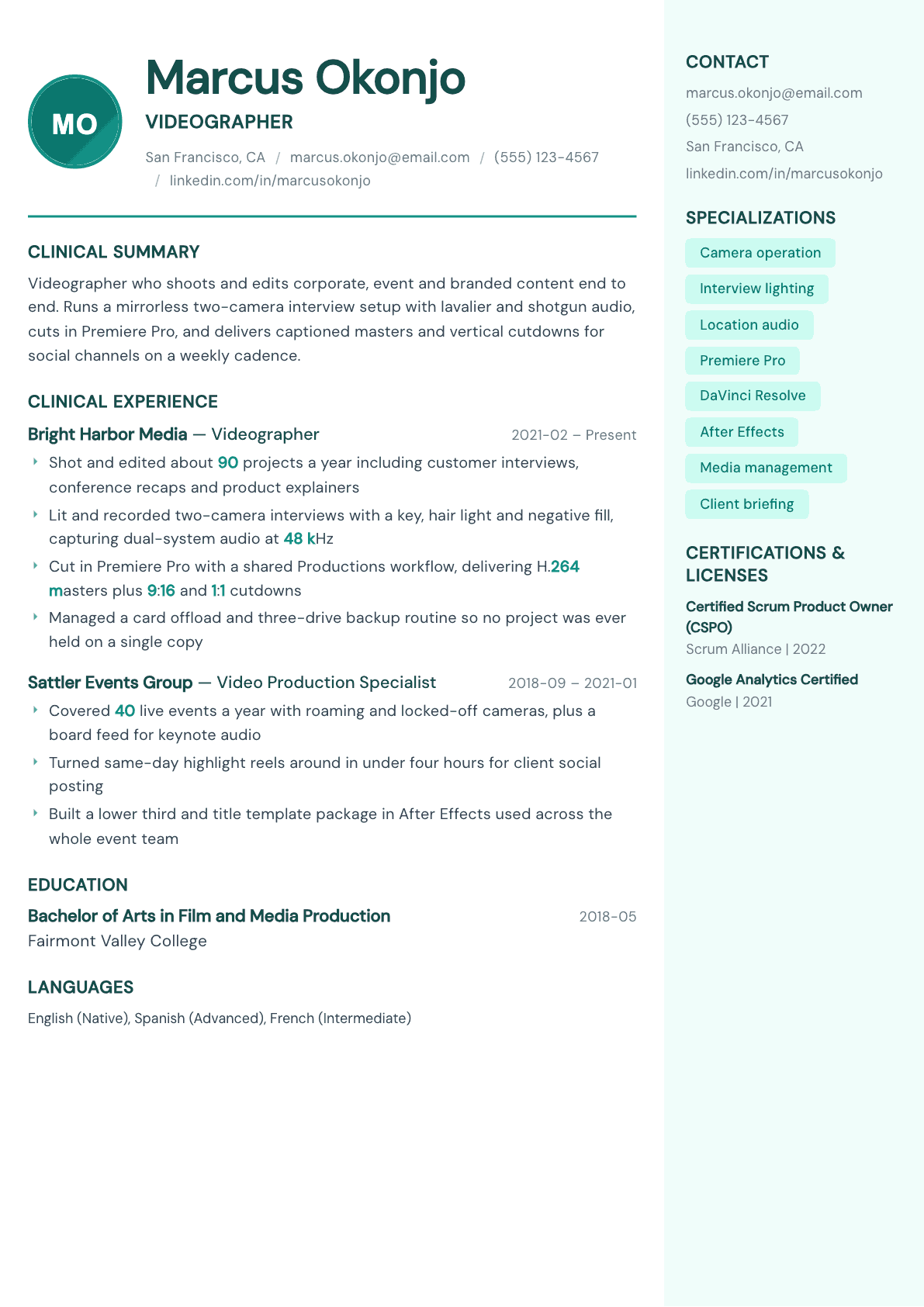
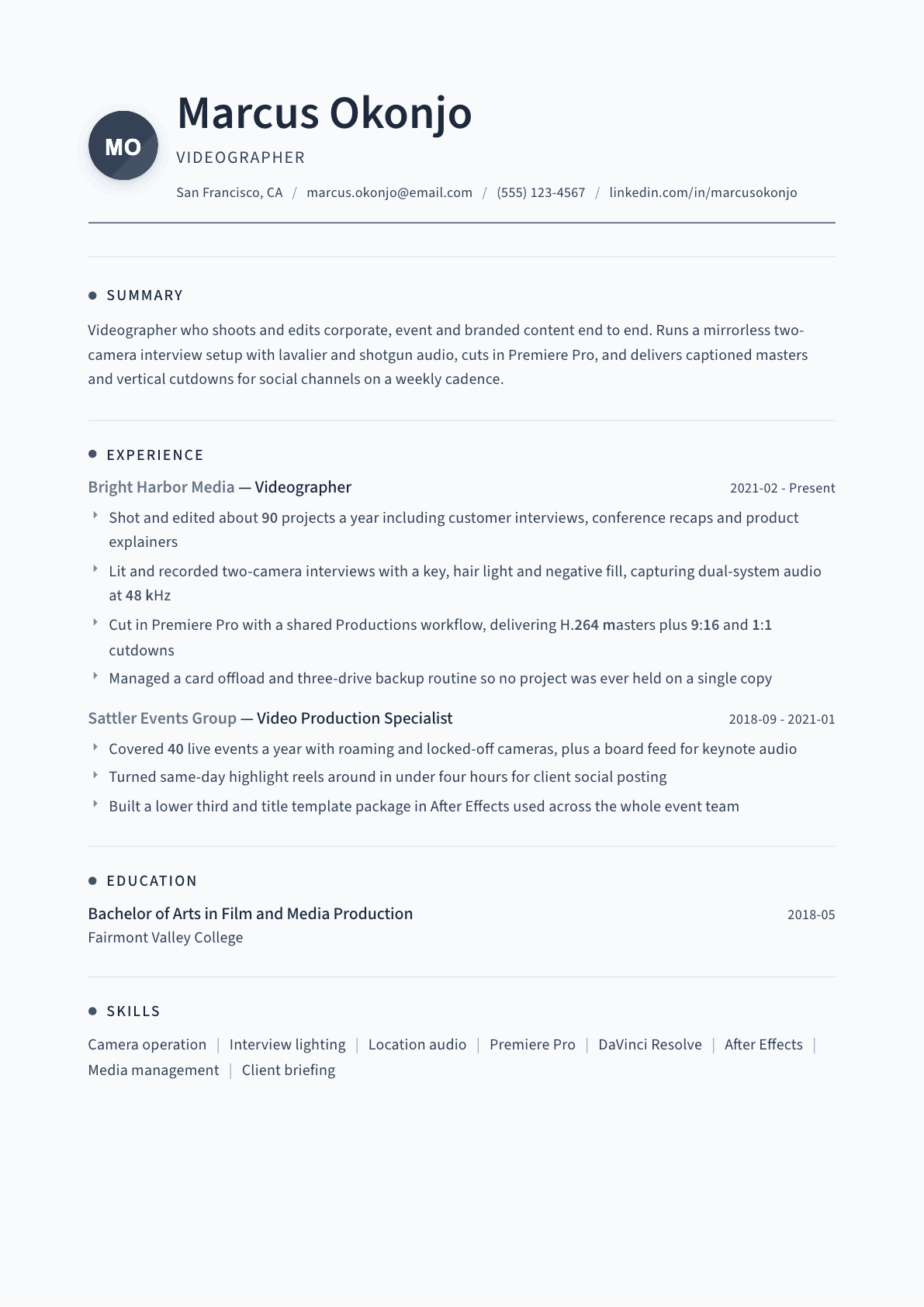
Example Videographer summary
Videographer who owns projects from brief to final delivery: interview lighting, two-camera coverage, dual-system audio, edit, color and captions. Delivers roughly ninety corporate and event pieces a year in Premiere Pro with social cutdowns in vertical and square. Runs a disciplined offload and backup routine and briefs clients directly on scope, timeline and revisions.
Skills to list on a Videographer resume
- Camera operation
- Interview lighting
- Location audio recording
- Gimbal and handheld work
- Premiere Pro
- DaVinci Resolve
- After Effects
- Color correction
- Audio sweetening
- Media management and backup
- Storyboarding
- Client briefing
- Captioning and accessibility
- Social cutdowns
What actually gets this resume read
- Say clearly whether you shoot only, edit only, or run the whole project, because one-person-band roles are a separate hire.
- Name your bodies, lenses, lights and audio chain, since a producer needs to know what you own before booking you.
- Give your project volume per year and your typical turnaround, which together describe your realistic working pace.
- List the delivery formats you handle: codec, frame rate, captions, aspect ratio variants and the platform specs you meet.
- Include lighting and audio detail explicitly, because bad sound is the most common reason a corporate video gets rejected.
- Put a reel link in the header and keep it under two minutes with the strongest twenty seconds first.
How to write a videographer resume
Most videographer postings are really asking for a one person department. Somebody who scopes the brief, lights and shoots the interview, records clean audio, cuts the piece, colors it, adds captions and exports the vertical and square variants before the campaign date. A producer reading your resume is checking whether you can carry that whole chain alone or whether they will need to hire around your gaps.
The gaps that matter most are audio and delivery. Corporate video is rarely rejected for camera work. It gets rejected because the interview sounds like a room, or because the file came back in the wrong frame rate, without captions, or in a single aspect ratio when three were needed.
This guide covers how to state your scope honestly, what to include about lighting and the audio chain, how to describe project volume and turnaround together, and how to present delivery specifications so a producer stops worrying.
Format: one page with the reel link at the top
One page, reel link in the header. Keep the reel under two minutes and lead with the strongest twenty seconds, because a producer decides early and rarely returns. Where possible, link a full finished piece alongside the reel so a reviewer can hear the audio, read the captions and see whether the story holds for three minutes rather than for a cut sequence.
State your scope in the first line under your name: shoot and edit, shoot only, or edit only. This single clarification saves both sides a wasted conversation, and one person band roles are budgeted differently from crew positions.
- Header: name, city, phone, email, reel link, and travel radius or willingness to fly.
- Sections: summary, experience, equipment owned, technical and delivery skills, education.
- Note whether you hold your own liability insurance and whether you can invoice as a contractor.
Summary: scope, project types, volume, turnaround
Say what you own end to end, then the content types you have made: customer interviews, conference recaps, product explainers, recruiting films, event highlight reels, social cutdowns. Then the annual project volume and the turnaround you hold. Volume and turnaround together describe your working pace better than any claim about efficiency.
If you have a live event background, keep it visible. Same day highlight turnaround under pressure is a distinct skill and it reassures a producer about deadlines in a way that a portfolio of unhurried brand films does not.
Experience: the interview setup is the tell
The interview is the workhorse of corporate video and it is where a producer looks for competence. Describe the setup: two camera coverage with a wide and a tighter angle, a key light with a soft source, hair light and negative fill, and a subject placed off center with background separation. That paragraph tells an experienced reader you have lit real people in real offices, not just followed a diagram.
Then the audio chain, explicitly. Lavalier and shotgun in combination, dual system recording, sample rate, a backup track at a lower level, and how you handled a noisy room. Audio is where corporate video quietly fails, and almost nobody puts it on a resume.
Give the edit workflow next: the application, the project structure for shared or multi editor work, media relinking, and how you keep a project openable by somebody else six months later. Producers who have inherited an orphaned project file care about this more than they can easily explain.
Finish the block with media handling. Card offload with verification, a two or three drive routine before the cards are formatted, and an archive plan. It is one line and it separates professionals from enthusiasts.
Delivery: codecs, ratios, captions
List what you deliver, not just what you shoot. Master codec and container, frame rate and resolution, loudness handling for the audio mix, burned in and sidecar caption files, and the aspect ratio variants: full frame, square and vertical. Naming these makes you sound like somebody who has read a platform specification rather than guessed.
Captioning deserves its own mention because accessibility requirements are now standard in corporate and public sector work. Say whether you produce a caption file, whether you check the transcript rather than trusting the automatic pass, and whether you supply a transcript alongside the video.
Equipment: owned, rented, and what you can crew up
Split owned from rented. A producer booking you needs to know what walks in the door: bodies, lenses, lights, stands and modifiers, audio kit, support such as tripod, slider or gimbal, and a monitor. Then say what you can add through rental or a regular crew contact, because that is how a small shoot scales to a bigger one without a new hire.
Videography resume template, filled in
A videography resume template only needs six blocks, and the order matters more than the design. Here it is filled in for an invented shooter and editor, Owen Marsh, working in Toronto. Keep the order, swap in your own reel, clients and kit, and cut any line a producer could not check on a call.
If you shoot only or edit only, say so in the scope line and drop the blocks that do not apply, so a producer never has to guess what you deliver.
- Header: Owen Marsh, Videographer and Editor, Toronto, ON, phone, email, reel link, full finished piece link, will travel within Ontario.
- Scope and summary: Shoot and edit, one person department. Corporate interviews, event recaps and social cutdowns, about 60 projects a year, recap edits delivered within 48 hours.
- Experience, freelance, current: two camera interviews with key, hair light and negative fill; lavalier plus shotgun on dual system audio; edit and color in DaVinci Resolve; masters plus vertical and square variants with checked captions.
- Experience, in house, previous: video producer for a regional credit union, recruiting films and member stories from brief to delivery.
- Equipment owned: two mirrorless bodies, prime and zoom lenses, three LED lights with soft boxes, wireless lavaliers, shotgun microphone, tripod, slider and gimbal.
- Education: diploma in film and television production.
Videographer resume summary examples
First two years
Videographer with two years shooting and cutting social and event content, roughly 40 projects a year. Runs a single camera interview setup with a soft key and a lavalier plus shotgun pair, edits in Premiere Pro, and delivers captioned masters with vertical and square cutdowns on a one week turnaround.
Four years, shoot and edit
Videographer who shoots and edits corporate and branded content end to end, about 90 projects a year. Lights two camera interviews with key, hair light and negative fill, records dual system audio, and cuts in Premiere Pro. Delivers masters plus vertical and square variants with checked caption files.
Senior one person department
Senior videographer running production alone from brief to delivery for a marketing team: scoping calls, interview lighting, dual system audio, edit, color and captions. Built a shared project structure and a title template package used across the team, and maintains a verified offload and three drive backup routine for every shoot.
Work experience bullets: before and after
Before: Shot and edited videos for the company.
After: Shot and edited roughly 90 projects a year including customer interviews, conference recaps and product explainers, from scoping call to final delivery.
Volume, content types and the scope of ownership let a producer size the role you actually held.
Before: Filmed interviews with good lighting and sound.
After: Lit and recorded two camera interviews with a soft key, hair light and negative fill, capturing dual system audio from a lavalier and shotgun pair with a safety track at a lower level.
The named lighting positions and the redundant audio chain prove technique instead of asserting quality.
Before: Edited in Premiere Pro and delivered final files.
After: Cut in Premiere Pro on a shared project structure, delivering H.264 masters plus vertical and square cutdowns with a reviewed caption file for each.
Naming the project structure and the delivery variants shows an understanding of what happens after the edit.
Before: Turned around event videos quickly.
After: Turned same day highlight reels around in under four hours from an event floor, cutting on location while the closing sessions were still running.
A stated elapsed time and the working conditions make the speed claim verifiable rather than relative.
Before: Managed video files and backups.
After: Offloaded cards to two drives with a checksum verify before formatting, and kept a third archive copy so no project ever existed on a single copy.
The verification step and the copy count are the details that show a real media policy.
Hard skills
- Camera operation
- Interview lighting
- Location audio recording
- Gimbal and handheld work
- Premiere Pro
- DaVinci Resolve
- After Effects
- Color correction
- Audio sweetening and loudness
- Media offload and verification
- Storyboarding and shot lists
- Captioning and accessibility
- Social cutdowns and aspect ratios
Soft skills
- Client briefing
- Interviewing on camera
- Scope negotiation
- Working solo on location
- Time estimation
- Calm with nervous subjects
Certifications worth listing
- Remote Pilot Certificate, Part 107 (Federal Aviation Administration)
- Adobe Certified Professional in Video Design (Adobe)
- DaVinci Resolve Certified User (Blackmagic Design)
Mistakes that cost videographer candidates the interview
- Not saying whether you shoot, edit or both, which leaves a producer unable to place you against the budget line.
- Omitting the audio chain when bad sound is the most common reason a finished corporate video is rejected.
- Linking a reel with no complete piece behind it, so nobody can judge whether your storytelling survives three minutes.
- Listing every camera you have touched while leaving out lights, stands, modifiers and the audio kit you actually own.
- Ignoring delivery specifications, then discovering at handover that the client needed captions and a vertical variant.
- Giving project volume without turnaround, or turnaround without volume, since only the pair describes a working pace.
- Leaving out the offload and backup routine, which is the cheapest reassurance you can put on the page.
Videographer resume questions
How long should a videographer reel be?
Under two minutes, with the strongest work in the first twenty seconds. Link one or two complete pieces beneath it so a reviewer can assess pacing, interview audio and captions, which a cut sequence deliberately hides.
Do I need to own equipment to be hired?
It depends on the employer. In house teams often supply gear, while agencies and production companies frequently expect an owner operator. List what you own and what you rent, because that distinction changes both the rate conversation and the booking.
How do I write about drone work?
Name the certificate you hold, since commercial drone operation in the United States requires a Federal Aviation Administration remote pilot certificate. Then mention airspace authorization experience and the aircraft you fly, because insurance and permissions are the real constraint.
Should I list Premiere Pro and DaVinci Resolve both?
List both only if you would be comfortable being handed a project in either. Many teams grade in one application and cut in another, so genuine familiarity with the round trip between them is worth stating explicitly in a bullet.
What if my experience is all social and short form?
Lean into it. Vertical shooting, fast turnaround, caption styling and platform specifications are hiring criteria at most brands now. State the volume and cadence you sustained, and add one longer piece to show that you can hold a story beyond thirty seconds.