Photojournalist Resume Examples: the lines they read
Write a Photojournalist Resume That Editors Actually Read
By Mustafa Tarabya, founder of CVBooster · Published · Updated
A photojournalist resume example plus guidance on assignment credits, wire captions, ethics, filing speed, keywords and a writing guide.
Sample resumes for a photojournalist
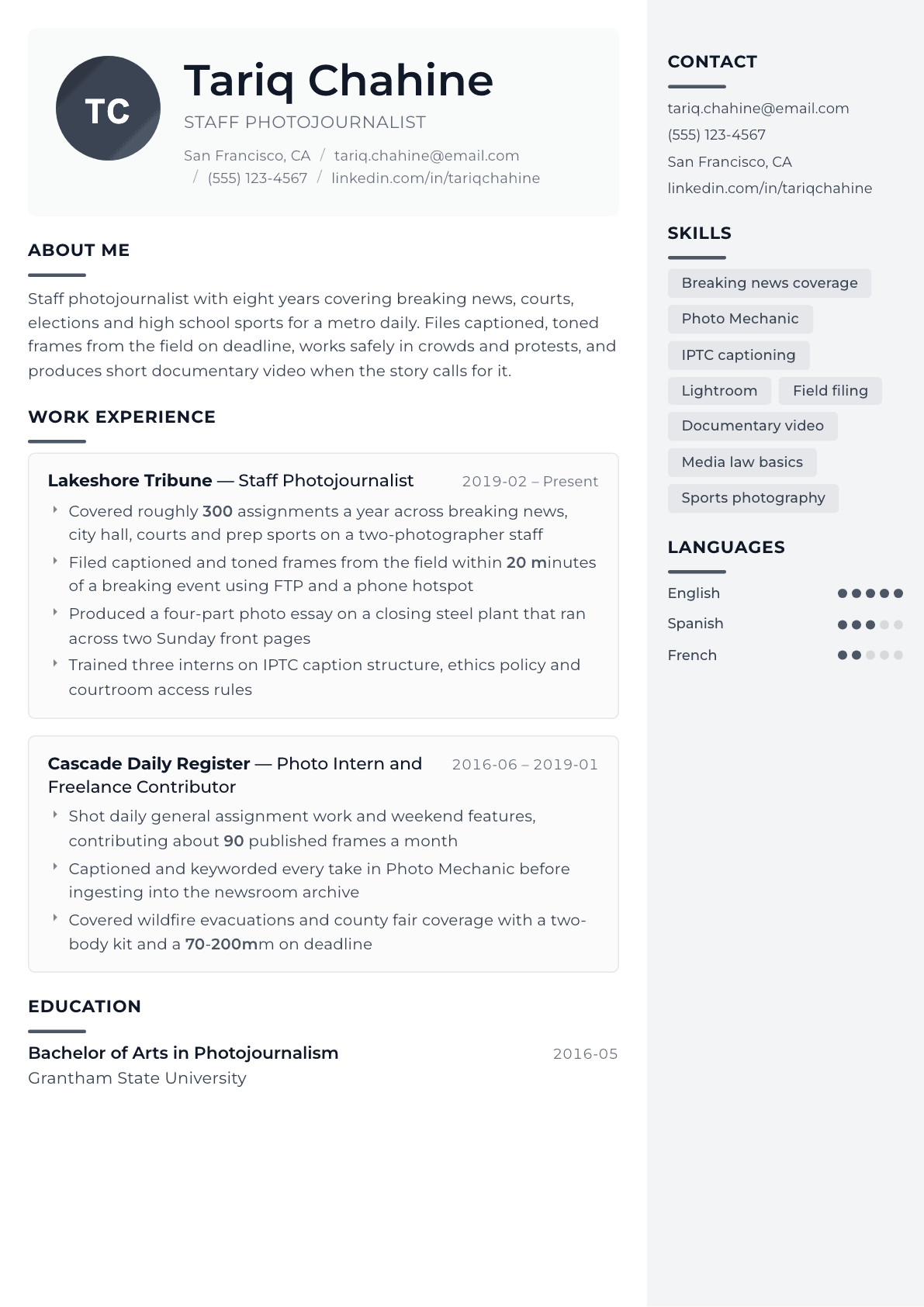
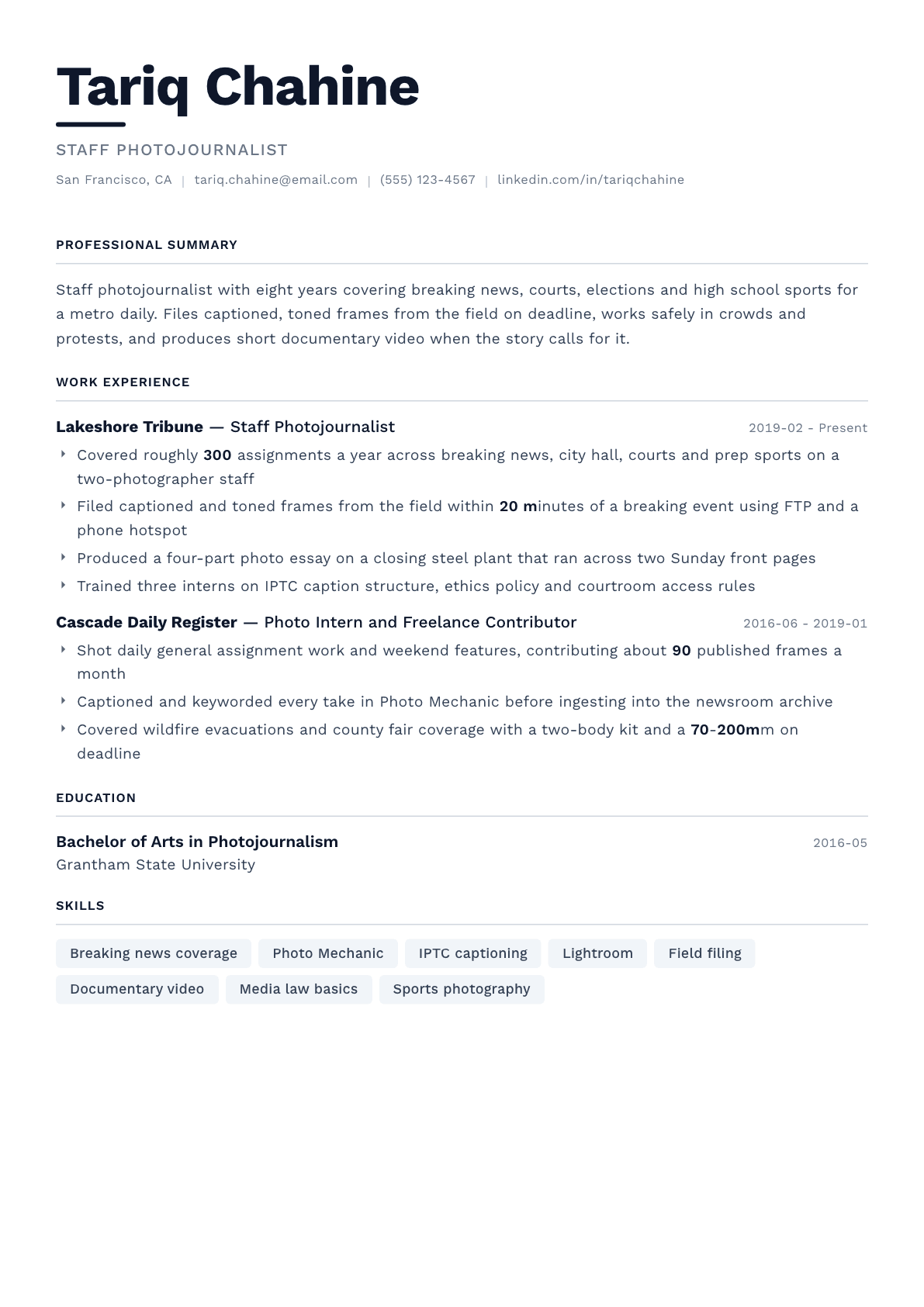
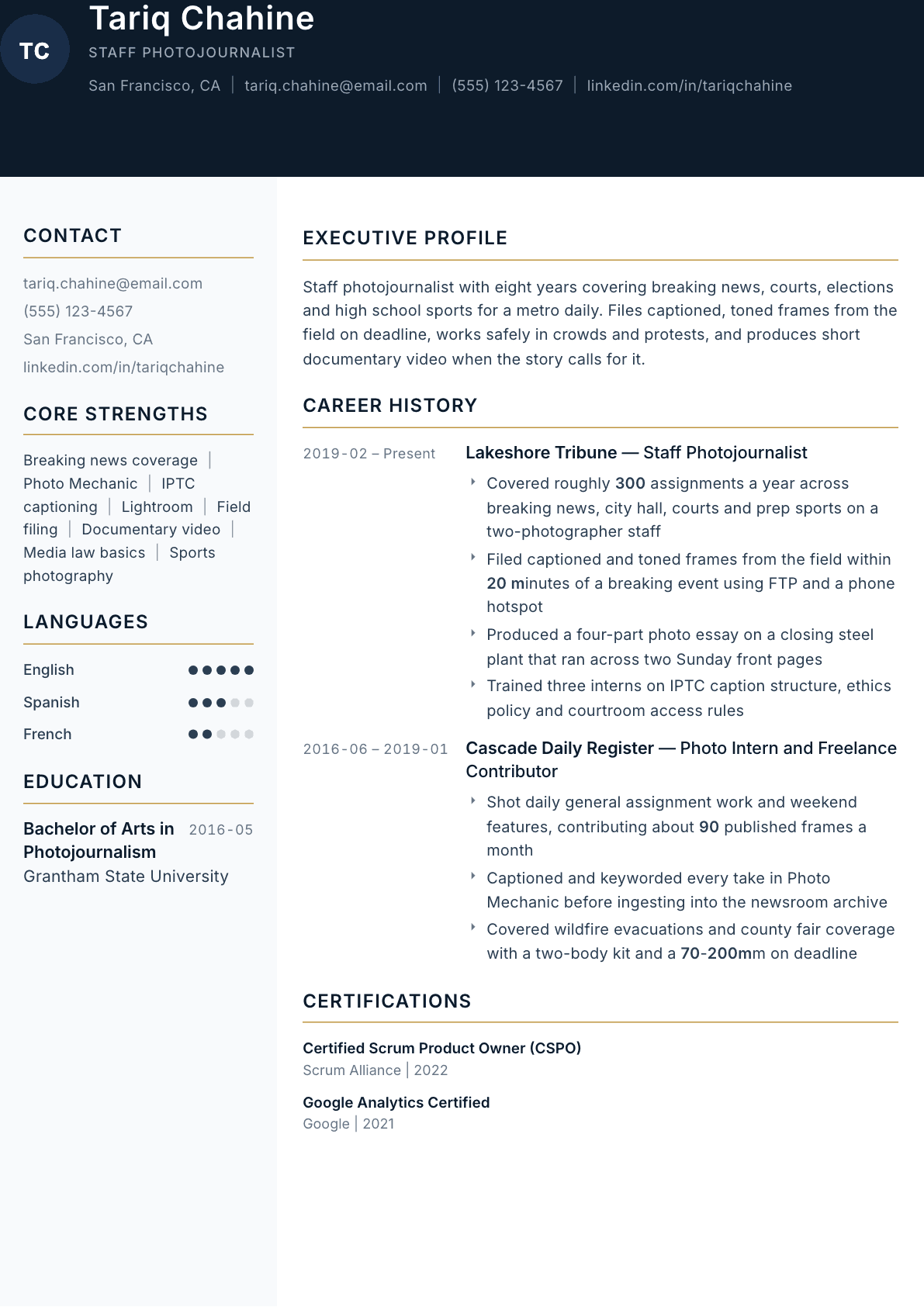
The same photojournalist content laid out in three CVBooster templates, so you can see what the finished document looks like before you write a word.
Example Photojournalist summary
Photojournalist with eight years on a metro daily staff covering breaking news, courts, elections and prep sports. Files captioned frames from the scene inside twenty minutes and works safely in protests and severe weather. Produced long-form photo essays that ran as Sunday front page packages, and shoots documentary video when a story needs motion and sound.
Skills to list on a Photojournalist resume
- Breaking news photography
- Feature and enterprise work
- Sports photography
- Photo essays
- Photo Mechanic
- IPTC caption writing
- Lightroom toning
- Field transmission
- Documentary video
- Audio gathering
- Media law and access
- Ethics and disclosure
- Source relationships
- Assignment planning
What actually gets this resume read
- Open with the beats you have covered and the outlets that published you, because editors hire against a beat list.
- Give your filing speed from the field, since deadline reliability separates working news photographers from portfolio shooters.
- Name Photo Mechanic, IPTC caption fields and your transmission method, because that is the newsroom workflow you will inherit.
- List the difficult assignments you can handle safely: protests, severe weather, courts, overnight crime scenes, hostile crowds.
- Mention video and audio capability separately if you have it, since most newsrooms now assign visual journalists to both.
- Keep a link to a tight edit of 20 frames rather than an archive, and update it before every application.
How to write a photojournalist resume
A photo director hiring a photojournalist is trying to answer one question: can this person be sent alone to something unpredictable and come back with publishable, accurately captioned frames before the deadline. Craft is assumed at the application stage. Judgment, access and filing speed are what get tested.
That is why the beat list matters more than the adjectives. Courts, city hall, elections, protests, severe weather, prep sports and enterprise features each demand different preparation, different access rules and different risk. A resume that names the beats you have worked lets an editor picture you on tomorrow's assignment desk.
This guide covers how to structure a news photography resume around beats and filing, how to write about ethics without sounding defensive, what to say about video and audio, and how to present a tight edit rather than an archive.
Format: one page, edit link in the header, credits kept honest
One page for anything short of a two decade staff career. Photo editors read applications in batches and the edit link is the first thing they click, so put it in the header and keep it to about twenty frames that could each stand alone on a section front.
List outlets accurately. Staff, contract, intern and freelance contributor are different relationships, and newsrooms are small enough that a misstated one gets caught. Freelance work is respectable; a padded staff claim is not.
- Header: name, city, phone, email, edit link, and a note on your driver license and vehicle if you cover a wide region.
- Sections: summary, staff and contract experience, freelance credits, awards, technical skills, education.
- A short awards block is worth including if you have juried recognition, listed with the organization and category.
Summary: beats, deadline behavior, staff size
Open with the beats and the type of newsroom. A photographer on a two person staff at a metro daily is doing a different job from a specialist at a large national outlet, and the small staff version is often the more impressive one because it implies self assignment, generalist range and constant turnaround.
Then say how fast you file from the field. Deadline reliability is the fault line between working news photographers and portfolio shooters, and it is nearly always missing from applications.
Experience: assignment volume, filing method, the hard days
Give an annual assignment count. Three hundred assignments a year across breaking news, courts and prep sports says more about your working life than any description of your style. Add the staff size, because two photographers covering a metro area is a workload claim in itself.
Describe the filing chain explicitly: caption and tone in the field, transmission over a phone hotspot or file transfer to the newsroom, and the elapsed time from event to filed frame. Naming the caption tool and the metadata standard you write to tells an editor you will slot into the desk without retraining.
Then the difficult assignments, stated without drama. Protests, severe weather, overnight crime scenes, courtroom access under local rules, and hostile crowds. An editor needs to know who on the roster can be sent to those safely and who cannot, and this is the only place on the resume where that gets answered.
Reserve one bullet for enterprise work. A photo essay that ran as a package, a long term project you pitched and sustained, or a story you found rather than were handed. Daily coverage proves reliability; enterprise proves you can see a story before an editor assigns it.
Captions, ethics and access
Captioning is a writing job and newsrooms treat it that way. Say that you write complete captions in the field, name the metadata fields you populate, and mention that you verify spellings of names on the scene. A photographer who returns beautiful frames with unusable captions creates work for the desk.
Ethics belongs on the page as practice rather than as a pledge. Describe it through what you do: no staging, no directed reenactment, toning limited to global adjustments the newsroom policy permits, disclosure when an image is a photo illustration, and training interns on the same rules. That is far more convincing than a line saying you have strong ethical standards.
Video, audio and the visual journalist job
Most newsrooms now assign a single visual journalist to both stills and motion, so state your video capability separately and honestly. Short documentary pieces, interviews with lavalier audio, or vertical clips for social are three different levels of claim. If you edit as well as shoot, name the editing application.
Audio deserves a mention on its own. A photographer who gathers usable ambient sound and clean interview audio is materially more useful than one who shoots video with an on camera microphone, and editors know the difference immediately.
Photojournalist resume summary examples
Recent graduate with an internship
Photojournalism graduate with two newspaper internships covering general assignment, prep sports and county government, contributing roughly 90 published frames a month. Captions and keywords every take in Photo Mechanic before ingest, and files toned frames from the field on deadline. Comfortable with a two body kit and a 70-200mm.
Five years on staff
Staff photojournalist with five years on a metro daily covering breaking news, courts, city hall and prep sports on a three photographer staff. Files captioned and toned frames within twenty minutes of a breaking event over a phone hotspot. Shoots short documentary video with dual system audio when a story needs motion.
Senior staff and mentor
Photojournalist with eight years covering breaking news, elections, protests and severe weather for a metro daily, roughly 300 assignments a year. Produced a four part photo essay on a closing steel plant that ran across two Sunday front pages. Trains interns on caption structure, ethics policy and courtroom access rules.
Work experience bullets: before and after
Before: Covered a wide range of assignments for the newspaper.
After: Covered roughly 300 assignments a year across breaking news, city hall, courts and prep sports on a two photographer staff.
The count, the beats and the staff size make the workload legible instead of implied.
Before: Filed photos quickly on deadline.
After: Filed captioned and toned frames from the field within twenty minutes of a breaking event using file transfer over a phone hotspot.
A stated elapsed time and a named transmission method is the deadline claim an editor can actually rely on.
Before: Shot a long term project about a factory closing.
After: Produced a four part photo essay on a closing steel plant over seven months of access, which ran across two Sunday front pages with a companion video.
Duration of access and where it published prove sustained reporting rather than a single visit.
Before: Trained interns.
After: Trained three summer interns on caption structure and metadata fields, newsroom ethics policy and courtroom access rules in the local jurisdiction.
The subjects taught show what you are trusted to be authoritative about.
Before: Photographed protests and bad weather.
After: Covered protest lines, wildfire evacuations and severe storm damage with a documented safety plan, protective gear and a check in schedule with the desk.
Adding the safety practice turns a risk claim into evidence of professional judgment.
Hard skills
- Breaking news photography
- Feature and enterprise reporting
- Sports photography
- Photo essay construction
- Photo Mechanic
- IPTC caption writing
- Lightroom toning
- Field transmission and file transfer
- Documentary video
- Ambient and interview audio
- Media law and public access
- Ethics policy and disclosure
- Assignment planning
Soft skills
- Source building
- Situational awareness
- Persistence with access
- Working alone
- Composure in crowds
- Editorial judgment
Mistakes that cost photojournalist candidates the interview
- Linking a full archive instead of a tight edit, which forces an editor to do the selecting you should have done.
- Leaving out filing speed, the single detail that separates a working news photographer from a portfolio shooter.
- Describing yourself as ethical rather than describing the toning limits, staging rules and disclosure practice you follow.
- Blurring freelance contributions into staff experience, which is easy for a photo editor to check and hard to recover from.
- Omitting the beats entirely, so an editor cannot tell whether you have ever covered a court hearing or a city budget vote.
- Treating video as an afterthought when most postings now describe the job as a visual journalist role with motion and audio.
- Filling the skills section with camera bodies while never mentioning captioning, metadata or the newsroom archive.
Photojournalist resume questions
How many images should my photojournalism edit contain?
About twenty, tightly chosen, each strong enough to run alone. Include a spread of beats and at least one multi frame story so an editor sees both single frame instinct and the ability to build a sequence. Refresh it before every application.
Do awards belong on a news photography resume?
Yes, in a short block, listed with the organization, the category and the year. Keep it factual and do not stretch a regional honorable mention into something larger, because photo editors know the contests and the judging pools well.
How should I list freelance work for many outlets?
Group it under one freelance heading with a date range and name the outlets that published you most, then use bullets for the assignment types and the volume. A long list of one off credits reads thinner than a grouped block with real numbers.
What if I have no staff newspaper experience at all?
Lead with published work regardless of outlet, including wire contributions, nonprofit newsroom assignments and student daily staff positions with real deadlines. Assignment volume and filing discipline matter more to an editor than the size of the masthead.
Should I mention safety training or protective gear?
If you have hostile environment training or you routinely work protests and severe weather, yes. Editors are increasingly careful about who they send into volatile assignments, and a documented safety practice is a genuine differentiator on the page.