News Anchor Resume Examples: free ATS score and gap list
Build a News Anchor Resume That Commands the Desk
By Mustafa Tarabya, founder of CVBooster · Published · Updated
Create a polished news anchor resume showcasing on-air delivery, breaking news expertise, and audience trust for broadcast and digital news organizations.
Sample resumes for a news anchor
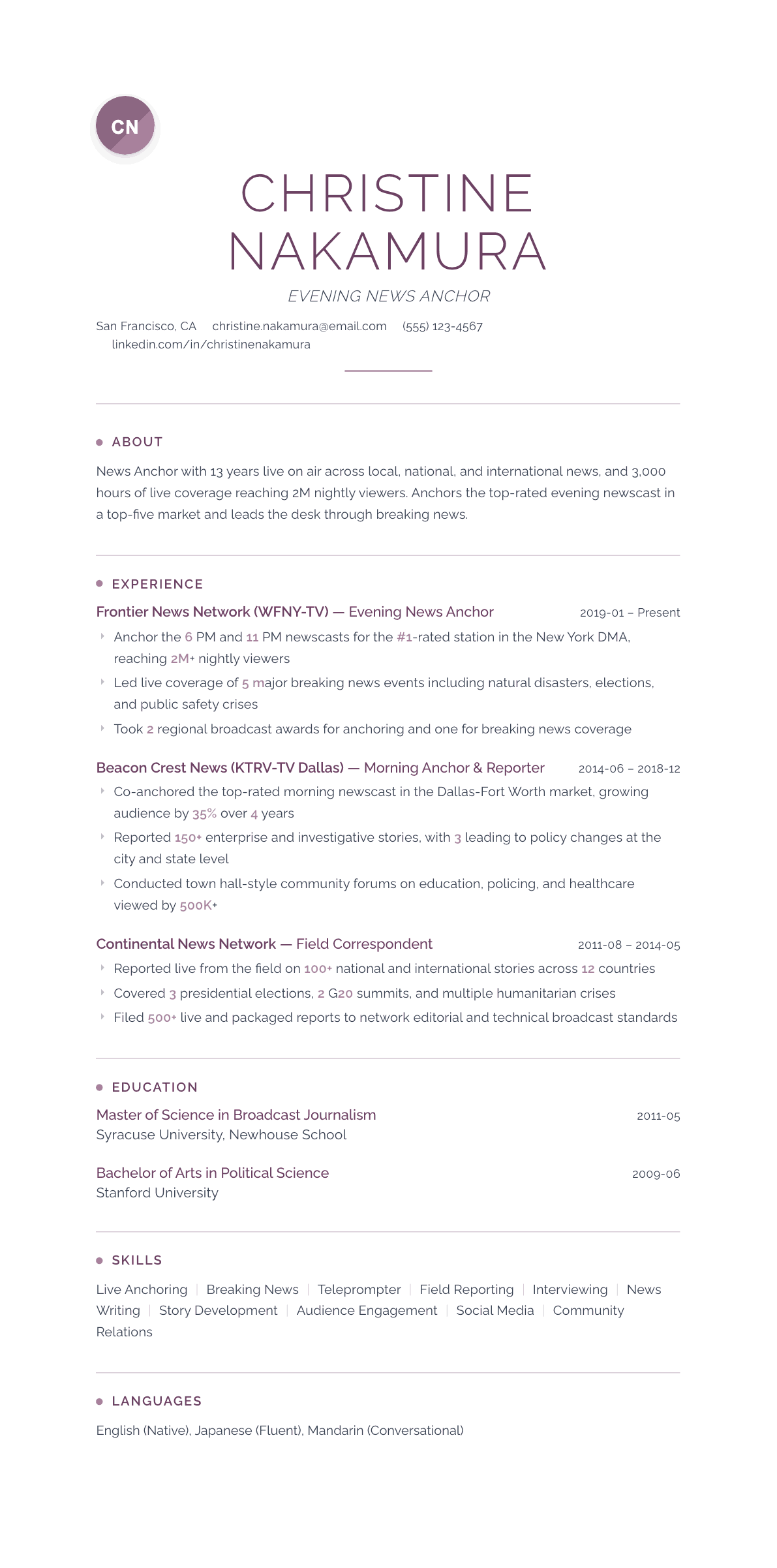
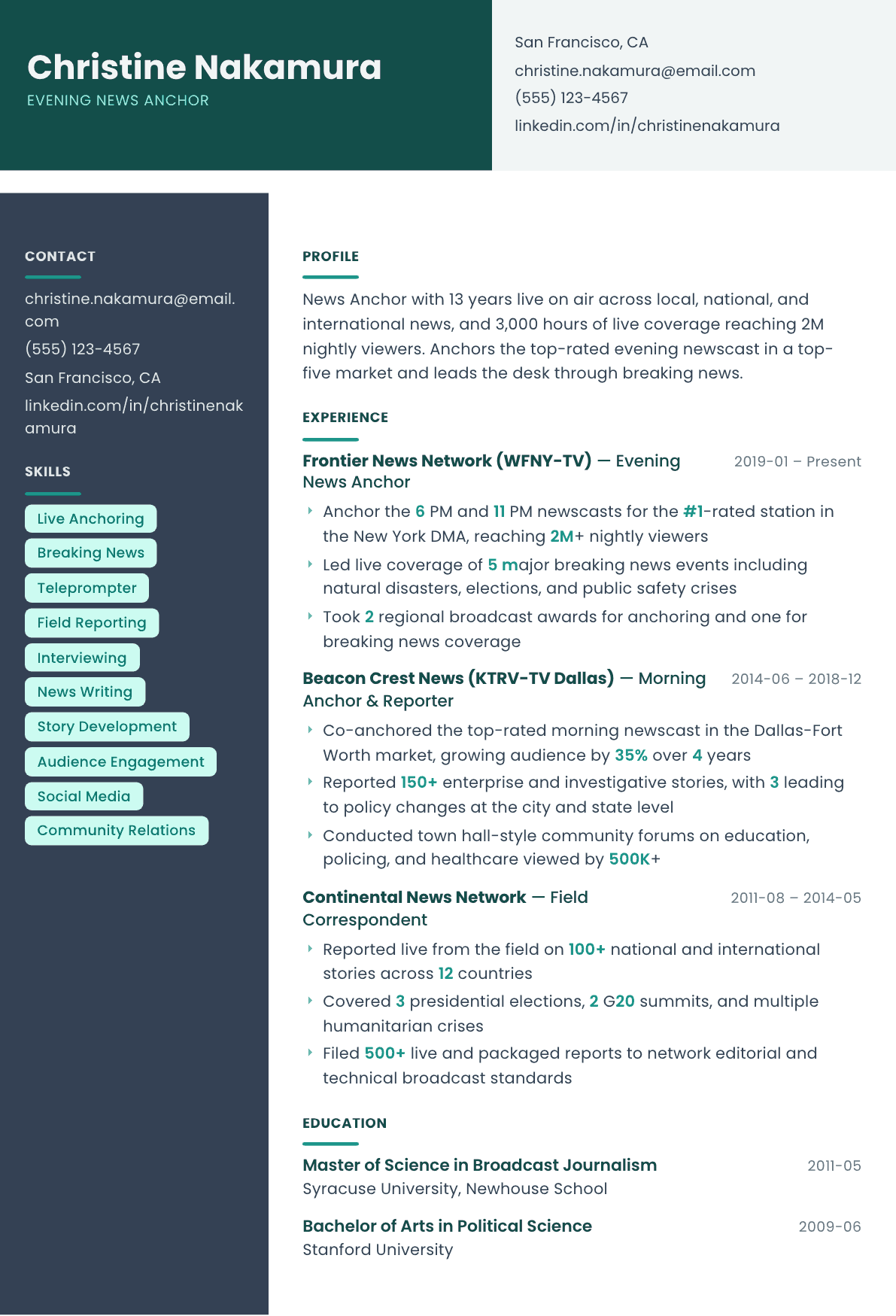
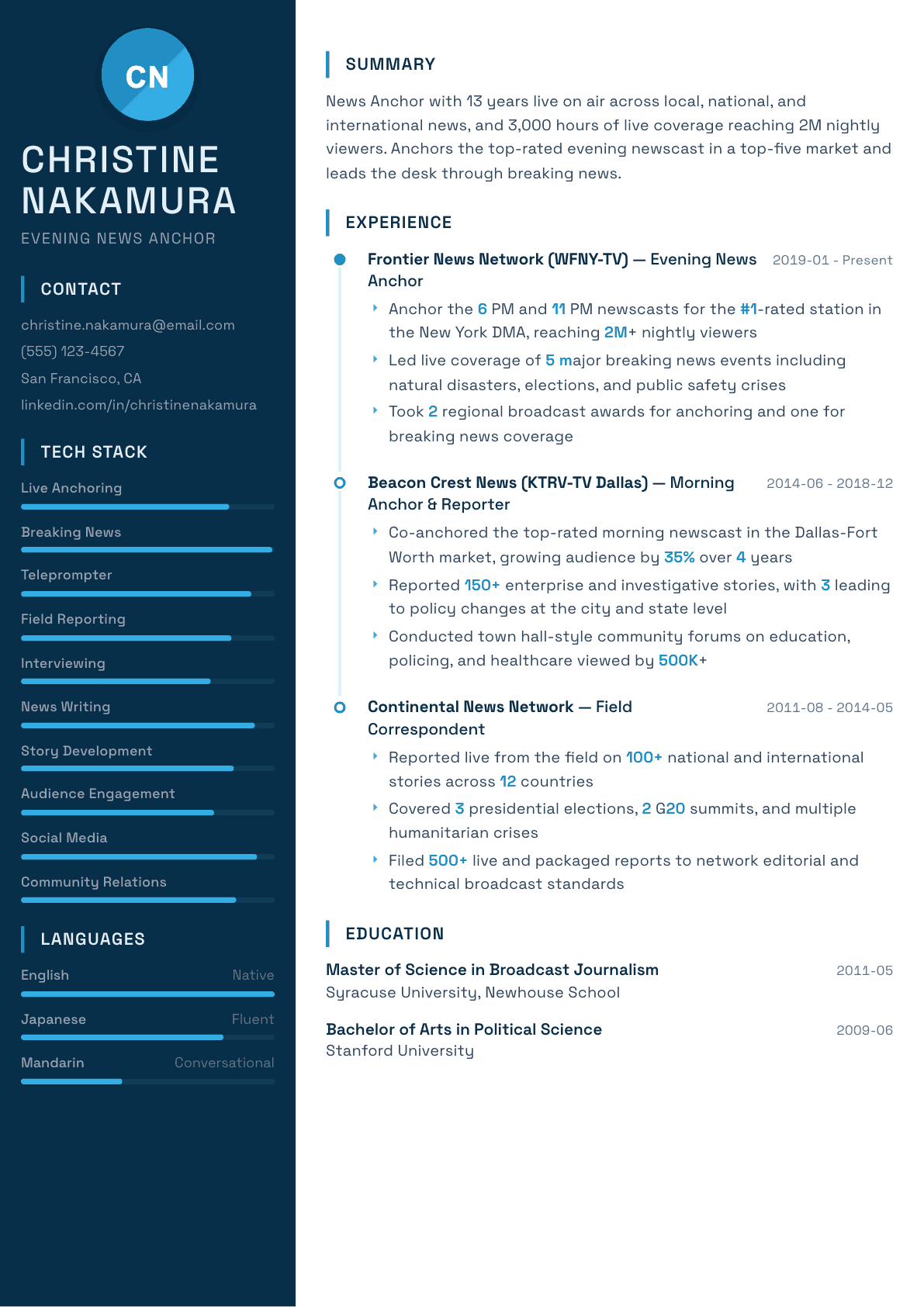
The same news anchor content laid out in three CVBooster templates, so you can see what the finished document looks like before you write a word.
Example News Anchor summary
News Anchor, 13 years and 3,000 hours of live coverage, currently the 6 PM and 11 PM desk at the top-rated station in a top-five market with 2M nightly viewers. Award-winning breaking news anchoring, plus five years of field reporting across 12 countries.
Skills to list on a News Anchor resume
- Live Anchoring
- Breaking News Coverage
- Teleprompter & IFB
- Field Reporting
- Interviewing
- News Writing
- Story Development
- Audience Engagement
- Social Media
- Community Outreach
- Digital Platforms
- Media Training
What actually gets this resume read
- Lead with market rank, audience size, and awards to establish your on-air credibility.
- Highlight breaking news experience. News directors value anchors who can lead live coverage under pressure.
- Include both anchor and reporting experience to show versatility.
- Mention community engagement: town halls, charity events, and public speaking appearances.
- Include a demo reel link. This is the most critical hiring tool in broadcast news.
How to write a news anchor resume
A news director hiring an anchor watches the reel before reading anything, but the resume decides whether the reel gets played at all. What she is checking is market history, dayparts and live capability. Which markets have you worked in and in what order, whether you anchored mornings, midday, evenings or weekends, and whether you can hold a desk through an hour of unscripted breaking coverage without a script in front of you.
The other half of the job is reporting and writing. Most anchors write their own copy, pitch and turn stories on non-anchor days, and are expected to carry a station presence on social and in the community. An anchor who cannot report is a reader, and news directors describe that as a limitation rather than a role.
This guide covers the format broadcast hiring expects, how to write about live coverage so it reads as capability rather than adjectives, three summaries from a first anchoring shift to a main anchor, before and after bullets, and the questions anchors ask about reels, market moves and non-compete situations.
Format: reel link at the top, station history below
Put the reel link in the header alongside the phone and email. It should play immediately, without a login, on a phone. Broadcast hiring still moves through reels, and any friction between a news director and your first thirty seconds is a lost opportunity.
Below that, a station history in reverse order: station, market and its rank, your title, the dayparts you anchored, and the years. Market rank is the shorthand the industry uses to size experience, and leaving it out forces the reader to look it up or move on.
- Header: name, title such as "Evening Anchor and Reporter", city, phone, email, reel link.
- Order: summary, station experience, live coverage highlights, skills, awards, education.
- State the dayparts and the newscast lengths you anchored under each station.
- Note whether you write your own copy and whether you also report in the field.
Summary: dayparts, live experience and what you cover
Three lines: how long you have anchored, the dayparts, the market sizes, and the kind of live coverage you have carried. A morning anchor running three and a half hours of live television a day and an evening anchor delivering two half-hour newscasts are doing very different work, and a news director is filling one specific hole.
If you are moving from reporting to anchoring, say so and point to the fill-in shifts, the live desk work and the special coverage you have anchored. News directors promote reporters who have already sat in the chair when someone was out.
Experience: newscasts, live coverage and the desk you ran
For each station, list the newscasts by name and length, your co-anchor arrangement, and whether you were solo. Then the live coverage: election nights, severe weather, breaking crime and public safety events, major trials, storms and evacuations, and long unscripted stretches where the rundown collapsed. That is the work an anchor is really hired for.
Say what you contributed beyond the desk. Writing and rewriting copy on deadline, producing your own blocks, pitching in the morning meeting, conducting live interviews with officials, hosting town halls and debates, and anchoring digital streams and social live coverage all belong here.
Reporting credits should be listed too, with the beats you covered and the kinds of stories you turned. An anchor who can produce a package on a light news day is worth more to a station than one who only reads, and news directors say so in interviews.
Skills: on-air, editorial and the technical side of the desk
Split the on-air skills from the newsroom skills. On-air: live anchoring, teleprompter delivery, ad-libbing without a script, live interviews, field reporting and live shots, and voicing. Newsroom: news writing to broadcast style, story selection, rundown awareness, and working with producers and directors on timing and stretch.
Then the systems: the newsroom computer system you write and build rundowns in, the editing tools you use to cut your own material, and the digital publishing and social platforms you post to. Smaller markets expect anchors to shoot and edit their own work, and stating that plainly widens the jobs you can take.
- On-air: live anchoring, ad-lib coverage, teleprompter, live interviews, field live shots.
- Editorial: broadcast news writing, story selection, rundown and block awareness, fact-checking.
- Systems: newsroom computer systems, nonlinear editing, digital publishing platforms.
- Digital: streaming newscasts, social live coverage, community engagement.
Awards, ratings and community work
List awards with the awarding organization and the category, since the field has a number of recognized honors and news directors know them all. Nominations count and should be labeled as nominations rather than blurred into wins.
Ratings claims need care. Say what you can support, such as anchoring a newscast during a period when it grew in its demographic, and be prepared to explain your basis. Community work belongs here too: hosting station events, moderating candidate forums, school visits and charity coverage all count, because stations hire anchors as public faces in their markets.
News Anchor resume summary examples
First anchor shift
Multimedia journalist with three years reporting in a mid-sized market who has anchored weekend morning newscasts for the past year. Writes all of her own copy, shoots and edits her own packages, and has anchored live coverage of two severe weather events and a local election night.
Weekday anchor
Evening anchor with seven years on air, currently co-anchoring two weeknight newscasts in a top fifty market and reporting two days a week. Has led live coverage of a hurricane landfall, a multi-day search operation and two statewide elections, and hosts the station monthly town hall.
Main anchor
Main evening anchor with sixteen years across three markets, currently anchoring the flagship newscasts in a top twenty market. Writes and produces her own blocks, has anchored more than a dozen election nights and severe weather emergencies, and mentors reporters through their first anchoring shifts.
Work experience bullets: before and after
Before: Anchored the evening news.
After: Co-anchored the weeknight newscasts at five, six and eleven, writing and approving copy for two of the three blocks and handling all live interviews with local officials.
Naming the newscasts and the writing and interviewing responsibility describes an anchor, not a reader.
Before: Covered breaking news when it happened.
After: Anchored four hours of unscripted live coverage during a citywide flooding emergency, working from scanner traffic and phone calls with officials while the rundown was rebuilt around us.
Duration and the unscripted conditions demonstrate the skill news directors screen hardest for.
Before: Also worked as a reporter for the station.
After: Reported two days a week on the education beat, turning packages on school funding and enrollment and developing sources across three districts.
A named beat with sources shows genuine reporting rather than occasional field days.
Before: Handled social media for my newscasts.
After: Ran a daily social live segment previewing the evening lead story and answered viewer questions on air, growing the station comment engagement on election night.
Describing the routine and the on-air payoff makes digital work part of the newscast rather than an add-on.
Before: Involved in the local community.
After: Moderated two candidate forums and a school safety town hall, and emceed the station annual food drive across four collection sites.
Named events are verifiable and show the public role stations expect an anchor to fill.
Hard skills
- Live anchoring
- Unscripted breaking news coverage
- Broadcast news writing
- Teleprompter delivery
- Live interviewing
- Field reporting and live shots
- Newsroom computer systems
- Rundown and block timing
- Nonlinear video editing
- Voicing and narration
- Election and severe weather coverage
- Digital and streaming newscasts
Soft skills
- Composure on air
- Ad-libbing under pressure
- Co-anchor chemistry
- News judgment
- Community presence
- Accepting coaching on delivery
Mistakes that cost news anchor candidates the interview
- Leaving off market rank and daypart, the two facts a news director uses to size an anchor career instantly.
- Sending a reel that opens with a montage instead of a live, unscripted stretch that shows what you do when things break.
- Presenting yourself as an anchor only, when most stations need someone who reports and writes as well.
- Blurring award nominations into wins, which is easy to check and hard to recover from.
- Hosting a reel that requires a login or plays badly on a phone, where most first views happen.
- Claiming ratings growth without being able to explain the period, the demographic and the basis.
- Listing every station in a long career with equal detail rather than focusing on the recent, relevant markets.
News Anchor resume questions
How long should a news anchor reel be?
Three to five minutes. Open with a live, unscripted stretch of breaking coverage, then a newscast open and a tease, then a package and an interview. News directors decide within the first minute, so lead with the strongest live moment you have.
Should I list market size on a broadcast resume?
Yes. Market rank is the standard shorthand for the scale of a station and its newsroom, and news directors use it to place your experience quickly. Leaving it out makes a reader work, and a busy reader usually moves to the next application.
How do I move from reporting to anchoring?
Take every fill-in shift offered, ask to anchor digital streams and cut-ins, and build a reel section from those appearances. Then apply for weekend anchor roles in a similar or smaller market, which is the usual route into a weekday chair.
Does a news anchor resume need a photo?
No. The reel and any station biography page already show you on air, and adding a headshot to the document makes it look less like a professional application. Keep the resume plain text and let the reel do the visual work.
What should I do about a non-compete clause when applying?
Know your contract dates and any restrictions before you apply, and be ready to state your availability plainly when asked. News directors plan hiring around start dates, so a clear answer about when you can begin is far better than a vague one.