Cinematographer Resume Examples: the lines they read
Write a Cinematographer Resume Built on Credits and Craft
By Mustafa Tarabya, founder of CVBooster · Published · Updated
Cinematographer resume example with credit formatting, camera and lighting detail, format specs, keywords and a full writing guide.
Sample resumes for a cinematographer
The same cinematographer content laid out in three CVBooster templates, so you can see what the finished document looks like before you write a word.
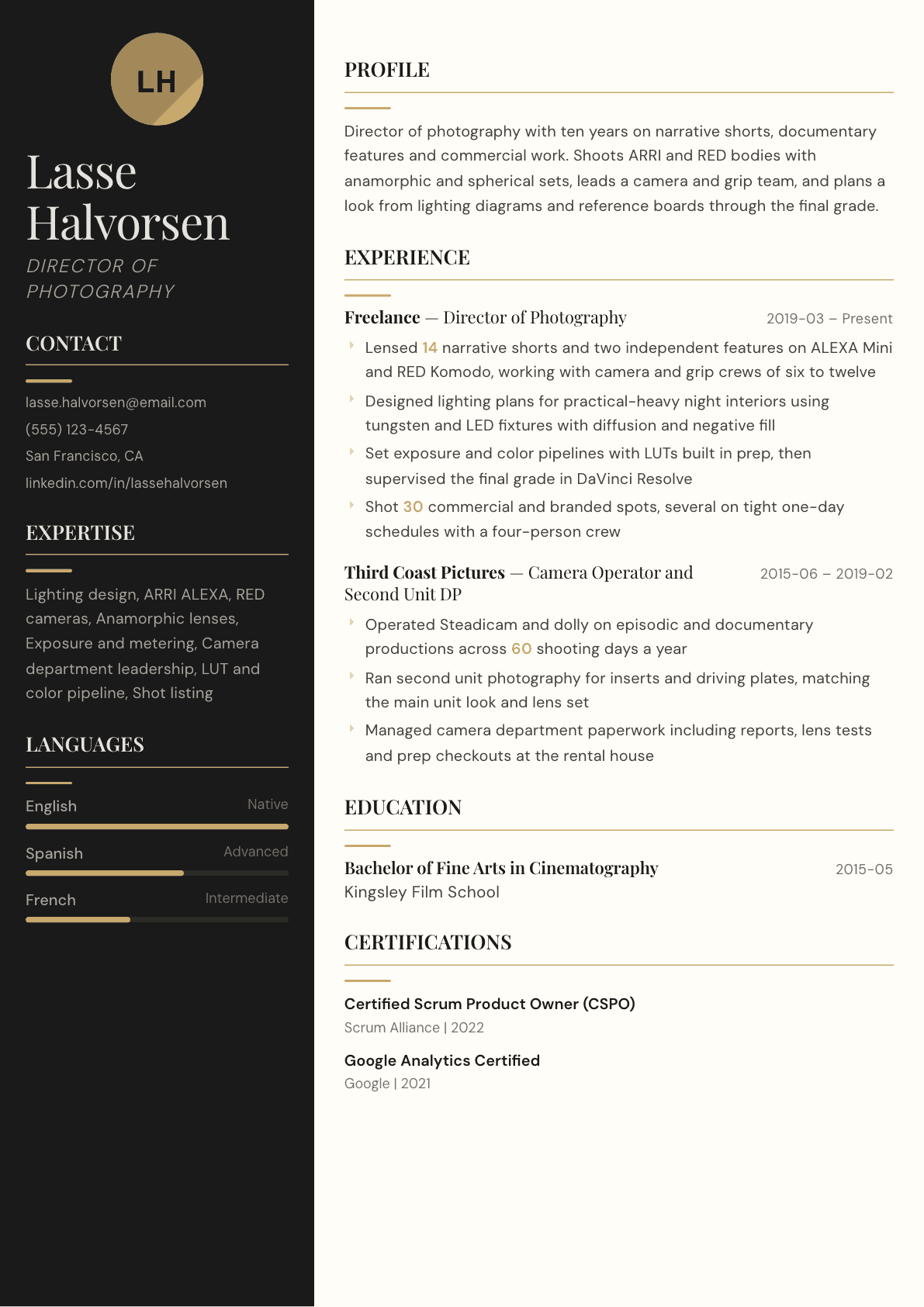
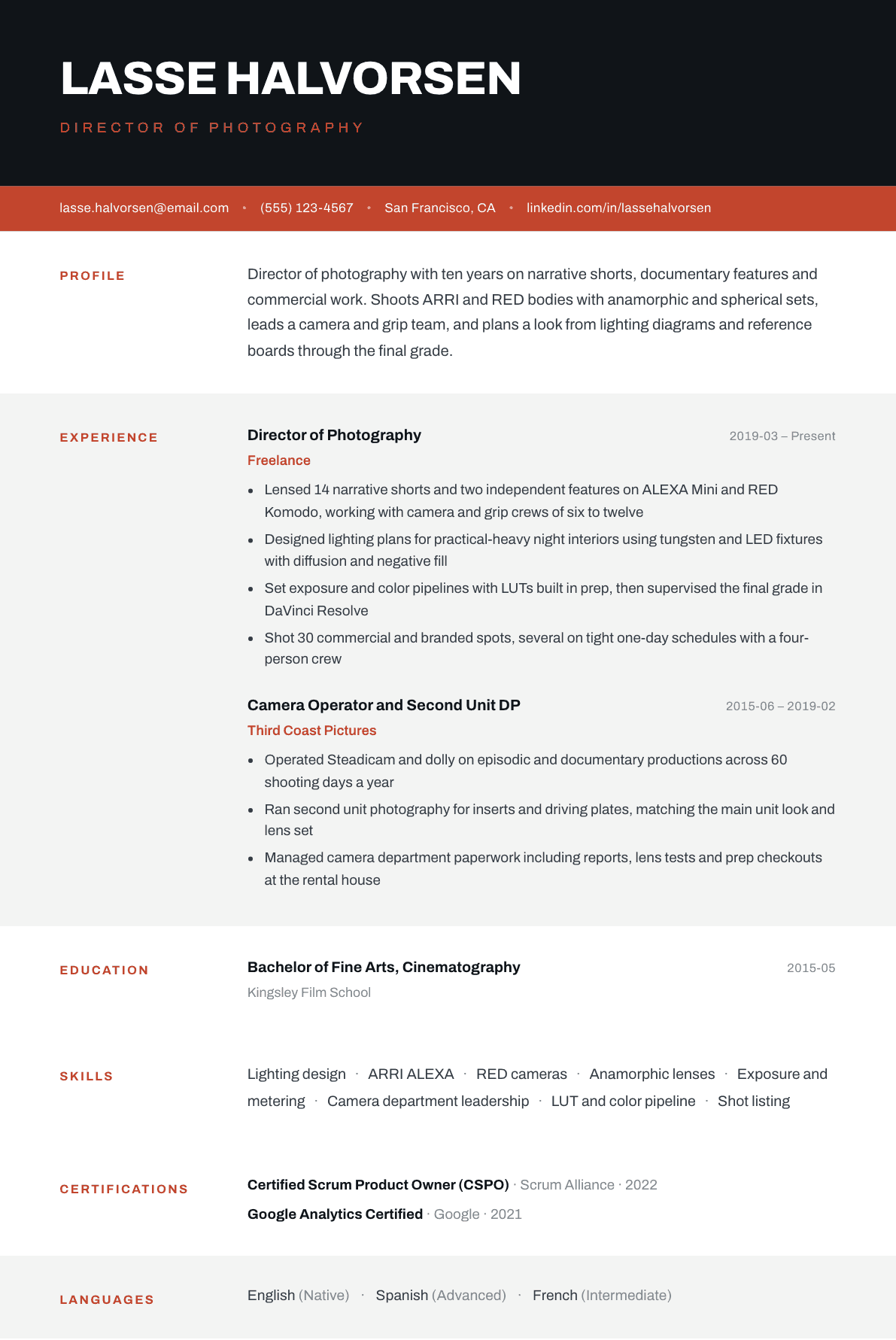
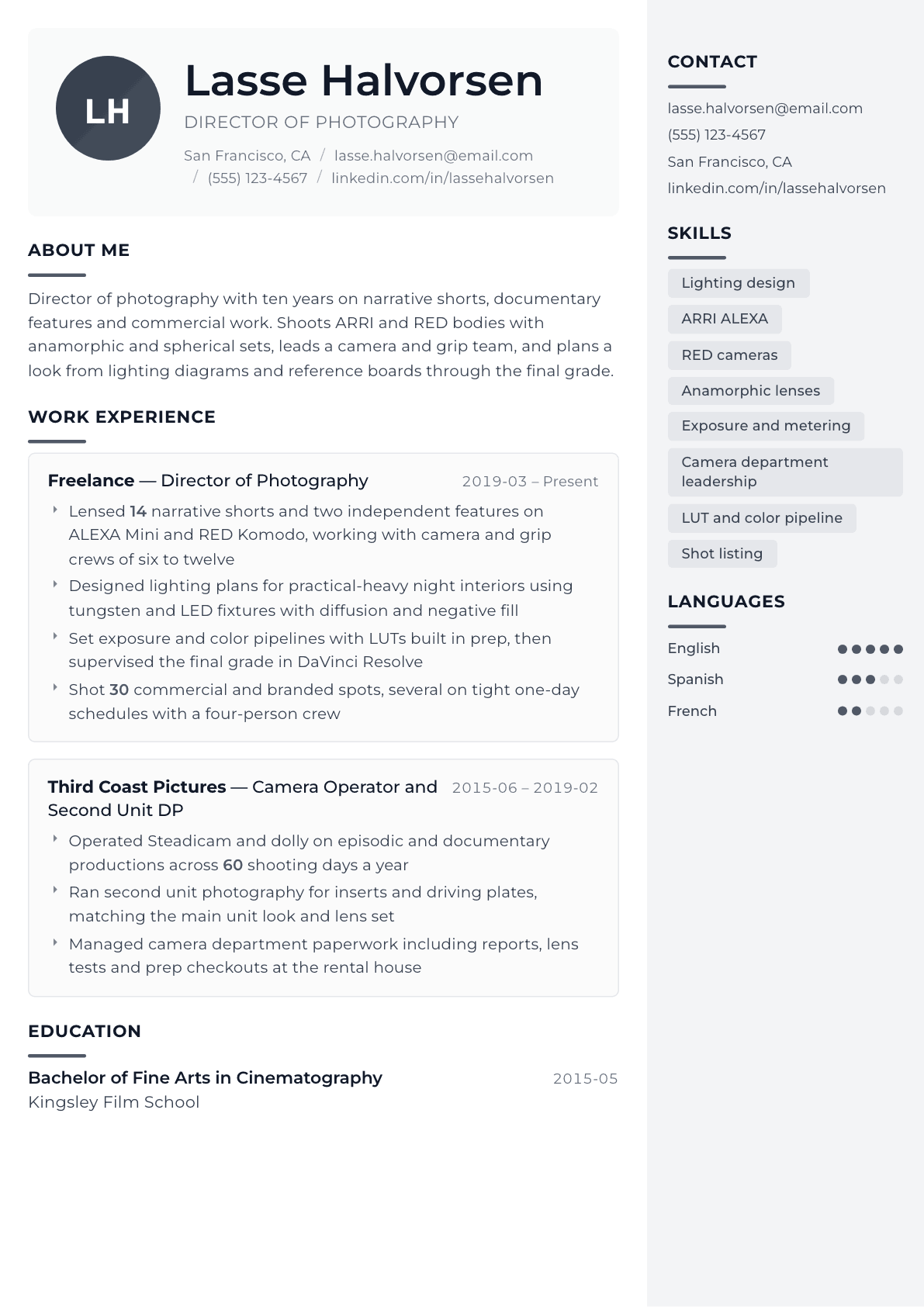
Example Cinematographer summary
Director of photography with ten years lensing narrative shorts, independent features, documentary and commercial work on ARRI and RED systems. Leads camera and grip departments of up to twelve, designs practical-heavy lighting for night interiors, and carries a look from prep references and on-set LUTs through the final grade. Comfortable delivering ambitious coverage on one-day commercial schedules.
Skills to list on a Cinematographer resume
- Lighting design
- Exposure and metering
- ARRI ALEXA
- RED camera systems
- Anamorphic and spherical lenses
- Camera movement and grip
- Steadicam operating
- Shot listing and coverage
- On-set LUT workflow
- Color grade supervision
- Crew leadership
- Location scouting
- Budget-aware gear planning
- Dailies and data workflow
What actually gets this resume read
- Format your credits like the industry does: project title, format, director, production company and your exact camera department role.
- Separate narrative, documentary and commercial credits into their own blocks so a producer can scan the relevant one fast.
- Name the bodies, lens sets and lighting packages you have actually run, not everything you have touched on set once.
- Describe the crew size you have led, because a DP hire is a department head hire and scope matters more than gear lists.
- Say how you handle the color pipeline: on-set LUTs, monitoring, dailies and whether you supervise the final grade.
- Keep a reel link and a stills gallery, since many producers judge lighting from frame grabs before they watch anything.
How to write a cinematographer resume
A director of photography is hired on credits and on trust. The credits establish what you have lensed and at what scale. The trust is about whether you can lead a camera and grip department, hold a schedule, and deliver the agreed look without burning a day arguing about a light. Producers read for both, and they read fast, because they are usually comparing several people at once against a shooting window.
The document itself is unusual. A cinematographer resume looks more like a credit list than a business resume: project title, format, director, production company and your role in the camera department, grouped by category. Prose bullets belong in a short section beneath, not wrapped around every credit.
This guide covers credit formatting, how to separate narrative, documentary and commercial work, what to say about gear without turning the page into a rental order, how to describe crew leadership, and how the color pipeline signals seniority.
Format: a credit list, not a business resume
Lead with credits grouped by category, each line carrying the project title, the format, the director, the production company and your exact camera department role. Formats matter: a short, a feature, an episodic block, a documentary and a commercial spot each imply a different schedule, crew size and failure mode.
Below the credits, add a short block of experience prose covering the department leadership, the lighting approach and the pipeline work. Then a compact technical section for camera systems, lens sets and lighting packages you have genuinely run. Keep the whole document to one or two pages and put the reel link plus a stills gallery in the header.
- Header: name, city, phone, email, reel link, stills gallery, and union local if you hold one.
- Credit line pattern: title, format, director, production company, your role, and the year.
- Group credits under narrative, documentary and commercial rather than in one merged chronology.
Summary: format range, crew scale, look ownership
Three sentences. The formats you have lensed, the camera systems you work on, and the size of the department you have led. Crew scale is the part most applicants leave out, and it is the clearest read on seniority, because leading a twelve person camera and grip team is a management job that a two person documentary crew never tests.
Close on how far you carry the look. A cinematographer who builds references in prep, sets a LUT, monitors exposure on set and supervises the final grade owns the image from end to end. One who hands off after wrap does not, and producers can tell the difference from the wording.
Lighting: describe the problem, not the kit
Lighting is where a reel and a resume should agree. Rather than listing fixtures, describe a lighting problem you solved: a practical heavy night interior built from motivated sources, a daylight exterior controlled with negative fill and bounce, a long take that required a lighting plan with no place to hide a stand.
Name the fixture families you plan around, tungsten and LED, and the control you use for shape: diffusion, flags, bounce and negative fill. A producer who has heard a hundred applicants talk about natural light notices immediately when somebody talks about controlling it.
Department leadership and schedule realism
A director of photography hire is a department head hire. Say how many people you have led across camera, grip and electric, who reported to you, and how you ran prep: lens tests, camera checkout at the rental house, camera reports and the paperwork that keeps a department honest.
Schedule realism is worth its own line. Delivering ambitious coverage on a one day commercial with a four person crew is a specific competence, and so is holding a page count on a compressed independent feature. Producers hire the person who will not lose the afternoon.
Color pipeline and data
Set out the pipeline in order: the raw format you shoot, the show LUT built in prep, on set monitoring and exposure discipline, the dailies path, and whether you attend and supervise the final grade. This paragraph is short and it is read closely, because a broken pipeline costs money in post and producers have paid for that mistake before.
Mention data handling if you have run it: the data manager relationship, checksum verified offloads, and the reports that travel with the media. On smaller productions the cinematographer often owns this by default.
Cinematographer resume summary examples
Camera assistant moving into lensing
Camera assistant with three years pulling focus and running the cart on commercials and shorts, now lensing student and independent narrative work. Lensed six shorts on a mirrorless body with vintage spherical primes, building lighting plans around practical sources. Handles lens tests, camera reports and rental house checkout independently.
Six years, shorts and commercials
Director of photography with six years lensing narrative shorts and commercial spots on ALEXA Mini and RED Komodo, leading camera and grip crews of four to eight. Designs practical heavy night interiors with tungsten and LED fixtures, diffusion and negative fill, and builds show LUTs in prep for on set monitoring.
Feature and commercial director of photography
Director of photography with ten years across narrative shorts, two independent features, documentary and thirty commercial spots. Leads camera and grip departments of up to twelve, shoots anamorphic and spherical on ARRI and RED systems, and carries the look from prep references and on set LUTs through the final grade in DaVinci Resolve.
Work experience bullets: before and after
Before: Shot several short films and two features.
After: Lensed fourteen narrative shorts and two independent features on ALEXA Mini and RED Komodo, working with camera and grip crews of six to twelve.
Counts, camera systems and crew size convert a vague credit claim into a scope a producer can weigh.
Before: Created beautiful lighting for night scenes.
After: Designed lighting plans for practical heavy night interiors, motivating every source from within the set and shaping with diffusion, flags and negative fill on a two ton grip package.
Describing the method and the package proves craft where an adjective only asserts taste.
Before: Worked with colorists in post.
After: Set the exposure and color pipeline with a show LUT built during prep, monitored to it on set, and supervised the final grade through two client passes.
Naming the prep, the monitoring and the grade attendance shows ownership of the image after wrap.
Before: Shot commercials on tight schedules.
After: Shot thirty commercial and branded spots, several as single day builds with a four person crew and a board of twelve setups.
The setup count against the crew size and the day makes the schedule pressure concrete.
Before: Operated camera on TV productions.
After: Operated Steadicam and dolly on episodic and documentary productions across roughly 60 shooting days a year, and ran second unit for inserts and driving plates matched to the main unit lens set.
Shooting days and the second unit matching detail show sustained professional operating rather than occasional days.
Hard skills
- Lighting design
- Exposure and metering
- ARRI ALEXA systems
- RED camera systems
- Anamorphic and spherical lens sets
- Camera movement and grip
- Steadicam operating
- Shot listing and coverage planning
- On set LUT workflow
- Color grade supervision
- Location scouting
- Camera department paperwork
- Dailies and data workflow
Soft skills
- Department leadership
- Collaboration with directors
- Budget aware planning
- Set diplomacy
- Decisiveness under schedule pressure
- Mentoring assistants
Certifications worth listing
- Remote Pilot Certificate, Part 107 (Federal Aviation Administration)
- Set Safety Passport Training (Contract Services Administration Trust Fund)
Mistakes that cost cinematographer candidates the interview
- Merging narrative, documentary and commercial credits into one chronology so a producer cannot find the relevant block.
- Listing every camera and lens you have ever touched, which reads as a rental catalog rather than a working preference.
- Leaving out crew size, the clearest signal of whether you have led a department or only operated within one.
- Omitting the color pipeline, then being unable to answer how you monitored exposure and who supervised the grade.
- Writing bullets around every credit instead of using a clean credit list with a short prose block beneath it.
- Hiding the reel and stills behind a contact form when many producers judge lighting from frame grabs first.
- Overstating a role, such as listing a second unit day as director of photography on the main unit.
Cinematographer resume questions
How should I format cinematography credits?
One line per project: title, format, director, production company, your camera department role and the year. Group by narrative, documentary and commercial so a producer can scan the category they are hiring for without reading the whole page.
Do I list a reel or a stills gallery?
Both. Producers frequently judge lighting from frame grabs before committing to watching motion, so a curated stills gallery gets you a longer look. Keep the reel short and make sure every shot in it is genuinely yours.
How do I show I can lead a camera department?
Give the crew size you have led across camera, grip and electric, name who reported to you, and describe prep responsibilities such as lens tests, rental house checkout and camera reports. Leadership is a scope claim, not an adjective.
Should I include union membership on the page?
Yes if you hold it. List the local and your status plainly in the header, because it determines which productions can legally book you and it is one of the first filters a line producer applies.
What if my credits are mostly unpaid shorts?
List them accurately with the director and production company, and let the reel do the persuading. Add any paid commercial, corporate or documentary work in its own block, since producers want evidence that you have worked to a client and a schedule.