Cardiologist Resume Examples: free ATS score and gap list
Write a Cardiologist Resume That Proves Imaging and Clinic Volume
By Mustafa Tarabya, founder of CVBooster · Published · Updated
A cardiologist resume guide with imaging volume examples, invasive and noninvasive positioning, board certification keywords and sample bullets that hiring groups read.
Sample resumes for a cardiologist
The same cardiologist content laid out in three CVBooster templates, so you can see what the finished document looks like before you write a word.
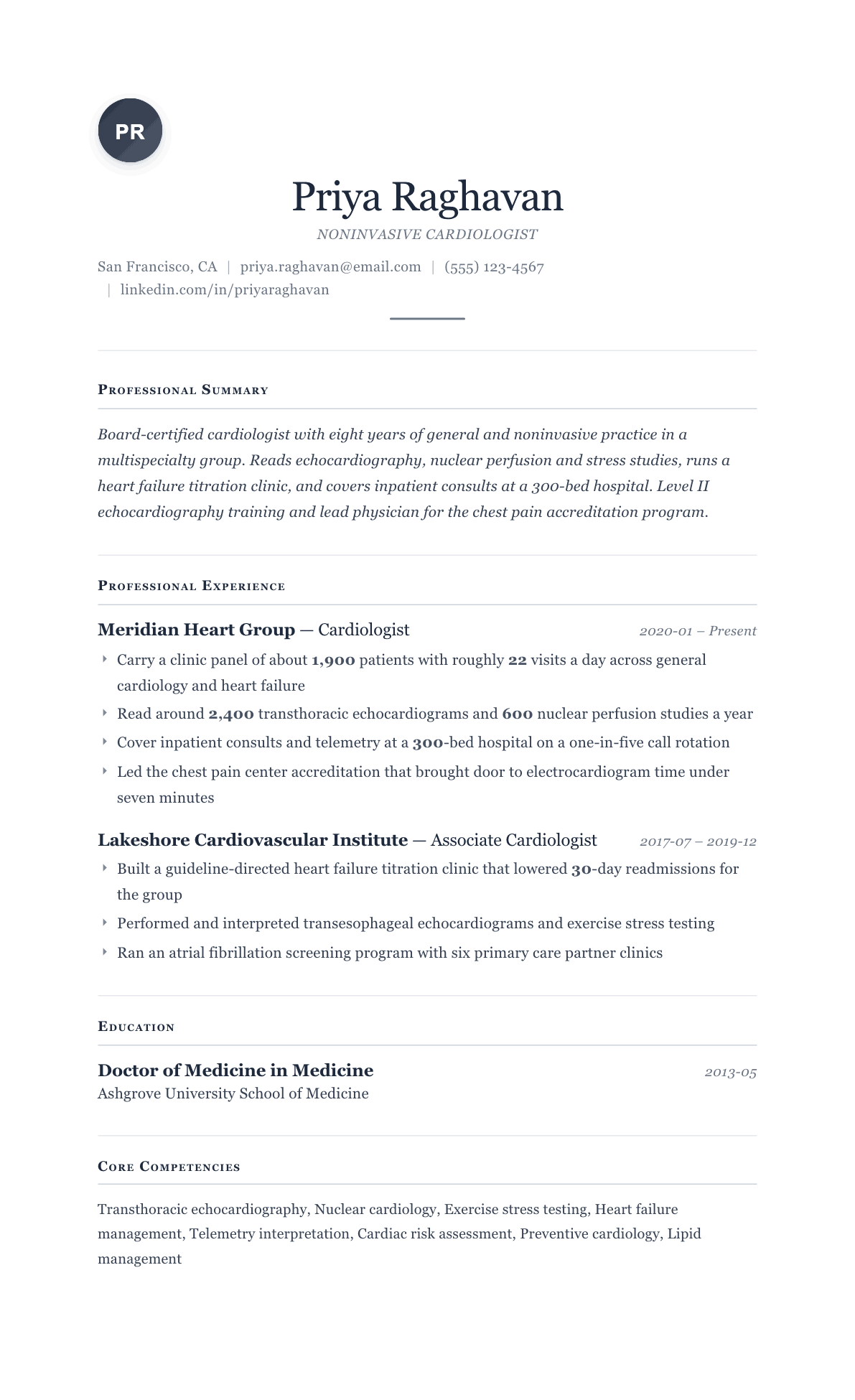
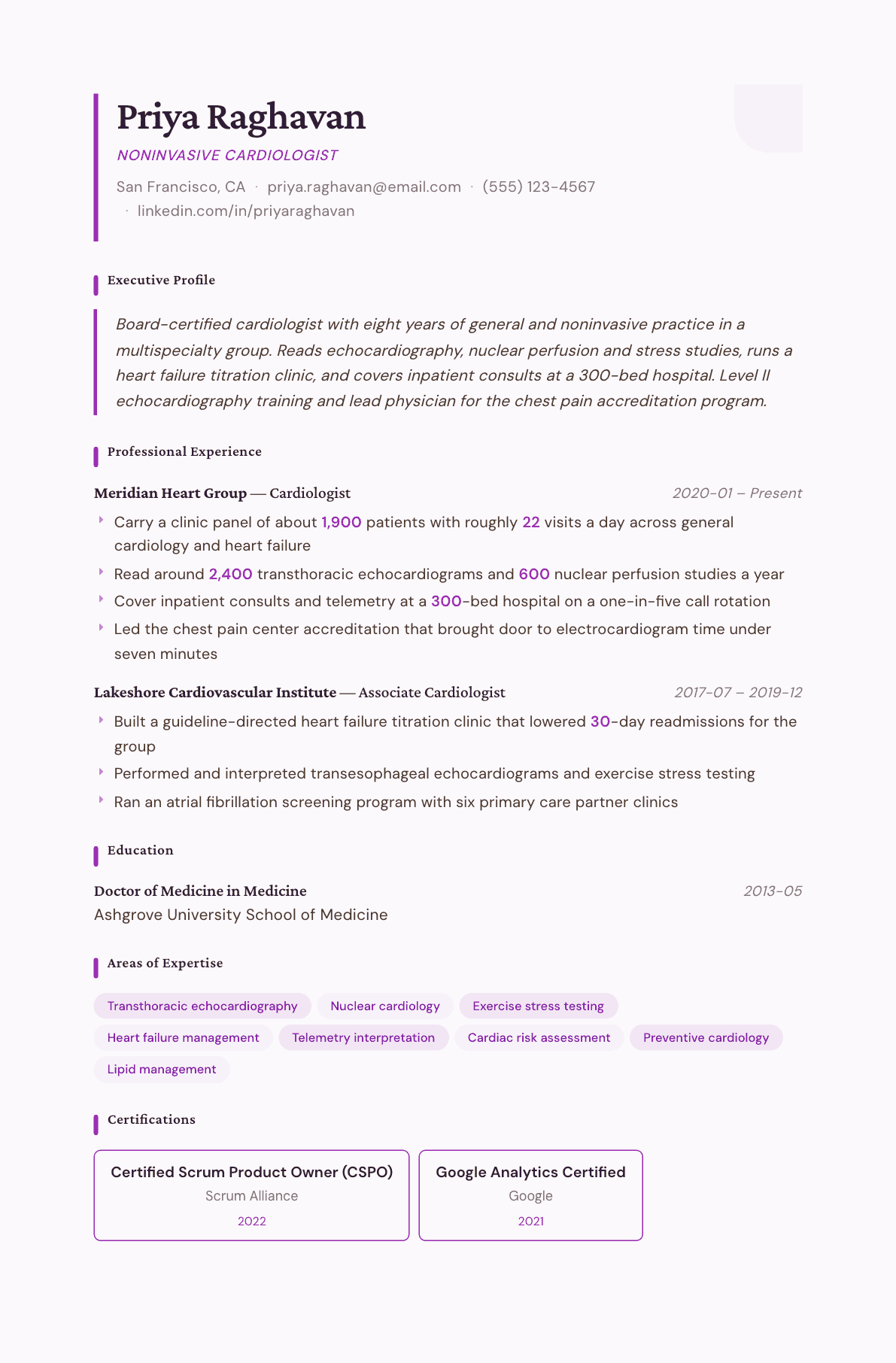
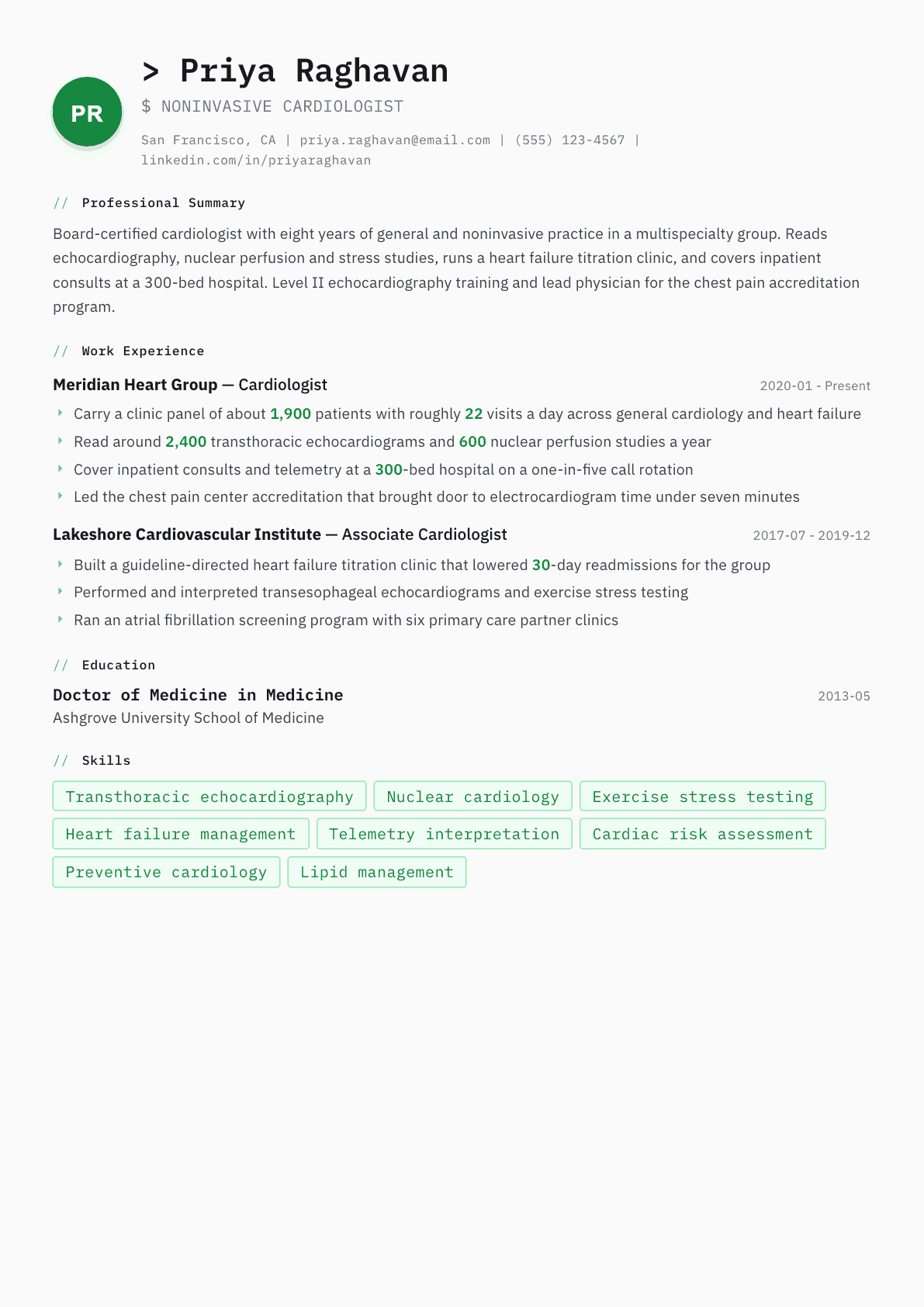
Example Cardiologist summary
Board-certified cardiologist with eight years of general and noninvasive practice, reading about 2,400 echocardiograms and 600 nuclear studies a year while carrying a clinic panel near 1,900 patients. Runs a guideline-directed heart failure clinic, covers inpatient consults at a 300-bed hospital, and led a chest pain center accreditation. Seeking a group role with imaging leadership and a structured heart failure program.
Skills to list on a Cardiologist resume
- General cardiology
- Transthoracic echocardiography
- Transesophageal echocardiography
- Nuclear cardiology
- Exercise and pharmacologic stress testing
- Heart failure management
- Arrhythmia management
- Preventive cardiology
- Lipid management
- Cardiac device follow-up
- Inpatient cardiology consultation
- Telemetry interpretation
- Guideline-directed medical therapy
- Chest pain evaluation
What actually gets this resume read
- State whether you practice invasive, interventional or noninvasive cardiology in the very first line of the summary.
- Give reading volumes for echocardiography, nuclear studies and stress testing, because groups hire against an imaging backlog.
- List your level of echocardiography training and any imaging certification together with the body that issued it.
- Describe the call rotation, the hospital bed count, and whether you cover the catheterization laboratory or device clinic.
- Show clinic throughput: panel size, visits a day, and the subspecialty clinics you personally built or run.
- Add quality work such as chest pain accreditation, readmission reduction or a lipid management protocol you wrote.
How to write a cardiologist resume
Cardiology hiring splits into narrow lanes long before anyone reads a resume. A group is looking for an interventionalist to fill a catheterization laboratory rotation, an imager to clear an echocardiography backlog, an electrophysiologist for device volume, or a general cardiologist to take clinic and consults. A resume that does not declare its lane in the first two lines gets read by the wrong person.
The second thing a group looks for is production. Cardiology is measured in reads and visits: how many echocardiograms, nuclear studies and stress tests you interpret in a year, how large your clinic panel is, how many patients you see in a day, and what call you take at which hospital.
This guide covers lane declaration, imaging volume, procedural credentialing, the quality and program work that gets a cardiologist onto a leadership track, and the questions cardiologists ask most when they update this document mid-career.
Format: declare the lane, then credentials, then production
Two pages, reverse chronological, no columns. The first line of the summary should contain the word invasive, interventional, noninvasive, electrophysiology or advanced heart failure. A recruiter sorting a stack of cardiology applications is sorting on that word.
Under the header, a credentials block: internal medicine and cardiovascular disease certification with status, subspecialty certification, state licenses with expiration, imaging certification and level of training, and current life support cards. Cardiology credentialing is document heavy and a clean block moves your file faster.
- Header: name and degree, city and state, phone, email.
- Credentials: board certification, subspecialty certification, imaging certification and level, licenses.
- Then summary, practice history, fellowship, residency, education, skills, quality and leadership roles.
Summary: lane, years, imaging volume, clinic panel, call
Name the lane, the years, the setting and its size, the annual reading volume for your main modalities, and the call rotation. If you run a dedicated clinic, such as heart failure titration, lipid management or a device clinic, name it here rather than burying it three bullets deep.
For a cardiologist moving from an academic center to private practice, the summary should show breadth and independence. For the opposite move, lead with imaging leadership, teaching and any research or trial participation.
Experience: reading volume, clinic throughput, and coverage
Open each position with the group size, the hospital bed count and whether the site has a catheterization laboratory, a cardiac surgery program and an accredited chest pain center. Those facts define the scope of the job you held better than any job title.
Then give production. Annual transthoracic and transesophageal echocardiogram reads, nuclear perfusion studies, exercise and pharmacologic stress tests, and event monitor interpretations. On the clinic side, panel size and daily visit volume, split between new consultations and follow-up if the difference is meaningful.
Coverage comes next: call rotation, inpatient consult service, telemetry oversight, and whether you take primary responsibility for admitted cardiac patients or consult only. Groups are hiring for a rotation, so the rotation you have carried is the most transferable fact on the page.
- Group size, hospital bed count, catheterization laboratory and surgery program presence.
- Annual reads by modality, rounded.
- Clinic panel size, daily visit volume, and the named clinics you run.
- Call rotation, consult service, telemetry and inpatient responsibility.
Procedures and imaging credentialing
For invasive and interventional cardiologists, give annual diagnostic catheterization and percutaneous coronary intervention volume, radial access share, and any structural heart, peripheral or intravascular imaging work. Say whether you take primary angioplasty call for myocardial infarction activation, because that is often the whole reason the position exists.
For imagers, level of echocardiography training and any imaging board certification belong in the credentials block, not hidden in a skills list. Note the vendors and reading platforms you have used, along with strain, contrast and structural imaging experience if you have it.
Device work deserves its own line. Interrogation, remote monitoring oversight and implant experience are distinct skills, and a group with a device clinic will screen for them specifically.
Quality, programs and keywords
Cardiology postings repeat a predictable vocabulary: cardiovascular disease board certification, echocardiography, nuclear cardiology, stress testing, heart failure, arrhythmia management, preventive cardiology, chest pain evaluation, guideline-directed medical therapy. Use the posting language once in the skills block and once inside a bullet where it is demonstrated.
Program and quality work is what separates a productive cardiologist from a promotable one. Chest pain center accreditation, door to electrocardiogram or door to balloon time work, heart failure readmission programs, lipid protocols, registry participation and echocardiography laboratory accreditation all belong on the page with the result attached.
Cardiologist resume summary examples
Finishing general fellowship
Cardiovascular disease board eligible, completing general cardiology fellowship with level II echocardiography training and roughly 400 supervised diagnostic catheterizations. Interpreted about 900 echocardiograms and 250 nuclear studies during training. Seeking a noninvasive position in a group with imaging mentorship and an active heart failure clinic.
Eight years in practice
Board-certified noninvasive cardiologist reading about 2,400 transthoracic echocardiograms and 600 nuclear perfusion studies a year while carrying a clinic panel near 1,900 patients. Runs a guideline-directed heart failure titration clinic and covers inpatient consults at a 300-bed hospital on a one-in-five rotation.
Medical director of cardiac imaging
Cardiologist and director of cardiac imaging with fifteen years of practice, responsible for echocardiography laboratory accreditation, protocol standards and reading quality across four sites and nine physicians. Maintains a personal reading volume above 3,000 studies a year and built the structural imaging service.
Work experience bullets: before and after
Before: Interpreted echocardiograms and nuclear studies.
After: Read about 2,400 transthoracic echocardiograms and 600 nuclear perfusion studies a year, including contrast and strain studies, with same-day reporting on inpatient requests.
Volume by modality plus the reporting expectation tells a group exactly how much of their backlog you would clear.
Before: Managed patients with heart failure.
After: Built a nurse-supported heart failure titration clinic that brought 140 patients to target doses of guideline-directed therapy and lowered 30-day readmissions for the group.
A named clinic with a patient count and an outcome shows you created a service rather than treated a diagnosis.
Before: Worked on chest pain quality improvement.
After: Led the chest pain center accreditation with the emergency department, cutting median door to electrocardiogram time from 19 minutes to under 7.
The specific metric and the partner department make the quality work verifiable instead of decorative.
Before: Took hospital call for cardiology.
After: Covered inpatient cardiology consults and telemetry oversight at a 300-bed hospital on a one-in-five rotation, averaging nine new consults per call day.
The rotation and consult volume describe the workload a group is trying to redistribute.
Before: Saw patients in the outpatient clinic.
After: Carried a clinic panel of about 1,900 patients at 22 visits a day, split between new cardiology consultations and follow-up for coronary disease, arrhythmia and heart failure.
Panel size, daily throughput and case mix answer the throughput question a practice manager is actually asking.
Hard skills
- Transthoracic echocardiography interpretation
- Transesophageal echocardiography
- Nuclear cardiology interpretation
- Exercise and pharmacologic stress testing
- Ambulatory rhythm monitoring review
- Heart failure management and titration
- Arrhythmia and anticoagulation management
- Cardiac device interrogation and remote monitoring
- Preventive cardiology and lipid management
- Inpatient cardiology consultation
- Chest pain and acute coronary syndrome evaluation
- Imaging laboratory accreditation
- Cardiac registry reporting
Soft skills
- Risk communication with patients
- Referring physician relationships
- Consultative clarity in written reports
- Team leadership in a device or heart failure clinic
- Teaching fellows and advanced practice clinicians
- Prioritizing an urgent reading list
Certifications worth listing
- Cardiovascular Disease Certification (American Board of Internal Medicine)
- Advanced Heart Failure and Transplant Cardiology Certification (American Board of Internal Medicine)
- Adult Comprehensive Echocardiography (ASCeXAM) (National Board of Echocardiography)
- Nuclear Cardiology Certification (Certification Board of Nuclear Cardiology)
- Advanced Cardiovascular Life Support (ACLS) (American Heart Association)
Mistakes that cost cardiologist candidates the interview
- Failing to say in the first line whether you are invasive, interventional, noninvasive or electrophysiology trained.
- Listing imaging modalities with no annual read volume, which leaves a group unable to model your production.
- Hiding echocardiography training level inside a paragraph rather than putting it in the credentials block.
- Describing clinic work without panel size or daily visit volume, the two numbers a practice manager needs.
- Omitting the call rotation, so the reader cannot tell whether you would ease or worsen their coverage problem.
- Skipping quality and accreditation work, which is the usual route onto a cardiology leadership track.
Cardiologist resume questions
How do I show imaging volume for a cardiologist position?
Give rounded annual counts for each modality you read, such as transthoracic echocardiography, transesophageal studies, nuclear perfusion and stress testing. Add the reporting turnaround expected of you, because groups hire imagers to fix a backlog and want to know your throughput.
Does a general cardiologist need to list catheterization numbers?
Only if you still perform them or want a role that includes the laboratory. If you trained invasively but practice noninvasively now, say so in one line so the reader understands the skill exists without expecting you to take primary angioplasty call.
Where should heart failure or device clinic work go?
In the summary if it is a meaningful share of your week, then as its own bullet in the relevant position with the patient count and any outcome you measured. Named clinics are the easiest way to differentiate two otherwise similar general cardiology resumes.
Should I include research and trial participation?
Yes if you were a site investigator or enrolled patients, in a short block near the end. Private groups value trial participation for referral reputation and revenue, so name the therapeutic area and your role rather than listing every protocol number.
How do I handle a move from academic to private cardiology?
State the move in the summary and reframe the experience around independence and volume rather than teaching and publications. Show that you can carry a full clinic panel, a reading list and a call rotation without fellows covering the first hour of every consult.