Cath Lab Nurse Resume Examples: the lines they read
Build a Cath Lab Nurse Resume Around Procedures and Call
By Mustafa Tarabya, founder of CVBooster · Published · Updated
Cath lab nurse resume examples covering STEMI call, conscious sedation and hemodynamic monitoring, with sample bullets and a full writing guide.
Sample resumes for a cath lab nurse
The same cath lab nurse content laid out in three CVBooster templates, so you can see what the finished document looks like before you write a word.
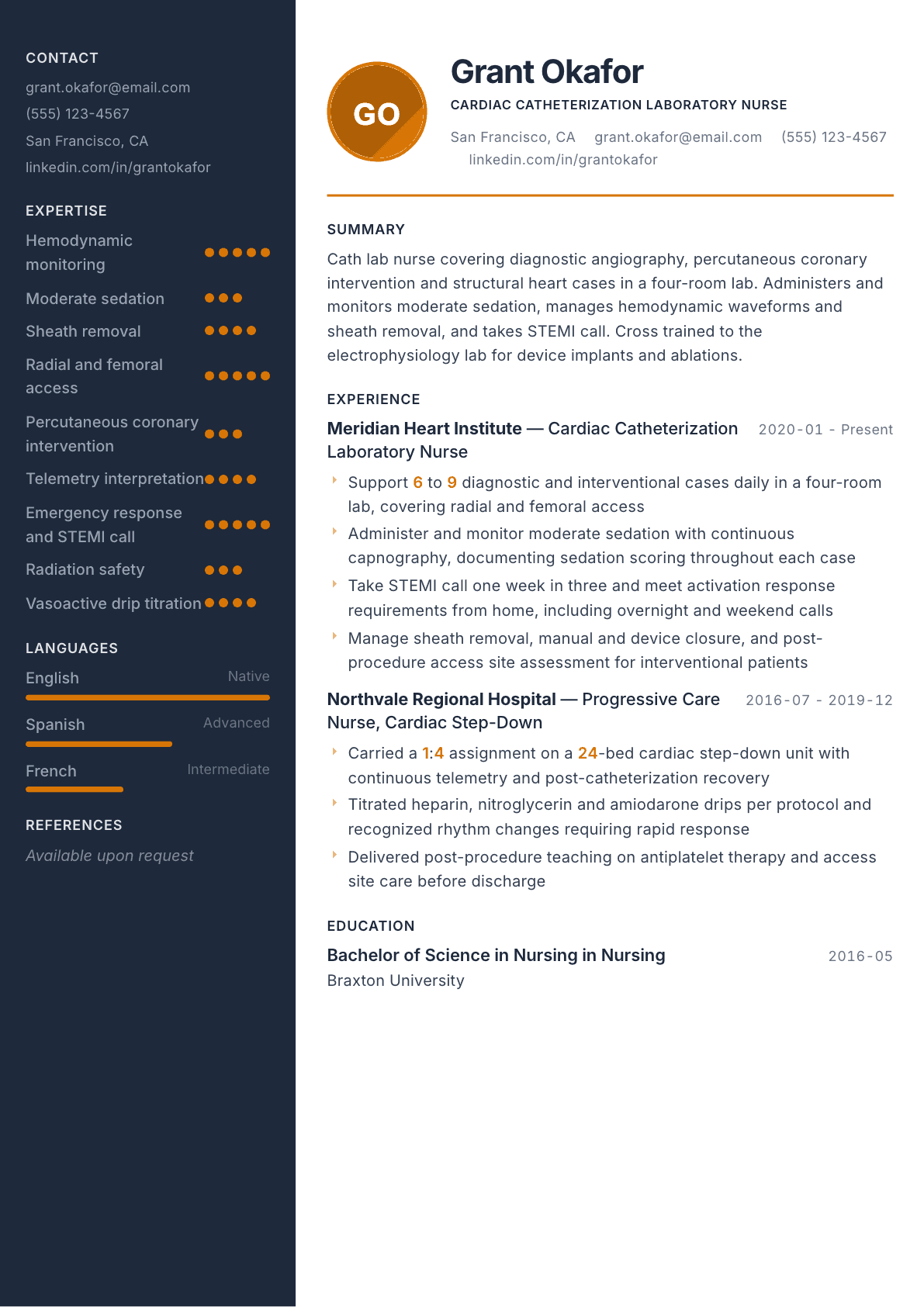
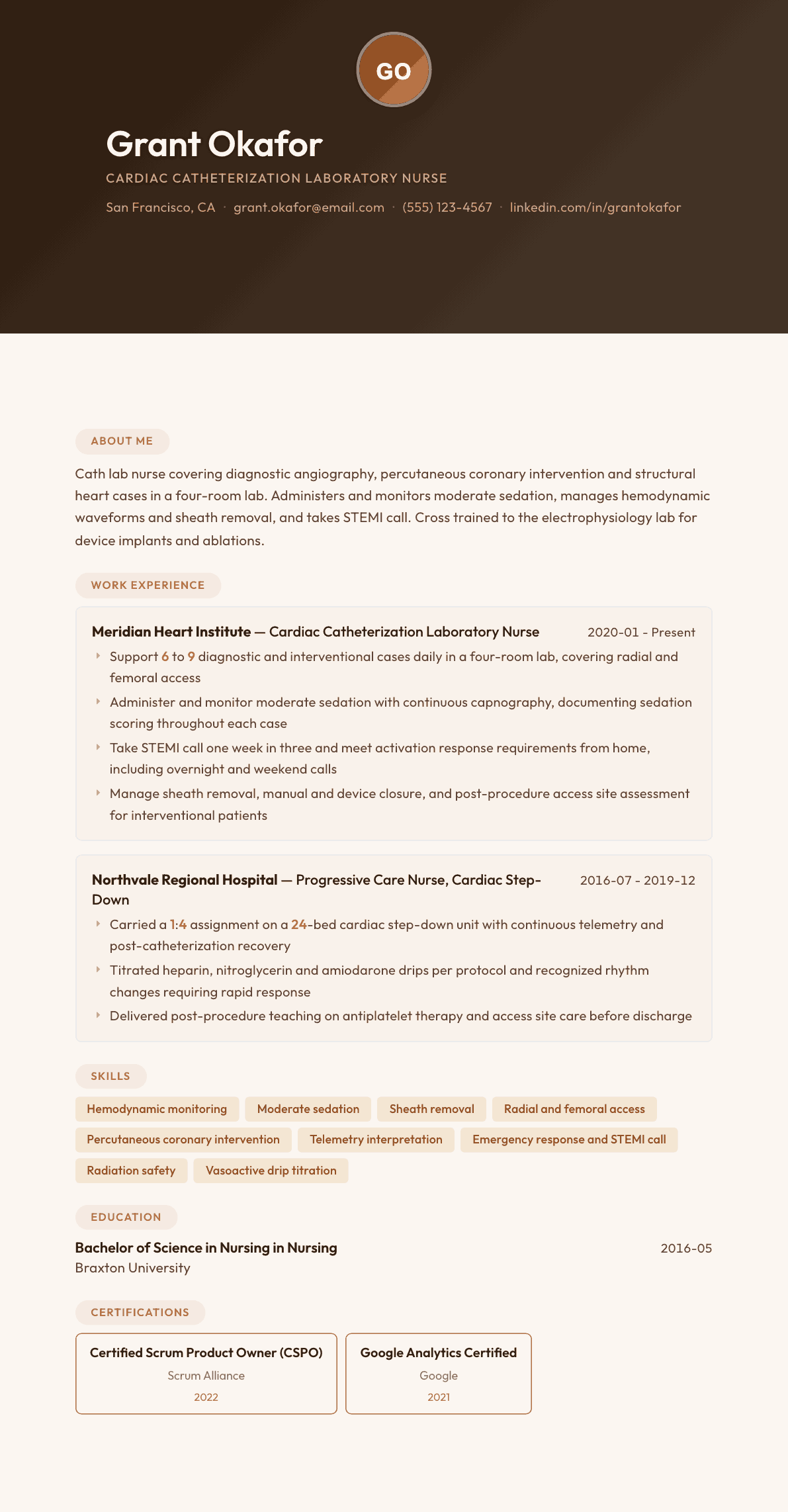
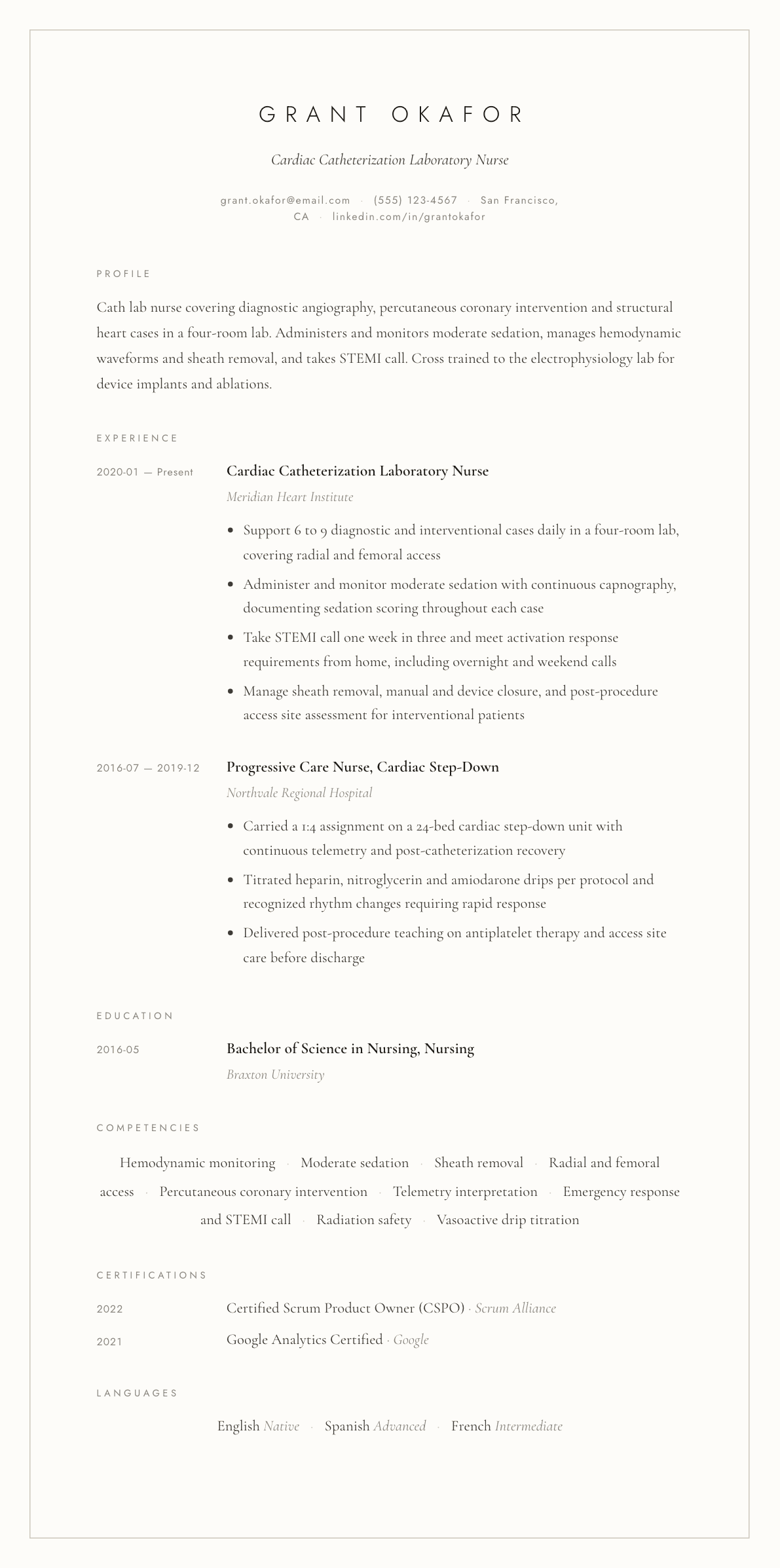
Example Cath Lab Nurse summary
Cardiac catheterization laboratory nurse with eight years in cardiology, the last five in a four-room lab supporting diagnostic, interventional and structural heart cases. Administers moderate sedation with capnography, manages sheath removal and closure, and covers STEMI call one week in three. Cross trained to electrophysiology for device implants. Seeking a cath lab charge nurse position in a tertiary cardiac center.
Skills to list on a Cath Lab Nurse resume
- Hemodynamic monitoring
- Moderate sedation administration
- Capnography
- Sheath removal and closure devices
- Radial and femoral access care
- Percutaneous coronary intervention support
- Electrophysiology case support
- Telemetry and rhythm interpretation
- Vasoactive drip titration
- Intra-aortic balloon pump
- Radiation safety and lead practice
- Contrast and renal protection protocols
- STEMI activation response
- Sterile field setup
What actually gets this resume read
- List the case types you support by name: diagnostic angiography, percutaneous coronary intervention, structural heart, peripheral or electrophysiology.
- State your call commitment and whether you meet a STEMI activation window from home, since managers screen for that first.
- Show the three cath lab roles separately if you rotate through them: monitor, scrub and circulate each carry different skills.
- Name the sedation you administer and how you monitor it, including capnography and the sedation scale you document with.
- Include sheath management, closure devices and access site complications; these are the bullets that mark a real cath lab nurse.
- Keep ACLS current and visible, and add any critical care background because hemodynamic instability is routine in this lab.
How to write a cath lab nurse resume
A cath lab manager hires for two things at once: someone who can hold a sedated patient steady through a complex intervention, and someone who will answer the phone at two in the morning when a heart attack activation comes in. A resume that proves only the first gets a polite decline, because the call roster is the constraint every lab lives under.
The reader is scanning for case types, for the three lab roles of monitor, scrub and circulate, for sedation practice with capnography, for sheath and closure management, and for the response window you have met from home. General cardiac nursing language will not carry any of that. Telemetry experience is a foundation, not a substitute.
This guide lays out how a cath lab resume should be ordered, three summaries covering entry from step-down through to a lab charge role, before and after bullets taken from procedure work, and answers to the questions cardiac nurses ask when they write for the lab.
Format: procedures, roles and call in the first third
Reverse-chronological and two pages once you have both floor and lab history. Put your credentials and ACLS status in the header, and immediately under the summary add a block naming the case types you support, the roles you rotate through and your call commitment.
Cardiology hiring moves fast when a resume answers the obvious questions early. A manager reading a cath resume is deciding whether to call you before a competing hospital does, and she decides on that block.
- Header: name, credentials, city and state, license state, current ACLS.
- Order: summary, case types and lab roles, certifications, cath lab experience, cardiac clinical experience, education.
- Nurses entering the lab lead with critical care or step-down acuity and any sedation and rhythm competencies already signed off.
Summary: lab size, case mix, call, sedation
Name the number of rooms, the case mix from diagnostic angiography through intervention and structural heart, whether you cover electrophysiology, and how often you take call. Add that you administer and monitor moderate sedation, because it is the competency most often listed as required.
For a nurse moving in from step-down or intensive care, use the summary to connect acuity to the lab: drip titration, rhythm recognition, post-procedure access site care and hemodynamic instability all transfer, and naming them prevents the reader from filing you as inexperienced.
Experience: the case, the role, the volume
Cath lab nurses rotate through distinct roles and managers staff by them. Monitoring means hemodynamics, sedation and documentation. Scrubbing means the sterile field, wires, catheters and device handoff. Circulating means supplies, medications, equipment and the flow of the room. Write bullets that make clear which of the three you can be assigned to and how often.
Give daily or weekly case volume and access approach. Radial and femoral access differ in preparation, closure and post-procedure care, and a lab converting toward radial first wants a nurse who already works that way.
The bullets that carry the most weight are the unstable ones: a patient who dropped pressure during intervention, a retroperitoneal bleed recognized at the bedside, a rhythm that required immediate defibrillation on the table, or balloon pump support during a transfer. Write one of these with the recognition and the action, not just the outcome.
Sedation, sheaths and radiation
Sedation deserves its own bullet. Name the agents you administer under protocol, the monitoring you document including continuous capnography, and the sedation scale you score with. Managers screen carefully here because it is the practice with the clearest regulatory footprint.
Sheath management is the second signature skill. Manual pressure, closure devices, timing off anticoagulation, access site assessment and the complications that follow are what mark a cath lab nurse rather than a cardiac floor nurse. Radiation practice belongs here too: lead discipline, dosimetry and shielding for the team.
Certifications and keyword discipline
ACLS is non-negotiable and should never be missing or expired on a cardiology resume. Add critical care or cardiac vascular certification when you hold it, with the issuing body written out, and note any radiology safety course the employer requires.
Postings for this role reuse a compact vocabulary: hemodynamic monitoring, moderate sedation, sheath removal, closure device, radial access, percutaneous coronary intervention, structural heart, electrophysiology, heart attack activation and call response. Mirror the posting once high in the resume and once inside a bullet doing real work.
Cath Lab Nurse resume summary examples
Moving in from step-down
Registered nurse with three years on a 24-bed cardiac step-down unit carrying a 1:4 assignment with continuous telemetry and post-catheterization recovery. Titrates heparin and nitroglycerin per protocol and holds current ACLS. Seeking a cath lab position with structured orientation to monitoring and circulating.
Four years in the lab
Cath lab nurse supporting diagnostic angiography, percutaneous coronary intervention and peripheral cases in a four-room lab, rotating through monitor, scrub and circulate. Administers moderate sedation with continuous capnography, manages sheath removal and closure devices, and takes call one week in three.
Lab charge nurse
Cardiac catheterization laboratory charge nurse with eleven years in interventional cardiology, running daily board assignments and call coverage for a six-room lab. Supports structural heart and electrophysiology cases, leads sedation competency review, and precepts nurses through a six-month lab orientation.
Work experience bullets: before and after
Before: Cared for patients undergoing cardiac procedures.
After: Supported 6 to 9 diagnostic and interventional cases daily in a four-room lab, rotating through monitor, scrub and circulate for both radial and femoral access.
Daily volume, lab size, the three roles and access approach describe a staffing fit that the original sentence cannot.
Before: Gave sedation during procedures.
After: Administered and monitored moderate sedation under protocol with continuous capnography, documenting sedation scoring and airway status at set intervals through each case.
The monitoring method and documentation cadence show competent practice rather than a task performed.
Before: Removed sheaths after cases.
After: Managed femoral sheath removal with manual pressure and device closure, timed off anticoagulation results, and performed access site assessment through the recovery period.
It names the decision points, which is where sheath complications actually come from.
Before: Took call for emergencies.
After: Covered heart attack activation call one week in three, meeting the program response requirement from home overnight and on weekends across a full year without a missed activation.
Call frequency plus a response standard answers the manager question that decides the hire.
Before: Responded when patients became unstable.
After: Recognized a falling pressure and rising heart rate during intervention as a retroperitoneal bleed, escalated to the interventionalist, and prepared blood products and volume resuscitation in the room.
A recognition-to-action sequence proves clinical judgment better than any adjective.
Hard skills
- Hemodynamic waveform monitoring
- Moderate sedation administration
- Capnography and airway monitoring
- Sheath removal and closure devices
- Radial and femoral access care
- Percutaneous coronary intervention support
- Structural heart case support
- Electrophysiology case support
- Rhythm interpretation and defibrillation
- Vasoactive and anticoagulant titration
- Intra-aortic balloon pump
- Radiation safety and dosimetry practice
Soft skills
- Steadiness during instability
- Closed-loop communication in the room
- Patient reassurance under sedation
- Reliability on call
- Handoff to recovery
- Teaching families about access site care
Certifications worth listing
- Advanced Cardiovascular Life Support (ACLS) (American Heart Association)
- Basic Life Support (BLS) (American Heart Association)
- CCRN (Acute/Critical Care Nursing) (American Association of Critical-Care Nurses)
- Cardiac Vascular Nursing Certification (CV-BC) (American Nurses Credentialing Center)
- Registered Cardiovascular Invasive Specialist (RCIS) (Cardiovascular Credentialing International)
Mistakes that cost cath lab nurse candidates the interview
- Leaving call commitment off the resume when it is the staffing problem the manager is trying to solve.
- Describing procedures generally instead of naming diagnostic, interventional, structural or electrophysiology case types.
- Not saying which of the monitor, scrub and circulate roles you can cover, which decides how you get assigned.
- Listing sedation with no mention of capnography, scoring or the protocol you work under.
- Skipping sheath management and access site complications, the skills that separate lab nurses from floor nurses.
- Letting ACLS lapse or omitting its expiry, which stalls a cardiology application at the recruiter stage.
Cath Lab Nurse resume questions
Can I get a cath lab job straight from a medical-surgical floor?
It is harder than moving from step-down or intensive care, but labs do hire into orientation. Strengthen the resume with telemetry hours, drip titration, current ACLS and any rapid response participation, and say plainly that you are seeking a structured lab orientation.
How do I show call experience on a cath lab nurse resume?
Write the frequency as a rotation, such as one week in three, and add the response expectation you met from home. If your program tracked activation times, say that you met the standard consistently rather than quoting a number you cannot support.
Should I list every device and catheter I have handled?
No. Group them by case type instead: coronary intervention, peripheral, structural heart, device implant. A manager reads case categories to plan assignments, and a long device list makes the resume look padded without answering the staffing question.
Does a cath lab nurse need critical care certification?
It is rarely required and often valued, because cath lab patients decompensate quickly and the certification signals comfort with hemodynamics and vasoactive support. Include it with the issuing body when you hold it, and keep ACLS visible either way.
How long should the resume be if I have cross-trained to electrophysiology?
Two pages, with electrophysiology given its own short block rather than mixed into coronary bullets. Device implants, ablations and mapping systems carry different skills, and a manager staffing both labs wants to see the split clearly.