Telemetry Nurse Resume Examples: the lines they read
Write a Telemetry Nurse Resume Built on Rhythm Skill
By Mustafa Tarabya, founder of CVBooster · Published · Updated
Telemetry nurse resume examples covering rhythm interpretation, drip titration, step-down ratios and the certifications cardiac units screen for.
Sample resumes for a telemetry nurse
The same telemetry nurse content laid out in three CVBooster templates, so you can see what the finished document looks like before you write a word.
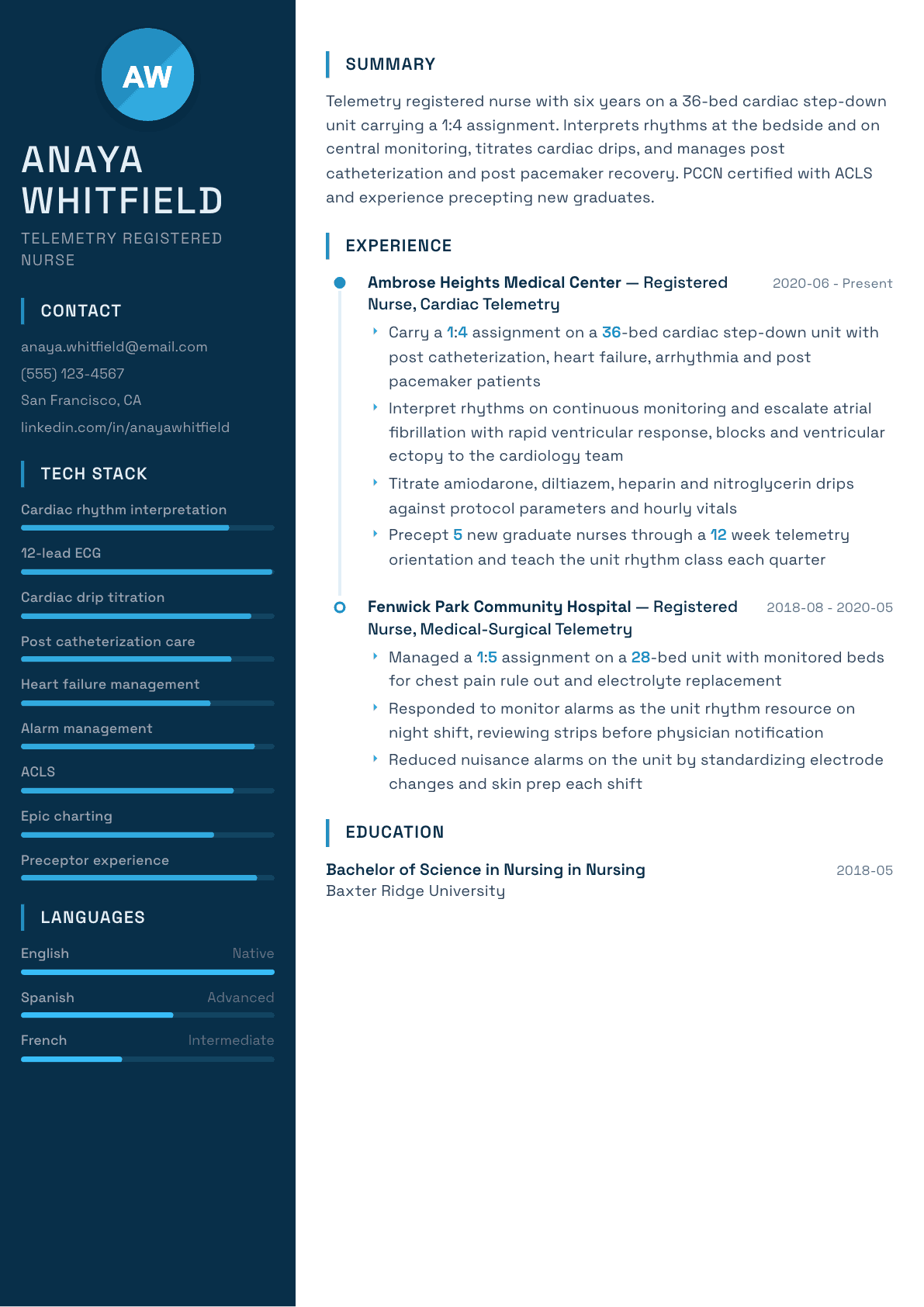
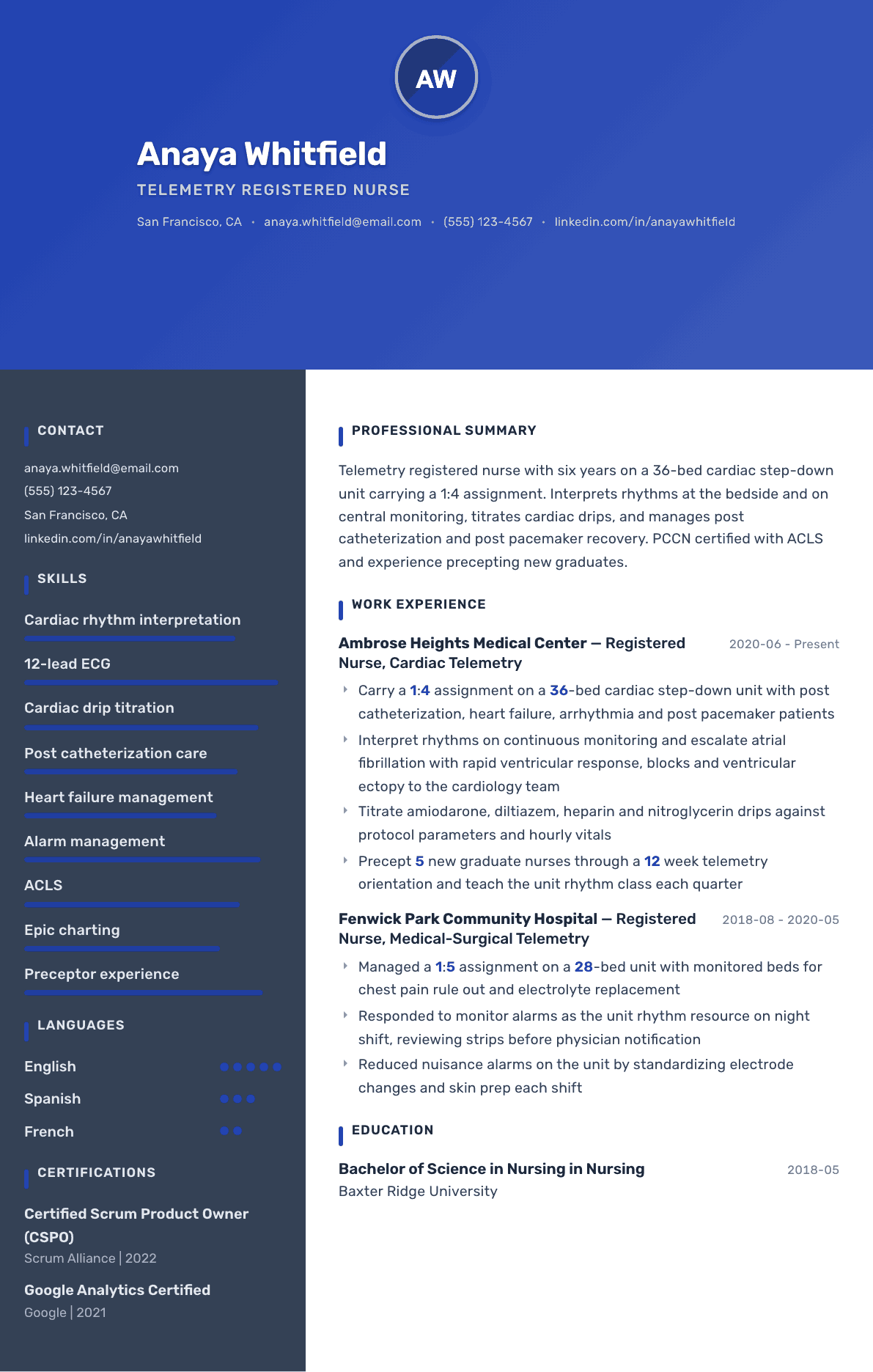
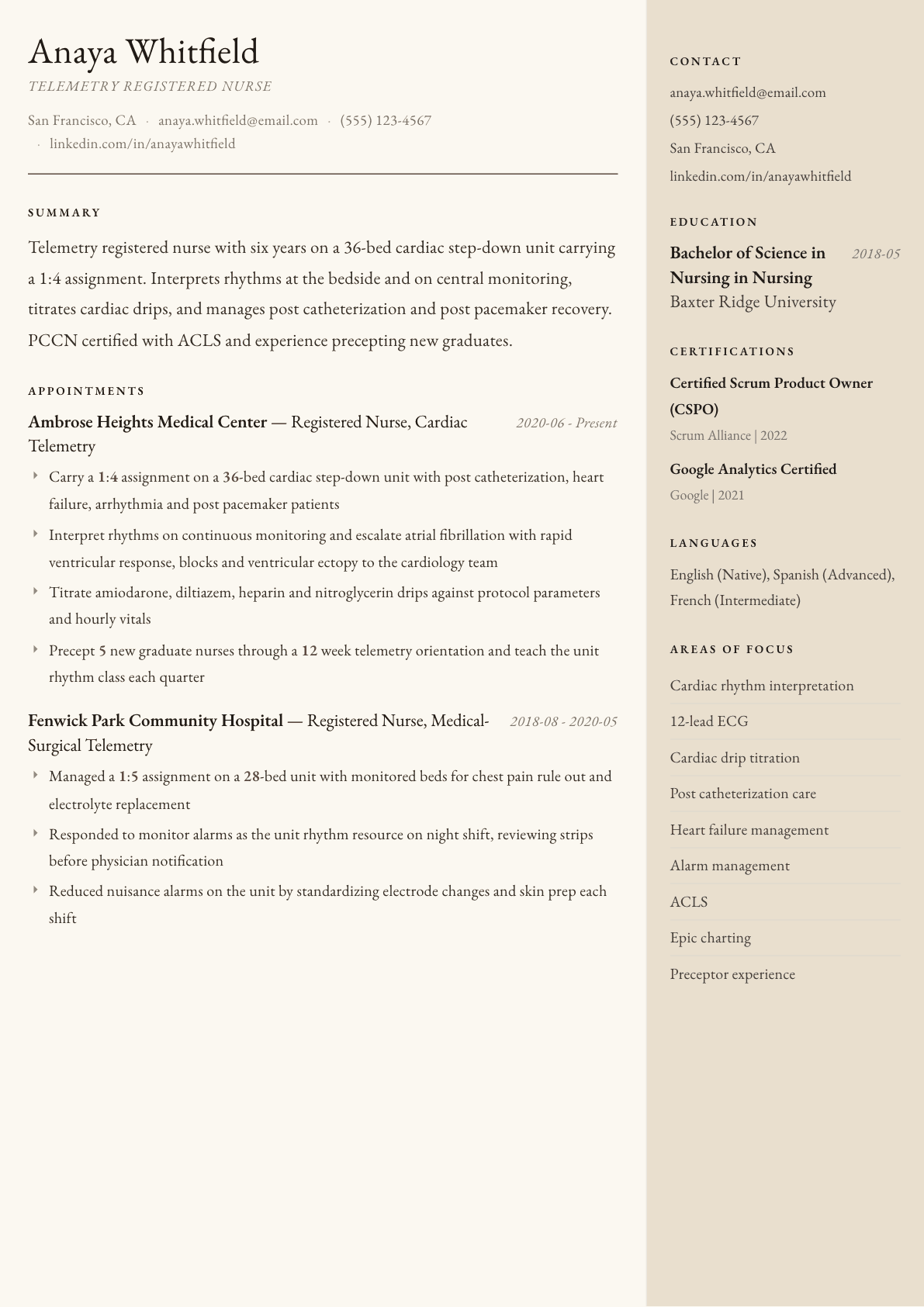
Example Telemetry Nurse summary
Telemetry registered nurse with six years on a 36-bed cardiac step-down unit at a 1:4 ratio, caring for post catheterization, heart failure, arrhythmia and post pacemaker patients. Interprets rhythms on continuous monitoring, titrates amiodarone, diltiazem and heparin against protocol, and escalates blocks and rapid ventricular response to cardiology. PCCN and ACLS certified, precepts new graduates each cohort.
Skills to list on a Telemetry Nurse resume
- Cardiac rhythm interpretation
- 12-lead ECG acquisition
- Telemetry monitoring
- Cardiac drip titration
- Heart failure management
- Post catheterization care
- Sheath removal and groin checks
- Pacemaker and ICD precautions
- Chest pain protocols
- Electrolyte replacement
- ACLS and BLS
- Alarm management
- Epic charting
- New graduate precepting
What actually gets this resume read
- Put the bed count, ratio and patient mix in the first line of every telemetry job so acuity is obvious.
- Name the rhythms and interventions you handle, not just the phrase cardiac monitoring, which every applicant writes.
- List the drips you titrate with the protocol context, since that is what separates step-down from general med-surg.
- Add ACLS and PCCN near the top, because cardiac units filter on those two before reading experience.
- Include post procedure recovery detail such as sheath removal, groin checks and pacemaker precautions if you have it.
- Mention alarm management or rhythm teaching work, which reads as unit leadership rather than routine bedside care.
How to write a telemetry nurse resume
Telemetry is the floor where a nurse manager finds out whether you can read a change before it becomes a code. A cardiac step-down unit gives you four or five patients who are all being watched for a reason, and the resume that gets an interview is the one that proves you know why each of them is on a monitor and what you would do when the rhythm shifts.
The common failure is a resume that says cardiac monitoring and stops. Every applicant for a telemetry line writes that phrase. What separates candidates is the rhythms they name, the drips they titrate against protocol parameters, the post procedure care they have delivered, and the escalation decisions they have made at three in the morning with a cardiologist on the phone.
This guide covers the format a cardiac manager expects, how to write rhythms and drips so they read as competence rather than exposure, three summaries across a telemetry career, and the mistakes that make an experienced step-down nurse look like a general medical-surgical applicant.
Format: unit size, ratio and patient mix on the first line
Reverse chronological, one page under five years and two pages after. Every telemetry job opens with a context line: bed count, nurse to patient ratio, shift, and the patient mix. A 36-bed cardiac step-down at 1:4 with post catheterization and post pacemaker patients is a completely different job from a 24-bed medical floor with eight monitored beds, and only one of those lines makes the case for a progressive care posting.
Keep certifications in a block right under the summary. Cardiac units filter on advanced cardiovascular life support and progressive care certification before anyone reads your bullets, so putting them on page two is a self-inflicted wound.
- Header: name, credentials in the order degree, license, specialty certification, city and state, contact, license state.
- Order: summary, licenses and certifications, experience, education, skills, committee and preceptor work.
- Name whether monitoring is central, unit based or watched by a dedicated monitor technician.
Rhythms: name them, and name what you did about them
Write the arrhythmias you recognize and act on: atrial fibrillation with rapid ventricular response, atrial flutter, supraventricular tachycardia, first, second and third degree blocks, ventricular tachycardia and fibrillation, paced rhythms and failure to capture, and the ST changes that send a patient back to the catheterization laboratory.
Then attach the action. Interpretation alone is a course completion. Interpretation plus notification, plus the medication given, plus the twelve lead you acquired, plus the transfer you initiated is nursing practice. A manager reading the second version knows you will not sit on a run of ventricular tachycardia waiting for someone else to notice.
Include strip review habits: printing and measuring intervals, comparing to the prior tracing, and reviewing before the provider call. That level of detail is invisible to outsiders and instantly recognizable to a cardiac manager.
Drips, protocols and post procedure care
List the infusions you titrate and the parameter you titrate against: amiodarone, diltiazem, heparin against activated partial thromboplastin time or anti factor ten a levels, nitroglycerin against chest pain and blood pressure, dobutamine, and insulin on a drip protocol where your unit runs one. Titration authority is the clearest signal that you worked step-down rather than general medical.
Post procedure care is the other differentiator. Sheath removal and manual pressure, radial band deflation schedules, groin and pulse checks, bed rest protocols, watching for retroperitoneal bleed, pacemaker and defibrillator precautions with arm restrictions and wound checks, and post ablation monitoring.
Add the disease management: heart failure with daily weights and diuretic response, chest pain rule out with serial troponin, electrolyte replacement protocols, and anticoagulation teaching for new atrial fibrillation.
Alarms, safety and unit contribution
Alarm fatigue is a live problem on every monitored unit, and a nurse who has worked on it stands out. Electrode placement and daily changes, skin prep, customized alarm limits per patient, and the audits that follow are concrete safety work you can describe without inventing a result.
Add the unit roles that show you are more than an assignment: rhythm class instructor, monitor technician trainer, code committee member, preceptor for new graduates, or the resource nurse the shift calls before the rapid response. These lines are what turn an experienced staff nurse into a candidate for a charge or progressive care position.
Keywords a cardiac unit posting matches on
The recurring terms are telemetry, cardiac step-down, progressive care unit, rhythm interpretation, twelve lead electrocardiogram, atrial fibrillation, drip titration, heparin protocol, post catheterization care, pacemaker, heart failure, chest pain protocol and alarm management. Use the posting wording once in the skills block and once inside a bullet.
Keep the general acute care terms too. Telemetry patients still need wound care, discharge teaching, sepsis screening and fall prevention, and postings usually list those alongside the cardiac vocabulary.
Telemetry Nurse resume summary examples
Two years on telemetry
Registered nurse with two years on a 28-bed medical telemetry unit carrying a 1:5 assignment. Interprets common arrhythmias, manages chest pain rule out with serial troponin, and follows electrolyte replacement protocols. Advanced cardiovascular life support certified and seeking a cardiac step-down position.
Six years, cardiac step-down
Telemetry nurse with six years on a 36-bed cardiac step-down unit at a 1:4 ratio, caring for post catheterization, heart failure and post pacemaker patients. Titrates amiodarone, diltiazem and heparin against protocol, escalates blocks and rapid ventricular response to cardiology, and precepts new graduates. Certified in progressive care nursing.
Resource nurse moving to progressive care
Senior telemetry nurse and unit rhythm resource with ten years across cardiac step-down and medical telemetry. Teaches the quarterly rhythm class, trains monitor technicians, and leads the unit alarm management work. Relief charge on nights with responsibility for assignments and admissions. Pursuing a progressive care staff position.
Work experience bullets: before and after
Before: Cared for patients on cardiac monitors.
After: Carried a 1:4 assignment on a 36-bed cardiac step-down unit with post catheterization, heart failure, arrhythmia and post pacemaker patients across twelve hour shifts.
Ratio, bed count and case mix show acuity that the phrase cardiac monitors leaves undefined.
Before: Interpreted heart rhythms.
After: Interpreted rhythms on continuous monitoring and escalated atrial fibrillation with rapid ventricular response, second degree blocks and ventricular ectopy to cardiology with a printed strip.
Named rhythms plus the escalation habit turn a course skill into demonstrated bedside practice.
Before: Gave cardiac medications and drips.
After: Titrated amiodarone, diltiazem, heparin and nitroglycerin drips against protocol parameters, rechecking blood pressure and rhythm at every rate change.
Titration against parameters is the authority that separates step-down from general medical practice.
Before: Took care of patients after heart procedures.
After: Managed post catheterization recovery including sheath removal with manual pressure, radial band deflation, hourly pulse and groin checks, and bed rest protocol enforcement.
Procedure-specific tasks prove the recovery skills a cardiac unit cannot train quickly.
Before: Helped reduce alarm noise on the unit.
After: Standardized daily electrode changes and skin prep on the unit and set patient specific alarm limits, which cut nuisance alarms reported at the monthly safety huddle.
A named intervention with a forum for the result is credible where a claimed reduction is not.
Hard skills
- Cardiac rhythm interpretation
- Twelve lead electrocardiogram acquisition
- Continuous telemetry monitoring
- Cardiac drip titration
- Heparin and anticoagulation protocols
- Post catheterization and sheath care
- Pacemaker and defibrillator precautions
- Heart failure and diuretic management
- Chest pain and troponin protocols
- Electrolyte replacement protocols
- Alarm management and electrode care
- Rapid response and code participation
- Epic and Cerner documentation
Soft skills
- Pattern recognition under a full assignment
- Clear escalation to providers overnight
- Teaching rhythms to newer nurses
- Family education on cardiac diagnoses
- Staying calm during a sustained arrhythmia
Certifications worth listing
- Advanced Cardiovascular Life Support (ACLS) (American Heart Association)
- Basic Life Support (BLS) (American Heart Association)
- PCCN (Progressive Care Nursing) (American Association of Critical-Care Nurses)
- Cardiac Vascular Nursing Certification (CV-BC) (American Nurses Credentialing Center)
- Medical-Surgical Nursing Certification (MEDSURG-BC) (American Nurses Credentialing Center)
Mistakes that cost telemetry nurse candidates the interview
- Writing cardiac monitoring and nothing else, which is the one phrase every applicant for the line uses.
- Leaving out the ratio and bed count, so a progressive care manager cannot judge the acuity you carried.
- Naming drips without the parameters, which reads as hanging bags rather than titrating them.
- Putting advanced life support and progressive care certification on page two under a filter that never reaches it.
- Skipping post procedure care detail even though sheath and pacemaker recovery is hard to train quickly.
- Describing rhythm interpretation as a class you took rather than decisions you made at the bedside.
Telemetry Nurse resume questions
What is the difference between a telemetry and a progressive care resume?
Progressive care postings expect higher acuity: more titratable drips, more post procedure recovery, sometimes non-invasive ventilation. Lead with those bullets, put the ratio and drip list first, and add the progressive care certification if you hold it or say when you plan to sit it.
Do I need advanced cardiovascular life support certification for a telemetry job?
Nearly always, and many units want it before your start date rather than during orientation. If yours is current, put it in the header credentials and the certification block. If it is expired, renew before applying instead of listing it with an old date.
How do I show rhythm competence if my unit had a monitor technician?
Say so plainly, then describe your role in the loop: reviewing the strip the technician called, measuring intervals, comparing with prior tracings, deciding on the twelve lead and making the provider notification. Managers care about the decision, not who watched the screen.
How long should a telemetry nurse resume be?
One page for under five years and two pages beyond that. Use the second page for preceptor work, committees, rhythm teaching and additional units rather than repeating the same bedside bullets across three similar telemetry jobs.
Can medical-surgical experience get me a cardiac step-down job?
Yes, when you lead with the monitored beds you covered, the arrhythmias you escalated, the chest pain rule out protocol and any drip experience. Add advanced life support certification before applying, since that credential is what most cardiac postings filter on first.