Sonographer Resume Examples: free ATS score and gap list
Write a Sonographer Resume Organized by Registry and Specialty
By Mustafa Tarabya, founder of CVBooster · Published · Updated
Sonographer resume example built around ARDMS registries, specialty exam lists, protocol detail and diagnostic imaging keywords.
Sample resumes for a sonographer
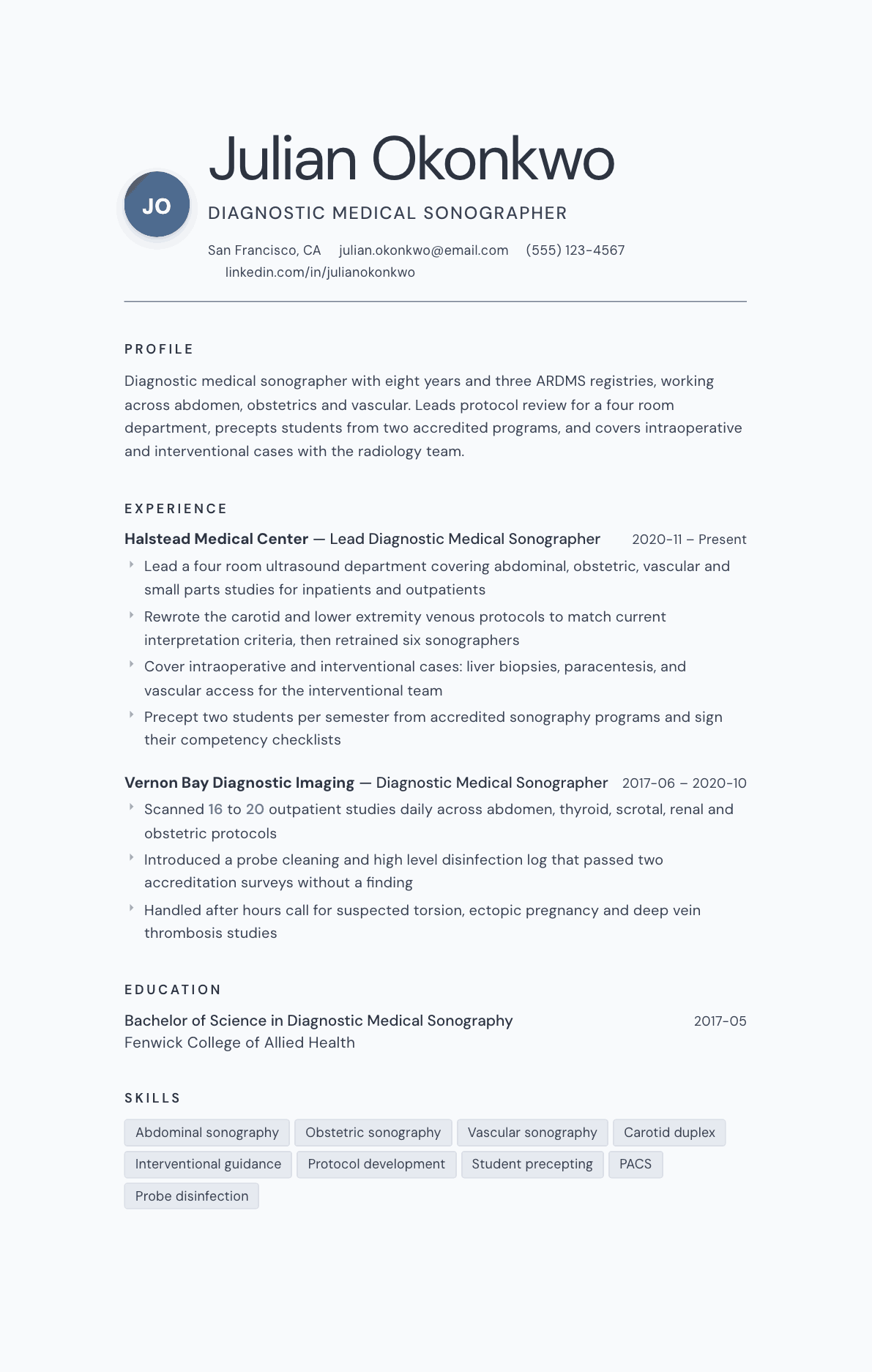
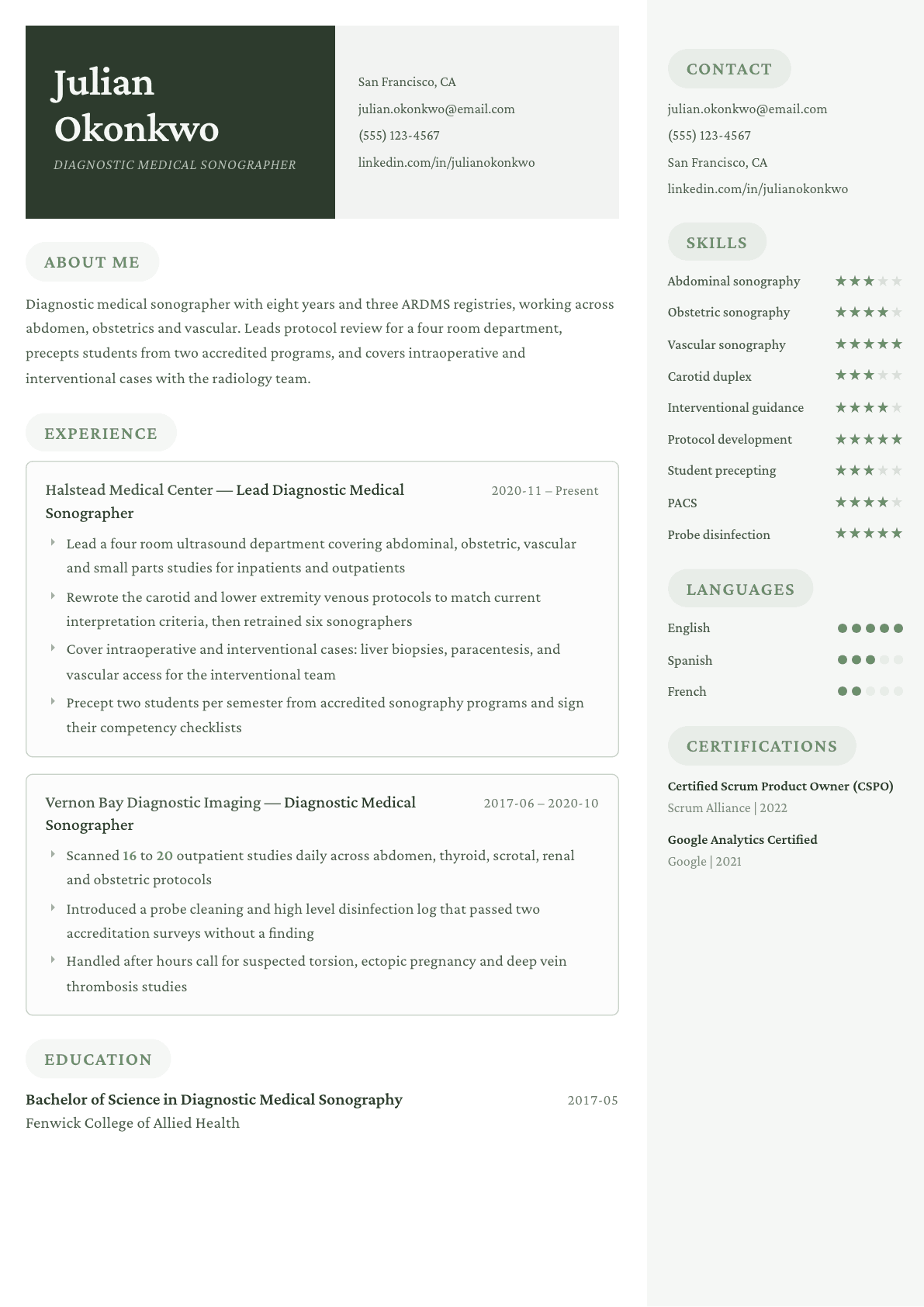
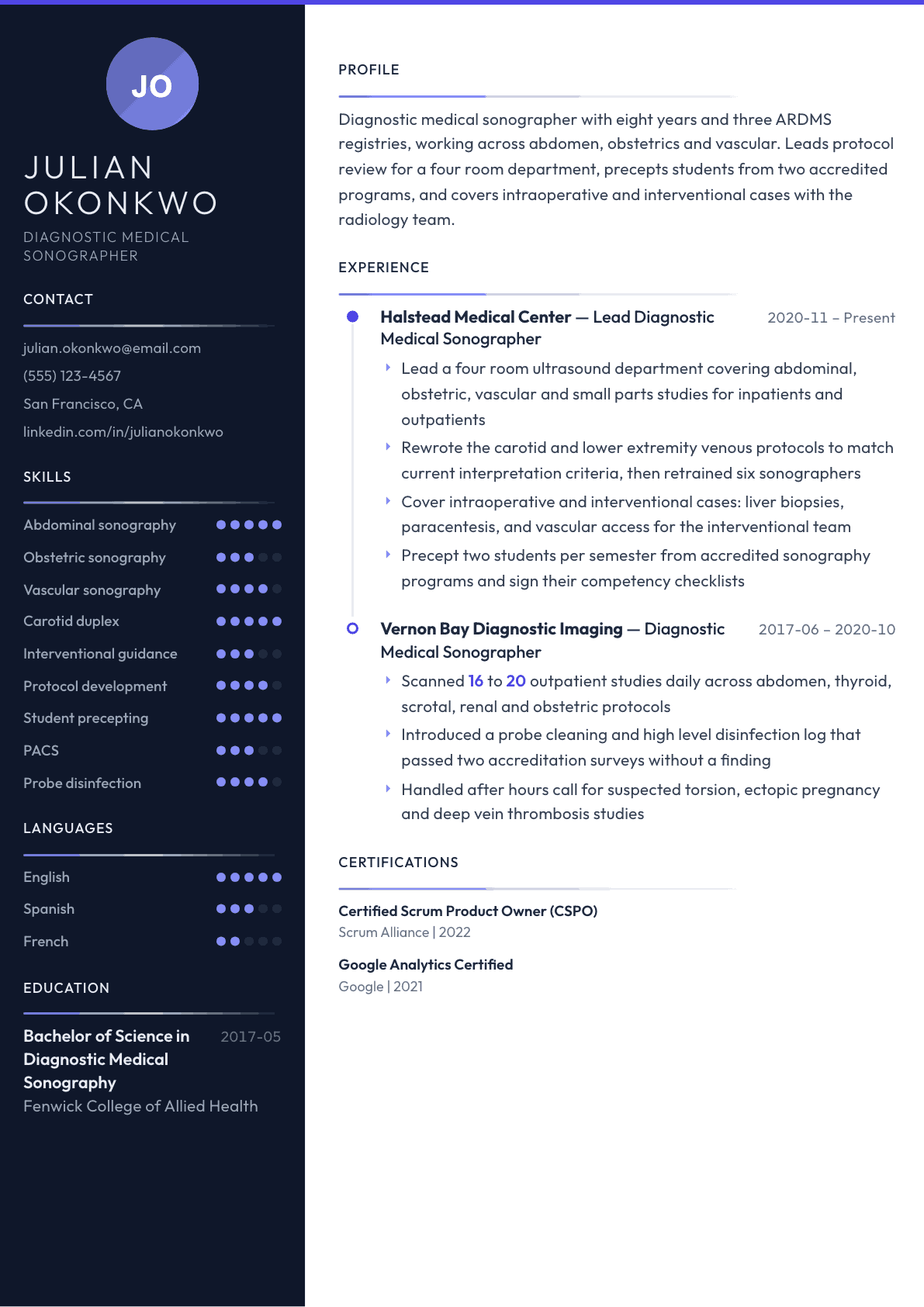
The same sonographer content laid out in three CVBooster templates, so you can see what the finished document looks like before you write a word.
Example Sonographer summary
Diagnostic medical sonographer with eight years and three ARDMS registries covering abdomen, obstetrics and vascular studies. Leads a four room department, rewrote the carotid and venous protocols against current interpretation criteria, and precepts students from two accredited programs. Comfortable in the interventional suite guiding biopsies and drainage. Looking for a lead or clinical coordinator role in a hospital imaging service.
Skills to list on a Sonographer resume
- Abdominal sonography
- Obstetric and gynecologic sonography
- Vascular sonography
- Carotid and cerebrovascular duplex
- Peripheral venous and arterial studies
- Small parts and thyroid sonography
- Interventional procedure guidance
- Intraoperative ultrasound
- Protocol development
- Accreditation survey preparation
- Student precepting
- Probe high level disinfection
- PACS and reporting systems
- Image optimization
- Ergonomic scanning technique
What actually gets this resume read
- Head your resume with your registry credentials in the exact ARDMS abbreviations, since recruiters search on those letters.
- Group experience by specialty area rather than one long list, so a vascular lab can find its own work at a glance.
- Include protocol writing, accreditation surveys and precepting, because those are what separate a lead from a staff sonographer.
- Name the accreditation body your department passed under, and what your role in the survey preparation was.
- Describe your call coverage: torsion, ectopic pregnancy and deep vein thrombosis studies are the after hours reality.
- Keep your image quality and disinfection practice on the page, since surveyors and managers both look for that discipline.
How to write a sonographer resume
Sonographer postings are written by departments that must keep an accreditation intact. Each service line, whether it is vascular, obstetric, breast or general abdominal, requires appropriately credentialed staff, so the credential letters on your resume are not decoration. They decide which service you are allowed to cover.
Beyond the letters, a lead sonographer or imaging director reads for depth in one specialty rather than a thin coverage of all of them. Interpretation criteria change, protocols get rewritten, and the sonographers who stand out are the ones who have been part of that work rather than only executing it.
This guide covers how to build the resume around registries and specialty depth, how to write protocol and accreditation bullets, what a senior sonographer should show that a staff sonographer does not, and the questions that come up when moving between specialties.
Format: credentials as the headline
Put every registry credential directly after your name in the exact abbreviation the certifying board uses, then repeat them in a credentials block with the issuing body and current status. Imaging directors and credentialing offices both read those letters as the qualification, and an unabbreviated description can miss a recruiter search entirely.
Two pages is acceptable once you have specialty depth, protocol work and teaching on the record. Keep a single column and plain section headings, since hospital systems parse those reliably and a lost date line ends the screen.
- Header: name with registry abbreviations, contact details, state license where applicable.
- Credentials block: each registry with issuing body and specialty, plus BLS.
- Section order: summary, credentials, sonography experience, specialty depth, teaching and quality work, education.
Organize experience by specialty, not just by employer
Within each position, group your bullets by service line: general abdominal, obstetric and gynecologic, vascular, small parts, breast, musculoskeletal, and interventional guidance. A vascular laboratory manager should be able to find her own work in three seconds without reading a chronological narrative.
Under each service line, say what you scan independently and what volume you carry. Depth reads better than breadth here. A sonographer who covers carotid, transcranial, peripheral arterial and venous studies in a dedicated vascular laboratory is a stronger vascular hire than one who lists eight service lines with no detail behind any of them.
Intraoperative and interventional work is worth calling out separately. Guiding a liver biopsy, mapping veins before access, or scanning in the operating room are all responsibilities a department cannot assume you have.
Protocol work, accreditation and teaching
The clearest signal of a senior sonographer is protocol ownership. Describe a protocol you rewrote, why it changed, whose interpretation criteria you aligned it to, and how you retrained the staff who scan it. That paragraph answers a lead posting more directly than any list of exams.
Accreditation experience is the second signal. Name the accrediting body, the service line under review, what documentation you prepared, and the outcome. Departments live in three year cycles around these surveys and a sonographer who has carried one is a known quantity.
Teaching is the third. Student precepting from accredited programs, competency checklists you sign, new hire onboarding and continuing education you have delivered all belong on the page, with counts where you have them.
- Name the equipment vendor and the reporting or measurement package you use.
- Include quality assurance duties: image review, correlation with final reports, and phantom or probe testing.
- List call coverage and after hours studies, which are the hardest shifts to fill.
Image quality and the physics you actually use
Write about optimization in operational terms rather than textbook terms. Frequency and depth selection for body habitus, focal zone placement, gain and time gain compensation discipline, harmonic and compound imaging choices, Doppler angle correction and wall filter settings, and how you deal with shadowing behind bowel gas or a calcified plaque.
One bullet on artifact management goes a long way. Reverberation, mirror image, twinkling and aliasing are the artifacts that mislead a reader if a sonographer does not recognize and address them at the machine, and naming them shows that you scan with intent.
Keywords sonography postings repeat
Departments reuse a compact vocabulary in these job descriptions: diagnostic medical sonography, vascular duplex, Doppler waveform analysis, obstetric biometry, image optimization, protocol adherence, accreditation standards, technologist worksheet and probe disinfection. Mirror the true ones once, then prove them inside bullets.
Where the posting names an accrediting body or a specific registry, use the same words. Those two terms are the most common hard filters on a sonography application.
Sonographer resume summary examples
First registry
Diagnostic medical sonographer with abdomen and obstetrics registries and 18 months in a general hospital department, scanning abdominal, renal, obstetric, thyroid and scrotal studies. Comfortable with portable inpatient work and structured worksheets. Preparing for the vascular registry and seeking a department with a vascular rotation.
Six years in
Sonographer with six years and three registry credentials covering abdominal, obstetric and vascular studies in a hospital imaging department. Scans 16 to 20 studies a day, assists interventional radiology with biopsies and drainage, and carries after hours call for torsion and deep vein thrombosis referrals.
Lead sonographer
Lead sonographer with twelve years of practice, now running a four-room department and eight staff. Rewrote the carotid and lower extremity venous protocols against current interpretation criteria, prepared two successful accreditation surveys, and precepts two students per semester from accredited programs.
Work experience bullets: before and after
Before: Scanned a variety of ultrasound exams every day.
After: Scanned 16 to 20 studies daily across abdominal, renal, thyroid, scrotal and obstetric protocols in a hospital department with portable inpatient coverage.
The daily count and the named protocol families let a manager slot you into a specific room and shift.
Before: Updated department scanning protocols.
After: Rewrote the carotid and lower extremity venous protocols to match current interpretation criteria, then retrained six sonographers and revalidated their measurements.
Naming the protocols, the criteria and the retraining shows ownership rather than participation.
Before: Helped the department pass its accreditation.
After: Prepared the vascular service line for accreditation review: case submissions, protocol documentation, quality assurance logs and correlation records, passing without a finding.
The service line, the documents and the outcome make an accreditation claim verifiable.
Before: Trained students who came to the department.
After: Precepted two students per semester from accredited sonography programs, reviewing image quality weekly and signing competency checklists before program submission.
Cadence, review practice and sign-off responsibility describe a teaching role, not occasional supervision.
Before: Got good images even on difficult patients.
After: Optimized frequency, focal zone and harmonic settings for large body habitus and bowel gas, recovering diagnostic renal and aortic images on studies previously recorded as limited.
Naming the machine adjustments and the exams they rescued converts a vague claim into demonstrated technique.
Hard skills
- Abdominal sonography
- Obstetric and gynecologic sonography
- Vascular duplex imaging
- Carotid and transcranial studies
- Peripheral arterial and venous studies
- Small parts and thyroid sonography
- Interventional procedure guidance
- Intraoperative sonography
- Doppler waveform analysis
- Protocol development and revision
- Accreditation documentation
- Quality assurance and report correlation
- Probe high level disinfection
- PACS and structured reporting
Soft skills
- Specialty mentoring of junior staff
- Working the referring clinician relationship
- Steady scanning through long procedures
- Discretion with unexpected findings
- Survey week composure
- Ergonomic technique and self-protection
Certifications worth listing
- Registered Diagnostic Medical Sonographer (RDMS) (American Registry for Diagnostic Medical Sonography)
- Registered Vascular Technologist (RVT) (American Registry for Diagnostic Medical Sonography)
- Registered Diagnostic Cardiac Sonographer (RDCS) (American Registry for Diagnostic Medical Sonography)
- Registered Vascular Specialist (RVS) (Cardiovascular Credentialing International)
- Sonography certification, S (American Registry of Radiologic Technologists)
Mistakes that cost sonographer candidates the interview
- Presenting registries as prose instead of the abbreviations that recruiters and credentialing offices search on.
- Listing eight service lines with no depth in any of them, which reads as exposure rather than competence.
- Leaving protocol work and accreditation preparation off a resume aimed at a lead or coordinator posting.
- Describing image optimization in textbook language rather than the settings you adjust on a real patient.
- Omitting interventional and intraoperative work, which departments cannot assume and will not ask about.
- Skipping call coverage entirely, when after hours staffing is the gap most hospital departments are trying to close.
- Failing to separate the studies you scan independently from those you have only assisted with.
Sonographer resume questions
Which sonography specialty should I build my resume around?
Build it around the specialty you want to be paid for, and let the others support it. A resume led by vascular depth reads as a vascular hire, while an even spread across six service lines reads as a generalist and competes in a much larger pool.
How do I write a sonographer resume for a lead or coordinator role?
Shift the weight from exam volume to ownership. Protocol revisions, accreditation preparation, quality assurance review, student precepting, scheduling and new hire competency sign-off are the responsibilities that distinguish a lead application from a strong staff one.
Do I need to list every registry exam I have passed?
List every current one, each on its own line with the issuing body, because different service lines depend on different credentials for department accreditation. Drop expired credentials rather than listing them, since a lapsed registry raises a question you do not want asked.
How much detail should I give about equipment?
Name the vendor and system family you have scanned on and the reporting package you document in. Departments care because applications training takes weeks, and a sonographer who already knows the keyboard and the measurement package reaches full schedule sooner.
How do I add a new specialty to my resume before I am registered in it?
State the pathway honestly: the studies you scan under supervision, the clinical volume you have logged toward the exam, and the registry date you have booked. Departments regularly hire sonographers partway through a second registry because it solves a coverage gap ahead of time.