Radiology Technician Resume Examples: what gets the call
Radiology Technician Resume: Radiology Tech and Technologist Samples
By Mustafa Tarabya, founder of CVBooster · Published · Updated
Sample rad tech resume for new graduates and CT cross trained techs: a radiology technologist resume example written out, with credentials and keywords.
Sample resumes for a radiology technician
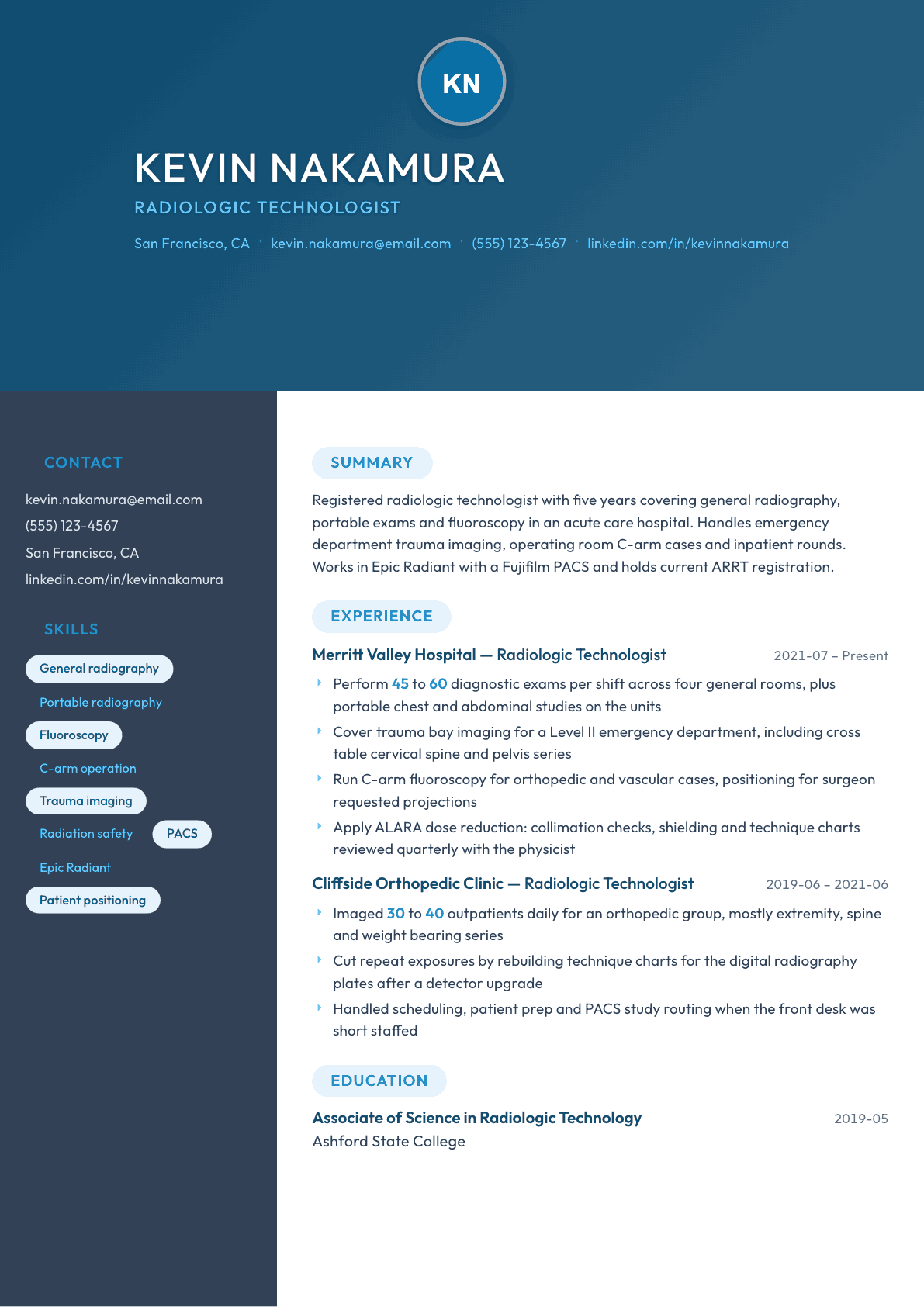
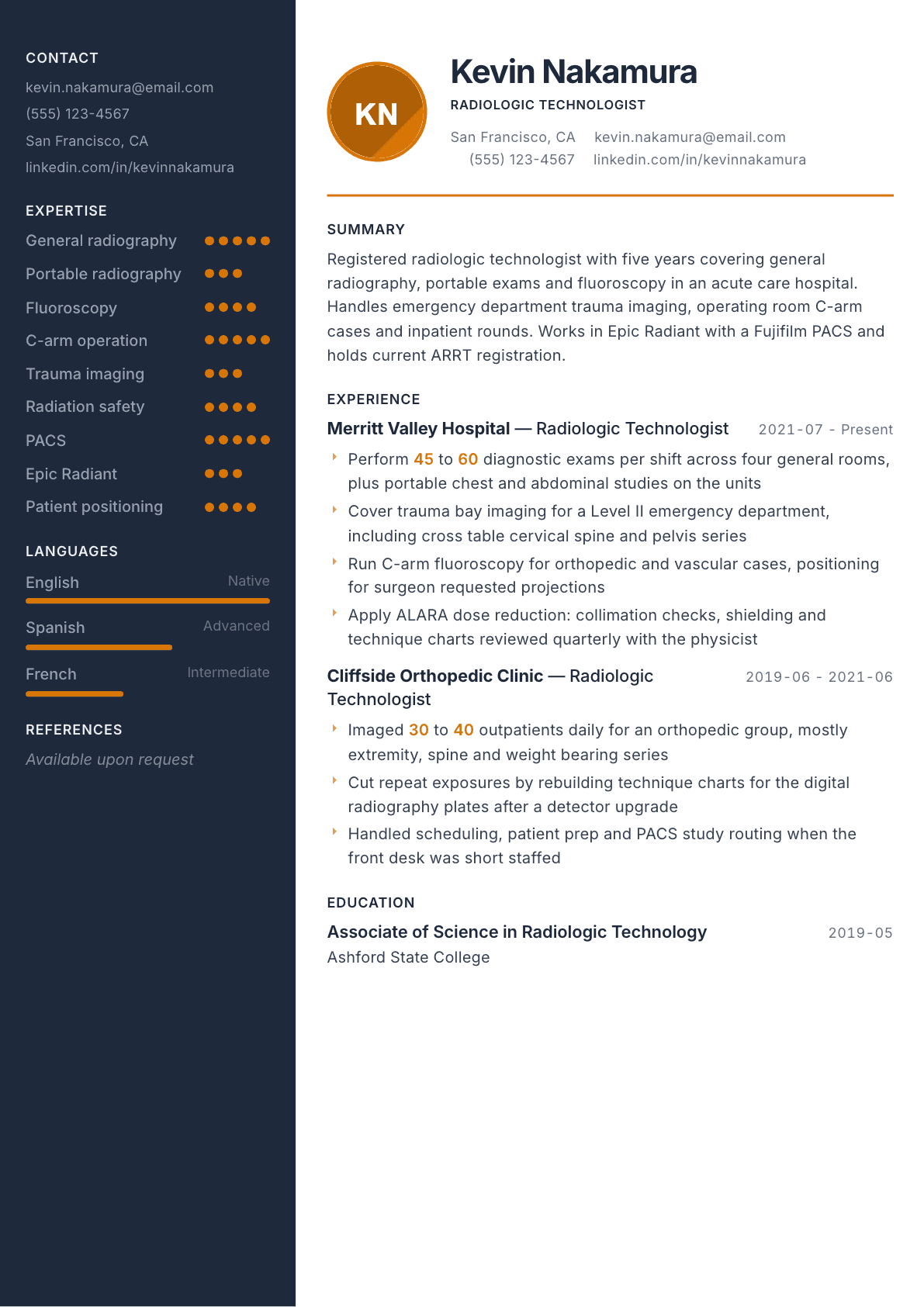
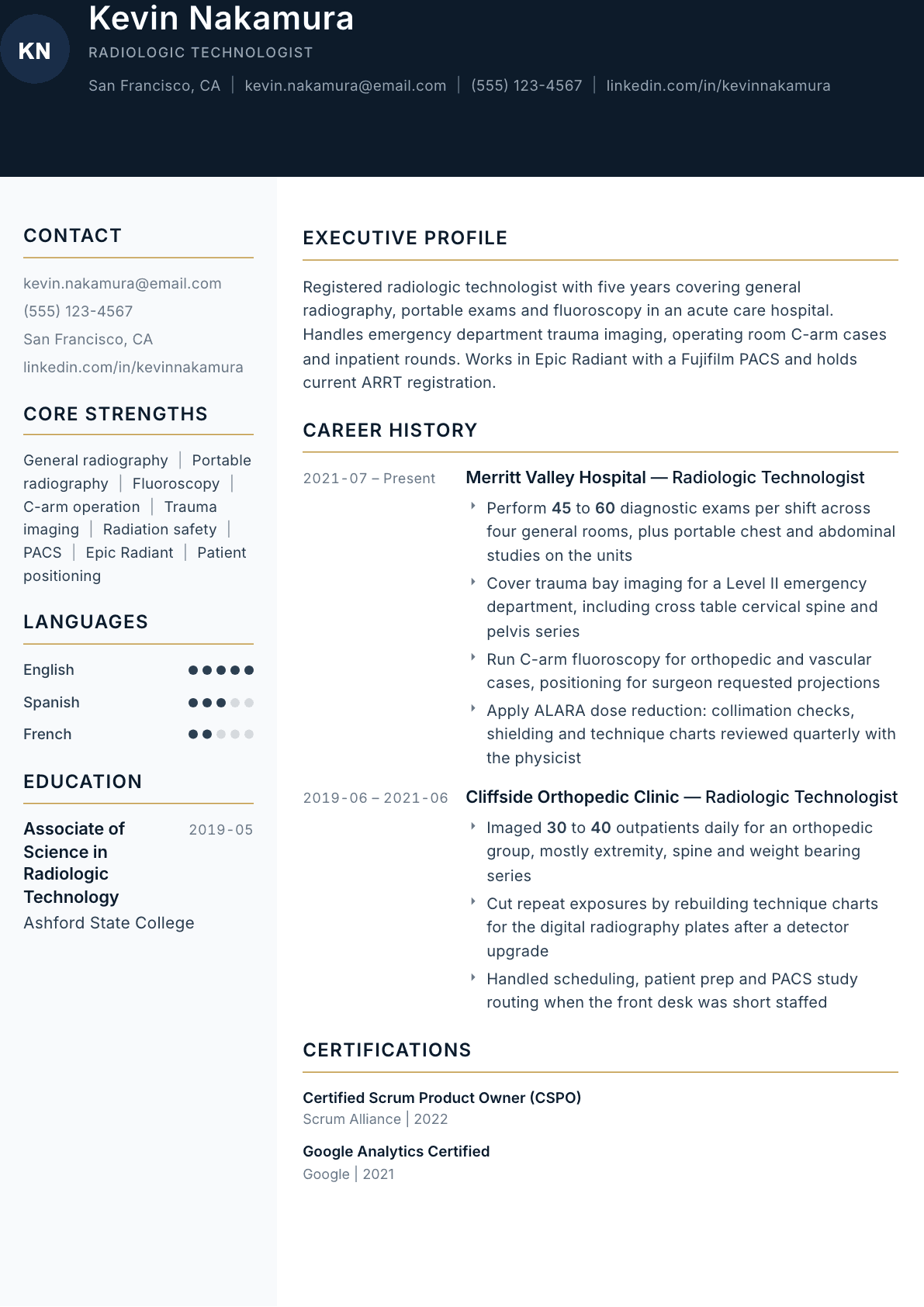
The same radiology technician content laid out in three CVBooster templates, so you can see what the finished document looks like before you write a word.
Example Radiology Technician summary
Registered radiologic technologist with five years in acute care, performing up to sixty exams a shift across general rooms, portable studies and fluoroscopy. Covers trauma bay imaging for a Level II emergency department and runs C-arm for orthopedic cases. Careful with dose: rebuilt technique charts after a detector upgrade and cut repeats. Seeking a hospital position with a path into computed tomography.
Skills to list on a Radiology Technician resume
- General radiography
- Portable and bedside imaging
- Fluoroscopy
- C-arm operation
- Trauma and emergency imaging
- Patient positioning
- Digital radiography
- Radiation safety and ALARA
- Technique chart optimization
- PACS study routing
- Radiology information systems
- Contrast administration support
- Image quality assurance
- Equipment quality control
- Patient screening and history
What actually gets this resume read
- Open each job with the modalities you run and the room count, because imaging managers staff by modality coverage.
- Put your ARRT registration number status and state license on line two of the header where a recruiter cannot miss it.
- Give exams per shift rather than a vague high volume claim, and separate portable and fluoroscopy work from room exams.
- Name your PACS and radiology information system, since imaging departments filter on the exact products they run.
- Show radiation safety habits concretely: collimation, shielding, technique charts and repeat rate review all read well.
- If you are cross trained in CT, mammography or bone density, list each with the credential status rather than one label.
How to write a radiology technician resume
An imaging manager builds a schedule out of modality coverage. When she reads a radiology technician resume she is really asking which rooms you can cover alone, whether you can take portables and trauma, and whether you will need supervision on fluoroscopy. Every other detail on the page is arranged around those answers.
The second filter is credentials. Registration status and state licensure decide whether you can legally be scheduled at all, so they belong in the header rather than at the bottom under education.
This guide covers how to lay out a radiology technician resume, which is the same document as an x ray tech or x ray technologist resume, the modality line that belongs under every job, how to write positioning and dose bullets that read as competence, and what to do when you are cross training into computed tomography or mammography.
Format: registration in the header, modality under every job
One page under eight years, two after that, single column. Radiology departments in hospital systems run applicant tracking software that handles plain headings well and multi-column layouts badly, and a dropped date line costs you the screen.
The header should carry your name with credentials, your registration status with the certifying board, your state license, and your BLS certification. Underneath, one line naming the modalities you are qualified in tells the manager immediately where you fit on her board.
- Header: name with credentials, contact details, registration and state license status.
- Section order: summary, credentials, imaging experience, technical skills, education, continuing education if recent.
- New graduates add a clinical rotation section listing sites, modalities and total competencies completed.
The modality and setting line under each job
Under every position write one line: facility type, trauma level if any, room count, modalities you covered and shift. A community hospital with four general rooms, portable coverage on two floors, C-arm for orthopedics and a Level II emergency department gives a reader the whole picture before the bullets start.
Volume goes in the same place. Exams per shift is more useful than exams per year, because it maps to how a manager staffs. Separate room exams from portable studies, since a shift with thirty portables is a completely different day from thirty walk-in extremity series.
Bullets: positioning, dose, and the difficult exam
Positioning is the craft of this job, so write about the exams that are hard to get right. Cross table lateral cervical spine on a trauma board, swimmer view, scoliosis series, weight bearing knee and foot studies, pediatric extremity work, and portable chests on ventilated patients where you cannot move the patient at all.
Dose belongs in its own bullet. Collimation discipline, shielding practice, technique chart maintenance, repeat exposure review and any work you have done with a medical physicist show that you understand your own responsibility rather than trusting the automatic exposure control to decide for you.
Fluoroscopy and surgical work is the third block. C-arm positioning for orthopedic reductions and vascular access, barium studies and other radiologist assisted exams, and how you communicate projections with a surgeon under drapes.
Do not write bullets that describe radiography as a concept. Performed x-ray examinations on patients tells a reader only that you held the job title.
- Name the equipment vendor and whether you work with digital radiography plates or computed radiography cassettes.
- Name the PACS and radiology information system, since departments filter on the products they run.
- Include quality control duties: detector calibration checks, reject analysis and equipment logs.
Credentials, cross training and continuing education
List your primary registration in radiography with the certifying board and your state license separately, because they are not the same thing and both are checked. Add BLS, and any state permit that governs fluoroscopy operation where your state issues one.
Cross training is where the job offers come from. Each additional modality certification opens a different set of postings, so list computed tomography, mammography, bone densitometry, vascular interventional or magnetic resonance separately with the credential status rather than folding them into one line. If you are mid pathway, say how many clinical competencies you have completed.
Keywords imaging postings repeat
Radiology job descriptions reuse a compact vocabulary: diagnostic radiography, portable imaging, fluoroscopy, patient positioning, radiation safety, image quality, contrast media, patient screening, PACS and radiology information system. Mirror the ones that are true of you once in the summary or skills, and demonstrate two or three inside your bullets.
Where the posting names a specific modality mix, echo that mix. A department advertising radiography with computed tomography cross training wants to see both words on your page, in that order.
Sample rad tech resume: a resume for a radiology tech written out
This sample rad tech resume follows the order an imaging department reads in: header with credential, summary, license and registration, experience by setting, clinical rotations or education, then a keyword line. A resume for a radiology tech is read by an imaging manager who checks three things first: the registration, the state license and the modalities. The radiology technologist resume example below is written out for a new graduate and for an experienced technologist cross trained in CT, so you can see how the same layout grows. Treat it as a sample to copy line by line: keep the order, then swap in your own registry categories, rotations, rooms and exam volumes.
Put the credential after your name exactly as the registry issues it, list the state license with its number on request, and name the setting under every job: hospital, outpatient center, urgent care or orthopedic clinic.
- New graduate summary: Radiologic technologist, R.T.(R)(ARRT), licensed in the state, with clinical rotations in a level two trauma center and an outpatient imaging center. Performed general radiography, portable and fluoroscopy exams under supervision, including trauma and pediatric patients.
- New graduate bullets: completed the required clinical competencies across chest, extremity, spine and abdomen exams; positioned patients in the emergency department for portable chest and extremity studies during evening rotations.
- Experienced summary: Radiologic technologist with seven years in a community hospital, registered in radiography and computed tomography, R.T.(R)(CT)(ARRT). Covers general radiography, portables, OR fluoroscopy and CT on rotating shifts, and trains students from the local program.
- Experienced bullets: performs CT head, chest, abdomen and angiography studies on a busy emergency department shift and follows the department dose protocols; serves as clinical instructor for students and checks their competency forms each semester.
- Education line for either level: Associate of Applied Science in Radiologic Technology, the program name and city, graduation month and year, and the clinical sites if you are a new graduate.
- Keyword line for either level: radiography, computed tomography, fluoroscopy, portable imaging, PACS, RIS, ALARA, radiation safety, patient positioning, contrast administration, BLS.
Radiology Technician resume summary examples
New graduate
Radiography graduate with clinical rotations across a community hospital, an orthopedic clinic and an emergency department, completing all required competencies plus portable and surgical C-arm experience. Registered with the certifying board and state licensed. Trained on digital radiography and PACS. Seeking a hospital position with night and weekend coverage.
Five years in
Registered radiologic technologist with five years in acute care, performing 45 to 60 exams per shift across four general rooms plus portable and fluoroscopy coverage. Handles trauma bay imaging for a Level II emergency department and runs C-arm for orthopedic cases. Currently completing computed tomography clinical competencies.
Lead technologist
Lead radiologic technologist with eleven years in hospital imaging, now supervising eight technologists across two shifts. Owns the reject analysis program, technique chart reviews with the medical physicist, and student clinical placement for two accredited programs. Registered in radiography, computed tomography and mammography.
Work experience bullets: before and after
Before: Performed x-ray exams on patients.
After: Performed 45 to 60 diagnostic exams per shift across four general rooms plus portable chest and abdominal studies on the inpatient units.
Volume, room count and the split between fixed and portable work describe your actual day rather than your job title.
Before: Worked in the emergency room when needed.
After: Covered trauma bay imaging for a Level II emergency department, including cross table cervical spine, pelvis and chest series on patients who could not be repositioned.
Trauma level and the specific projections show a manager you can hold the hardest room in the department.
Before: Followed radiation safety guidelines.
After: Applied dose reduction in practice: collimated to anatomy on every exposure, shielded per policy, and reviewed technique charts quarterly with the medical physicist.
Named practices and a review cadence prove a habit, where following guidelines is something everyone claims.
Before: Reduced the number of repeat images.
After: Rebuilt technique charts after a detector upgrade and led monthly reject analysis, cutting repeated exposures on extremity and chest series.
The cause, the method and the affected exam types make the improvement believable and specific to radiography.
Before: Assisted in surgery with imaging equipment.
After: Operated C-arm fluoroscopy for orthopedic reductions and vascular access cases, positioning for surgeon requested projections while maintaining a sterile field.
The case types and the sterile field detail show surgical suite competence rather than general assistance.
Hard skills
- General diagnostic radiography
- Portable and bedside imaging
- Trauma and emergency positioning
- Fluoroscopy
- C-arm operation in surgery
- Pediatric positioning
- Digital radiography systems
- Technique chart maintenance
- Radiation safety and dose reduction
- Reject analysis and image quality review
- Contrast media preparation and screening
- PACS and study routing
- Radiology information systems
- Equipment quality control checks
Soft skills
- Clear instruction to anxious patients
- Working around nursing and surgical teams
- Composure in the trauma bay
- Physical care in patient transfers
- Precepting radiography students
- Judgment on when to repeat an exam
Certifications worth listing
- Registered Technologist in Radiography, R.T.(R) (American Registry of Radiologic Technologists)
- Computed Tomography postprimary certification, R.T.(CT) (American Registry of Radiologic Technologists)
- Mammography postprimary certification, R.T.(M) (American Registry of Radiologic Technologists)
- Basic Life Support (BLS) (American Heart Association)
Mistakes that cost radiology technician candidates the interview
- Leaving registration and state license status off the header, which stalls the file at the first credentialing check.
- Giving one exam count for a whole career instead of exams per shift with the modality mix attached.
- Folding every modality into a single imaging experience line, so a manager cannot tell what you can be scheduled for.
- Writing radiation safety as a phrase rather than the collimation, shielding and technique practices behind it.
- Omitting the PACS and radiology information system when the posting names both by product.
- Never mentioning portable or surgical work, which is where most of the hard positioning in this job actually happens.
- Listing continuing education credits without saying which modality they moved you toward.
Radiology Technician resume questions
Is an x ray tech the same as a radiology technician or radiologic technologist?
Usually yes. Employers use x ray tech, radiology technician and radiologic technologist for the same registered role, and postings mix them freely. Write the title the job description uses in your summary, and keep the formal credential wording in your credentials section so a recruiter matching on any of the terms still finds you.
Should I list every exam type I can perform?
List categories rather than an exhaustive catalog: chest and abdomen, extremities, spine, skull and facial bones, pediatric, trauma and surgical fluoroscopy. Then use bullets to name the difficult exams you routinely handle, which carries far more weight than a long list.
How do I show that I am cross training into another modality?
Put the pathway on the resume with your progress: the modality, the number of clinical competencies completed and the target exam date. Departments actively look for technologists partway through a cross training pathway because it fills a scheduling gap sooner.
Do I need to include clinical rotations as a new graduate?
Yes for the first two years. Give each site, the modalities you rotated through, the total competencies completed and any surgical or portable exposure. Drop the rotations once you have a full year of registered work behind you.
What should a sample radiology tech or radiologic technologist resume include?
Your credential after your name as the registry issues it, the state license, a summary naming your modalities and setting, then jobs with the exam types, volume and shifts you cover. Add clinical rotations if you are a new graduate, BLS and any cross training. The resume for a radiology tech sample above shows both levels.