Older Worker Resume Examples: free ATS score and gap list
Build an Older Worker Resume That Sells Depth, Not Decades
By Mustafa Tarabya, founder of CVBooster · Published · Updated
Older worker resume example, keyword list and writing guide covering the fifteen-year rule, date trimming, current tools and mentoring evidence.
Sample resumes for a older worker
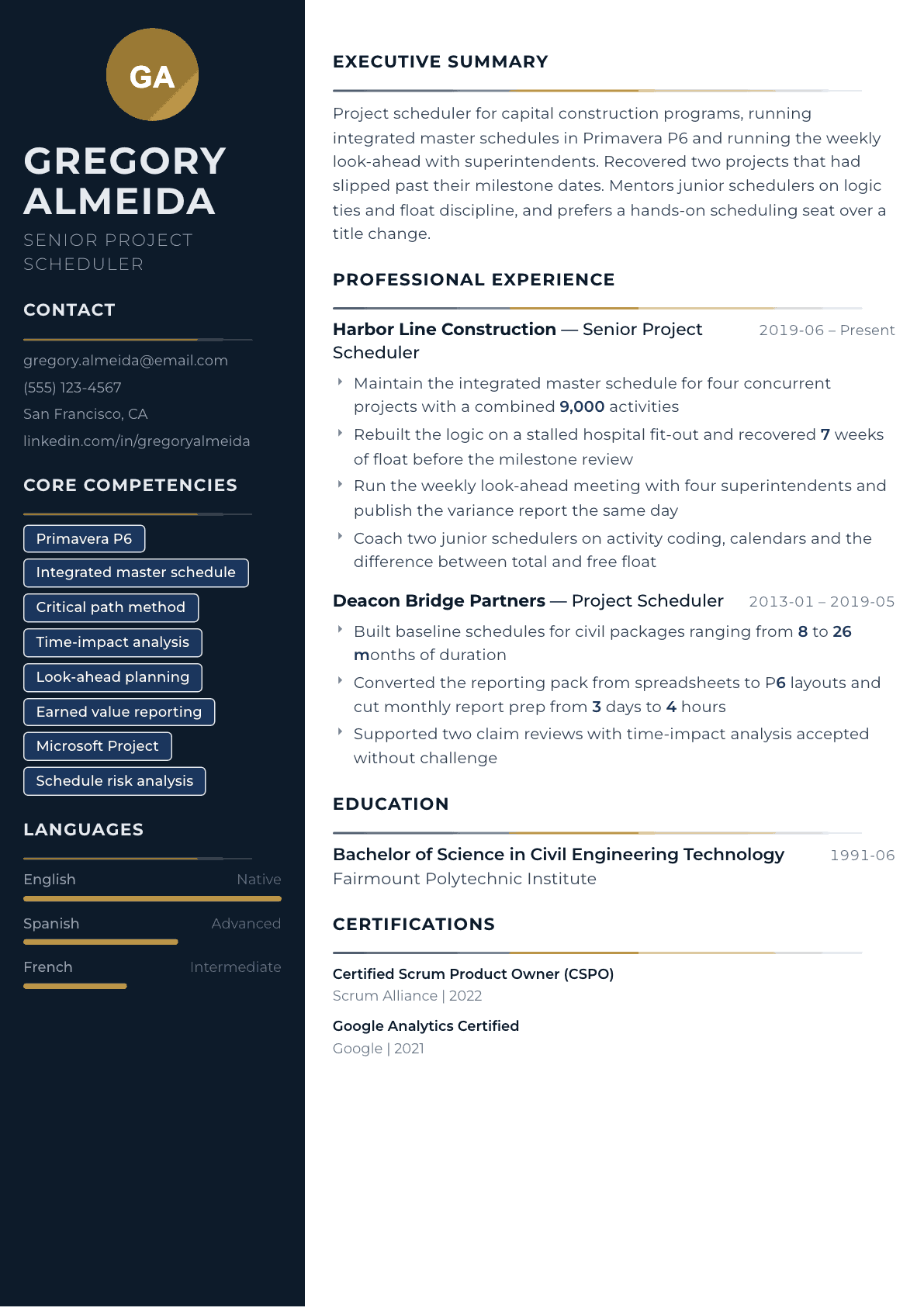
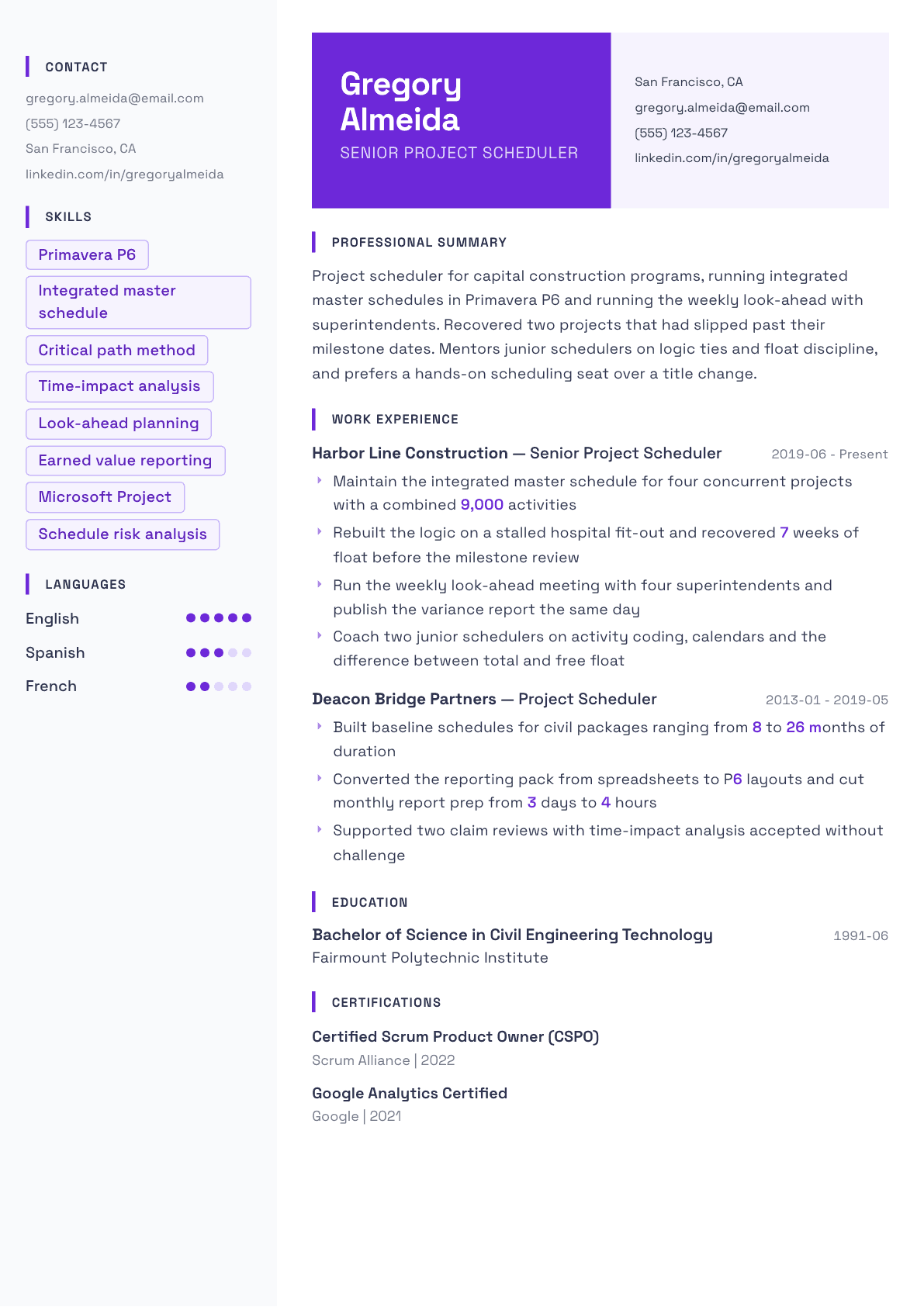
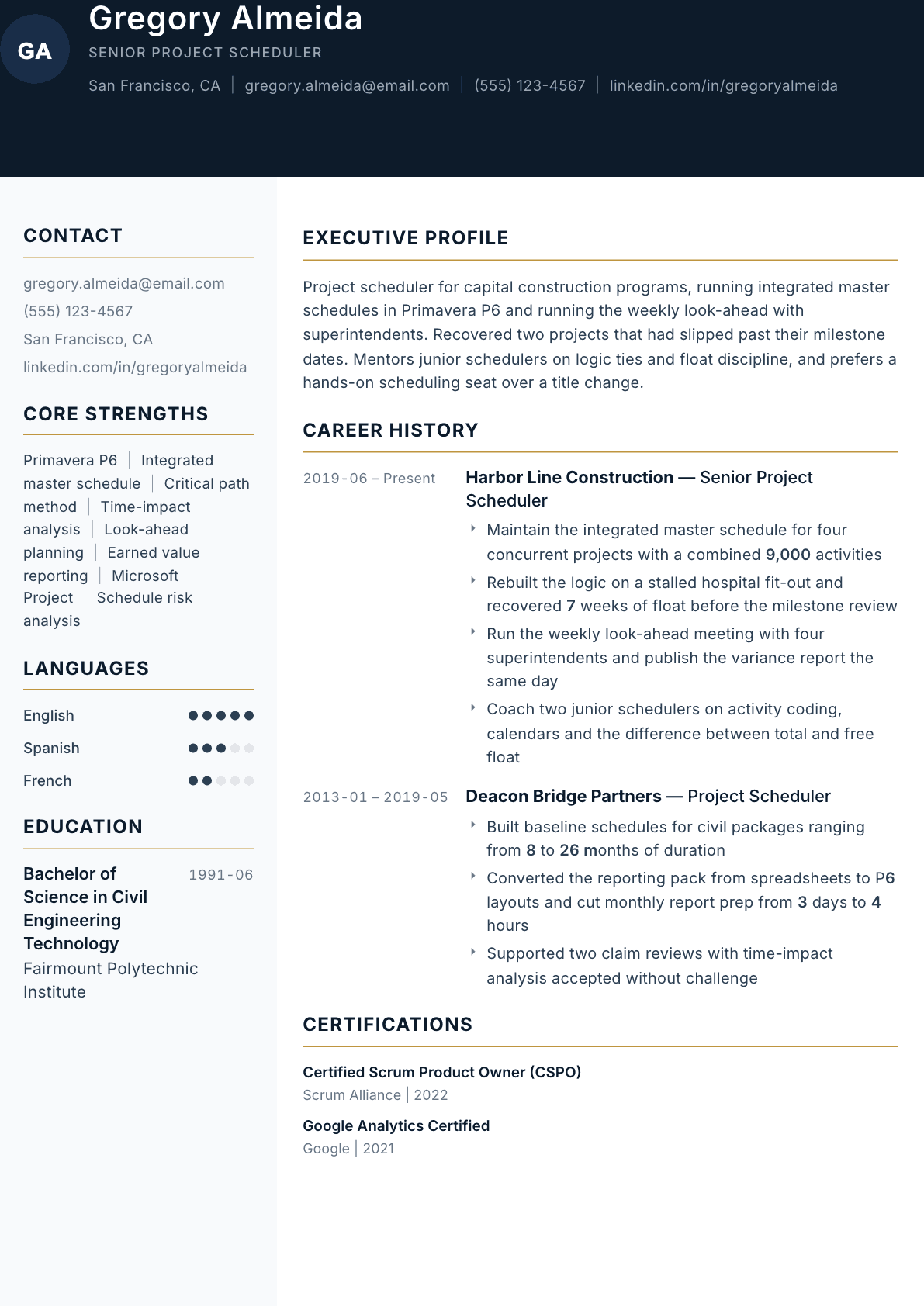
The same older worker content laid out in three CVBooster templates, so you can see what the finished document looks like before you write a word.
Example Older Worker summary
Senior project scheduler running integrated master schedules on concurrent capital projects, with recovery of a stalled hospital fit-out and a claim-ready record of time-impact analysis. Works daily in the current Primavera P6 release, runs the superintendent look-ahead, and coaches two junior schedulers on float discipline. Seeking a hands-on scheduling role on a large program rather than a management track.
Skills to list on a Older Worker resume
- Fifteen-year experience window
- Prior experience summary block
- Current software versions
- Mentoring and knowledge transfer
- Outcome-led bullet writing
- Modern contact block
- Certification currency
- Hybrid and remote tooling
- Continuing education records
- Portfolio of recent projects
- Interview age-bias framing
- Reference selection
What actually gets this resume read
- Show the last fifteen years in full detail and compress everything earlier into a short prior experience line.
- Leave the graduation year off the education block when the degree sits more than twenty years back.
- Name the current version of every tool you use, because an outdated version number dates the page instantly.
- Replace long tenure counts with recent outcomes, since a screener reads results faster than service length.
- Add one mentoring or knowledge-transfer bullet, the strongest argument a longer career can make on paper.
- Use a modern email domain and drop the street address, keeping city, state and a link to your profile.
How to write a older worker resume
An experienced candidate rarely loses a screen because of age itself. The resume loses it first, through signals that have nothing to do with capability: a graduation date from four decades back, an America Online address, a tools list naming versions that were retired years ago, and a history so long the recruiter cannot find the last three years without scrolling. Each of those is fixable in an afternoon, and fixing them changes the callback rate more than any rewrite of the bullets.
The second problem is a story problem. A hiring manager screening a longer career quietly asks whether this person will be bored, expensive, resistant to a younger supervisor, or gone in eighteen months to retirement. None of that gets said out loud, so none of it gets answered unless you answer it unprompted. The strongest experienced resumes do exactly that, by showing recent hands-on delivery, current tooling, and an explicit statement of the kind of seat the candidate wants next.
This guide covers the fifteen-year window, what to do with the earlier decades, how to date education, which signals to modernize, and how to make depth of experience read as an asset a manager can use rather than a cost she has to justify.
Format: a fifteen-year window and a prior experience block
Give full detail to roughly the last fifteen years and compress everything before it. The compression is not deletion: a two-line block titled Prior Experience, listing employers and titles without dates, keeps the depth visible while removing the arithmetic that invites bias. Nobody is being deceived, because the block is clearly labeled as earlier work.
Two pages is the right length for a long career, and the second page must earn itself. A third page is read by nobody. If the trimming feels brutal, remember what the reader is buying: what you can do in the next twelve months, evidenced by what you did in the last three years.
- Detailed entries for the last fifteen years, most recent first, with dates on every one.
- A short Prior Experience block for earlier employers and titles, without dates.
- Education with the degree and institution, and no graduation year once the degree is well behind you.
- A dated certification block showing the most recent renewals at the top.
- Contact line with city and state, a mobile number, a current email domain and a profile link.
Modernize the signals before you touch the prose
Screeners read the metadata before the sentences. An email at a defunct provider, a home street address, a landline, an objective statement at the top of the page, two spaces after a period and a Word template with a horizontal rule under the name all date the document independently of its content. Replace them with a plain modern layout, a current mailbox and a one-line professional summary.
Do the same for the tools. Naming a software suite without a version is safe. Naming the version you learned twenty years ago is not, and neither is listing a skill nobody hires for anymore beside the platform that replaced it. Read three current postings and use the vocabulary they use, then check that everything on your skills list is something you have used inside the last two years.
Experience: lead with outcomes, not tenure
Length of service is not an achievement, and a bullet that opens with twenty-two years of experience in tells the reader nothing about what happened during them. Open each bullet with what changed: the schedule you recovered, the audit you closed clean, the process you rebuilt, the team you brought through a system migration. Depth then arrives as a conclusion the reader draws rather than a claim you make.
Be careful with scope inflation too. Experienced candidates often write bullets at the altitude of the whole department because they eventually ran it, which reads as vague to a manager hiring for a hands-on seat. Bring at least half the bullets down to the level of the actual work: the tool, the file, the meeting, the number.
One bullet per role should show adaptation. A system migration you led, a methodology you converted to, a new platform you learned on the job. That single line does more against the assumption of rigidity than any adjective in the summary.
Turn depth into the thing they cannot hire elsewhere
The genuine advantage of a long career is pattern recognition and the ability to lift other people. Both belong on the page in concrete form. Mentoring two junior colleagues through a certification, writing the training material a team still uses, being the person called when a stalled project needs recovering: those are outcomes only a long career produces, and a manager reads them as risk reduction.
Say what you want next, plainly, in the summary. A candidate who states an interest in a hands-on senior contributor role has answered the two silent questions about ambition and cost in a single line, and has taken the awkwardness out of the first conversation.
- Mentoring, training design and knowledge transfer, with the number of people involved.
- Recovery work: the stalled project, the failed audit, the account that was about to leave.
- Cross-generational tooling: legacy systems you still support alongside their replacements.
- Institutional knowledge made portable, such as documentation a team adopted.
- A one-line statement of the role type you are targeting next.
Applications, networks and the screen you can skip
Job boards are the worst channel for an experienced candidate, because they maximize the number of strangers making a fast judgment on a page. A referral converts that judgment into a conversation, and a long career means a long contact list. Work the former colleagues who now run teams, and let the resume follow the introduction instead of leading it.
When you do apply cold, tailor properly. An experienced generalist who sends one resume to every posting looks overqualified for half of them and unfocused for the rest. Cutting your own history down to the parts that match one posting is not underselling, it is the whole job of a resume.
Older Worker resume summary examples
Experienced candidate entering a new field
Operations professional of 20 years moving into quality assurance after completing an auditor training course in 2025. Ran supplier corrective actions and inspection records in a manufacturing plant, and now seeking a hands-on quality technician role where documentation discipline and shop floor credibility both count.
Senior specialist, hands-on seat
Project scheduler running integrated master schedules across four concurrent capital projects, with 9,000 activities under maintenance and 7 weeks of float recovered on a stalled hospital fit-out. Works daily in the current Primavera P6 release and coaches two junior schedulers. Seeking a hands-on scheduling role on a large program.
Late career, transferring knowledge
Controller with two decades across manufacturing and distribution, most recently closing a 5-entity consolidation in 6 business days. Built the close checklist and trained 4 accountants who now run it. Targeting a senior finance role with a mandate to strengthen controls and develop the team.
Work experience bullets: before and after
Before: Over 25 years of experience in project scheduling.
After: Recovered 7 weeks of float on a stalled hospital fit-out by rebuilding the logic ties and resequencing three trade packages before the milestone review.
One recovered project proves more capability than a service length the reader can count from the dates.
Before: Proficient in Microsoft Office and various scheduling software.
After: Maintain the integrated master schedule for four concurrent projects in the current Primavera P6 release, publishing variance reports out of custom layouts the same day as the look-ahead.
A current release and a named deliverable retire the doubt that your tooling stopped updating years ago.
Before: Trained and supervised many staff over my career.
After: Coach two junior schedulers on activity coding, calendars and the difference between total and free float, both now running their own project schedules.
A specific coaching outcome shows knowledge transfer, which is what a long career uniquely offers.
Before: Adapted to new technology as it was introduced.
After: Converted the monthly reporting pack from spreadsheets to native scheduling layouts, cutting report preparation from 3 days to 4 hours across the portfolio.
Naming the migration and the time saved answers the flexibility question with evidence instead of assertion.
Before: Worked at Deacon Bridge Partners from 1994 to 2001 as a planner.
After: Prior experience: planner and scheduler roles across civil and infrastructure contractors, covering baseline development, progress measurement and claim support.
Rolling the oldest jobs into an undated block keeps the depth on the page without inviting date arithmetic.
Hard skills
- Fifteen-year experience window editing
- Prior experience block construction
- Current software version literacy
- Applicant tracking system formatting
- Achievement-led bullet writing
- Certification currency and renewal
- Targeted resume tailoring
- Mentoring and training design
- Knowledge transfer documentation
- Referral-led job search
- Remote and hybrid collaboration tools
- Salary expectation framing
Soft skills
- Working comfortably for a younger manager
- Coaching without taking over the task
- Curiosity about tools you did not grow up with
- Calm under an audit or a stalled project
- Reading organizational politics quickly
Mistakes that cost older worker candidates the interview
- Listing every job back to the first one, which pushes the recent and relevant work onto page three.
- Keeping the graduation year on a degree earned decades ago when the degree alone carries the same weight.
- Using an email address at a provider that dates the candidate before a single bullet has been read.
- Opening bullets with years of experience instead of the outcome those years produced.
- Naming software versions that have been out of support for years, which reads worse than naming none.
- Writing every bullet at department altitude when the posting is for a hands-on contributor seat.
- Relying on job boards alone when a long career has produced the contact list that makes referrals possible.
Older Worker resume questions
How far back should an experienced candidate go on a resume?
About fifteen years in full detail. Everything older belongs in a short undated block of employers and titles. That keeps the depth visible while putting the reader's attention on the work that predicts what you will do next year.
Should I remove my graduation year?
Yes, once the degree is more than roughly fifteen years old. The degree and institution still matter, the year does not, and leaving it on hands a screener a number they were not entitled to and cannot unsee.
Will trimming my history make me look like I am hiding something?
Not if the trimming is labeled. A block headed prior experience is obviously a summary of earlier work, and no recruiter reads it as concealment. What does look evasive is removing dates from recent jobs or leaving unexplained holes.
How do I handle being told I am overqualified?
Answer it before it is asked. State in your summary the type of role you want and why, whether that is hands-on delivery, a shorter commute or a specific technical domain. Overqualified is usually shorthand for a fear you will leave quickly.
Is it worth adding recent training to an already long resume?
It is one of the highest-value additions you can make. A course finished this year, a renewed credential or a new platform certification proves that learning did not stop, which is the specific doubt an experienced resume has to clear.