ICU Nurse Resume Examples: free ATS score and gap list
ICU Nurse Resume and ICU RN Resume Samples
By Mustafa Tarabya, founder of CVBooster · Published · Updated
ICU RN resume samples written out, from new graduate and step down to experienced critical care RN, with unit header lines, drip bullets and CCRN placement.
Sample resumes for a icu nurse
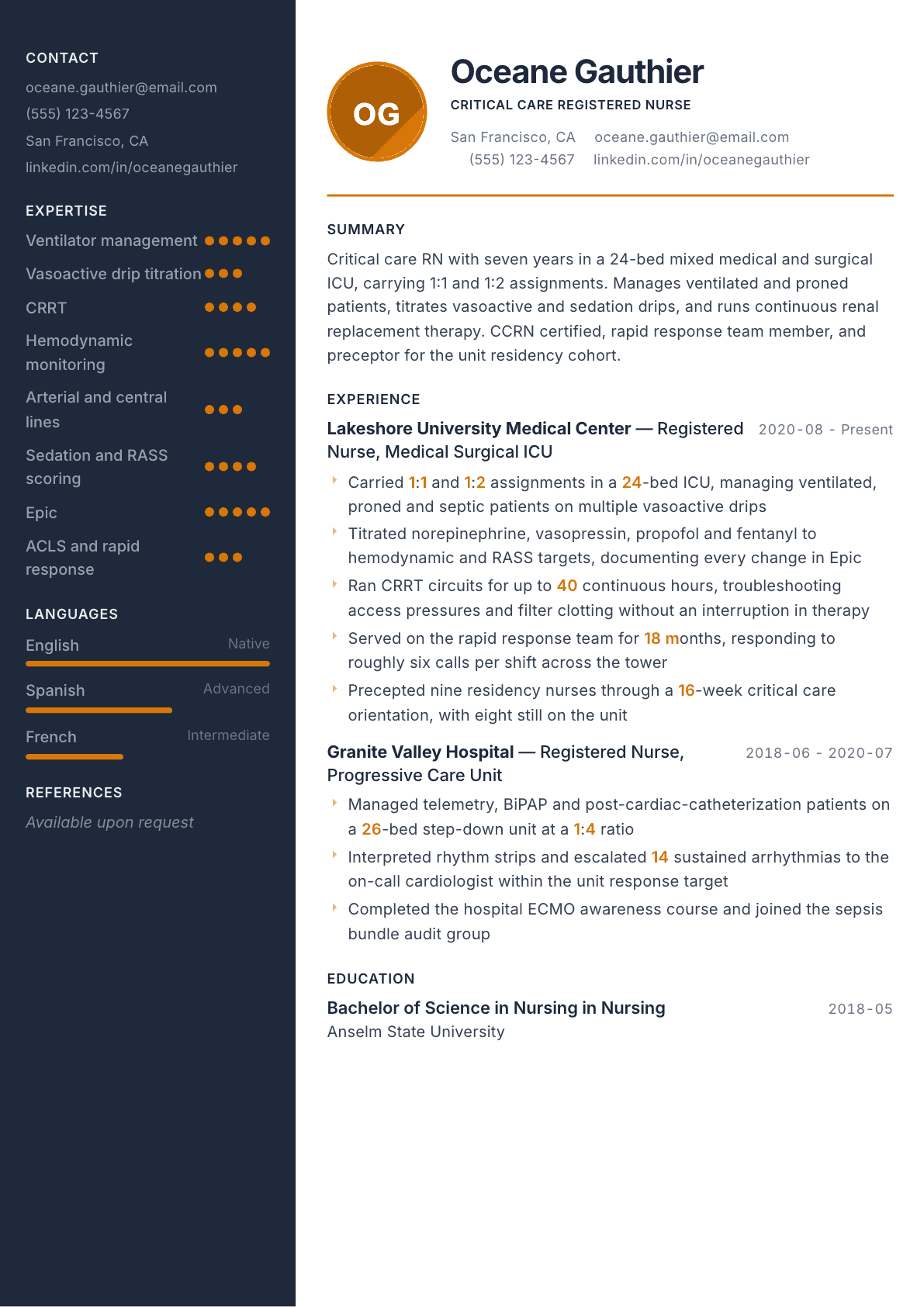
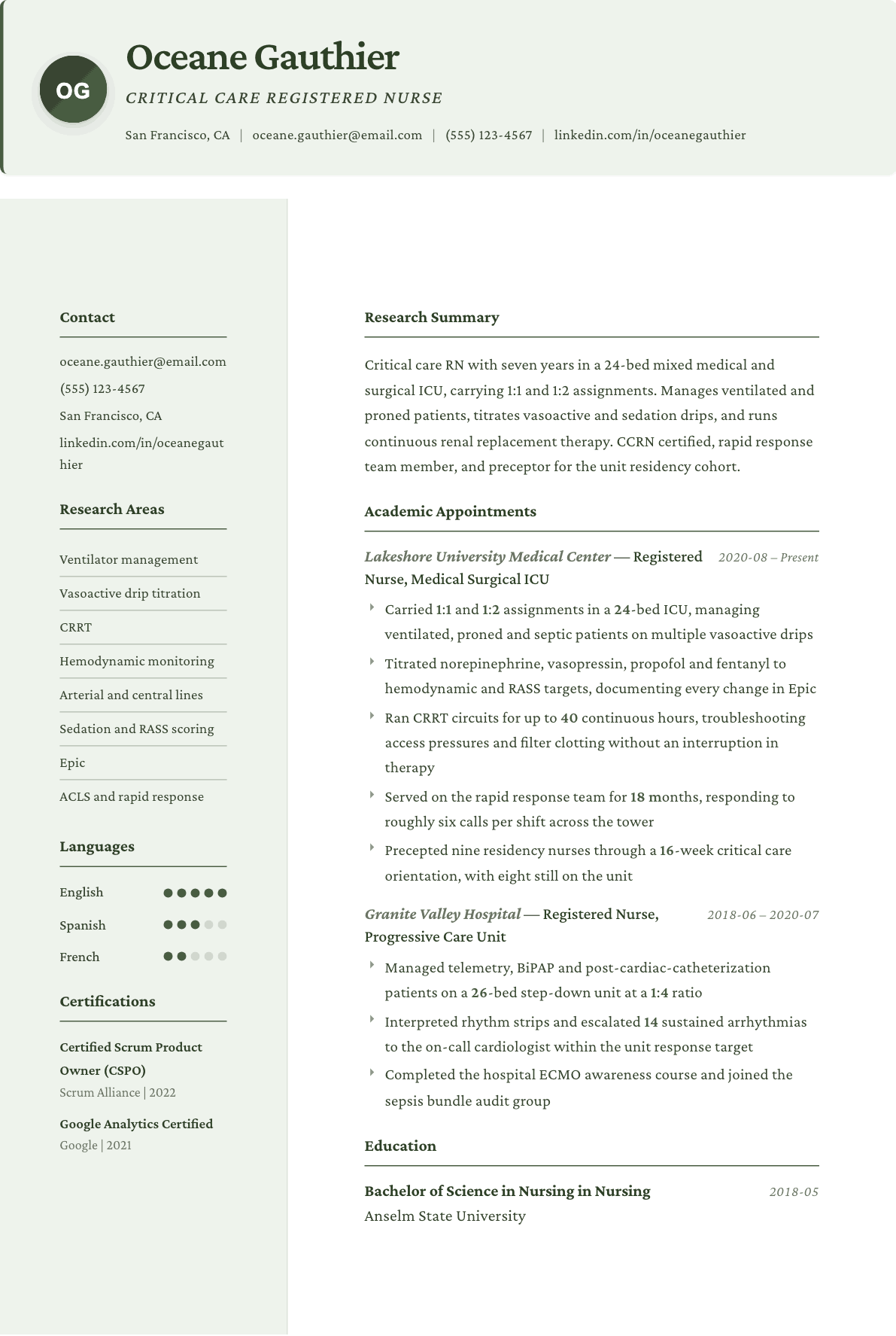
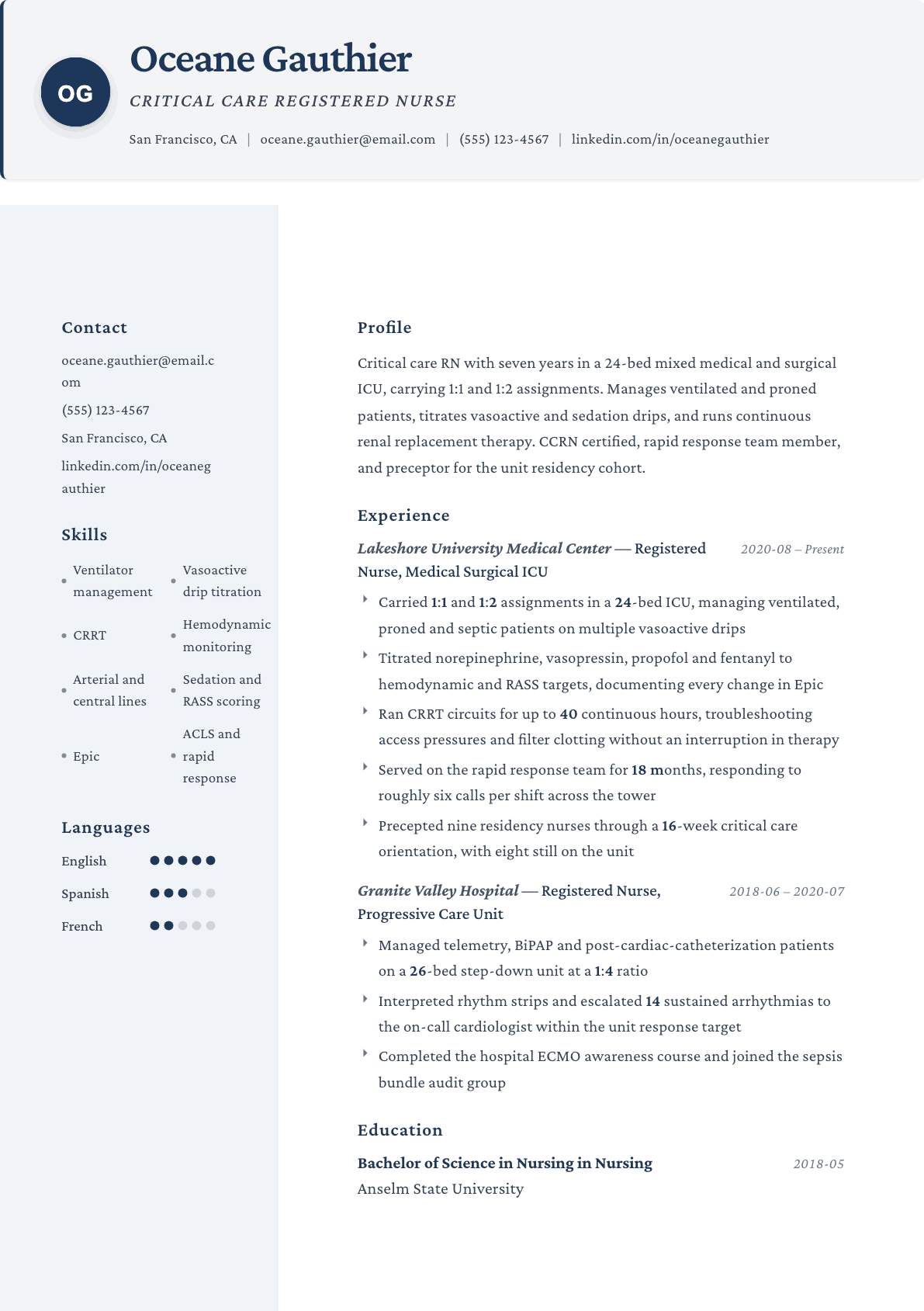
The same icu nurse content laid out in three CVBooster templates, so you can see what the finished document looks like before you write a word.
Example ICU Nurse summary
CCRN certified critical care nurse with seven years in a 24-bed mixed ICU. Carries 1:1 assignments on ventilated, proned and multi-drip patients, runs CRRT independently, and responds with the rapid response team across the tower. Precepted nine residency nurses through critical care orientation. Seeking a cardiothoracic ICU where post-operative recovery and mechanical support are the daily work.
Skills to list on a ICU Nurse resume
- Mechanical ventilation
- Vasoactive drip titration
- Continuous renal replacement therapy
- Hemodynamic monitoring
- Arterial line management
- Central venous access
- Sedation management
- Prone positioning
- ACLS resuscitation
- Targeted temperature management
- Sepsis bundle compliance
- Rhythm interpretation
- Epic charting
- Family communication in critical illness
- Rapid response
What actually gets this resume read
- Open every job with the ICU type, bed count and nurse to patient ratio, because those three facts define your acuity.
- Name the drips you titrate and the targets you titrate them to rather than writing the phrase critical care medications.
- List the equipment you have run independently: ventilators, CRRT, IABP, Impella, ECMO circuits, targeted temperature management.
- Put CCRN in the header after your name and again in a licenses and certifications block near the top.
- Mention rapid response, code team or transport roles separately, since they signal you can work outside your own four walls.
- If you are moving from step-down to ICU, lead with drips, BiPAP and high-acuity admissions instead of routine discharges.
How to write a icu nurse resume
Critical care hiring is a match on acuity, and an ICU nurse resume either proves acuity in the first ten lines or it does not. The unit educator reading it wants to know what kind of intensive care unit you worked in, how many beds it held, whether you carried one patient or two, which drips you titrated without calling anyone, and what equipment you ran alone at three in the morning. Those facts decide whether you orient in six weeks or sixteen.
The trap is that critical care vocabulary is easy to borrow. Any nurse can write "cared for critically ill patients on ventilators". Only a nurse who actually did it can write the drug names, the titration targets, the circuit troubleshooting and the ratio, and the educator reading the file knows the difference immediately.
This guide covers how to structure a critical care resume, three ICU RN resume samples written out in full, from new graduate to experienced critical care RN, what belongs in each job header, how to write drip and device bullets that survive an interview, which certifications carry weight, and how to make a step-down or emergency background read as ICU ready.
Format: credentials in the header, certifications near the top
Write your name with credentials in the standard order, degree then license then certification, so "Elena Vasquez, BSN, RN, CCRN". Under contact details, place a licenses and certifications block: RN license and state, compact status if you hold it, CCRN, ACLS, BLS, and any device or specialty course such as targeted temperature management or CRRT competency.
Keep one column in the experience section. Many hospital parsers scramble two-column layouts and drop employment dates, and a critical care resume that loses its dates loses the years of acuity that make it worth reading.
- Header: name with credentials, city and state, phone, email.
- Certifications block: license and state, CCRN, ACLS, BLS, device competencies.
- Order: summary, certifications, clinical experience, education, skills.
- One page under six years, two pages after that.
The job header line: unit type, bed count, ratio
Before the bullets, give a one-line description of the unit itself. "Registered Nurse, 24-bed mixed medical and surgical ICU, 1:1 and 1:2 assignments, Level I trauma center" answers half of the manager's questions before she reads a single accomplishment.
Specify the flavor of intensive care unit, because they hire differently. Medical, surgical, cardiothoracic, neurosciences, burn, trauma, cardiac and pediatric ICU nurses build very different reflexes, and a cardiothoracic manager needs to know whether you have recovered fresh hearts or only managed medical sepsis.
Experience bullets: name the drips, the devices and the targets
Write the drug names. Norepinephrine, vasopressin, epinephrine, nicardipine, amiodarone, propofol, dexmedetomidine, fentanyl and insulin infusions are the vocabulary of the unit, and titrating them to a mean arterial pressure or a sedation score is the work. A bullet that says you titrated vasoactive agents to hemodynamic goals and documented every change in the record proves competence in one line.
Do the same for devices. Say whether you managed ventilated and proned patients, ran continuous renal replacement therapy circuits and troubleshot access pressures, cared for patients on intra-aortic balloon pumps or percutaneous ventricular assist devices, monitored arterial and central lines, or supported ECMO cannulation. If you only assisted rather than owned a therapy, say assisted, because the interview will find out.
Add the work that happens outside your assignment: rapid response team shifts, code team rotation, intrahospital transport of unstable patients, sepsis bundle audits, and precepting. Those bullets show a nurse the unit can build a schedule around, not only a nurse who can hold two beds.
Certifications and the CCRN question
CCRN is the credential critical care managers look for, and it belongs in the header, the certifications block and the summary. If you are eligible and have not sat the exam, say that you are eligible and give the month you plan to test, because that reads as intent rather than absence.
Beyond CCRN, subspecialty credentials for cardiac medicine and cardiac surgery, progressive care certification from an earlier step-down role, and trauma nursing course completion all carry real weight. List each with the issuing body so a recruiter can verify without a call.
Skills and keywords the tracking system is reading
Critical care postings recycle the same phrases: hemodynamic monitoring, mechanical ventilation, vasopressor titration, continuous renal replacement therapy, arterial line, central venous access, sepsis, ACLS, rapid response, prone positioning, sedation management. Mirror the wording of the posting once in the skills section and once inside a bullet where you show it happening.
Name the charting system too, because critical care documentation is dense and a nurse who already builds flowsheets in Epic or Cerner needs less orientation time than one who does not.
ICU RN resume samples: three critical care nurse resumes written out
These ICU RN resume samples show the header line, certifications and bullets for three common starting points: a new graduate in an ICU residency, a step down nurse moving into intensive care, and an experienced critical care RN. All three use one column and are written as they would sit on the page. The names and hospitals are invented.
Example one: Grace Adeyemi, BSN, RN. New graduate who finished a 200 hour ICU capstone and is applying to a critical care nurse residency. Example two: Rachel Kim, BSN, RN, PCCN. Progressive care nurse with three years on a 28 bed cardiac step down unit, applying to a medical ICU. Example three: Omar Haddad, BSN, RN, CCRN. Critical care RN with eight years in a mixed medical and surgical ICU at a Level I trauma center, applying to a cardiovascular ICU.
- Example one, clinical header: Senior capstone, 20 bed medical ICU, 200 hours, 1:2 assignments under a preceptor, academic medical center.
- Example one: managed ventilated patients with her preceptor, including suctioning, oral care bundles and spontaneous breathing trial checks, and documented every titration change her preceptor ordered.
- Example one: cared for patients on norepinephrine and propofol infusions under supervision, and completed the unit's arterial line and central line dressing competencies.
- Example one, certifications: RN license, BLS, ACLS; applying to a 16 week critical care residency program.
- Example two, job header: Registered Nurse, 28 bed cardiac step down unit, 1:3 to 1:4 ratio, teaching hospital.
- Example two: titrates heparin, diltiazem and amiodarone drips by protocol and recovers patients after cardiac catheterization and ablation.
- Example two: joins the rapid response team twice a month and transfers deteriorating patients to the ICU with a structured handoff.
- Example two, certifications: RN license, PCCN, ACLS, BLS; working toward CCRN eligibility after ICU orientation.
- Example three, job header: Registered Nurse, 24 bed mixed medical and surgical ICU, 1:1 and 1:2 assignments, Level I trauma center.
- Example three: titrates norepinephrine, vasopressin and propofol to MAP and sedation targets and manages ventilated and proned patients.
- Example three: runs CRRT circuits, monitors arterial and central lines, and has precepted six new ICU nurses.
- Example three, certifications: RN license, CCRN, ACLS, BLS, TNCC.
ICU Nurse resume summary examples
ICU residency graduate
BSN graduate completing a 16-week critical care residency in a 20-bed medical ICU, with a 200-hour capstone on the same unit. Comfortable managing ventilated patients, monitoring arterial lines and titrating sedation under preceptor supervision. ACLS certified and seeking a night shift ICU position with continued mentorship.
Seven years in critical care
CCRN certified ICU nurse with seven years in a 24-bed mixed medical and surgical unit. Carries 1:1 assignments on ventilated, proned and multi-drip patients, runs continuous renal replacement therapy independently, and responds with the rapid response team. Precepted nine residency nurses through critical care orientation.
Charge and resource nurse
Charge nurse in a 32-bed cardiothoracic ICU with twelve years of critical care practice, running assignments, bed flow and fresh post-operative heart recoveries on nights. Experienced with mechanical circulatory support, ECMO circuits and open chest management, and serves as the unit resource nurse for new device rollouts.
Work experience bullets: before and after
Before: Cared for critically ill patients on ventilators.
After: Carried 1:1 and 1:2 assignments in a 24-bed ICU, managing ventilated, proned and septic patients on two or more vasoactive infusions at a time.
Ratio, bed count and the specific patient picture prove acuity that the phrase "critically ill" only implies.
Before: Administered IV drips per orders.
After: Titrated norepinephrine, vasopressin, propofol and fentanyl infusions to mean arterial pressure and sedation score targets, documenting each change and the patient response in Epic.
Drug names and titration targets show independent hemodynamic judgment rather than following a rate on an order.
Before: Used dialysis equipment on the unit.
After: Ran continuous renal replacement therapy circuits for stretches of up to 40 hours, troubleshooting access pressures and filter clotting without an interruption in therapy.
Duration and the specific failure modes you handled tell the educator you can run the machine without a resource nurse.
Before: Responded to codes in the hospital.
After: Served eighteen months on the rapid response team, answering roughly six calls per shift across the tower and stabilizing deteriorating floor patients before ICU transfer.
Tenure and call volume turn a generic emergency claim into a measurable second role you held.
Before: Trained new nurses on the unit.
After: Precepted nine residency nurses through a 16-week critical care orientation, building weekly competency plans, and eight remain on the unit today.
Numbers, program length and a retention outcome give the reader evidence of teaching that actually held.
Hard skills
- Mechanical ventilation management
- Vasoactive infusion titration
- Continuous renal replacement therapy
- Hemodynamic monitoring
- Arterial and central line management
- Sedation and delirium scoring
- Prone positioning
- Targeted temperature management
- Sepsis bundle execution
- Rhythm interpretation and defibrillation
- Intrahospital transport of unstable patients
- Epic and Cerner critical care flowsheets
Soft skills
- Prioritization when two patients decline at once
- Closed-loop communication in codes
- Goals-of-care conversations with families
- Escalation judgment
- Precepting
- Composure under sustained pressure
Certifications worth listing
- CCRN (Adult Acute and Critical Care Nursing) (American Association of Critical-Care Nurses)
- CMC (Cardiac Medicine Subspecialty) (American Association of Critical-Care Nurses)
- CSC (Cardiac Surgery Subspecialty) (American Association of Critical-Care Nurses)
- PCCN (Progressive Care Nursing) (American Association of Critical-Care Nurses)
- Advanced Cardiovascular Life Support (ACLS) (American Heart Association)
- Trauma Nursing Core Course (TNCC) (Emergency Nurses Association)
Mistakes that cost icu nurse candidates the interview
- Writing critical care in general terms without naming the drips, the devices or the ratio you carried.
- Leaving out the type of intensive care unit, so a cardiothoracic manager cannot tell whether you have recovered a fresh heart.
- Claiming a therapy you only assisted with, which unravels in the first technical question at interview.
- Hiding CCRN in a footer instead of putting it beside your name where the screener reads it first.
- Using a two-column template with icons, which hospital parsers frequently read out of order and strip of dates.
- Listing basic skills such as Foley insertion that every nurse has, while omitting balloon pumps or CRRT that few do.
ICU Nurse resume questions
How do I get into an ICU from a medical-surgical or step-down unit?
Rewrite your bullets around the highest acuity work you already do: BiPAP, telemetry interpretation, titrated drips your unit permits, rapid response calls and unstable transfers. Then name your ACLS status and any critical care coursework you have finished on your own.
Do I need CCRN to apply for ICU jobs?
No, most units hire without it and many pay for the exam. It still moves your file up the pile, so if you have the required direct care hours, state that you are eligible and give the month you intend to test.
Should I list the number of ICU beds and the nurse to patient ratio?
Yes, because those two numbers are how critical care managers calibrate everything else you claim. A 1:1 assignment in an eight-bed unit at a community hospital reads differently from a 1:2 in a large academic center, and the reader wants to place you accurately.
What should ICU RN resume samples include?
A good critical care nurse resume sample has a unit header line with the ICU type, bed count and ratio, then bullets naming the drips you titrate, the devices you manage and the targets you work to. Add CCRN or your plan to sit it, ACLS and BLS near the top, and the rapid response, code or precepting work you do.
How long should an ICU nurse resume be?
One page if you have under six years of practice, two pages once you have multiple units, certifications, precepting and committee work. Never three, because the third page is always the one filled with duties every critical care nurse performs.