Fleet Manager Resume Examples: free ATS score and gap list
Drive Your Career Forward with a Fleet Manager Resume
By Mustafa Tarabya, founder of CVBooster · Published · Updated
Build a fleet manager resume showcasing your vehicle management, cost control, and DOT compliance expertise.
Sample resumes for a fleet manager
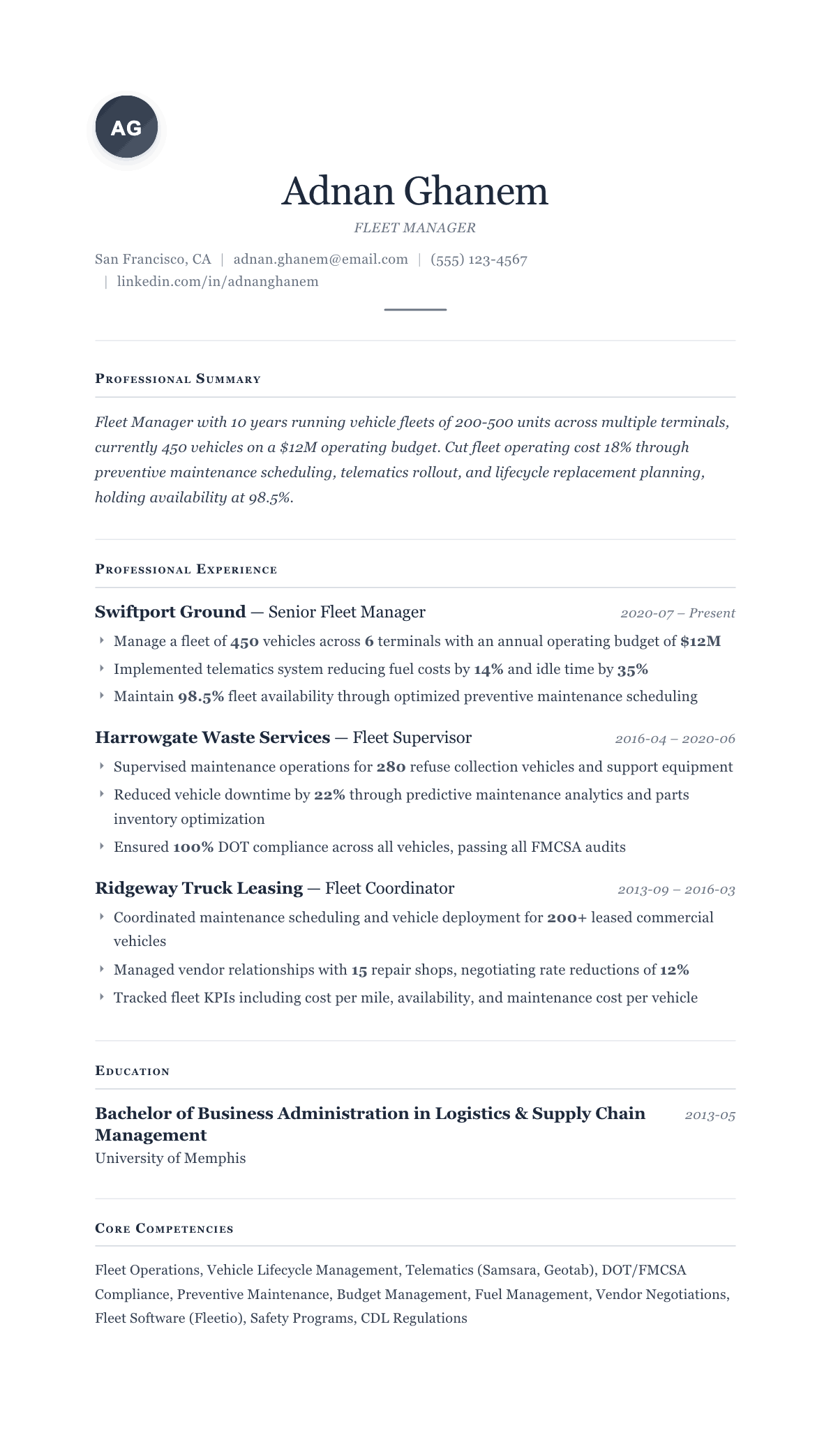
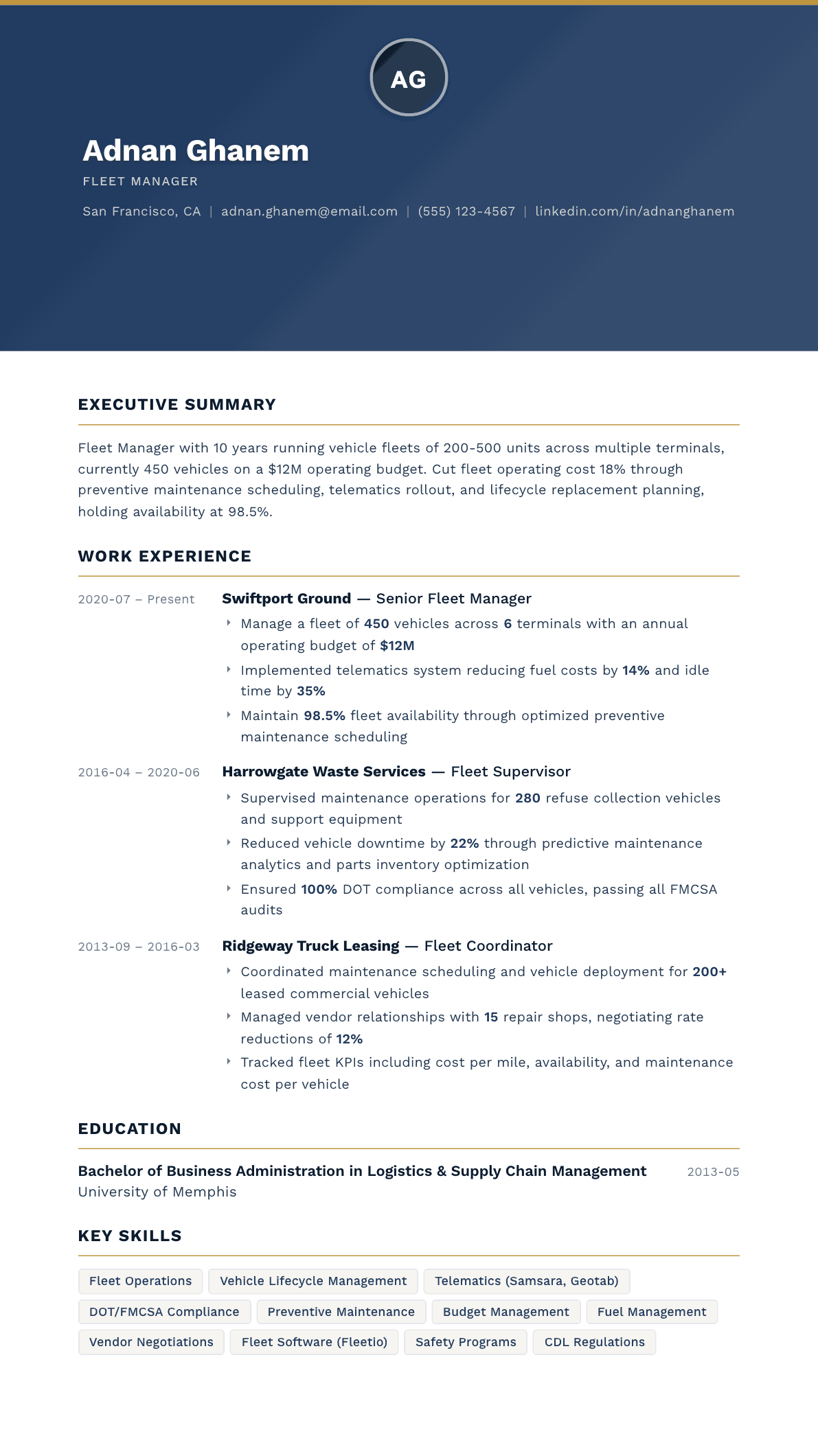
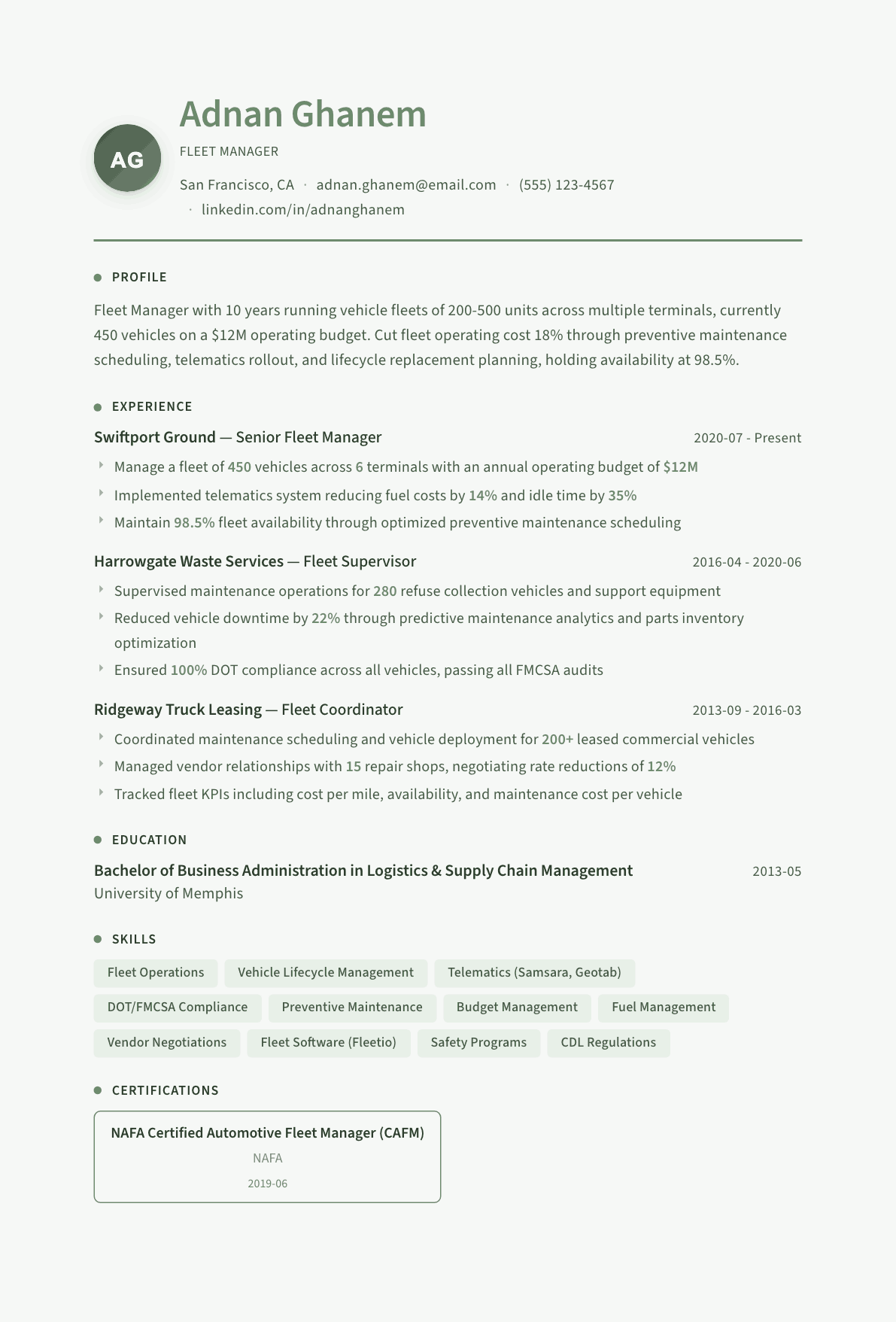
The same fleet manager content laid out in three CVBooster templates, so you can see what the finished document looks like before you write a word.
Example Fleet Manager summary
Fleet Manager, 10 years across 200-500 unit fleets and $12M operating budgets, with a clean FMCSA audit record. Telematics and preventive maintenance work cut operating cost 18%, fuel 14%, and downtime 22%. Seeking a director-level fleet role.
Skills to list on a Fleet Manager resume
- Fleet Operations
- Vehicle Lifecycle Management
- Telematics Systems
- DOT / FMCSA Compliance
- Preventive Maintenance
- Budget Management
- Fuel Optimization
- Vendor Management
- Fleet Software
- Safety Programs
- Asset Tracking
- Parts Inventory
- Driver Management
- Sustainability / EV Transition
What actually gets this resume read
- Quantify your fleet: number of vehicles, types, locations, and annual operating budget.
- Highlight cost reduction achievements: fuel savings, maintenance cost per mile, downtime reduction.
- Include telematics and fleet management software experience (Samsara, Geotab, Fleetio, Verizon Connect).
- Emphasize DOT/FMCSA compliance record and audit results.
- Mention vehicle lifecycle management: acquisition, spec development, disposal, and replacement cycling.
- Include NAFA CAFM or CAFS certification as these are highly valued credentials.
How to write a fleet manager resume
Fleet management is asset economics wearing a hard hat. The person hiring you is responsible for a large pool of depreciating equipment that has to be available every morning, legal on every road, and cheap enough per mile that the operation it supports stays profitable. So the resume is read for three things: the size and mix of the fleet you have owned, the cost and uptime numbers you moved, and whether the regulator has ever had a reason to visit you.
Fleet size alone is not scope. A pool of 300 light-duty service vans is a different job from 120 heavy tractors and trailers, which is different again from a municipal fleet of refuse trucks, plows and specialty equipment. Each has its own replacement economics, inspection obligations, technician skills and parts problem. Say the vehicle classes, the count of each, and how many locations they sit at, because that is the sentence a hiring director uses to place you.
This guide covers the layout for private fleets, municipal fleets and leasing roles, how to write maintenance and cost metrics, how to present compliance and safety without overclaiming, three summaries from a fleet coordinator to a director, before-and-after bullets, and the questions fleet managers ask when they change industries.
Format: a fleet profile line under every job title
Two pages, reverse-chronological, single column. Under each title write a fleet profile before the bullets: total units, breakdown by class, number of locations or terminals, in-house shop or vendor network, technician headcount and whether the assets were owned, leased or a mix. That line does more work than any summary paragraph.
Keep the metric names consistent throughout. Cost per mile, maintenance cost per unit, fleet availability, downtime days and preventive maintenance compliance are the standard terms, and a reader will trust a resume that uses them the same way in every entry.
- Header: name, city and state, phone, email, and any commercial driver license class you hold.
- Sections in this order: summary, fleet management experience with a profile line each, compliance and safety, systems, certifications and education.
- State ownership model: owned, leased, contract maintenance, or a mixed book, since the levers differ completely.
- Municipal and public sector applicants name the procurement rules they worked under.
Summary: fleet size and mix, locations, and the cost line you moved
Name the years, the largest fleet you have run with its class mix, the number of sites, and the single financial result you are proudest of. Cost per mile, maintenance cost per unit, fuel consumption per unit, availability and resale recovery on remarketed units are the figures a fleet director reads for.
If you are crossing industries, address it directly. A manager moving from a private truck fleet to a municipal one inherits public procurement, specialty equipment and a seasonal workload, while one moving into leasing inherits customer accounts and residual value risk. Naming what changes shows you have thought about the move.
Experience: acquisition, maintenance, cost and disposal
A fleet job runs the whole asset life, so write bullets across all four phases. Acquisition covers writing specifications, comparing bids, upfitting, negotiating with dealers and lessors, and setting replacement cycles from age, mileage and repair history. Skipping this phase is common and costly, because specification and cycle decisions determine the maintenance bill for years.
Maintenance is the core. Preventive maintenance schedules and compliance rate, in-house shop versus vendor mix, technician staffing and productivity, parts inventory and turns, warranty recovery, tire and battery programs, and the breakdown or roadside event rate. Availability and downtime days are the outcome metrics that tie it together.
Cost and disposal close the loop. Fuel program management including card controls and idle reduction, cost per mile trends, budget preparation and variance, remarketing channel choice, and resale recovery against book value. A manager who can talk about the back end of the asset life is immediately more senior in a reader mind than one who only talks about repairs.
- Fleet profile: units by class, sites, ownership model, average age, annual mileage per unit.
- Maintenance: preventive maintenance compliance rate, repair turnaround, downtime days, breakdown frequency, warranty dollars recovered as a count of claims.
- Cost: cost per mile, maintenance cost per unit, fuel per unit, idle share, budget variance.
- Lifecycle: replacement cycle length, units acquired and disposed per year, resale recovery, lease versus purchase analysis.
Compliance and safety: the section that decides serious hires
Give compliance its own section once you have carried a regulated fleet. Vehicle inspection programs including daily driver reports and annual inspections, driver qualification files, hours of service oversight where applicable, controlled substance testing program administration, fuel tax reporting and apportioned registration, and any audit or intervention and how it closed.
Safety scores matter because carriers are ranked on them publicly. If you improved a carrier safety rating category through inspection preparation, maintenance quality or driver coaching, say which category and what changed. If you have never carried that responsibility, do not imply that you have, because it is the first thing verified.
Municipal and utility fleets bring their own overlay: emissions rules, idling ordinances, specialty equipment inspections, and a public works schedule that peaks with the weather. Say which you have worked under.
Systems, electrification and the language of the posting
Name the fleet maintenance management software you worked in, the telematics platform, the fuel card program, the parts and inventory system, and any enterprise finance system you fed. Fleet software migrations are painful, and a manager who has run one should say so, because employers planning a change will pay for that experience.
Electrification is now a live line item for many fleets. If you have run a pilot, evaluated total cost of ownership on battery-electric units, planned charging infrastructure or trained technicians on high-voltage safety, put it in writing. If you have not, do not invent it, because the follow-up questions are technical and specific.
Mirror the posting. Private fleets use cost per mile, uptime and driver satisfaction. Leasing companies use residual value, term structure and client reporting. Municipal postings use procurement, specification, capital replacement plan and council budget cycle. Use the vocabulary of the reader.
Fleet Manager resume summary examples
Fleet coordinator
Fleet coordinator with three years supporting 180 light-duty service vans across two depots, scheduling preventive maintenance, managing vendor repair orders and maintaining registration and inspection records. Raised preventive maintenance compliance from 71% to 94% by rebuilding the scheduling calendar around mileage triggers.
Fleet manager
Fleet manager with eight years running 280 refuse and utility vehicles from a single in-house shop with nine technicians. Cut downtime by 22% through predictive maintenance scheduling and parts inventory changes, and held vehicle inspection compliance without a single out-of-service order at the annual audit.
Director of fleet
Director of fleet operations with fifteen years and 450 units across six terminals, covering heavy tractors, trailers and light-duty support vehicles. Owns specification, replacement cycles, the maintenance network and the fuel program, and implemented telematics that cut idle time by 35% and fuel use by 14%.
Work experience bullets: before and after
Before: Managed a large fleet of vehicles.
After: Managed 450 units across six terminals, made up of 190 heavy tractors, 160 trailers and 100 light-duty support vehicles under a mixed owned and leased book.
Class mix, site count and ownership model are what actually define scope, while fleet size alone is ambiguous.
Before: Reduced fleet operating costs.
After: Cut maintenance cost per unit by 18% over two years by moving brake and tire work in house, renegotiating three vendor labor rates and extending the preventive maintenance interval on light-duty units after a failure analysis.
Three named levers and a failure analysis show engineering rather than a cost freeze.
Before: Implemented a telematics system for the fleet.
After: Rolled out telematics across 450 units in four months, set idle and speed thresholds with operations, and cut idle time by 35% and fuel consumption by 14% within two quarters of go-live.
Rollout scale, the configuration decisions and two outcome metrics prove the system was adopted rather than merely purchased.
Before: Kept vehicles compliant with regulations.
After: Ran annual inspections and daily driver report follow-up across 280 vehicles, closing defects within two working days and passing the last federal audit with no maintenance violations recorded.
A named process, a closure standard and an audit outcome make compliance verifiable instead of assumed.
Before: Handled vehicle replacements and disposals.
After: Rebuilt the replacement cycle using repair history and age curves, retired 60 units a year through two remarketing channels and lifted average resale recovery against book value by nine points.
Lifecycle analysis, disposal volume and a recovery figure show asset management, which is the senior half of the job.
Hard skills
- Fleet lifecycle and replacement planning
- Preventive maintenance program design
- Cost per mile and total cost of ownership analysis
- Vehicle specification and upfitting
- Telematics deployment and reporting
- Fleet maintenance management software
- Parts inventory and vendor management
- Fuel program and card controls
- Vehicle inspection and defect closure
- Fuel tax reporting and apportioned registration
- Warranty claim recovery
- Remarketing and asset disposal
- Technician staffing and shop scheduling
Soft skills
- Vendor negotiation
- Working with drivers and operations
- Budget discipline
- Technician coaching
- Judgment on repair versus replace
- Clear reporting to executives
Certifications worth listing
- Certified Automotive Fleet Manager (CAFM) (NAFA Fleet Management Association)
- Certified Director of Maintenance (CDM) (North American Transportation Management Institute)
- Medium and Heavy Truck Certification Series (National Institute for Automotive Service Excellence)
- Certified Transportation Professional (CTP) (National Private Truck Council)
- OSHA 30-Hour General Industry (Occupational Safety and Health Administration)
Mistakes that cost fleet manager candidates the interview
- Giving a unit count with no class mix, so the reader cannot tell a van pool from a heavy tractor fleet.
- Writing only about repairs and ignoring acquisition, specification and disposal, which is where the senior work lives.
- Claiming a cost reduction without naming the levers behind it.
- Leaving compliance out entirely on a regulated fleet, where audits and inspection records are the first thing verified.
- Overstating responsibility for a carrier safety rating you never owned.
- Omitting the maintenance software and telematics platform, which decide how quickly you become useful.
- Using private carrier vocabulary on a municipal application that runs on procurement rules and a capital replacement plan.
Fleet Manager resume questions
What metrics belong on a fleet manager resume?
Fleet size with class mix, cost per mile or maintenance cost per unit, fleet availability and downtime days, preventive maintenance compliance, fuel and idle figures, and resale recovery on disposed units. Every improvement needs a starting point and the lever you used.
Do I need a CDL to be a fleet manager?
It is rarely required, though holding one helps in heavy fleets because it signals you understand what drivers face and what an inspection involves. What employers actually require is knowledge of the inspection, qualification and testing programs your fleet operates under.
How do I move from technician to fleet manager on paper?
Keep the technical years short and factual, then build the page around anything managerial you already do: scheduling the shop, ordering parts, controlling repair costs, managing vendors, tracking downtime. Add a fleet certification to signal the shift from wrench to asset management.
Should I mention electric vehicle experience?
Yes, if it is real. Say what you actually did: a pilot, a total cost of ownership comparison, charging infrastructure planning, route feasibility analysis or high-voltage technician training. Do not claim it otherwise, because the interview questions on this topic are detailed.
How is a municipal fleet resume different from a private one?
Public fleets run on procurement rules, capital replacement plans, council budget cycles and specialty equipment such as plows, refuse bodies and emergency vehicles. Show that you can write a specification, run a competitive bid and defend a replacement plan to people outside the operation.
Related resume examples
- Logistics Coordinator Resume example
- Dispatch Coordinator Resume example
- Truck Driver Resume example
- Fleet Coordinator Resume example
- Transportation Manager Resume example
- Delivery Operations Manager Resume example