Locomotive Engineer Resume Examples: what gets the call
Build a Locomotive Engineer Resume Around Certification and Territory
By Mustafa Tarabya, founder of CVBooster · Published · Updated
Locomotive engineer resume example covering engineer certification, territory qualification, train handling, keywords and a detailed writing guide.
Sample resumes for a locomotive engineer
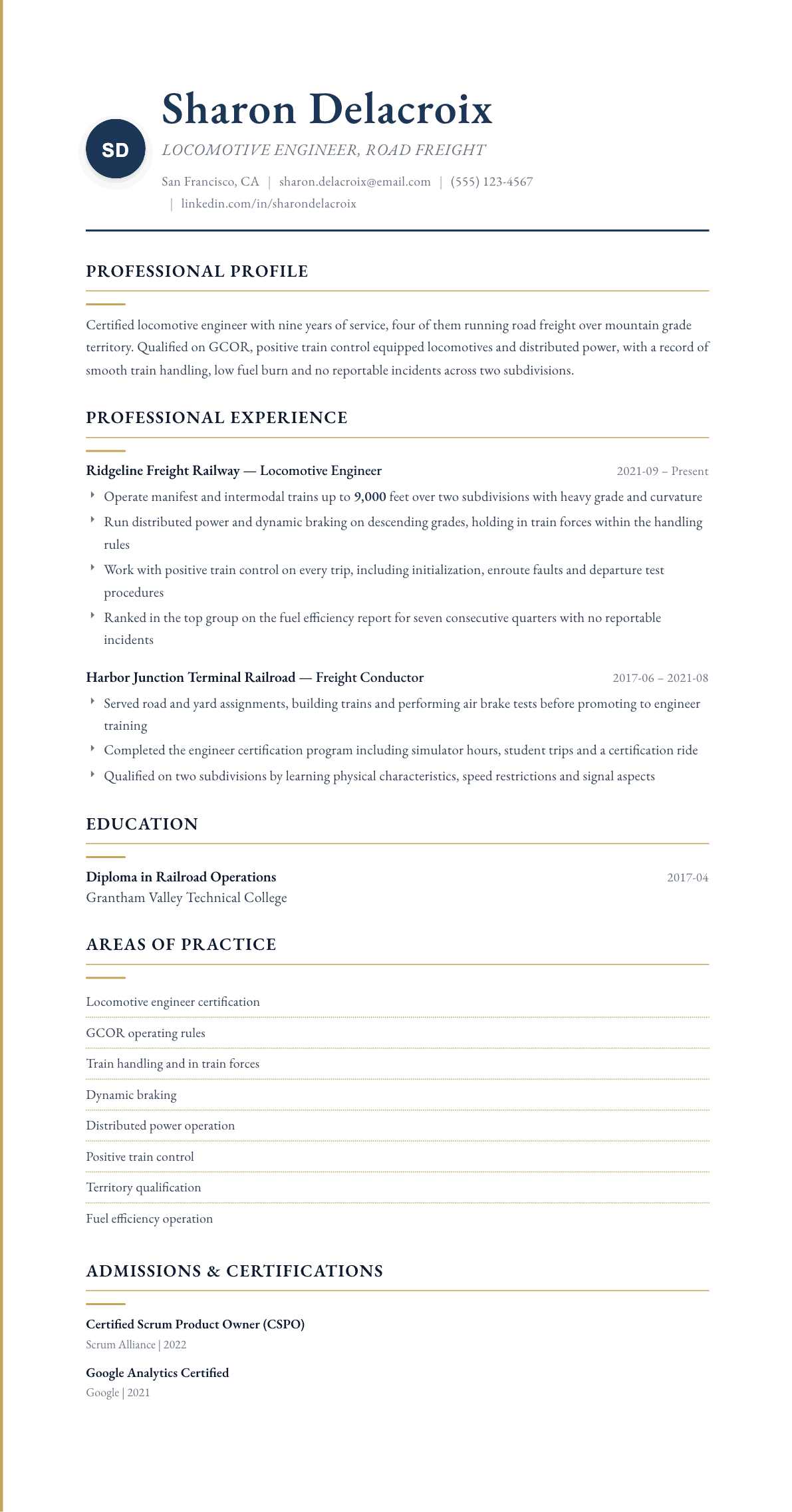
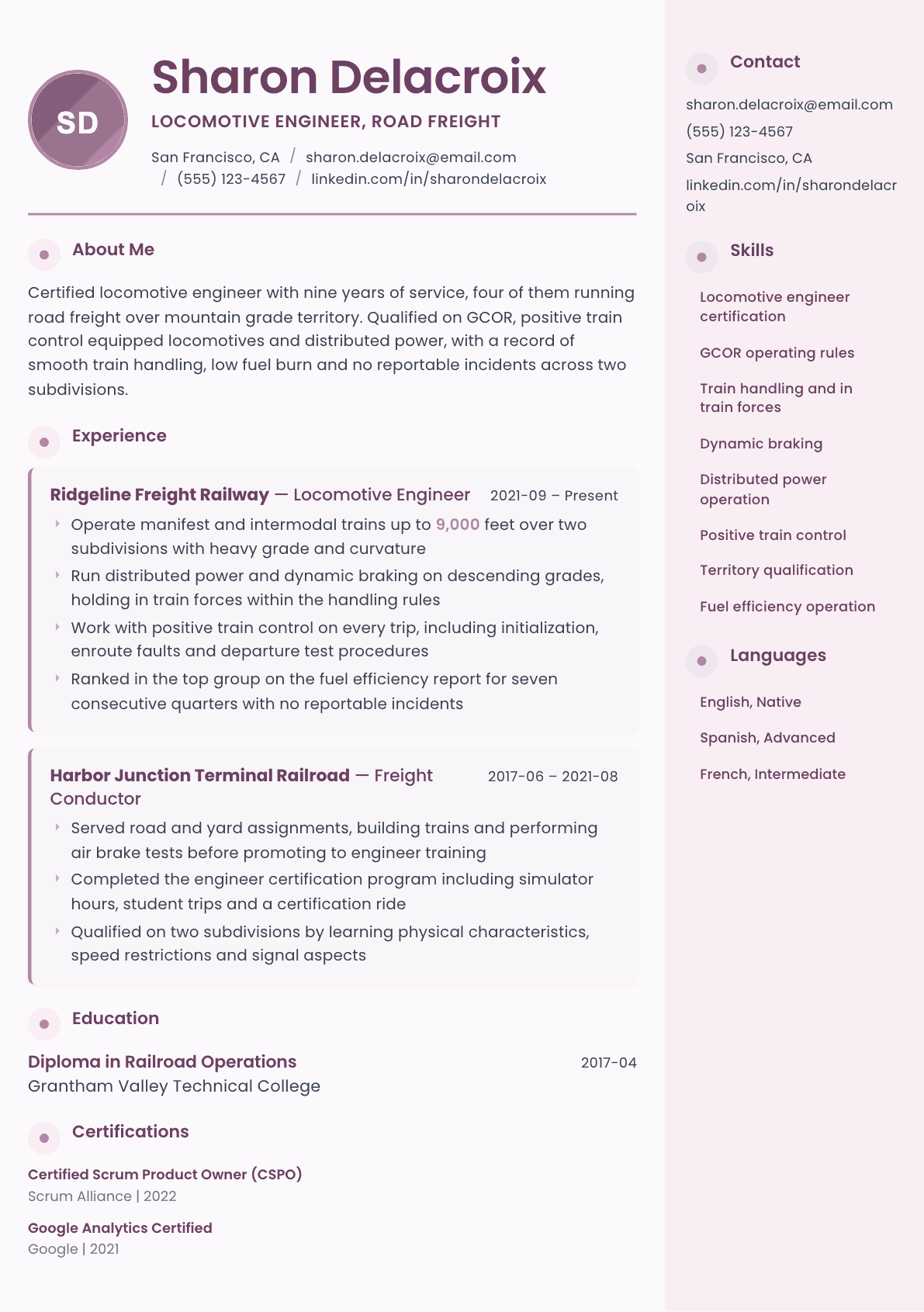
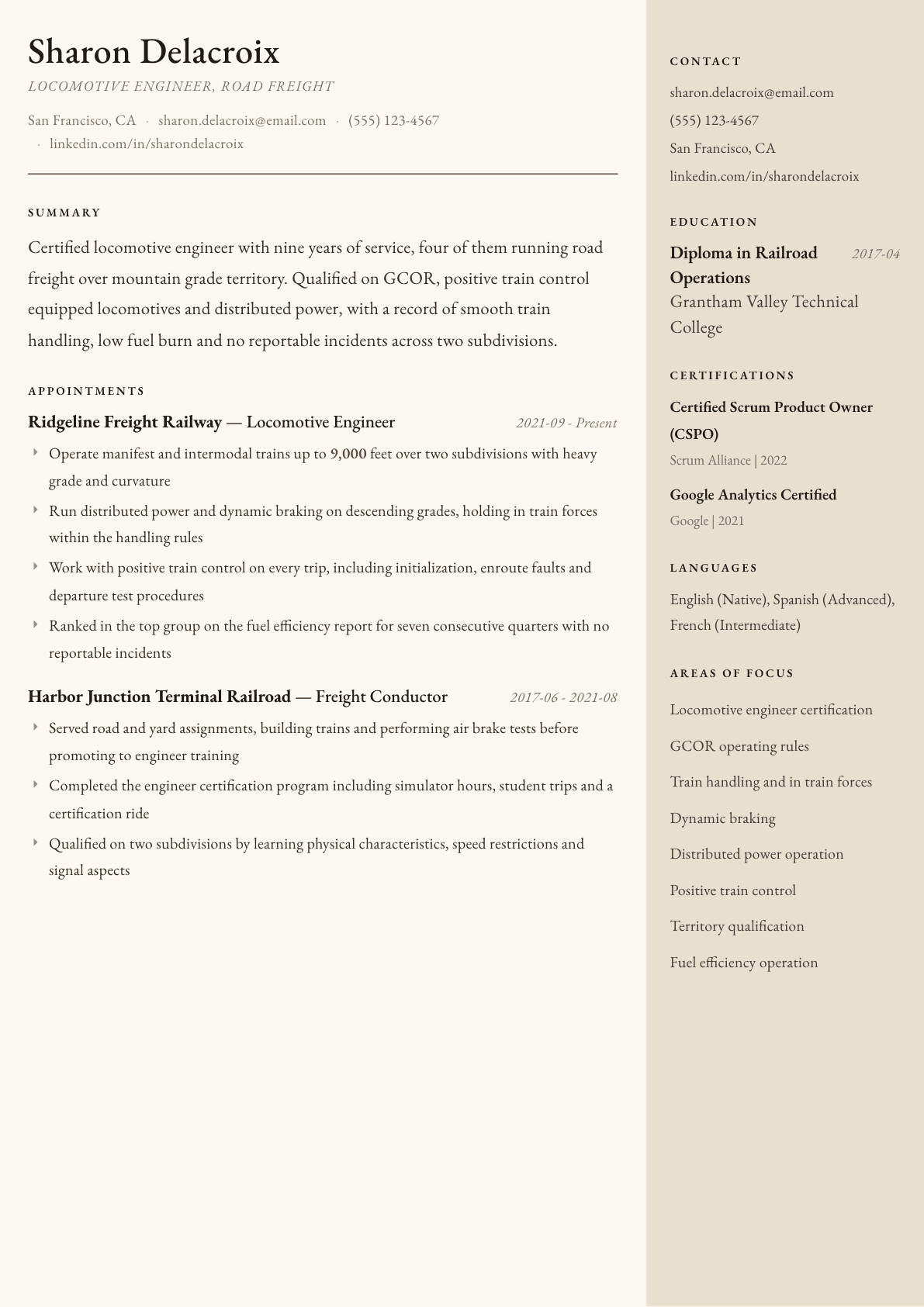
The same locomotive engineer content laid out in three CVBooster templates, so you can see what the finished document looks like before you write a word.
Example Locomotive Engineer summary
Certified locomotive engineer with nine years of railroad service, four at the throttle on mountain grade road freight. Qualified on GCOR, positive train control equipped locomotives and distributed power, and known for smooth handling of long manifest trains on descending grades. Holds a record of no reportable incidents and repeated top group placement on the quarterly fuel efficiency report.
Skills to list on a Locomotive Engineer resume
- Locomotive engineer certification
- GCOR and timetable rules
- Train handling technique
- In train force management
- Dynamic braking on grade
- Distributed power operation
- Positive train control systems
- Air brake system knowledge
- Territory physical characteristics
- Signal aspect recognition
- Fuel conservation operation
- Locomotive inspection
- Radio and dispatcher communication
- Simulator and student trip training
What actually gets this resume read
- Lead with your engineer certification, the rule book you are qualified on and the subdivisions you know by name.
- Separate engineer time from conductor time, since a hiring officer counts your years at the throttle differently.
- Describe train handling in concrete terms: tonnage, length, grade, dynamic braking and distributed power setups.
- Name the locomotive models and the control systems you have run, including positive train control equipment.
- Report your safety and efficiency record: reportable incidents, rules compliance rides and fuel performance ranking.
- Mention simulator training, student trips and any time you spent as a road foreman or engineer trainer.
How to write a locomotive engineer resume
An engineer application is read by someone who has run trains. He is checking whether your certification is current, which rule book you are qualified on, which territory you know, and how you handle a long train on a grade. Those four items decide whether you can be placed on an assignment, and no amount of general description substitutes for them.
The craft difference matters on the page. Time as a conductor is valuable and should be shown, but a hiring officer counts years at the throttle separately, because train handling is a physical skill built over trips rather than a rule you memorize. Separate the two clearly so nobody has to guess how much operating time you actually hold.
This guide covers the certification block, how to describe train handling in the language operating officers use, what a fuel and safety record proves, which qualifications belong on the page, and the questions engineers ask when they change railroads or move into road foreman work.
Format: certification, territory, then trips
One page unless you carry training or supervisory history, then two. Header, certification and qualification block, experience split by craft, training and simulator history, education, and an availability line covering the on call board and away from home terminal rest.
Keep it printable and plain. A road foreman will print this and mark it up beside a seniority roster, so anything that depends on color or a sidebar disappears.
- Certification: locomotive engineer certification with class, the issuing railroad and current status.
- Qualification: the operating rule book, the air brake and train handling rules, and the subdivisions you are qualified on.
- Equipment: locomotive models operated, distributed power, positive train control systems and any electronic air brake equipment.
Train handling: the vocabulary an operating officer expects
Write handling in the terms used on a compliance ride. In train forces, slack action, dynamic braking on descending grade, throttle modulation over undulating profile, air brake application and release timing, distributed power setups and how you split the consist for a given tonnage. That vocabulary is how an operating officer decides whether you learned to run or merely learned to pass.
Attach the physical situation to it. Tonnage, train length, grade percentage described in words rather than figures, curvature, restricted speed zones and whether you were operating loaded or empty. A person who has run the same territory will read those details and know instantly whether your description is real.
Then name the technology. Positive train control initialization, enroute faults, departure tests, cut out procedures under the rules, energy management systems and the fuel report they generate. Railroads have invested heavily in this equipment and an engineer who works with it rather than around it is easier to place.
- Say whether your time is road freight, local, yard, passenger or transit, since handling differs sharply between them.
- Say how many subdivisions you are qualified on and roughly how long each qualification took.
- Say what you do on a bad day: broken air hose, undesired emergency, stalled on grade, weather restriction, a defect detector alarm.
Record: compliance rides, efficiency tests and fuel
Three records follow an engineer and all three belong on the resume. Compliance and rules rides passed, efficiency test cycles with no exceptions, and reportable incidents. State them plainly with the period they cover, because a hiring railroad will obtain your certification history and any gap between your page and their file costs you credibility.
Fuel performance is the quiet one that separates candidates. Most railroads rank engineers on fuel used per gross ton mile, and a consistent top group placement over several quarters says more about smooth handling than any adjective. If your railroad publishes that ranking, quote your standing and the number of quarters you held it.
Promotion path and training history
Show how you got the certificate: conductor years, the engineer training program, simulator hours, student trips and the certification ride. A railroad hiring an experienced engineer wants to know the standard you were trained to, and naming the program and the trip count answers it.
If you have trained others, say so precisely. Student engineers taken through their trips, evaluations written, remedial handling coaching delivered, or time acting as a road foreman of engines. That work is the natural path into operating management and it should be visible if that is where you are heading.
Locomotive Engineer resume summary examples
Newly certified
Newly certified locomotive engineer promoted in 2025 after four years as a freight conductor, qualified on one subdivision of local and manifest service. Completed the engineer training program with simulator hours, forty student trips and a first attempt certification ride, and is building road freight handling time.
Four years at the throttle
Certified locomotive engineer with nine years of railroad service, four of them running road freight over mountain grade territory. Qualified on the general code of operating rules, distributed power and positive train control equipped locomotives, with no reportable incidents and repeated top group fuel performance.
Engineer and road foreman candidate
Locomotive engineer with eighteen years at the throttle across manifest, unit coal and intermodal service, qualified on six subdivisions. Has trained twenty two student engineers through certification, written handling evaluations, and led remedial coaching after undesired emergency events on grade territory.
Work experience bullets: before and after
Before: Operated freight trains over assigned territory.
After: Operate manifest and intermodal trains up to 9,000 feet over two subdivisions with heavy grade and curvature, working both loaded and empty directions.
Train length, service type and territory profile let an operating officer judge the handling you have done.
Before: Used dynamic brakes on hills.
After: Run distributed power and dynamic braking on descending grades, holding in train forces within the handling rules and avoiding undesired emergency applications.
The technical vocabulary and the outcome show learned technique rather than familiarity with a control.
Before: Worked with positive train control equipment.
After: Work with positive train control on every trip, including initialization, departure tests and enroute fault handling under the cut out rules with dispatcher notification.
Listing the specific procedures proves the system is part of the routine rather than an obstacle.
Before: Saved fuel while operating trains.
After: Ranked in the top group on the quarterly fuel efficiency report for seven consecutive quarters while recording no reportable incidents over the same period.
A ranking held across many quarters is measurable evidence of consistently smooth handling.
Before: Learned the territory for my assignments.
After: Qualified on two subdivisions by learning physical characteristics, permanent and temporary speed restrictions and signal aspects, then held both qualifications current through the annual cycle.
Naming what qualification actually covers shows the depth a railroad expects behind the word.
Hard skills
- Locomotive engineer certification
- Operating rules and timetable qualification
- Train handling and in train force management
- Dynamic braking on grade
- Distributed power operation
- Air brake system operation and testing
- Positive train control procedures
- Territory physical characteristics knowledge
- Signal aspect recognition
- Fuel conservation and energy management systems
- Locomotive inspection and defect reporting
- Dispatcher and radio communication protocol
Soft skills
- Sustained concentration on long trips
- Composure during equipment failures
- Precise briefing with the conductor
- Attendance on an on call board
- Coaching student engineers
- Honest self reporting after an event
Certifications worth listing
- Locomotive Engineer Certification (Federal Railroad Administration)
- Conductor Certification (Federal Railroad Administration)
- Hazardous Materials Transportation Training (Pipeline and Hazardous Materials Safety Administration)
- Roadway Worker Protection (Federal Railroad Administration)
Mistakes that cost locomotive engineer candidates the interview
- Merging conductor years and engineer years into one figure, when a hiring officer counts throttle time separately.
- Leaving out the rule book and the subdivisions, which are the two facts that decide whether you can be placed.
- Describing handling in general words when compliance ride vocabulary is what an operating officer recognizes.
- Skipping the certification history when the hiring railroad will request it from your current employer.
- Ignoring the fuel and efficiency ranking, which is the one published measure of handling quality most railroads keep.
- Failing to mention positive train control experience on a railroad that has fully equipped its fleet.
- Omitting student trips, simulator time and the certification ride, which tell a reader what standard you were trained to.
Locomotive Engineer resume questions
How do I show engineer time separately from conductor time?
Give each craft its own employment entry with its own dates, even at the same railroad. State the promotion date explicitly, then let the engineer entry carry the handling bullets while the conductor entry carries the ground work and paperwork.
Does engineer certification transfer between railroads?
Certification is issued by the employing railroad under federal rules, so a new employer runs its own qualification process. Prior certification shortens that path considerably, so list your current certification, its class and its status rather than assuming it carries over.
What does territory qualification mean on a locomotive engineer resume?
It means you have learned the physical characteristics of a subdivision, including grades, curvature, signal locations, speed restrictions and industry locations, and passed a check on them. Name each subdivision, because a railroad hiring in that region values it directly.
Should I include my fuel efficiency ranking?
Yes when your railroad publishes one. Quote your standing and the number of consecutive quarters you held it, since smooth throttle and brake work is difficult to demonstrate on paper any other way and operating officers trust their own measure.
How do I write the resume if I want a road foreman position?
Keep the handling record but lead the recent entry with the training and evaluation work: student engineers taken to certification, handling evaluations written, remedial coaching delivered, and any involvement in rules classes or incident review. That is the work the role is actually made of.
Related resume examples
- Railroad Conductor Resume example
- Diesel Mechanic Resume example
- Crane Operator Resume example
- Logistics Manager Resume example
- Dispatcher Resume example
- CDL Driver Resume example