VP of Sales Resume Examples: free ATS score and gap list
Write a VP of Sales Resume That Proves Revenue Ownership
By Mustafa Tarabya, founder of CVBooster · Published · Updated
A VP of Sales resume guide with a full example, the quota and forecast numbers hiring boards check, ATS keywords, and section-by-section advice.
Sample resumes for a vp of sales
The same vp of sales content laid out in three CVBooster templates, so you can see what the finished document looks like before you write a word.
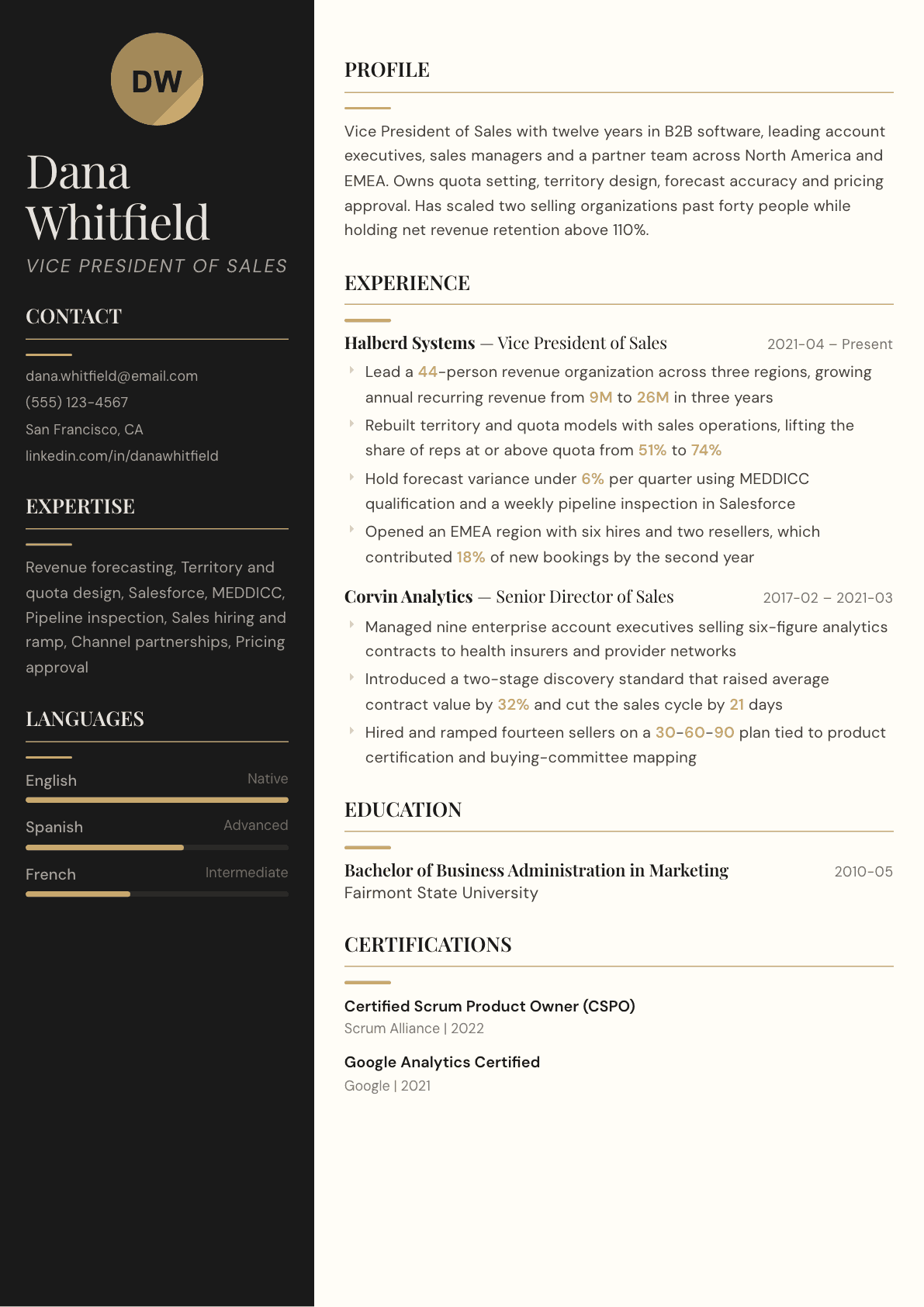
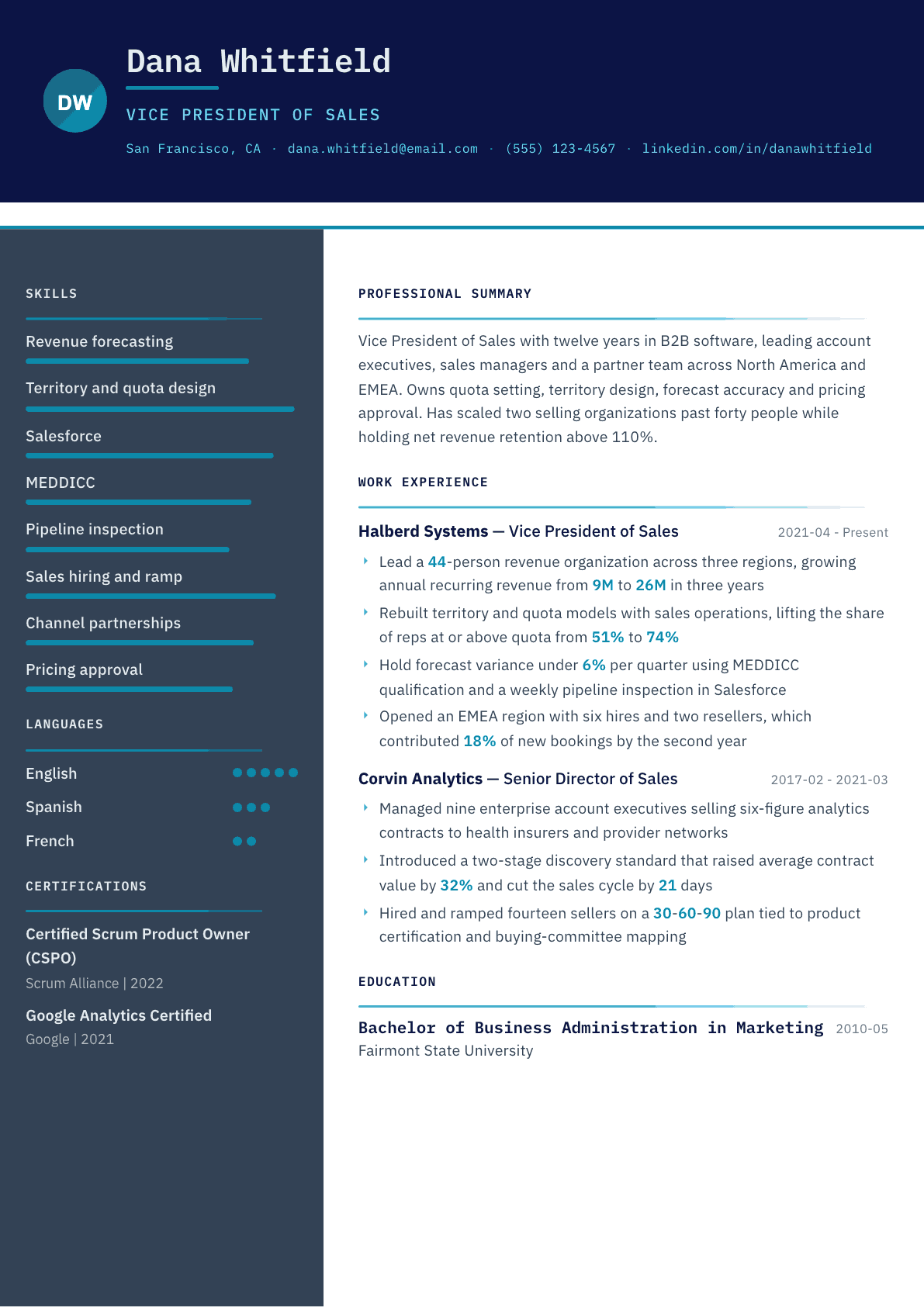
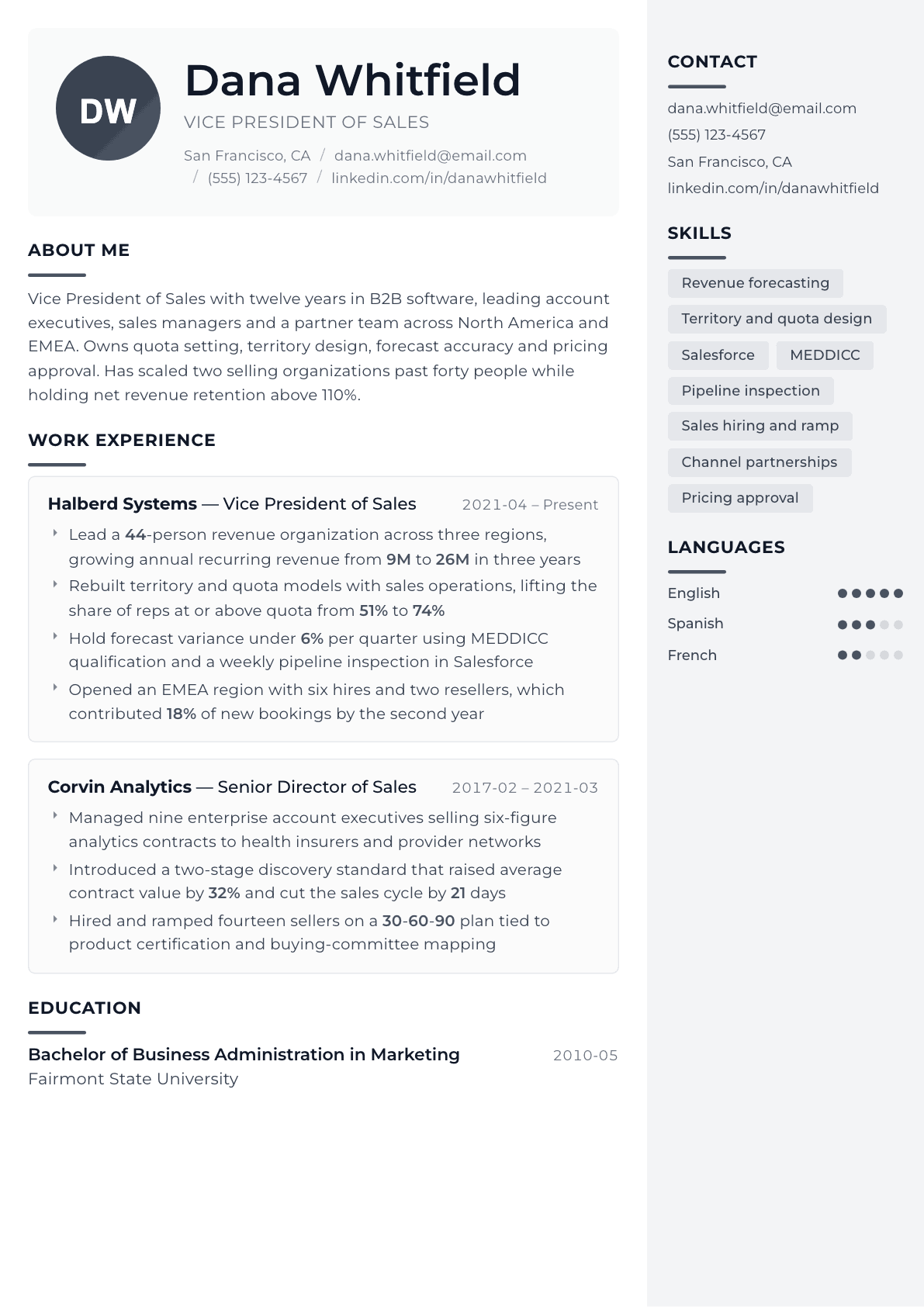
Example VP of Sales summary
Vice President of Sales with eleven years leading enterprise software teams, most recently a 40-person organization carrying a 25M annual number across three regions. Rebuilt territories and compensation, raised quota attainment across the team, and held forecast variance in single digits for eight straight quarters. Seeking a VP role at a company moving from founder-led selling to a repeatable sales motion.
Skills to list on a VP of Sales resume
- Revenue forecasting
- Territory planning
- Quota setting
- Pipeline management
- Sales strategy
- Salesforce
- MEDDICC
- Enterprise selling
- Sales hiring
- Partner and channel sales
- Compensation plan design
- Board reporting
- Net revenue retention
- Deal desk and pricing
- Cross-functional leadership
What actually gets this resume read
- Open with the revenue you carried, the team size you led, and the segment, because a board reads that line first.
- Give every role a scope line: number of reps, number of managers, territories, and the annual number you owned.
- Show forecast discipline by naming your qualification method and the variance you held between commit and close.
- Prove you can build, not just run: name the hires, the ramp time, and the attainment those hires reached.
- Separate new business from expansion in your numbers so a reader can tell growth from renewal carry.
- Name the CRM, the sales engagement tool and the forecasting stack you standardized the team on.
How to write a vp of sales resume
A VP of Sales resume is read by a chief executive, a board member or an investor, and all three are asking the same private question: has this person carried a number of this size before, and did the machine keep working after they left. Nothing else on the page matters as much as the answer to that.
Most candidates for this job write a resume that reads like a longer version of their account executive resume. Big verbs, one growth percentage, no scope. The reader cannot tell whether the growth came from a market that lifted everyone or from territory design, quota work and hiring that the candidate actually did. Scope and mechanism are what separate a VP resume from a director resume.
This guide covers the format executive readers expect, how to state revenue scope without inflating it, which operating metrics to include, three summaries at different stages of a sales leadership career, before-and-after bullets, and the questions sales leaders ask when they finally sit down to rewrite this document.
Format: two pages, scope lines, no skills wall
Two pages is standard at this level and one page reads as thin. Reverse chronological, with the most recent role given roughly half of page one and everything older compressed hard. A VP hired for enterprise software does not need four bullets about a regional role from a decade ago.
Under each job title, add a one-line scope statement before the bullets. Something like "Direct: 3 sales directors, 34 AEs, 6 SDRs. Number: 26M ARR. Segments: mid-market and enterprise, North America and EMEA." A reader can grade your fit from that line alone, which is exactly what you want.
Skip the long skills grid that account executives use. At this level the skills section should be short, and the evidence should live in the bullets.
- Header: name, city, phone, email, and a link line for your professional profile.
- Section order: summary, experience with scope lines, selected results, education, board or advisory work if any.
- Compress anything more than ten years old into a two-line early career block.
Summary: the number, the team, the segment, the stage
Four lines maximum. Name the annual number you own, the size and shape of the team, the segment and geography, and the company stage. Stage matters more than most candidates realize: a leader who grew a business from four sellers to thirty is not interchangeable with one who inherited a hundred-person organization and optimized it.
Then add the one thing you are unusually good at, and make it operational. Territory and quota design, pipeline generation, enterprise deal strategy, or turning around an underperforming team are all credible specialties. "Passionate about building winning cultures" is not one, and every reader has learned to skip that sentence.
Experience: show the mechanism behind the growth
Growth alone proves nothing. A hiring board wants the causal chain: what was broken, what you changed, what moved. Write bullets that carry all three. "Rebuilt territories around installed-base density and reset quotas to capacity, taking the share of reps at plan from half the team to three quarters" tells a reader you understand where sales results come from.
Cover four areas across your bullets, because a VP of Sales is graded on all four. Attainment and revenue against plan. Forecast accuracy and pipeline coverage. Talent, meaning hiring, ramp time and voluntary attrition. Process, meaning the qualification method, the stage definitions and the reviews you run.
Be honest about inherited versus created. Naming the starting point of every run, and the year the run started, makes your numbers more believable rather than less. Boards discount unbaselined growth claims automatically.
- Attainment: share of the team at or above quota, and plan attainment for the whole organization.
- Forecast: the variance you held between commit and closed, and the cadence that produced it.
- Talent: hires made, ramp time to first closed deal, and regretted attrition.
- Process: qualification framework, stage exit criteria, deal desk, and pipeline coverage standard.
Metrics that belong on the page, and ones that do not
Include annual recurring revenue or bookings against plan, average contract value, win rate on qualified opportunities, sales cycle length, quota attainment distribution, and net revenue retention if you carry expansion. These are the numbers that appear in a board deck, and using them signals that you have sat in those meetings.
Leave out activity metrics. Calls made, emails sent and meetings booked are the sales development manager's scoreboard, and putting them on a VP resume reads as though you never moved past managing effort. Leave out any metric you cannot defend with a story in the interview, because you will be asked for the story.
Keywords an executive search filters on
Search firms and internal recruiters filter this level on segment and motion, not on generic verbs. Get the exact vocabulary of the business you are targeting onto the page: enterprise, mid-market, product-led, channel, land and expand, direct, inside sales, field sales. Add the systems, because a company standardized on one revenue stack wants a leader who has run it.
Repeat the target title once in the summary. If you have been a Senior Director carrying a VP scope, use the real title in the job history and describe the scope in the line beneath it. Inventing a title is the fastest way to fail a reference check.
VP of Sales resume summary examples
First-time sales leader
Sales manager stepping into a first head of sales role. Led seven account executives to 112% of a 6M plan in 2023 after building the team's first documented qualification process. Six years selling enterprise software personally before moving into management.
Director carrying a region
Sales director owning 18M in annual recurring revenue across the eastern region: 2 managers, 16 account executives and 4 sales development reps. Raised quota attainment from 48% to 71% of the team in 2024 by resetting territories to installed-base density and rebuilding the ramp plan.
VP of Sales
VP of Sales with twelve years in B2B software, currently leading a 44-person organization against a 26M plan across North America and EMEA. Took the business from 9M by rebuilding territory design, quota capacity and the partner route, and has held forecast variance under 6% for eight quarters.
Work experience bullets: before and after
Before: Grew revenue significantly year over year.
After: Grew annual recurring revenue from 9M to 26M over three years, with 62% of new bookings coming from segments the team did not sell into before.
The baseline, the endpoint and the source of the growth turn an unverifiable claim into something a board can test.
Before: Responsible for hiring and managing the sales team.
After: Hired 21 sellers and 3 managers across two years, cut ramp to first closed deal from seven months to four, and held regretted attrition to two people.
Hiring volume alone is not leadership; ramp time and attrition prove the hires actually worked.
Before: Improved forecasting accuracy.
After: Introduced MEDDICC qualification with written stage exit criteria and a weekly pipeline inspection, bringing quarterly forecast variance from over 20% to under 6%.
Naming the method and the cadence shows how the accuracy was produced rather than asserting that it improved.
Before: Built out new territories for the team.
After: Redesigned 14 territories around installed-base density and account potential, then reset quotas to seller capacity, lifting the share of reps at or above plan from 51% to 74%.
Territory work is only credible when the reader can see the design principle and the attainment it moved.
Before: Worked closely with marketing and product.
After: Agreed a single qualified-opportunity definition with marketing and a quarterly feedback loop into the product roadmap, which raised opportunity-to-close rate on marketing-sourced deals from 14% to 23%.
Cross-functional work needs an artifact and an outcome, otherwise it reads as attendance at meetings.
Before: Managed key customer relationships.
After: Personally sponsored the eight largest accounts, running executive business reviews twice a year and renewing all eight on multi-year terms.
Executive sponsorship is a real duty at this level, and naming the account count and the renewal result makes it concrete.
Hard skills
- Revenue forecasting
- Territory and quota design
- Sales compensation planning
- Pipeline coverage modeling
- MEDDICC and qualification frameworks
- Salesforce administration and reporting
- Capacity and headcount planning
- Enterprise deal strategy
- Channel and partner sales
- Deal desk and pricing governance
- Net revenue retention analysis
- Board and investor reporting
Soft skills
- Coaching sales managers
- Executive presence
- Difficult performance conversations
- Cross-functional negotiation
- Hiring judgment
- Composure in a missed quarter
Mistakes that cost vp of sales candidates the interview
- Giving a growth percentage with no starting revenue, which a board reads as a number chosen to flatter.
- Omitting team size and structure, leaving the reader unable to tell a nine-person team from a ninety-person organization.
- Listing activity metrics such as calls and meetings booked, which belong on a sales development scoreboard.
- Claiming a VP title you did not hold instead of stating the real title with a scope line underneath it.
- Filling the page with adjectives about culture while leaving quota attainment, forecast accuracy and ramp time out entirely.
- Treating every company the same when the stages were different: a turnaround, a scale-up and a mature business need separate framing.
- Running to four pages because early-career selling roles were never compressed.
VP of Sales resume questions
Should a VP of Sales resume be one page or two?
Two pages. At this level a single page forces you to cut the scope lines, the attainment figures and the hiring record, which are the only parts a board actually reads. Keep the last two roles detailed and compress everything older.
How do I show revenue scope without breaking confidentiality?
Use ranges and relative figures. Writing that you grew a business unit from roughly 9M to 26M, or that you carried a quarter of total company bookings, gives the reader scale without disclosing anything a former employer would object to.
Do I need an MBA to be considered for a VP of Sales role?
No. Hiring boards at this level weigh revenue scope, team size and repeatable results far above the degree. Put education at the bottom in two lines. An MBA helps most when you are moving toward a chief revenue officer seat with finance exposure.
What if my last year missed plan?
Do not hide it, because references will surface it. Frame the period honestly and show what you did about it: the segment you exited, the cost structure you changed, the pipeline you rebuilt. A leader who can describe a miss precisely reads as more credible than one with an unbroken record.
Should I include a separate achievements section?
Only if you have results that span companies, such as two businesses taken through a similar scaling phase. Otherwise keep achievements inside the relevant job so the reader can see the context, the team and the number they were produced against.