Charge Nurse Resume Examples: free ATS score and gap list
Write a Charge Nurse Resume That Shows Unit Command
By Mustafa Tarabya, founder of CVBooster · Published · Updated
Charge nurse resume examples, staffing and bed-flow keywords, and a full writing guide covering assignments, escalation and shift leadership.
Sample resumes for a charge nurse
The same charge nurse content laid out in three CVBooster templates, so you can see what the finished document looks like before you write a word.
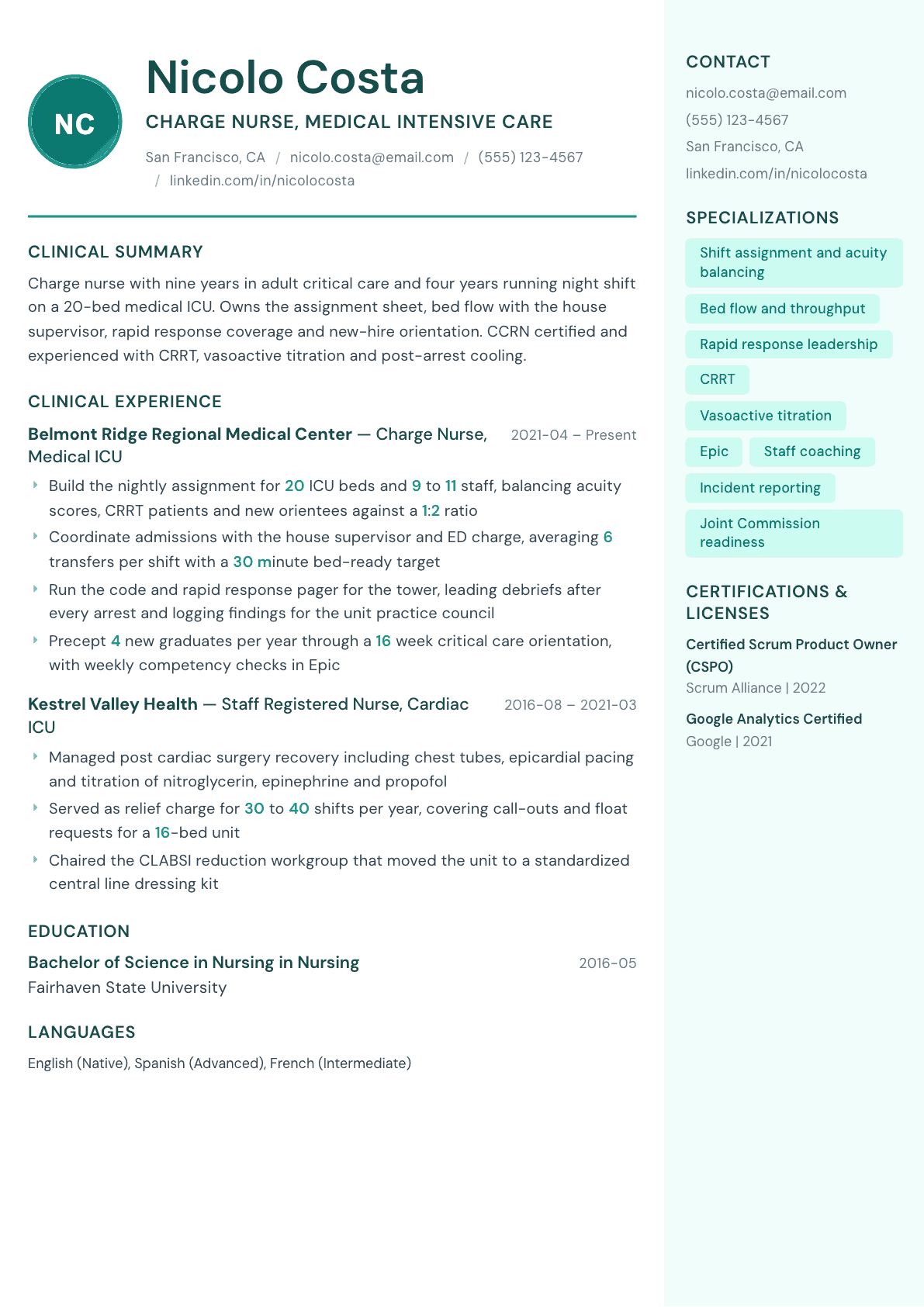
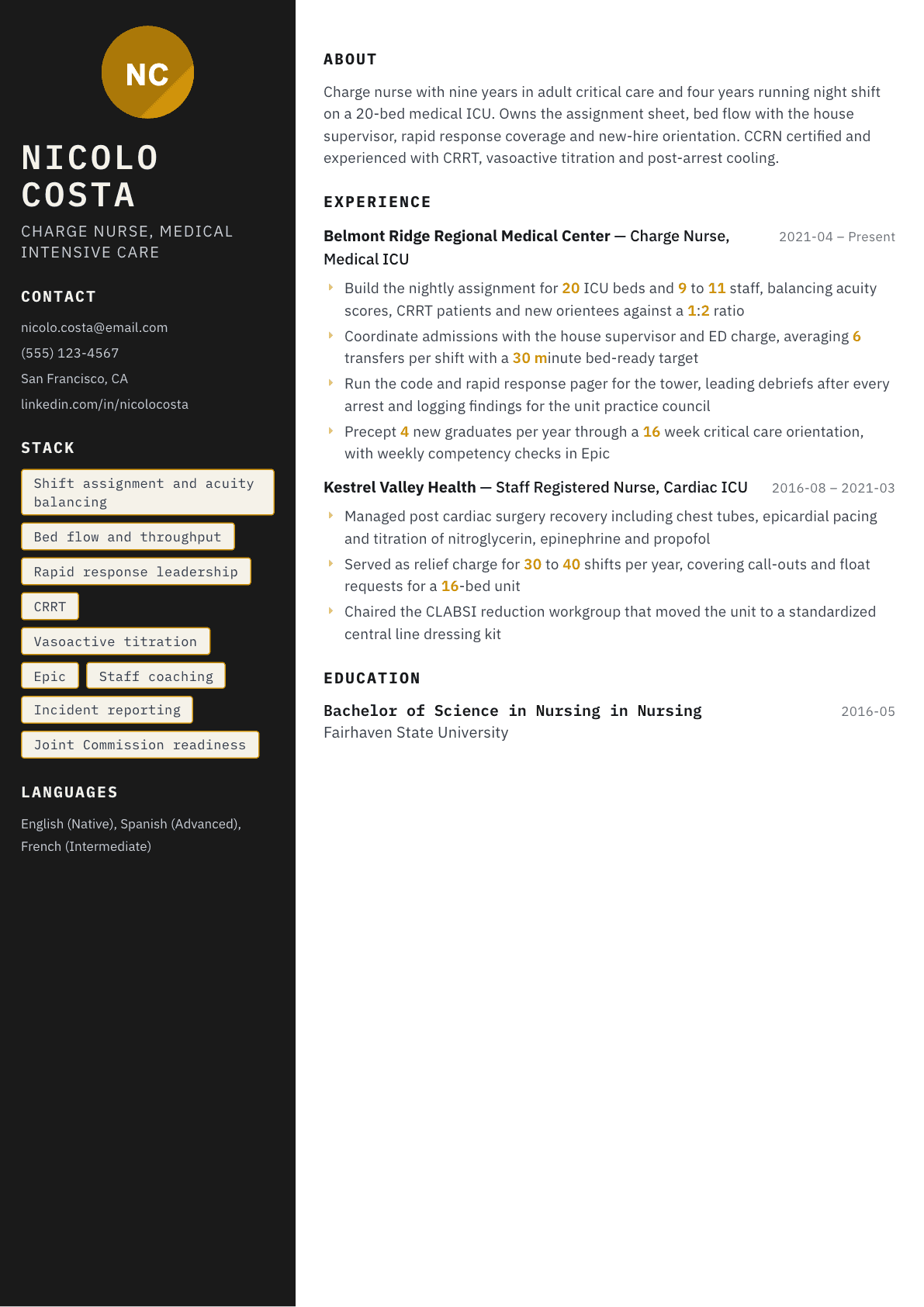
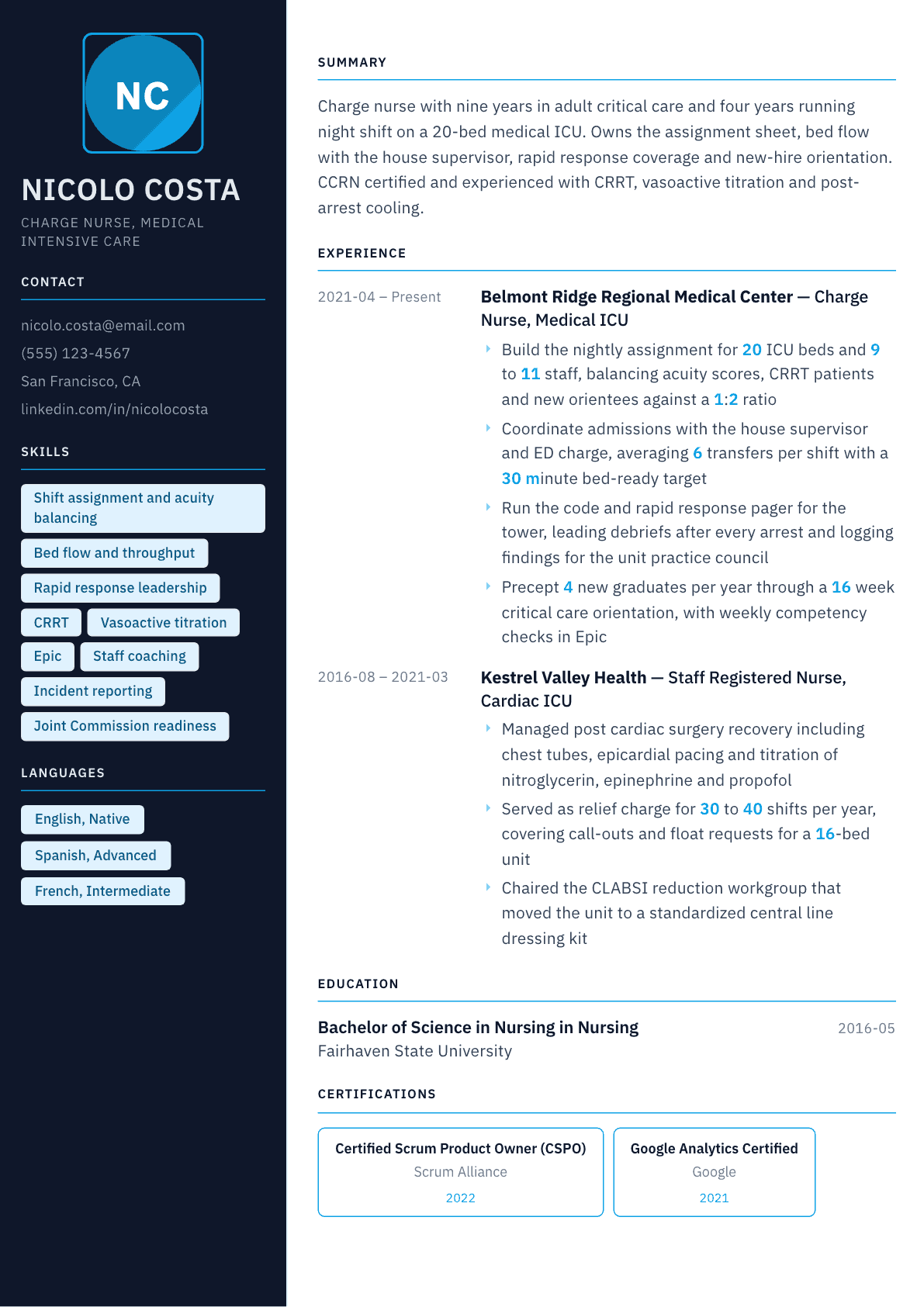
Example Charge Nurse summary
Charge nurse and CCRN with nine years in adult critical care, four of them leading night shift on a 20-bed medical ICU. Builds acuity-balanced assignments for eleven staff, coordinates bed flow with the house supervisor, and carries the rapid response pager for the tower. Precepts four new graduates a year and chaired the unit central line workgroup. Seeking a charge role in a Level I academic ICU.
Skills to list on a Charge Nurse resume
- Shift assignment planning
- Patient acuity scoring
- Bed flow coordination
- Staffing and call-out coverage
- Rapid response leadership
- Code team management
- Preceptor and orientation
- Conflict resolution
- Epic charting
- Incident and safety reporting
- Regulatory survey readiness
- Interdisciplinary rounds
- Sepsis and stroke protocols
- Quality improvement projects
What actually gets this resume read
- Open every job with the unit type, bed count, staffing ratio and how many nurses you assign each shift.
- Separate the charge duties from the bedside duties so a manager can see where your leadership time goes.
- Quantify throughput work: admissions taken per shift, transfer turnaround, float coverage arranged, call-outs backfilled.
- Name the escalation you own, such as rapid response, code team, sepsis alerts or the difficult airway page.
- List CCRN, PCCN or your specialty certification above BLS, because it is the credential the posting screens on.
- Show staff development in numbers: orientees precepted, competencies signed off, huddles led, policies rewritten.
How to write a charge nurse resume
A charge nurse resume has a job that a staff nurse resume does not: it has to prove you can run a shift when the unit is full, two nurses call out and the emergency department is holding three admissions. Nurse managers hire charge nurses for judgment under pressure, and they look for it in the way you describe the assignment sheet, the bed board and the escalations you own.
The trap most applicants fall into is writing a bedside resume with the word charge sprinkled through it. Titrating drips and doing dressing changes is what you did as staff. What a director wants to see is how many nurses you assign, how you weight acuity, who you call when the unit is unsafe, and what happens to throughput on your shift.
This guide separates the leadership half of the resume from the clinical half, gives summaries for a relief charge, an established charge nurse and a candidate reaching for a manager seat, and rewrites the bullets that sound like duties into bullets that sound like command.
Format: keep the clinical spine, add a leadership layer
Reverse chronological, two pages once you have charge experience. Under each job write one context line, then split the bullets into charge duties and clinical duties. A director reading fifteen files can find the leadership block in two seconds if it always sits in the same place.
The context line carries the numbers that define the shift: unit type, bed count, staffing ratio, number of nurses and aides you assign, and the shift you cover. Nights charge is a different job from days charge because the resources on site are different, so name the shift.
- Header credentials in order: degree, license, then specialty certification such as CCRN, PCCN or CEN.
- Sections: summary, licenses and certifications, experience, leadership and committee work, education, skills.
- Relief charge belongs inside the staff nurse job, with the number of charge shifts per month.
Summary: shift size, span of control, and what you are trusted with
Four lines at most. Name the unit and its bed count, the years in charge, the number of staff you assign, and the one responsibility that only the charge nurse carries on your floor: the code pager, the bed board, the float negotiation with the house supervisor.
If you are moving up from relief charge, say so plainly and attach the count. A line that reads relief charge on forty shifts a year is far stronger than a claim of leadership experience with nothing behind it.
Experience: assignments, throughput, escalation, and staff
Assignments come first. Explain how you build them: acuity tool or scoring system, orientee pairing, isolation and CRRT placement, continuity for confused patients. A manager reads that and knows whether you think about the shift or just fill boxes.
Throughput comes second. Admissions accepted per shift, transfer turnaround, discharge pull, holds cleared, float requests negotiated. These are the numbers reported to the director every morning, so they are the numbers that make your resume legible to one.
Then escalation and people. Say which alerts you carry and what you do with them: rapid response, code team, sepsis or stroke alerts, the difficult airway page, chain of command when a provider will not come. Finish with staff work: orientees precepted, competencies signed, huddles led, corrective conversations held, schedule input given.
Quality and regulatory work belongs on the page
Charge nurses are the layer that survey readiness actually lives in. If you audit crash carts, run tracer rounds, own restraint documentation checks or lead a unit practice council, list it under a leadership heading rather than losing it in a bedside bullet.
Name the measures your unit was judged on and your part in them: central line infection rate, catheter days, falls with injury, hand hygiene audits, restraint hours. Do not claim a system result you did not drive. Describe the intervention you led and the scope it covered.
Skills and keywords the screener matches on
Hospital postings for this role recur on the same phrases: shift charge, patient acuity, staffing assignment, bed flow, throughput, chain of command, interdisciplinary rounds, preceptor, unit practice council, survey readiness. Mirror the exact wording from the posting once in the skills block and once inside a bullet where it is demonstrated.
Keep the clinical keywords too. A charge nurse who cannot take an assignment is no use on a short shift, so list the equipment and therapies your unit runs alongside the leadership terms.
Charge Nurse resume summary examples
Relief charge
Progressive care RN with four years on a 30-bed step-down unit and relief charge on roughly forty shifts a year. Builds acuity-balanced assignments for six nurses, coordinates admissions with the bed board, and precepts new graduates. PCCN certified and seeking a permanent charge nurse line.
Charge nurse, three years
Charge nurse with three years leading nights on a 24-bed medical ICU and nine years of critical care behind it. Assigns eleven staff against a 1:2 ratio, carries the rapid response and code pager for two towers, and runs post-arrest debriefs. CCRN certified with CRRT and post-arrest cooling experience.
Senior charge moving to management
Senior charge nurse over a 42-bed surgical unit with responsibility for the assignment sheet, daily bed flow and the preceptor pool. Chairs the unit practice council, owns crash cart and restraint audits for survey readiness, and mentors four relief charge nurses. Completing a master of science in nursing leadership.
Work experience bullets: before and after
Before: Acted as charge nurse on a busy unit.
After: Led night shift on a 24-bed medical ICU, assigning eleven staff against a 1:2 ratio and adjusting the sheet twice a shift for admissions and CRRT starts.
The bed count, staff number and ratio tell a director the size of the shift you actually ran.
Before: Made patient assignments each shift.
After: Built assignments from the unit acuity score, pairing orientees with strong preceptors and keeping continuity for delirious and post-arrest patients.
It shows the reasoning behind the sheet instead of the fact that a sheet existed.
Before: Helped with patient flow.
After: Coordinated an average of six admissions and transfers a shift with the house supervisor and ED charge, holding a thirty minute bed-ready target.
Throughput numbers are the metric a director already tracks, so the bullet lands in familiar terms.
Before: Responded to emergencies.
After: Carried the code and rapid response pager for two towers, led the resuscitation until the intensivist arrived, and ran a structured debrief after every arrest.
Naming the scope and the debrief turns a generic claim into a repeatable leadership practice.
Before: Worked on quality improvement projects.
After: Chaired the unit practice council through a central line dressing standardization, auditing forty kits a month and reporting findings to the nursing quality committee.
The reader sees the role you held, the volume of the audit and where the work was reported.
Before: Supported new staff.
After: Rebuilt preceptor pairing for the unit and signed off competencies for eight new graduates through a sixteen week orientation, tracking progress with the manager monthly.
Ownership of a process reads as leadership, while supported reads as help offered when asked.
Hard skills
- Shift assignment planning
- Patient acuity scoring
- Bed flow and throughput
- Staffing and call-out coverage
- Rapid response and code leadership
- Chain of command escalation
- Preceptor and orientation oversight
- Crash cart and equipment audits
- Restraint and safety documentation
- Interdisciplinary rounds
- Epic and Cerner charting
- Survey and accreditation readiness
Soft skills
- Decision making under pressure
- Conflict resolution with staff and providers
- Coaching and feedback
- Handoff and huddle communication
- Delegation
- Composure during resuscitation
Certifications worth listing
- Basic Life Support (BLS) (American Heart Association)
- Advanced Cardiovascular Life Support (ACLS) (American Heart Association)
- CCRN (Adult Acute/Critical Care Nursing) (American Association of Critical-Care Nurses)
- PCCN (Progressive Care Nursing) (American Association of Critical-Care Nurses)
- Certified Nurse Manager and Leader (CNML) (American Organization for Nursing Leadership)
- Nurse Executive Certification (NE-BC) (American Nurses Credentialing Center)
Mistakes that cost charge nurse candidates the interview
- Submitting a staff nurse resume with charge added to the job title and nothing about assignments or flow.
- Leaving out the number of staff assigned, which is the single fastest way for a director to size your span of control.
- Burying relief charge shifts inside bedside bullets so the reader never learns you have led a shift at all.
- Claiming a hospital-wide quality result when your actual contribution was one unit intervention.
- Skipping the shift you cover, even though nights charge carries decisions that days charge hands to a manager.
- Listing only BLS when the posting screens on CCRN or PCCN, so the file is filtered out before a human reads it.
- Writing soft leadership adjectives in the summary instead of the pager, the bed board and the assignment sheet.
Charge Nurse resume questions
How do I show charge nurse experience if my title was never charge nurse?
Add a line inside the staff nurse job that names relief charge and the number of shifts per month or year, then give two bullets on what you did in that role: assignments built, admissions coordinated, call-outs covered. Titles vary by hospital, counts do not.
Should a charge nurse resume still list bedside clinical skills?
Yes. Most charge nurses take an assignment when the unit is short, and managers screen for that. Keep a clinical block with the therapies your unit runs, such as drips, ventilators, CRRT or telemetry, under the leadership bullets rather than above them.
How long should a charge nurse resume be?
Two pages is standard once you have charge experience, multiple units and committee work. Keep it to one page only if you are moving from staff to your first charge line and have fewer than five years of clinical history to describe.
What numbers matter most on a charge nurse resume?
Bed count, nurse to patient ratio, number of staff assigned, admissions and transfers per shift, orientees precepted, and audit volume. Those six figures let a director picture your shift without an interview, which is exactly what a screening read is for.
Is a charge nurse resume different for a manager application?
Yes. For a manager posting, move budget input, scheduling, hiring panel participation, corrective conversations and council leadership above the clinical bullets, and add any leadership coursework or a nursing leadership degree in progress near the top.