Nursing Resume: Objective Examples, Licenses and Length
By Mustafa Tarabya, founder of CVBooster · Published · Updated
12 min read
Put your license and certifications above your experience, open every job with the unit and the patient population, and stop trying to squeeze it onto one page. A nursing resume is a credentials document first and a career story second, and that order is what most general resume advice gets wrong. The same order holds for any resume for nursing jobs, RN, LPN or CNA, in a hospital, a clinic or long term care. If you only need the top lines, the nursing resume objective examples below cover new graduates, students, nursing assistants, LPNs and specialty changes.
The reason is simple. Before anyone reads about your judgment, someone has to confirm you are legally allowed to do the job in that state, on that unit, with those patients. Make that confirmation take three seconds.
Where do your license and certifications go?
Near the top, in their own block, before experience. Licensure is how boards of nursing grant permission to practice, which is the framing the National Council of State Boards of Nursing uses on its own licensure page, so it is not a nice-to-have you tuck in at the bottom.
Give each entry the same four things: what it is, who issued it, the identifier where you are comfortable sharing one, and the expiry date. A certification with no date is read as current, and if it is not, that discovery happens at the worst possible moment.
- Registered Nurse, [State] Board of Nursing, license #, active, expires MM/YYYY
- Multistate privileges if you hold them: the Nurse Licensure Compact lets an eligible nurse hold one multistate license recognized in other participating states, which matters enormously for travel and border-region roles
- Basic Life Support and Advanced Cardiovascular Life Support with the issuing body named
- Specialty certifications written in full the first time, then the initials in brackets
- Pending items labelled as pending, with the sitting or issue date
Two things to be careful about. Do not write "NCLEX certified". The NCLEX, administered by the National Council of State Boards of Nursing, is the licensure examination, and the thing you hold afterwards is a license from a board of nursing. And do not invent an abbreviation: if you cannot name the organization that issued a certification, it does not belong on the page.
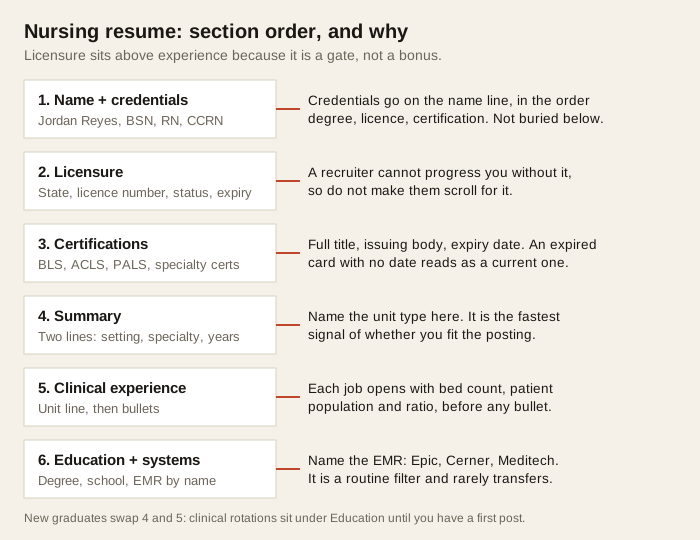
Why does a nursing resume run longer than one page?
Because a nurse carries more mandatory, checkable detail than almost any other applicant. License, certifications, unit types, patient populations, equipment, charting systems, and often several employers inside a few years, none of that is padding, and cutting it does not make you look concise, it makes you look unverifiable.
Two pages is normal for a nurse with a few years behind them. Three is defensible for a long career or a heavily certified specialty. The rule is not a page count, it is that every line has to be doing work: a fact a hiring manager needs, or evidence they would otherwise have to take on trust.
Tip: If you are cutting to fit, cut adjectives before you cut facts. "Compassionate, dedicated, hardworking" costs you a line and proves nothing. "32-bed cardiac telemetry, 1:4 ratio" costs the same line and answers a question.
How do you describe your unit and patient population?
Open each job with a one-line context sentence before any bullets. The hospital name tells a reader almost nothing; the unit tells them everything about whether your hands have done the work theirs need doing.
Include the setting, the bed count, the acuity, the patient population and your typical ratio. A nurse manager reading "18-bed neurosurgical ICU, 1:2, vented and post-craniotomy patients" already knows the shape of your day. The same nurse reading "provided excellent patient care in a fast-paced environment" knows nothing at all.
- Setting: ED, ICU, med-surg, telemetry, OR, L&D, PACU, oncology, LTC, home health, school, clinic
- Size: beds on the unit, or visits per year for an emergency department
- Population: adult, pediatric, neonatal, geriatric, trauma, post-surgical, behavioral health
- Ratio: your usual assignment, not the best night you ever had
- Level or designation where the facility has one, such as a trauma level or teaching status
Which clinical systems should you name?
All of them, by name. Charting systems are the one skill on a nursing resume that is routinely used as a hard filter, because a nurse who already knows the hospital's system needs less orientation time and costs less to onboard.
Write the vendor name as the vendor writes it, Epic, Cerner, Meditech, Allscripts, PointClickCare, and add the module if you worked deep in one. Do the same with equipment and pumps you were signed off on, telemetry systems, barcode medication administration, and any documentation standard your unit worked to.
What not to do: write "EMR/EHR experience" and leave it there. That phrase matches nothing a recruiter is searching for, and it hides the one detail that would have moved you forward.
Which numbers are honest to use?
The ones you could defend if a nurse manager asked you where they came from. Nursing is full of real, countable things, so there is no reason to reach for invented ones.
- Patient assignment and ratio, and how it changed on nights or when short
- Bed count, unit size, annual visit volume where the facility publishes it
- How many new graduates or students you precepted
- Charge shifts per month, or how long you held the charge role
- Committee work, audits run, or a protocol you helped write and roll out
- Float coverage: which other units you are competent to cover
Be careful with quality metrics. Falls, pressure injuries, CLABSI and CAUTI rates, sepsis bundle compliance and patient satisfaction scores are unit-level results produced by a whole team, and claiming a percentage improvement as your personal outcome invites a question you cannot answer. Describe your part instead: what you did, what the unit's initiative was, and what the unit achieved.
What does a strong nursing resume look like?
The block below is an invented example. The nurse, the hospital, the license and the numbers are all fictional and exist only to show the shape. Do not copy the details, copy the structure.
Example header: Jordan Reyes, BSN, RN, CCRN. Registered Nurse, Ohio Board of Nursing, active, expires 09/2027. BLS and ACLS (American Heart Association), current. CCRN (AACN Certification Corporation), expires 03/2028.
Example summary: "Critical care RN with six years in adult ICU and step-down, currently in a 20-bed medical ICU at 1:2 with vented, CRRT and post-arrest patients. Charge nurse on rotation, preceptor to eight new graduates, Epic since 2020. Looking for a cardiothoracic ICU post in the Columbus area."
Example experience heading: "Registered Nurse, Medical ICU, Riverbend Regional Medical Center, Columbus, OH. March 2021 to present. 20-bed closed medical ICU, 1:2 ratio, adult population, high ventilator and CRRT volume."
- Example bullet: "Manage a two-patient ICU assignment on a rotating 12-hour night schedule, typically including one ventilated patient and one on continuous renal replacement, with titratable vasoactive drips on most shifts."
- Example bullet: "Hold charge on roughly six shifts a month for a 20-bed unit: assignment planning across nine nurses, admission flow with the ED and rapid response coordination overnight."
- Example bullet: "Precepted eight new graduate nurses through a 12-week orientation, writing weekly competency notes and running the final sign-off conversation with the educator."
- Example bullet: "Sat on the unit's mobility working group that rewrote the early-mobility protocol, and delivered the bedside teaching to night staff during rollout."
Notice what those bullets do not contain: no percentage that a reader would have to take on faith, no adjective about being compassionate, and no verb like "utilized". Each one is a fact about the work, in the language of the unit.
Nursing resume objective examples
A nursing resume objective is two or three lines at the top that say what license you hold, what setting you trained or worked in, and the unit or role you want next. It earns its place on a new graduate, LPN, nursing assistant or specialty-change resume, where the reader needs to know why you are applying. Experienced nurses staying in their specialty should write a summary instead, because their units and patient numbers already say it. Each example below is tagged by level.
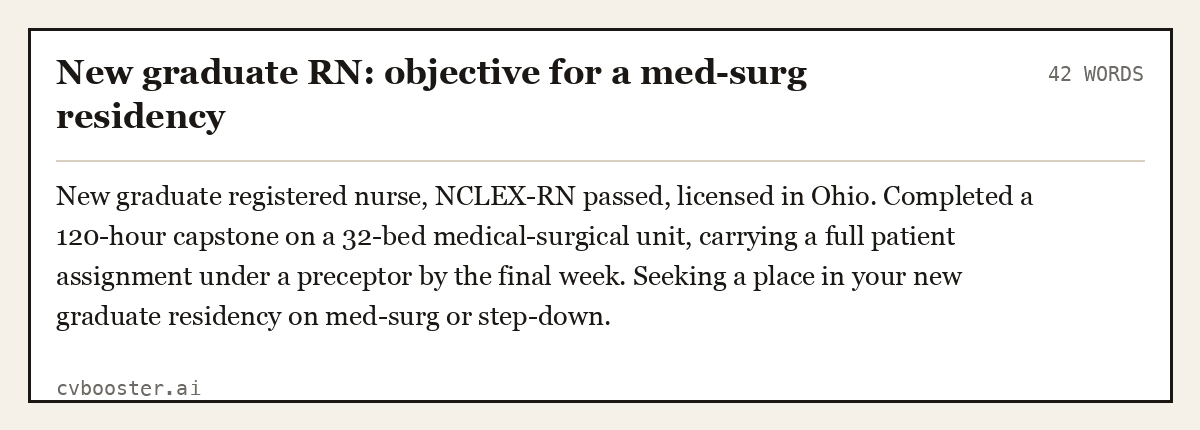
New graduate RN: objective for a med-surg residency (42 words)
New graduate registered nurse, NCLEX-RN passed, licensed in Ohio. Completed a 120-hour capstone on a 32-bed medical-surgical unit, carrying a full patient assignment under a preceptor by the final week. Seeking a place in your new graduate residency on med-surg or step-down.
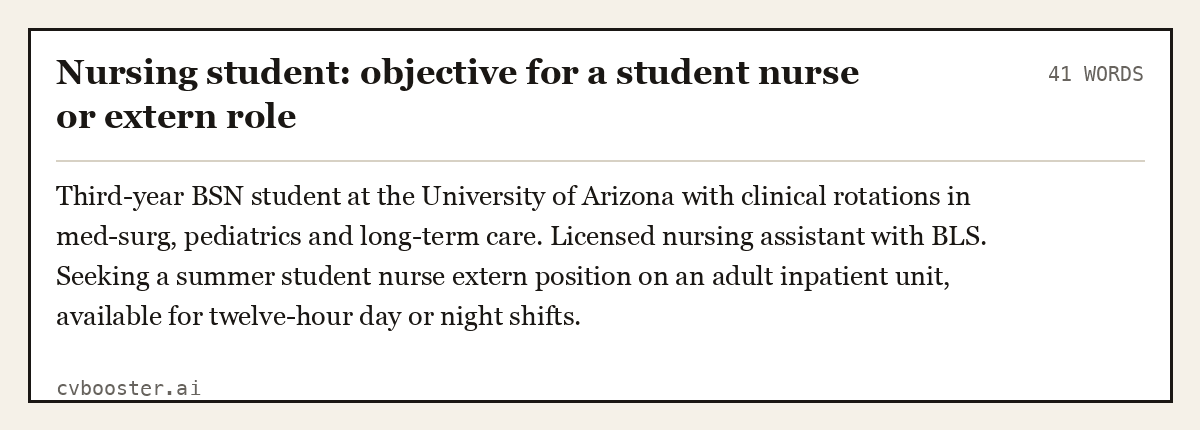
Nursing student: objective for a student nurse or extern role (41 words)
Third-year BSN student at the University of Arizona with clinical rotations in med-surg, pediatrics and long-term care. Licensed nursing assistant with BLS. Seeking a summer student nurse extern position on an adult inpatient unit, available for twelve-hour day or night shifts.
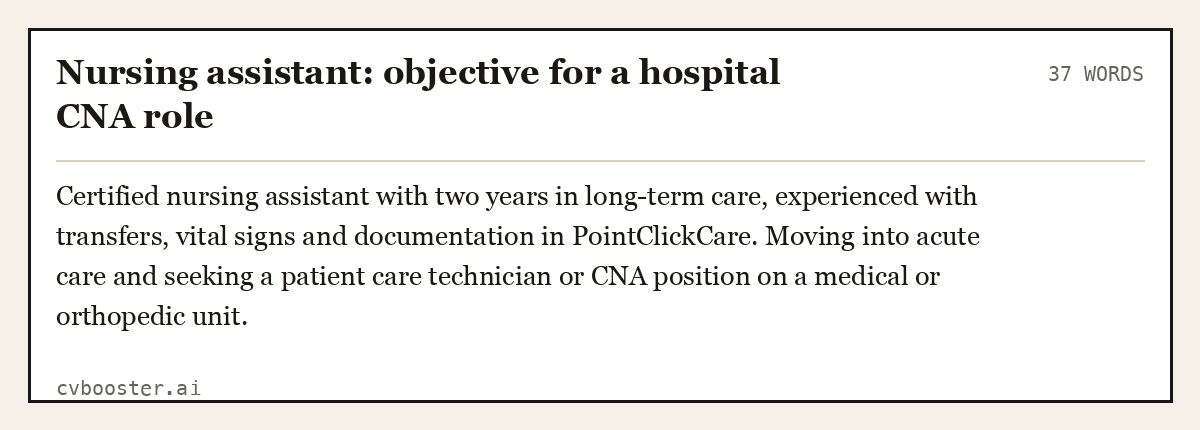
Nursing assistant: objective for a hospital CNA role (37 words)
Certified nursing assistant with two years in long-term care, experienced with transfers, vital signs and documentation in PointClickCare. Moving into acute care and seeking a patient care technician or CNA position on a medical or orthopedic unit.
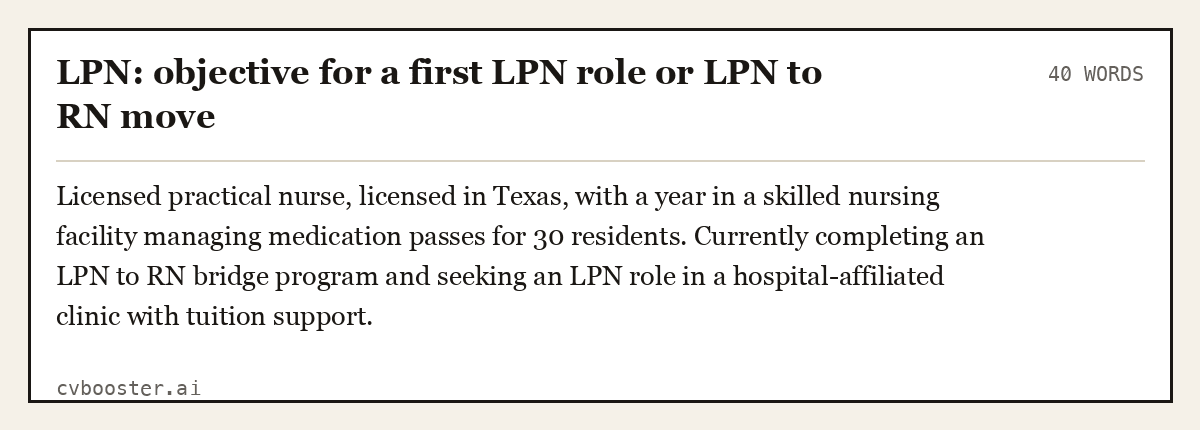
LPN: objective for a first LPN role or LPN to RN move (40 words)
Licensed practical nurse, licensed in Texas, with a year in a skilled nursing facility managing medication passes for 30 residents. Currently completing an LPN to RN bridge program and seeking an LPN role in a hospital-affiliated clinic with tuition support.
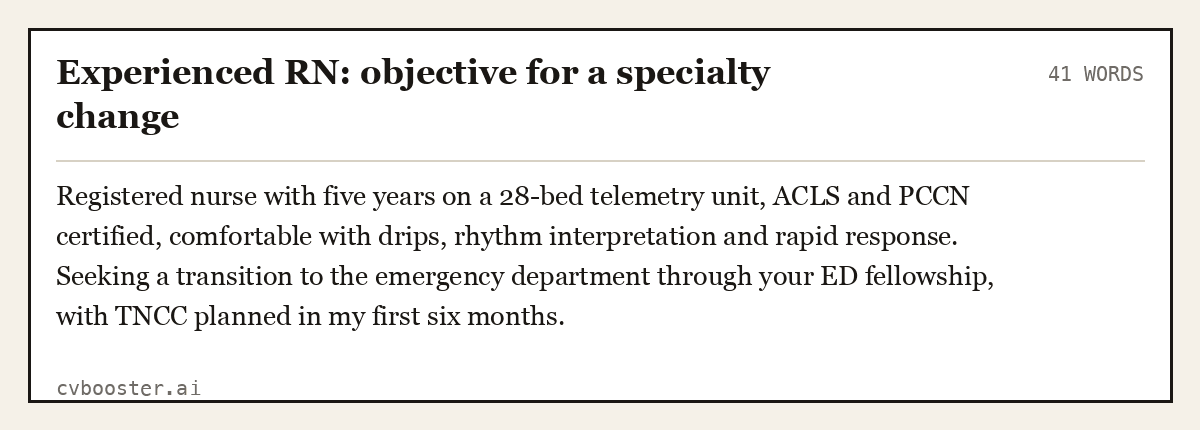
Experienced RN: objective for a specialty change (41 words)
Registered nurse with five years on a 28-bed telemetry unit, ACLS and PCCN certified, comfortable with drips, rhythm interpretation and rapid response. Seeking a transition to the emergency department through your ED fellowship, with TNCC planned in my first six months.
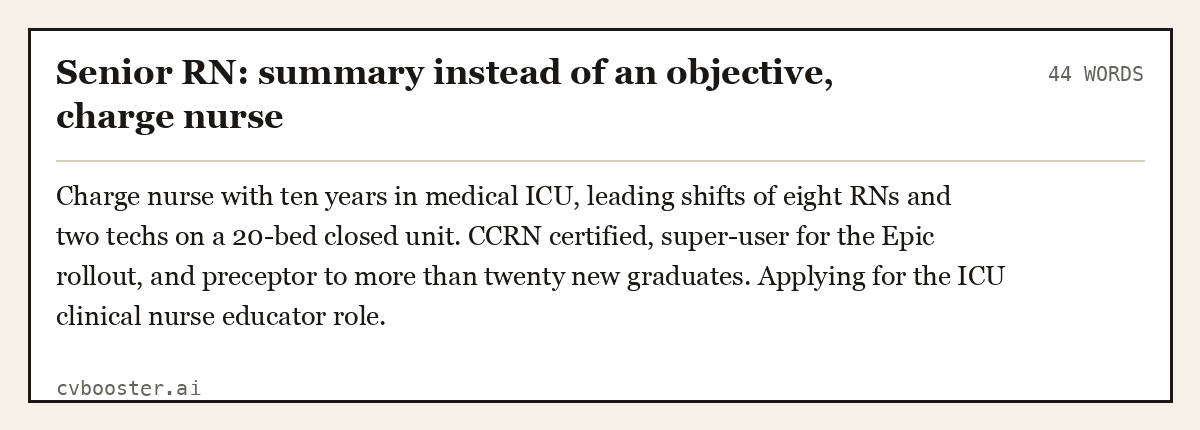
Senior RN: summary instead of an objective, charge nurse (44 words)
Charge nurse with ten years in medical ICU, leading shifts of eight RNs and two techs on a 20-bed closed unit. CCRN certified, super-user for the Epic rollout, and preceptor to more than twenty new graduates. Applying for the ICU clinical nurse educator role.
The pattern in every example is license, setting, evidence, target. Leave out lines like "seeking a challenging position to utilize my skills", which say nothing a charge nurse can check. If you are writing a CNA resume without paid experience yet, the CNA resume with no experience guide has six complete samples. When the posting asks for a letter as well, the healthcare cover letter examples follow the same order.
How is a new graduate nursing resume different?
The structure barely changes; only the contents of the experience section do. Clinical rotations become your experience, and you describe them exactly the way a working nurse describes a job: setting, bed count, population, hours, and what you were doing with your hands. If phlebotomy is the patient-facing job you are leaving, or the one you apply for while you study, the phlebotomist cover letter shows three annotated letters.
- List each rotation with the unit type, the facility, the number of hours and the term
- Name the preceptorship or capstone separately, because it is the longest continuous block you have
- Say plainly where your license stands: issued, pending, or exam date scheduled
- Keep prior non-nursing work if it was patient-facing, CNA, tech, EMT, care assistant, phlebotomy all count
- Put education above experience until you have a first nursing post
Formatting that survives a hospital applicant system
Large health systems run everything through parsing software, and the failures are always the same handful of layout choices rather than anything to do with your content.
- Standard headings: Licensure, Certifications, Clinical Experience, Education, Skills
- No tables or two-column layouts for your licenses, a parser can read the columns out of order
- No credentials or contact details inside the page header or a text box
- Dates in a consistent MM/YYYY format, every time
- Spell out an abbreviation once, then use it, so both a keyword search and a human find it
Tip: Paste your finished PDF into a plain text editor. If your license line survives that paste in one piece, it will survive the parser. If it arrives scrambled, the layout is the problem, not your experience.
Weak bullets, and what they should say instead
Most nursing resumes are not badly written. They are written in the language of a job description rather than the language of a shift. These pairs are invented examples, but the weak versions will look familiar.
Weak: "Provided compassionate patient care to assigned patients." Rewritten: "Carry a 1:5 assignment on a 32-bed cardiac telemetry unit, including post-PCI patients on their first night after the procedure and continuous telemetry for the whole assignment."
The rewrite adds nothing that was not already true. It just answers the questions a nurse manager was going to ask anyway: how many patients, how sick, what kind.
Weak: "Administered medications as ordered and documented in the EMR." Rewritten: "Administer oral and IV medications across a five-patient telemetry assignment, including heparin and amiodarone drips titrated to protocol, with barcode scanning at every pass and charting in Epic."
Every registered nurse gives medications. What distinguishes you is which ones, at what acuity, under which protocol, in which system, and all four of those fit in one line.
Weak: "Improved patient satisfaction scores by 35%." Rewritten: "Joined the unit's discharge-teaching redesign, wrote the plain-language heart failure handout now used at discharge, and taught the new process to night staff during rollout."
The first version claims a whole unit's result as a personal one and cannot survive the follow-up question. The second describes work only you did, and a manager can picture you doing it.
Weak: "Worked as part of a multidisciplinary team." Rewritten: "Run daily bedside rounds with the intensivist, pharmacist and respiratory therapist, presenting the overnight course and the day's goals for two ICU patients."
The rest of the worked example: skills and credentials
Still invented, still fictional, and still there for the shape rather than the content. These two blocks are where nurses tend to go vague, so they are worth seeing in full.
Example skills block: "Clinical: ventilator management, continuous renal replacement therapy, vasoactive drip titration, central and arterial line care, post-arrest and targeted temperature management, code response. Systems: Epic (Rover, bedside charting), Cerner at a previous employer, Alaris pumps, Philips telemetry, barcode medication administration. Additional, charge nurse, preceptor, rapid response team member, Spanish (conversational)."
Example credentials block: "Registered Nurse, Ohio Board of Nursing, active, expires 09/2027. BLS and ACLS, American Heart Association, current. CCRN, AACN Certification Corporation, expires 03/2028. NIH Stroke Scale certification, 2025. BSN, University of Cincinnati, 2019."
Notice that the credentials block names an issuing organization every single time. That is the discipline that separates a credible nursing resume from one a recruiter has to verify line by line before they can even shortlist you.
A fill-in template for nursing job resumes
Most nursing job resumes, hospital, clinic, home health or long term care, follow the same order. Copy the lines below into a blank document, replace every bracket from your own record, and use the worked example above for the wording.
- Header: [Full name], [credentials after your name, such as BSN, RN]. [City, state], [phone], [email].
- License and certifications: [RN or LPN], [state] Board of Nursing, [active or compact], expires [month/year]. [BLS, ACLS, PALS or specialty certification], [issuing organization], [expiry].
- Objective or summary: [license] with [years or clinical hours] in [unit or setting], looking for [the role in the posting]. One skill the posting asks for, in its own words.
- Experience: [Job title], [unit], [facility], [city, state], [dates]. One line on beds, population and ratio, then three to five bullets on assignments, procedures and the systems you chart in.
- Clinical rotations (new graduates): [unit], [facility], [hours], one line on what you were trusted with.
- Skills: clinical skills from the posting, then systems such as [Epic, Cerner, Meditech] and languages.
- Education: [BSN, ADN or LPN program], [school], [year]. NCLEX passed [month/year] if you are newly licensed.
The template does not change between nursing jobs; the words inside it do. Before each application, copy two or three phrases from the posting into the objective and the first bullets of your latest job, as long as they are true.
How does the resume change by specialty and stage?
Nursing is not one job, and a resume written for a med-surg floor does not read correctly to an ICU manager. The structure stays; the emphasis moves.
- New graduate: rotations and preceptorship carry the experience section, license status is stated explicitly, and prior CNA, tech or EMT work stays on the page.
- Med-surg: lead with assignment size, patient turnover, admissions and discharges per shift, and the range of diagnoses you handle at once.
- Telemetry and step-down: rhythm interpretation, drips you titrate, and what triggers an escalation to critical care.
- ICU: ventilators, CRRT, devices, lines, and the proportion of your assignment that is on continuous infusions.
- Emergency: triage system used, annual visit volume, trauma designation, and the fast-track versus resuscitation split of your shifts.
- Perioperative: service lines, case types, circulating versus scrub, and turnover expectations.
- Labour and delivery: fetal monitoring, deliveries and caesareans supported, and the neonatal support you provide.
- Long-term care and home health: caseload size, visit numbers, care planning, family teaching, and the documentation standard you work to.
- Travel and agency: list assignments in one grouped block under the agency, each with facility type, unit, ratio and contract length, so a reader sees breadth rather than job-hopping.
- Nurse educator, informatics or leadership: move the systems, project and teaching work above the bedside detail, but keep the clinical background visible.
Tip: If you are moving specialty, write one line in your summary that names the target unit and the transferable competencies you already hold. A manager who has to work out for themselves why a med-surg nurse is applying to the ICU usually does not bother.
What does nursing hiring actually look like?
Understanding the sequence tells you what the document has to do at each stage, and it explains why the credentials block matters so much.
- Your file goes into a large health system's applicant portal, where the fields are often typed in again alongside the upload. Keep both copies identical.
- An early screen checks that your license and required certifications exist and are current, which is why they sit at the top rather than the bottom.
- A recruiter call establishes specialty, shift, ratio expectations and start date, and every one of those is answered faster if your resume already says it.
- The nurse manager or educator reads for unit fit: acuity, population, equipment and how much orientation you will need.
- Peer or panel interviews focus on judgment, escalation and teamwork, so the bullets you wrote about protocols and precepting are the ones you will be asked to expand.
- References and pre-employment checks follow, and an offer is usually conditional on them.
At no point in that sequence does anyone reward a decorative resume. Every stage rewards a document that is specific, current and easy to verify.
The check before you send it
- License, state and expiry are visible without scrolling
- Every certification names its issuing body
- Every job opens with unit, population and ratio
- The EMR is named, not called "EHR software"
- No unit-level quality metric is written as if it were your personal result
- The specialty in your summary matches the specialty in the posting
If you want a starting layout rather than a blank page, our nurse resume page has a sample structure, a skills list and a summary example you can edit. This guide is the deeper version of the same thinking; that page is the template. For the letter that goes with it, see these medical cover letter examples.
Frequently asked questions
How do I write a resume for nursing?
Put the license block first: license type, issuing board, state and expiry, then certifications with their issuing bodies. Follow with a two or three line summary or objective, then experience where every job opens with the unit, the patient population and the ratio. Name your EMR, keep the layout single column, and finish with education.
Is a nursing resume different from a nursing CV?
In the US a nursing resume is the usual document for hospital and clinic jobs, two pages for most experienced nurses. A nursing CV is longer and adds research, publications and presentations, and it is used for academic, nurse practitioner faculty and research posts. Outside the US, CV is simply the word for a resume, and the nursing CV example shows that format.
How long should a nursing resume be?
One page for a new graduate or nursing student, two pages for most practicing nurses. The extra space goes to the license block, the unit and population line under each job and the systems you are signed off on. Cut duties that every nurse performs before you cut any of those details.
Should a nursing resume have an objective or a summary?
Use an objective if you are a new graduate, an LPN or CNA moving up, or a nurse changing specialty, because the reader needs to know why you are applying. Use a summary if you are staying in your specialty, because your units, acuity and years already make the case. The objective examples above are tagged by level.
Related articles
- RN Resume: Sample Resumes for RN Jobs and Every Section
- Sample EMT Resume Example: Six Full Resumes by Level
- Accounting Executive Resume: 5 Examples by Career Level
- Administration Resume Examples: 8 Samples, Entry to Manager
More articles
- 1 Page CV: 6 One Page CV Examples and When to Use 2 Pages
- How to Make a One Page Resume: 6 Examples That Fit
- Open Interview Definition: What It Is and How to Prepare