Sushi Chef Resume Examples: free ATS score and gap list
Craft a Sushi Chef Resume That Proves Your Knife Work
By Mustafa Tarabya, founder of CVBooster · Published · Updated
Sushi chef resume examples covering fish fabrication, omakase service and sourcing, with a guide to what itamae hiring looks for.
Sample resumes for a sushi chef
The same sushi chef content laid out in three CVBooster templates, so you can see what the finished document looks like before you write a word.
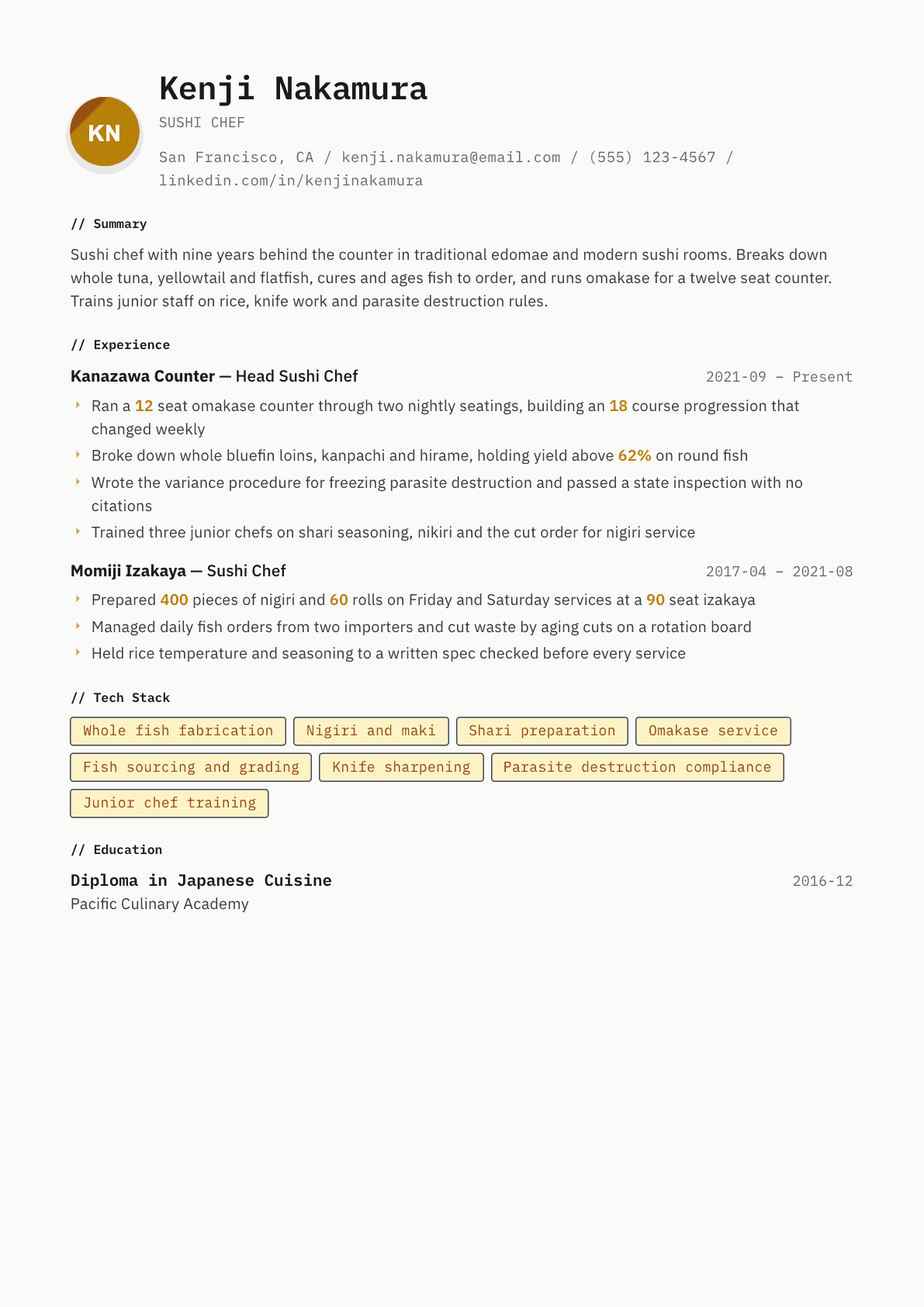
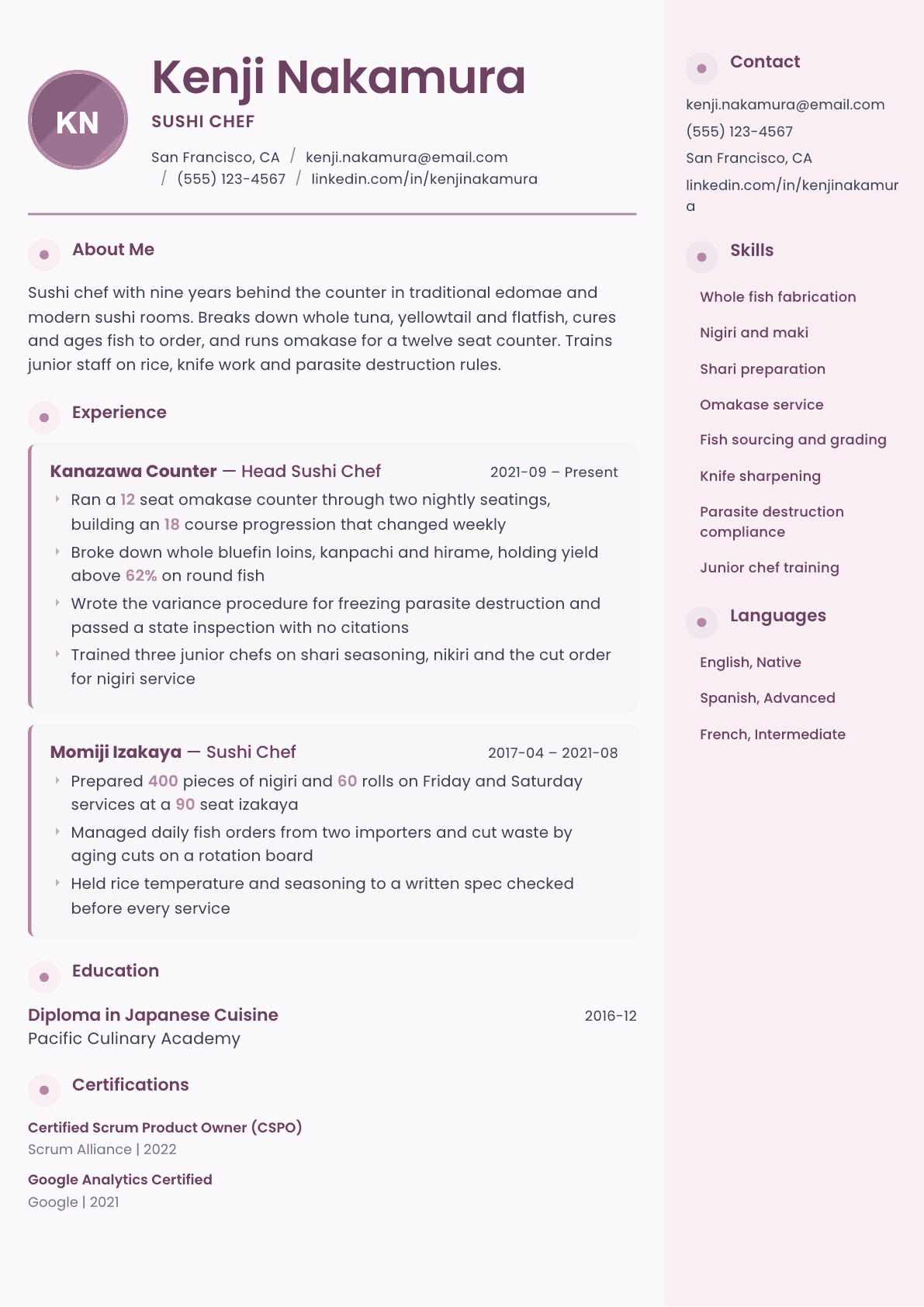
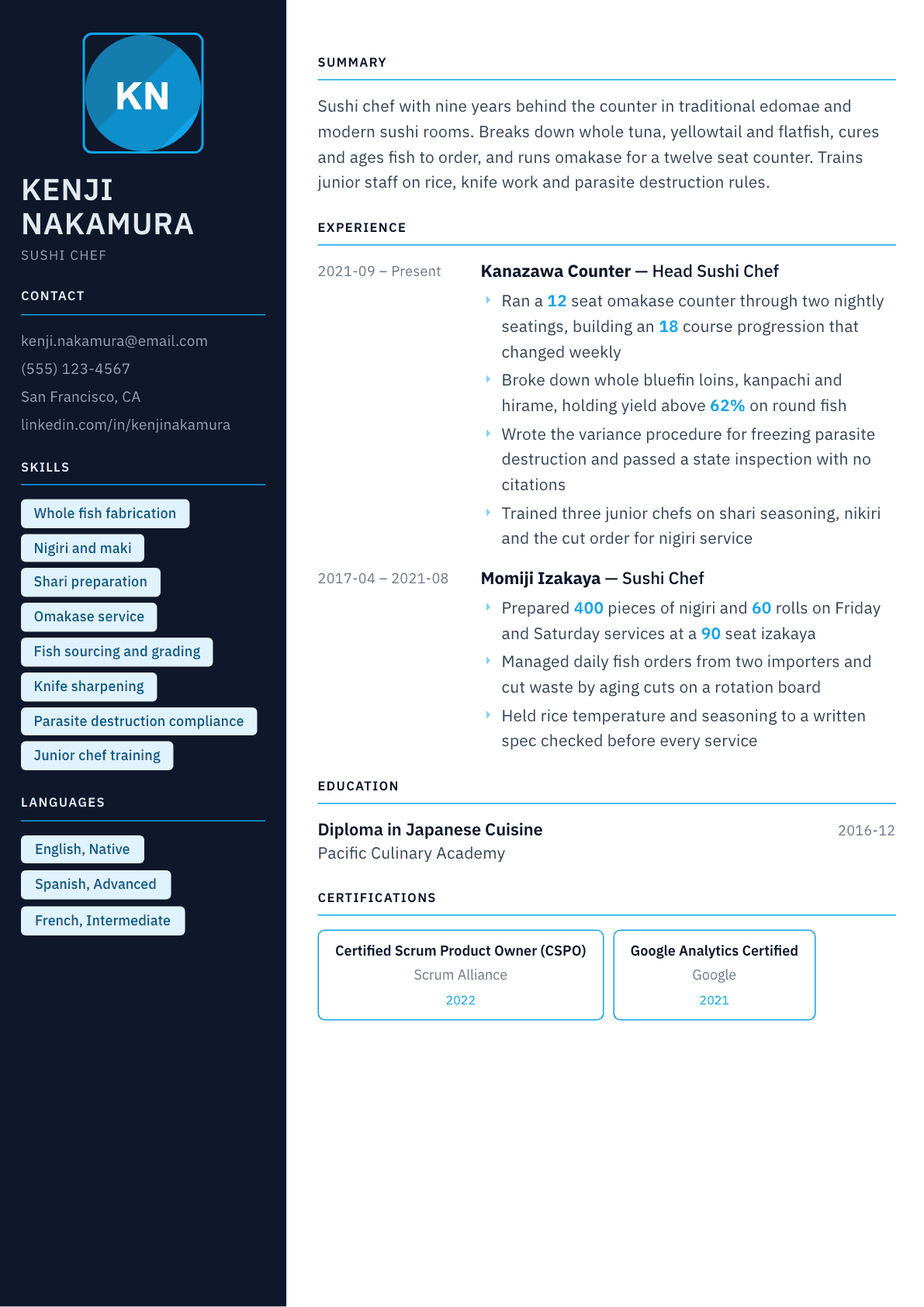
Example Sushi Chef summary
Sushi chef with nine years behind traditional and modern counters, breaking down whole tuna, yellowtail and flatfish and running omakase for a twelve seat room. Holds rice seasoning and holding temperature to written spec, manages direct importer relationships, and documents parasite destruction for health inspections. Trains junior chefs on knife work and cut order.
Skills to list on a Sushi Chef resume
- Whole fish breakdown
- Nigiri technique
- Maki and hosomaki
- Sashimi cutting
- Shari seasoning
- Omakase progression
- Fish grading and sourcing
- Curing and aging
- Nikiri and tare
- Knife sharpening
- Parasite destruction compliance
- HACCP variance documentation
- Counter guest interaction
- Inventory and yield tracking
What actually gets this resume read
- Name the species you break down whole, because that single line separates a sushi chef from a roll maker.
- Say whether the room was traditional edomae, modern fusion or high volume, since the skill sets differ.
- Include your rice work: seasoning ratio, holding temperature and who taught you the method.
- Cover parasite destruction and sourcing rules explicitly, as health departments hold sushi kitchens to them.
- List counter service experience separately from back line production if you have run omakase.
- Keep knife care, sharpening and your kit on the resume, since chefs read that as evidence of training.
How to write a sushi chef resume
A sushi chef resume is read by another sushi chef, and the first question in their head is whether you break down whole fish or assemble from portioned loins. Everything else on the page is weighed after that answer. It is the single line that separates a trained itamae from a competent roll maker, and most applicants never write it.
The second question is about rice. A chef who can state a seasoning approach, a holding temperature and where the method came from is describing an apprenticeship. A chef who lists rolls is describing a menu. Owners hire the first one because rice is the part of the counter that cannot be taught in a week.
This guide covers how to write fabrication and yield honestly, how to present counter and omakase work separately from back line production, how to handle parasite destruction and sourcing so a health department reader is satisfied, and the summaries and bullets that hold up when a chef asks you to prove them at the board.
Format: one page, technique visible immediately
One page for under eight years, two after that if you have run a counter or opened a room. Keep it a single column with clear job blocks. Owners and executive chefs read these quickly and often forward them by photo, so anything small or decorative disappears.
Under each employer, write the room type and the size in one line: a twelve seat omakase counter with two nightly seatings, or a 90 seat izakaya with a sushi bar and a hot line. Traditional edomae, modern fusion and high volume rooms demand different skill sets, and the reader needs to know which one built you before they read a single bullet.
- Order: summary, experience, training and mentors, certifications, technique and skills.
- Keep counter and omakase service in its own block, separate from back line production.
- A portfolio link with plated nigiri and a sample omakase progression carries real weight here.
Fabrication: name the species you break down whole
Write the species by name. Whole bluefin loins, kanpachi, hirame, saba, madai: the list tells a chef exactly which cuts you have handled and which knives you own the technique for. Add yield when you track it honestly, because yield on round fish is the number that decides whether a sushi program makes money.
Then the work around fabrication: curing and aging, kobujime, the rotation board you managed, freezing for parasite destruction, and the trimmings program that turns offcuts into staff meal, tartare or negitoro instead of waste. Owners read that section as food cost control even though it is written as technique.
Rice, seasoning and the counter
Give rice its own bullet in every job. The seasoning spec you held to, the holding temperature you checked before service, who taught you the method, and whether you trained others on it. A written rice spec checked before every service is a stronger credential in this trade than most certificates.
For counter work, describe the progression rather than the dishes: the number of courses, how often it changed, how many seatings a night, and how you paced a room while talking to guests. Omakase is service as much as cooking, and a chef who can hold a counter for two hours is a different hire from a chef who is fast behind a wall.
Food safety, sourcing and the health inspector
Sushi kitchens are held to rules other kitchens are not. Write your parasite destruction procedure, the freezing records you kept, any written food safety plan or variance you maintained, and how the last inspection went. A reader who has been through a citation will move your resume up for that section alone.
Sourcing belongs next to it. Direct importer relationships, the number of fish orders a week, how you grade on arrival, and how you handle a delivery that fails inspection. Owners hire chefs who can hold a supplier accountable without losing the account.
Keywords chefs and operators search
The vocabulary is narrow and searched exactly as written: sushi chef, itamae, nigiri, sashimi, omakase, edomae, fish fabrication, shari, knife skills, fish sourcing, parasite destruction, food safety variance, Japanese cuisine, sushi counter and yield management.
Use the words the room you want uses. A traditional counter posting speaks in edomae, shari and nikiri. A high volume restaurant group speaks in production, par levels and ticket times. Matching the vocabulary is the cheapest signal that you understand the job on offer.
Sushi Chef resume summary examples
Two years behind the bar
Sushi cook with two years at a high volume bar, producing 300 pieces of nigiri and 50 rolls on weekend services. Portions loins, cuts sashimi to spec and holds the rice standard set by the head chef. Training on whole fish breakdown under an itamae, and holds a food handler card.
Five years, full fabrication
Sushi chef with five years across an izakaya bar and a modern counter, breaking down whole yellowtail, flatfish and mackerel and cutting to order through service. Manages daily orders from two importers, ages cuts on a rotation board, and holds rice seasoning and temperature to a written spec checked before every service.
Head sushi chef
Head sushi chef with nine years behind traditional and modern counters, running an 18 course omakase for a 12 seat room across two nightly seatings. Breaks down whole bluefin loins holding yield above 62% on round fish, documents parasite destruction for state inspection, and trains junior chefs on shari, nikiri and cut order.
Work experience bullets: before and after
Before: Prepared sushi and sashimi daily.
After: Broke down whole bluefin loins, kanpachi and hirame each morning, holding yield above 62% on round fish and moving trim into staff meal and negitoro.
Named species and a yield figure prove fabrication skill, which portioned loin work never demonstrates.
Before: Ran omakase service.
After: Ran a 12 seat omakase counter through two nightly seatings, building an 18 course progression that changed weekly with the market order.
Seat count, seatings and course count let a chef picture the pace and the creative load you carried.
Before: Made the sushi rice.
After: Held shari to a written seasoning spec and a checked holding temperature before every service, and trained three junior chefs on the method.
Rice work with a spec and a handoff to juniors is the clearest evidence of a real apprenticeship.
Before: Followed health department rules for raw fish.
After: Wrote the freezing procedure for parasite destruction, kept the records with each delivery, and passed a state inspection with no citations.
The written procedure and the inspection result answer the question that worries every owner of a raw bar.
Before: Ordered fish from suppliers.
After: Managed daily orders from two importers, graded each delivery on arrival, and cut waste by aging slower moving cuts on a dated rotation board.
Sourcing detail plus the waste method shows a chef who protects the food cost, not just the quality.
Hard skills
- Whole fish breakdown
- Nigiri technique
- Maki and hosomaki
- Sashimi cutting
- Shari seasoning
- Omakase progression
- Fish grading and sourcing
- Curing and aging
- Nikiri and tare
- Knife sharpening and kit care
- Parasite destruction compliance
- Food safety plan documentation
- Yield and inventory tracking
Soft skills
- Counter presence with guests
- Precision under pace
- Teaching juniors
- Supplier relationships
- Consistency
- Respect for kitchen hierarchy
Certifications worth listing
- ServSafe Food Protection Manager Certification (National Restaurant Association)
- ServSafe Food Handler (National Restaurant Association)
- HACCP Manager Certification (International HACCP Alliance accredited providers)
- Certified Sous Chef (CSC) (American Culinary Federation)
Mistakes that cost sushi chef candidates the interview
- Never stating whether you break down whole fish, which is the first thing the chef reading it wants to know.
- Listing signature rolls instead of technique, which reads as a menu rather than a set of hands.
- Leaving rice work off the page entirely, when shari is the part of the counter owners cannot train quickly.
- Mixing counter service and back line production into one block, so nobody can tell whether you have held a room.
- Skipping parasite destruction and sourcing, which is the compliance question every raw bar operator carries.
- Claiming edomae training with no mentor, room or method named to support it.
- Writing knife skills as a bullet point with no mention of your kit, sharpening routine or who taught you.
Sushi Chef resume questions
What matters most on a sushi chef resume?
Whether you fabricate whole fish, and what you do with rice. Those two lines tell a chef more than an entire page of dish names, because both take years to learn and cannot be faked at a working interview at the board.
Do I need Japanese culinary training to work as a sushi chef?
It is not required in most kitchens, but the resume should say where your technique came from: a named mentor, a room you trained in, a program you completed. That lineage is how chefs in this field verify each other.
How do I show omakase experience?
Give the seat count, the number of seatings a night, the course count and how often the progression changed. Add how you paced the room and handled guest conversation, because counter service is judged as heavily as the cutting.
Should I mention health department compliance?
Yes, and in detail. Write your parasite destruction procedure, the records you kept, any written food safety plan you maintained and your last inspection outcome. Owners of raw bars carry that risk personally and hire for it.
How do I write this resume if I only worked at a high volume bar?
Own the volume honestly: piece counts, ticket times, the sales mix you produced against. Then name the fabrication and rice work you did handle, and say plainly which techniques you are still training on rather than implying full itamae range.
Related resume examples
- Chef Resume example
- Line Cook Resume example
- Head Chef Resume example
- Chef de Partie Resume example
- Private Chef Resume example
- Sous Chef Resume example