Chief Revenue Officer Resume Examples: read this first
Build a Chief Revenue Officer Resume for the Board Table
By Mustafa Tarabya, founder of CVBooster · Published · Updated
Chief Revenue Officer resume example and writing guide covering revenue scope, go-to-market ownership, board reporting, keywords and executive formatting.
Sample resumes for a chief revenue officer
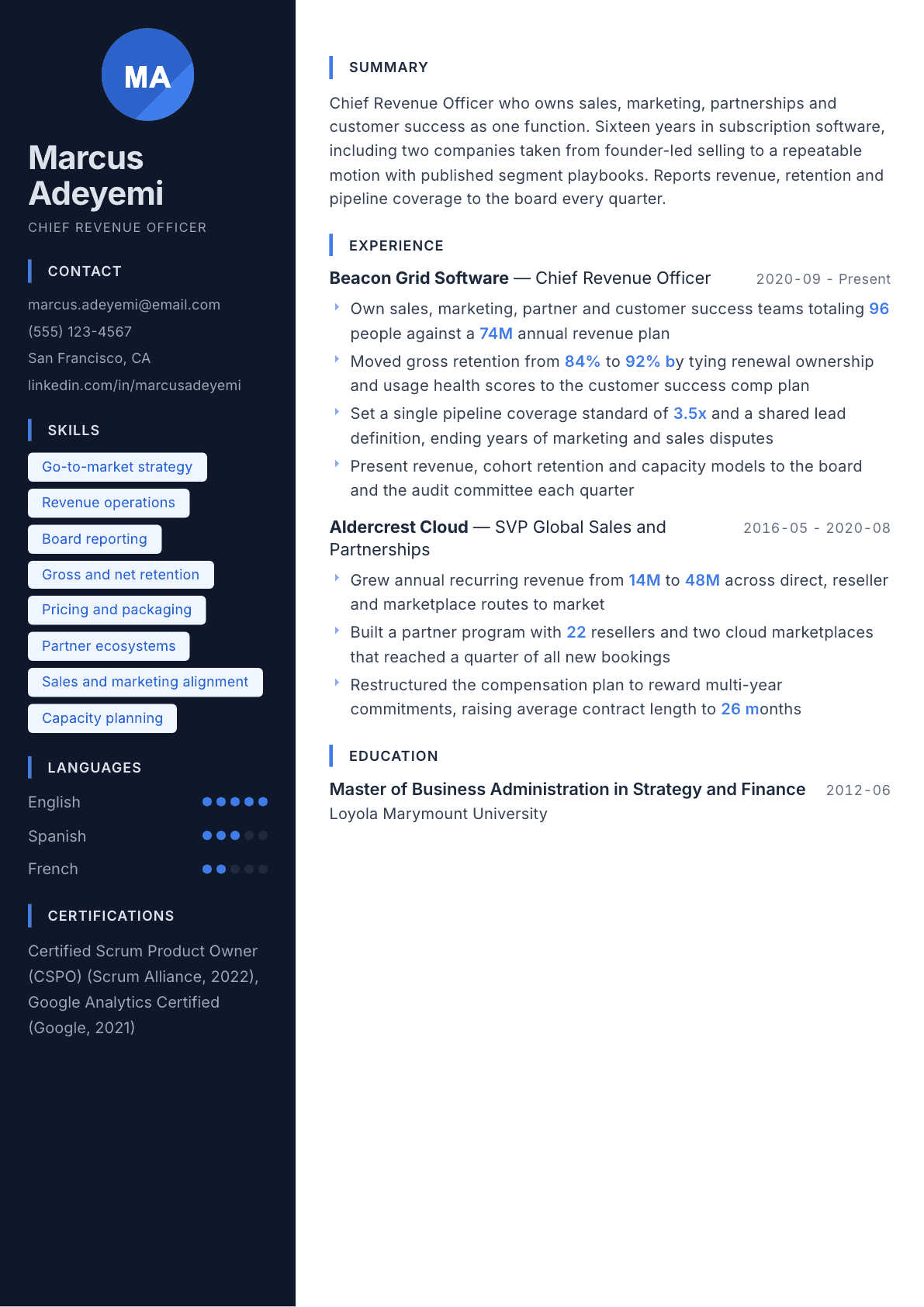
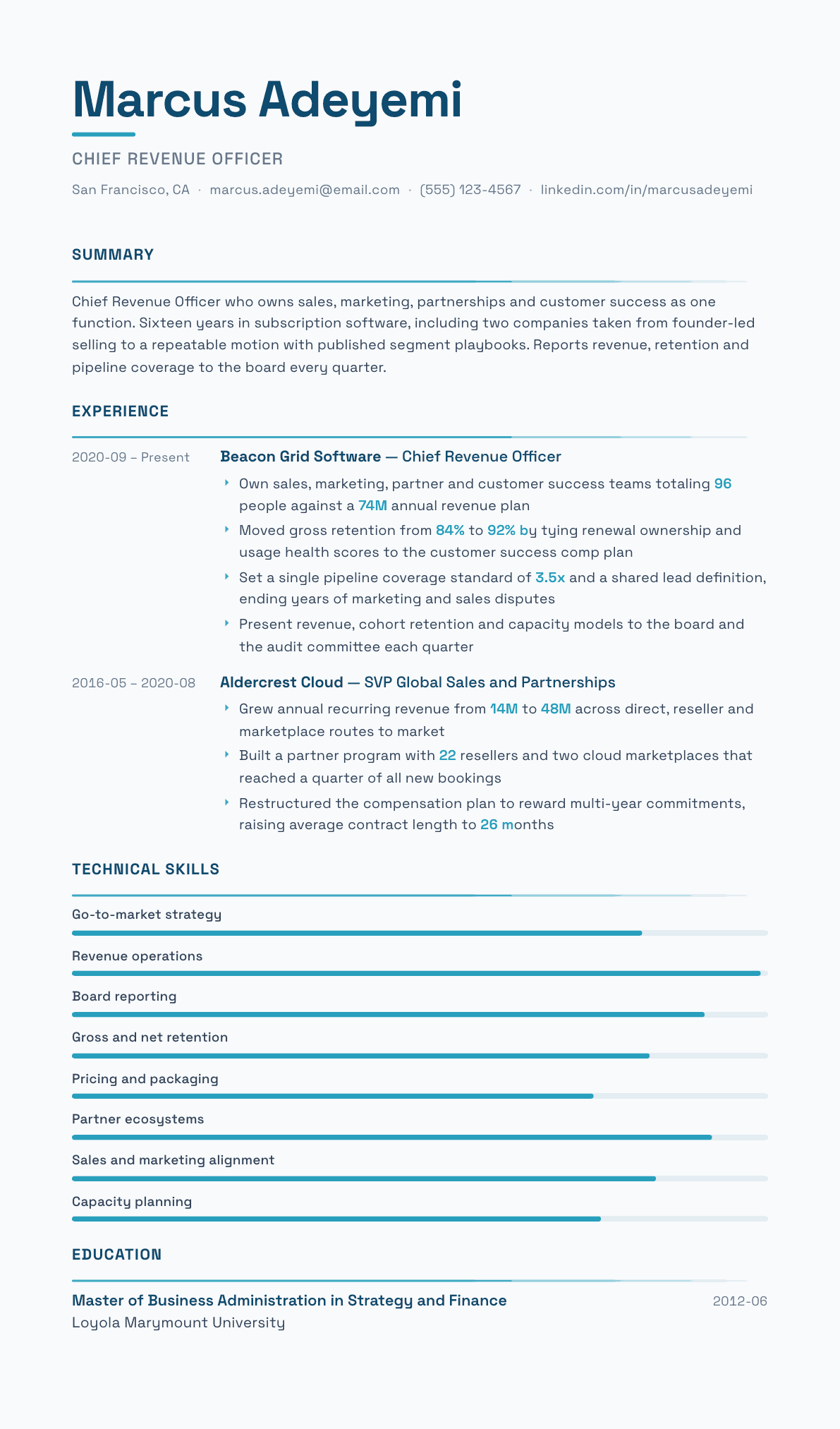
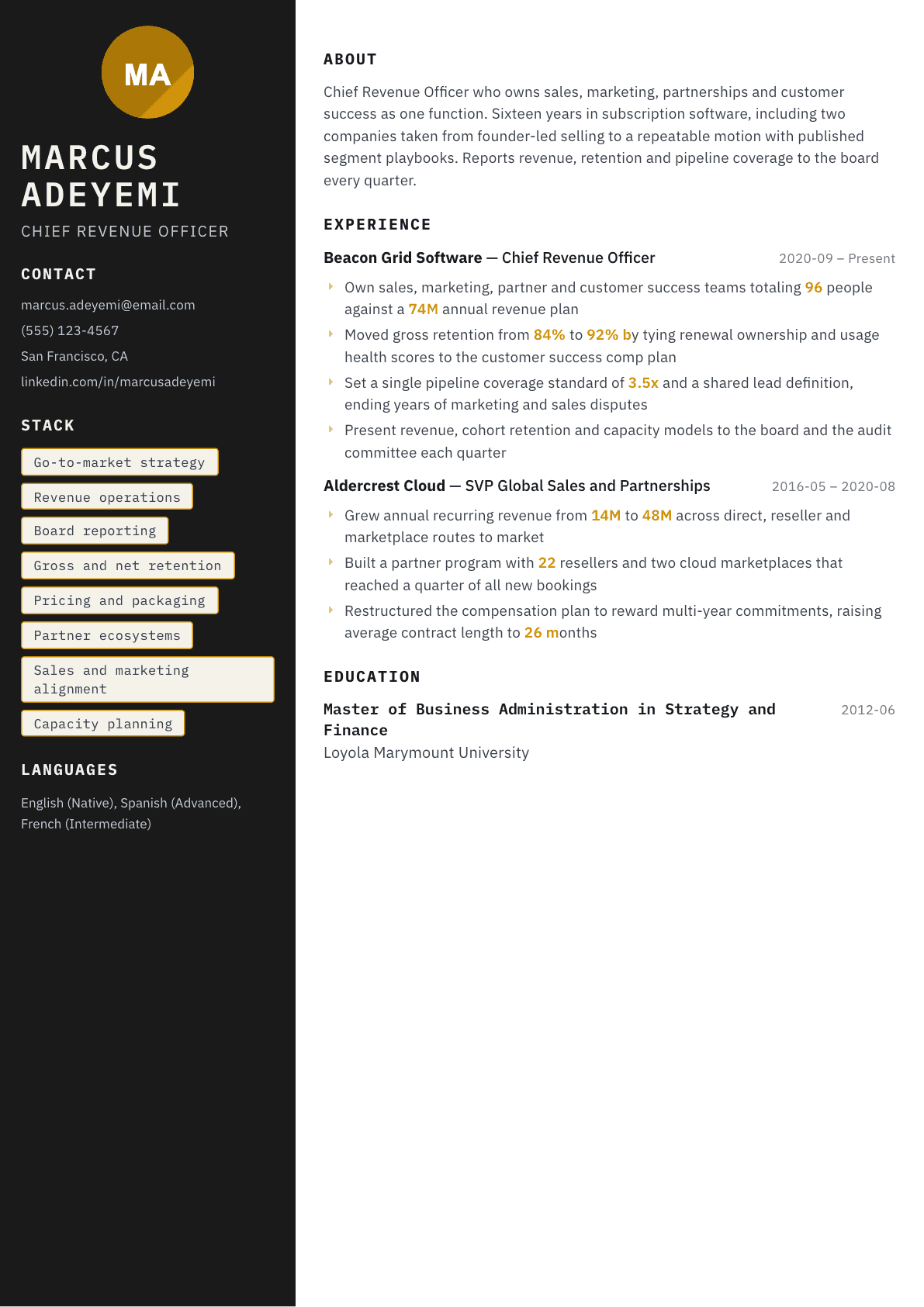
The same chief revenue officer content laid out in three CVBooster templates, so you can see what the finished document looks like before you write a word.
Example Chief Revenue Officer summary
Chief Revenue Officer with sixteen years in subscription software, currently accountable for sales, marketing, partnerships and customer success against a 74M plan. Took gross retention from the mid eighties to the low nineties, built a partner route that now carries a quarter of new bookings, and reports capacity and cohort models to the board. Looking for a growth-stage company that needs one owner across the whole revenue engine.
Skills to list on a Chief Revenue Officer resume
- Go-to-market strategy
- Revenue forecasting
- Pricing and packaging
- Net revenue retention
- Pipeline coverage
- Sales and marketing alignment
- Partner ecosystem strategy
- Customer success leadership
- Compensation design
- Capacity and headcount planning
- Board and investor reporting
- Market segmentation
- Revenue operations
- Executive hiring
What actually gets this resume read
- State the full revenue scope in line one: which functions report to you, how many people, and the plan number.
- Separate the growth you inherited from the growth you created by naming the starting point of each run.
- Show retention alongside new business, because a revenue chief is judged on both halves of the equation.
- Include the operating rhythm you installed: forecast cadence, pipeline reviews, and the coverage ratio you enforce.
- Mention pricing and packaging work, since that is where a chief revenue officer changes the model rather than the effort.
- Give one line per company on the stage: seed, growth, post-acquisition, or turnaround, so scope is read correctly.
How to write a chief revenue officer resume
The chief revenue officer resume has one job: convince a chief executive and a board that you can hold sales, marketing, partnerships and customer success together under a single plan and still hit the number. The candidates who fail this document are almost always excellent sales leaders who wrote a sales leadership resume and left the other three functions as an afterthought.
Readers at this level are quantitative and impatient. They look for the revenue you owned, the functions that reported to you, retention alongside new business, and evidence that you changed the model rather than pushing the team harder. They also look for stage fit, because a revenue chief who scaled a business past a hundred million is often the wrong hire for a company still finding its motion.
What follows is the structure that works for this role, the metrics that belong in it, three summaries covering the path into the seat, before-and-after bullets drawn from the way revenue leaders usually undersell themselves, and answers to the questions that come up when a first-time chief revenue officer sits down to write.
Format: two pages, functional scope stated in every role
Reverse chronological, two pages, and no design flourishes. The reader is scanning for scope, so give it to them structurally: a scope line under each title naming the functions, the headcount and the revenue plan, then four or five bullets that show what changed.
Put a short company descriptor next to each employer. "Vertical software for utilities, private equity backed, 96 employees in the revenue organization" saves the reader a search and lets them size the job correctly. Without it, a strong role at a small company and a weak role at a large one look identical.
- Header: name, target title, city, phone, email, professional profile link.
- Section order: summary, experience with scope and company descriptors, board or advisory roles, education.
- Compress pre-director roles into a two-line early career block.
Summary: functions owned, plan size, stage, and the model change you make
The opening block should answer four questions before the reader reaches the first bullet: which revenue functions report to you, how large the plan is, what stage of company you operate best in, and what you are known for changing. A chief revenue officer is hired to fix a specific defect, and naming yours makes you findable.
Common defects worth claiming, when true: founder-led selling that never became repeatable, a marketing and sales relationship that argues about lead quality, retention leaking faster than new business fills it, or a pricing model that no longer matches how customers buy.
Experience: new business and retention in the same picture
The distinguishing feature of a revenue chief resume is that both halves of the equation appear. Show new bookings growth and show gross and net retention. A leader who grew new business while retention slid is describing a leaky bucket, and an experienced board will spot the omission and assume the worst.
Give the operating rhythm you installed. Pipeline coverage standard, forecast cadence, the single definition of a qualified opportunity, the renewal ownership model, the quarterly business review format. These are the artifacts that outlive a leader, and they are the strongest evidence that your results were systematic.
Pricing and packaging deserve their own bullet if you have done the work. Moving from seat-based to consumption pricing, adding a lower entry tier, or lengthening average contract term changes the trajectory of a business in a way that no amount of coaching does.
- Revenue: bookings or annual recurring revenue against plan, with the starting baseline.
- Retention: gross retention, net revenue retention, and what you changed to move them.
- Efficiency: customer acquisition cost payback, pipeline coverage, and win rate on qualified deals.
- Structure: functions consolidated, roles created, and the operating cadence you set.
Marketing, partnerships and customer success: prove you can run them
Sales leaders moving into this seat lose credibility on the other three functions. Fix that with specifics. For marketing, name demand generation targets, the pipeline sourced share, and how you resolved the lead definition dispute. For partnerships, name the routes to market and the share of bookings they carried. For customer success, name the renewal ownership model, the health scoring, and what happened to churn.
If you have never run one of these functions, do not pretend. Show the closest adjacent work, such as jointly owning the demand plan or sitting on the renewal forecast, and let the interview do the rest.
Board readiness: the part most candidates omit
A chief revenue officer presents to a board. Say so, and say what you present: the revenue plan, cohort retention, capacity and hiring models, and the assumptions behind next year's target. Add any experience with fundraising diligence, an acquisition integration, or an annual planning cycle you ran with the finance chief.
This section is short but it separates candidates. It tells a chief executive that you will not need to be coached through your first board meeting.
Chief Revenue Officer resume summary examples
Stepping up from VP of Sales
VP of Sales taking on marketing and customer success in 2024, now accountable for a 31M plan and 58 people. Grew new bookings 34% while moving gross retention from 86% to 91% by giving renewals a named owner and a health score.
Revenue chief at a growth-stage company
Chief revenue officer for a vertical software business, owning sales, marketing, partnerships and customer success against a 48M plan. Built the partner route from nothing to a quarter of new bookings and lengthened average contract term to 26 months through a repriced multi-year tier.
Second-time chief revenue officer
Two-time chief revenue officer in subscription software, most recently leading 96 people against a 74M plan. Took gross retention from 84% to 92%, set one pipeline coverage standard across segments, and presented cohort and capacity models to the board and audit committee each quarter.
Work experience bullets: before and after
Before: Oversaw all revenue-generating functions for the company.
After: Owned sales, marketing, partnerships and customer success, 96 people against a 74M annual plan, with a weekly revenue council and one shared pipeline definition across all four functions.
Naming the functions, the headcount, the plan and the operating rhythm turns a title restatement into evidence of how you run.
Before: Improved customer retention.
After: Moved gross retention from 84% to 92% in six quarters by assigning every renewal a named owner, tying usage health scores to the customer success compensation plan, and starting renewal conversations 120 days out.
The mechanism is what a board wants; three specific changes make the retention gain repeatable rather than lucky.
Before: Aligned sales and marketing teams.
After: Ended a long-running lead quality dispute by writing one qualified-opportunity definition, holding marketing to a sourced-pipeline target and sales to a 5-day follow-up standard, which raised marketing-sourced win rate from 12% to 21%.
Alignment is a claim until you name the definition, the two obligations and the result they produced.
Before: Led pricing changes across the product line.
After: Repackaged three products into consumption-based tiers with a low entry price, lifting average contract value 28% and doubling the share of customers who expanded within their first year.
Pricing work should show the model change and both effects, on initial deal size and on expansion.
Before: Built a partner channel.
After: Recruited 22 resellers and listed on two cloud marketplaces, building a partner route that reached 25% of new bookings within two years, with a deal registration process that kept channel conflict complaints to fewer than five a year.
The route, the volume, the contribution and the conflict control together prove the channel was built properly.
Hard skills
- Go-to-market strategy
- Revenue planning and forecasting
- Pricing and packaging design
- Net and gross retention analysis
- Customer acquisition cost payback modeling
- Sales compensation architecture
- Partner and marketplace strategy
- Demand generation oversight
- Revenue operations and systems
- Capacity and headcount modeling
- Board and investor reporting
- Market segmentation
Soft skills
- Executive communication
- Building peer trust with finance and product
- Leading through a missed quarter
- Hiring and developing functional leaders
- Negotiating internal tradeoffs
- Long-range judgment under incomplete data
Mistakes that cost chief revenue officer candidates the interview
- Writing a sales leadership resume with the title changed, leaving marketing, partnerships and customer success invisible.
- Presenting new business growth without retention, which an experienced board reads as a deliberate omission.
- Skipping company descriptors, so the reader cannot tell a 74M plan at a mature business from a 74M plan built in three years.
- Listing tools and dashboards instead of the operating cadence and the decisions those tools supported.
- Ignoring stage fit and applying identical language to seed-stage and post-acquisition companies.
- Leaving out board exposure, which makes a chief executive wonder whether you have ever defended a plan under pressure.
Chief Revenue Officer resume questions
What is the difference between a chief revenue officer resume and a VP of Sales resume?
Scope. A VP of Sales resume proves you can run a selling organization. A chief revenue officer resume must also prove you can own demand generation, partnerships and retention, and that you make model changes such as pricing, segmentation and route to market.
Which metrics should appear on a chief revenue officer resume?
Bookings or annual recurring revenue against plan with a baseline, gross and net retention, win rate on qualified opportunities, average contract value and term, pipeline coverage, and acquisition cost payback. Include only what you can defend in detail during an interview.
How do I position myself if I have never carried marketing?
Show the adjacent ownership honestly. Joint accountability for the demand plan, agreeing pipeline targets with a marketing leader, or running the qualified-opportunity definition all count. State plainly that marketing reported elsewhere and let your record on the functions you did own carry the case.
Should I include the companies that did not work out?
Yes, with one line of context. A business that lost its funding round or pivoted away from your segment is a normal part of a revenue career. An unexplained gap invites a worse assumption than the truth, and search firms will find the history anyway.
How long should the summary be at this level?
Four lines. Name the functions you own, the plan size, the company stage you fit, and the specific defect you are known for fixing. Anything longer competes with the experience section for the twenty seconds you get on the first read.