Chiropractor Resume Examples: free ATS score and gap list
Align Your Career with a Chiropractor Resume That Stands Out
By Mustafa Tarabya, founder of CVBooster · Published · Updated
Create a chiropractor resume highlighting your spinal adjustment expertise, patient outcomes, and holistic approach to musculoskeletal health and wellness.
Sample resumes for a chiropractor
The same chiropractor content laid out in three CVBooster templates, so you can see what the finished document looks like before you write a word.
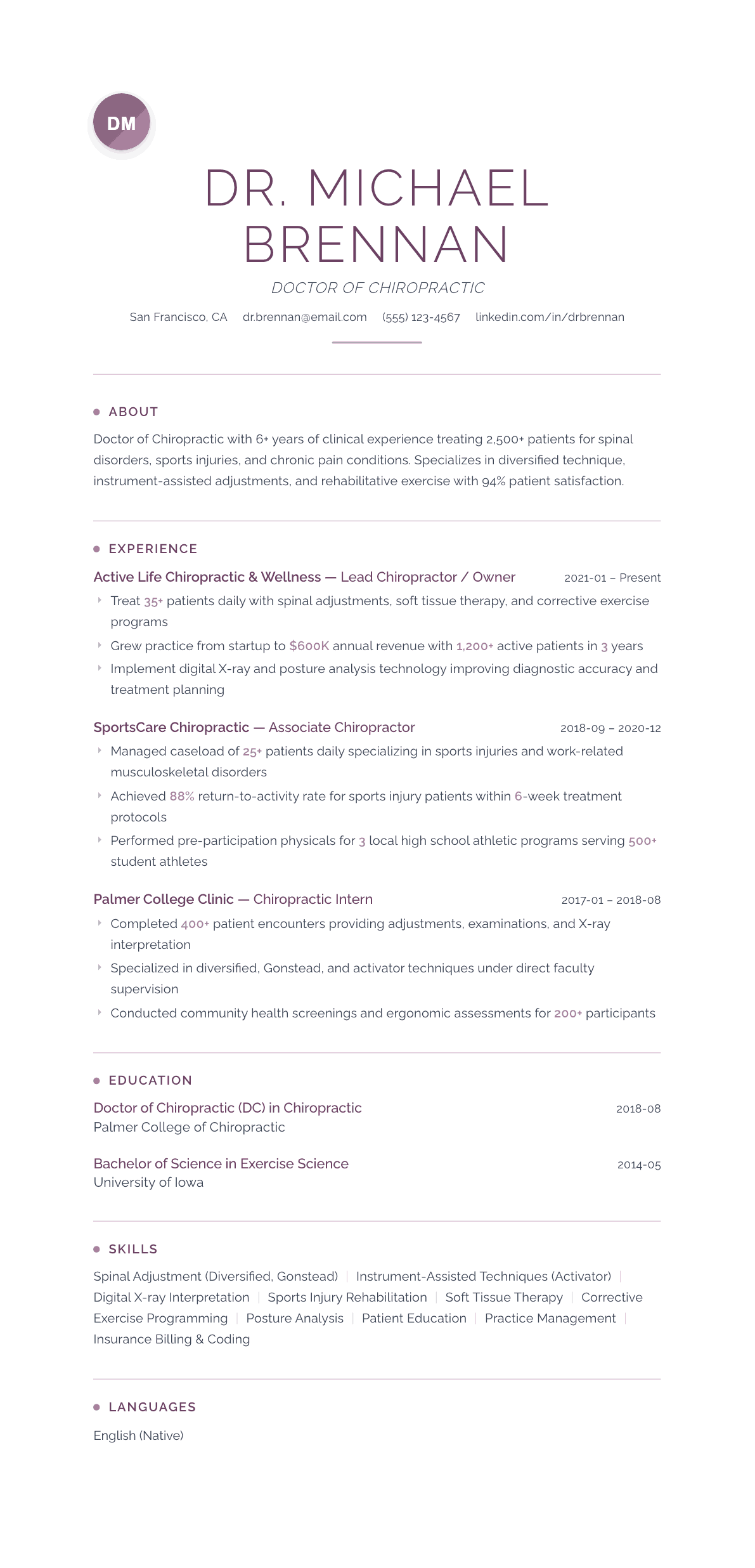
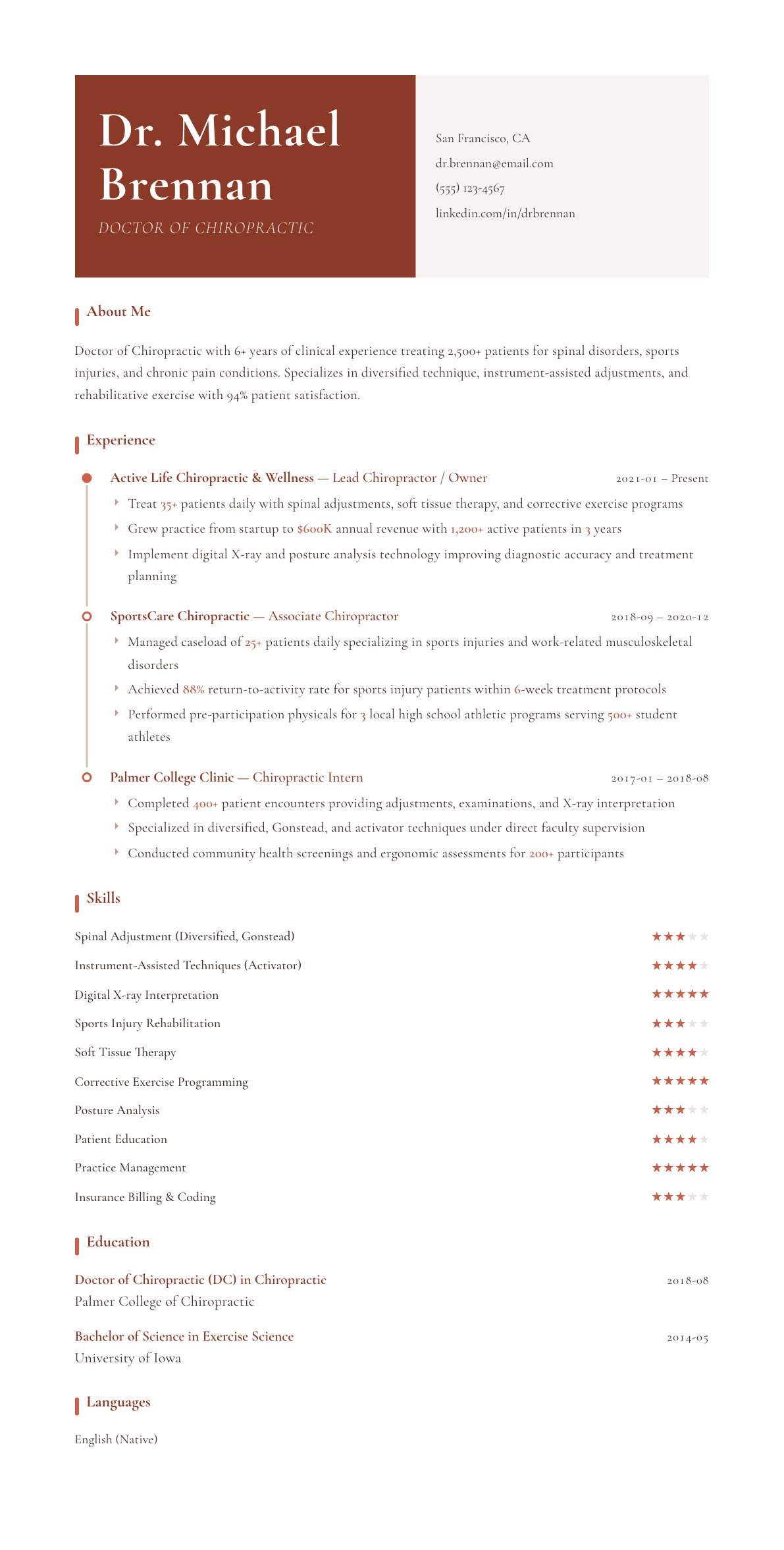
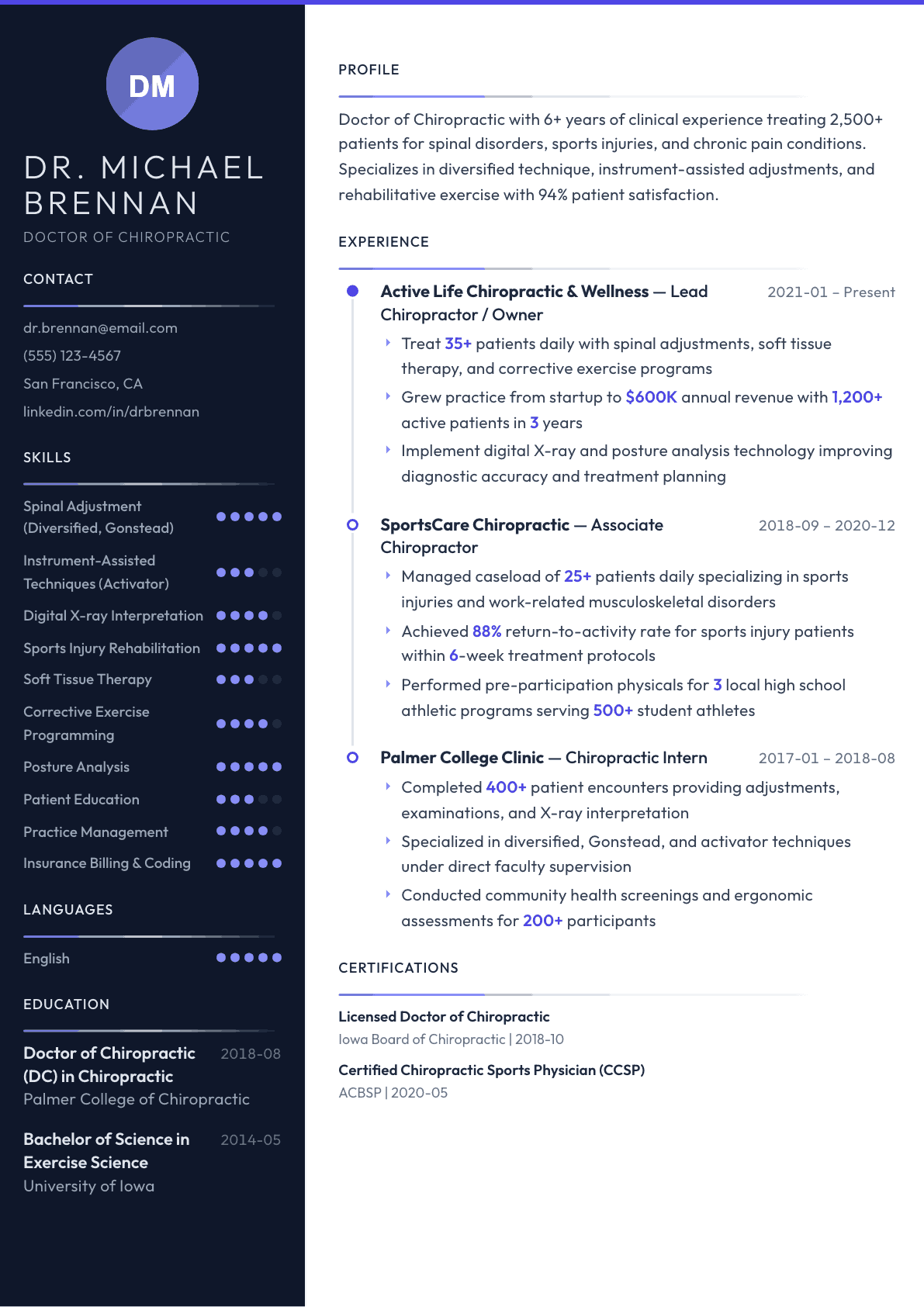
Example Chiropractor summary
Doctor of Chiropractic with 6 years of clinical experience treating 2,500+ patients for spinal disorders and sports injuries. Practice owner generating $600K annual revenue with 94% patient satisfaction and 88% return-to-activity rates.
Skills to list on a Chiropractor resume
- Spinal Manipulation
- Diversified Technique
- Gonstead Technique
- Activator Method
- Digital X-ray / Imaging
- Sports Injury Treatment
- Soft Tissue Therapy
- Corrective Exercise
- Patient Assessment
- Practice Management
- Insurance & Billing
- Ergonomic Assessment
What actually gets this resume read
- Include your DC degree and state licensure prominently at the top of your resume.
- Specify adjustment techniques you practice: diversified, Gonstead, activator, Thompson, flexion-distraction.
- Quantify patient volume, outcomes, and satisfaction to demonstrate clinical effectiveness.
- Highlight specializations: sports injuries, pediatrics, pregnancy, geriatrics, or workers' comp.
- If you own a practice, include business metrics: revenue growth, patient acquisition, retention rates.
How to write a chiropractor resume
A chiropractor resume is read by one of three people, and they want different things. A clinic owner hiring an associate is calculating whether you can carry a full schedule and whether you bring or build a patient base. A multidisciplinary group with physical therapy and medical providers is checking whether you document, code and communicate like the rest of the team. A hospital or veterans clinic is checking credentials and evidence based practice above everything.
Every one of them starts with the Doctor of Chiropractic degree, the state license and the National Board of Chiropractic Examiners parts you have passed. After that they read for two facts: what you treat and how many patients a week you can see. Technique preference matters less than most new graduates think and adaptability matters more, because you will inherit patients used to a different approach.
This guide covers the sections a chiropractic resume needs, how to describe technique and patient volume without overclaiming, three summaries by career stage, before and after bullets, and the questions chiropractors ask when they are choosing between associate work and ownership.
Format: one page, degree and license at the top
Reverse chronological, one page for under ten years. Put D.C. after your name and follow the summary with a licensure block: the state or states, the license status, National Board of Chiropractic Examiners parts passed including the physiotherapy examination where relevant, and any state specific certifications such as animal chiropractic or acupuncture where your license permits it.
Keep the layout plain and clinical. Clinic owners are reading quickly between patients, and a design heavy file with columns and icons often loses its dates when the practice runs it through a hiring system.
- Header: name with D.C., city and state, phone, email, and license state.
- Order: summary, licensure and certifications, clinical experience, techniques, education, professional memberships.
- New graduates put education and the student clinic above experience and list preceptorship hours.
Summary: patient population, volume, and setting
Three lines. Name the license, the years, the setting, the patient population and the weekly volume you sustain. Weekly patient visits is the number an owner uses to model whether hiring you works, and putting it in the summary answers their first question before they have to ask.
If you have a defined niche, say it. Sports and athletic injuries, prenatal and pediatric care, workers compensation and personal injury, geriatric mobility, or occupational and ergonomic work all attract different practices, and a niche paired with the referral relationships behind it is a strong opening.
Experience: what you assess, what you adjust, what you document
For each position give the practice type and size: solo, associate in a group, multidisciplinary with medical providers or physical therapy, a corporate on site clinic, or a franchise model. Then the weekly patient visit volume, the new patient volume, and the conditions that filled the schedule.
Describe your clinical process rather than only your adjustments. History and orthopedic and neurologic examination, imaging you order and read, when you refer out, the treatment plan structure you use, reassessment intervals, and the outcome measures you document. Naming a validated tool such as the Oswestry Disability Index or a neck disability index tells a multidisciplinary employer you can produce notes their medical colleagues will accept.
Cover techniques honestly: diversified, Gonstead, Thompson drop table, activator, flexion distraction, sacro occipital technique, instrument assisted soft tissue work, myofascial release, and rehabilitation exercise prescription. List what you use regularly first, and say which you can adapt to, because associates frequently inherit patients accustomed to another doctor's approach.
Include adjunct services if you provide them: therapeutic exercise, traction, electrical stimulation and ultrasound, dry needling where licensed, nutrition counseling, ergonomic assessment, and custom orthotic casting. These affect what the clinic can bill and are read as revenue relevant.
The business numbers a clinic owner actually reads
Associate hiring is an economic decision, so give the figures that inform it: weekly patient visits, new patients per month, patient visit average across a care plan, retention or reactivation rate, and case acceptance from report of findings. If you have run a practice, add collections trend, payer mix and the referral sources that drove new patients.
Do not invent these. If you have never tracked patient visit average, say what you did track. An honest weekly visit count plus a described referral pipeline beats a set of impressive numbers you cannot reproduce when the owner asks how they were measured.
Documentation, coding and compliance
This section quietly decides many hires. Say which electronic health record you chart in, whether you write your own notes daily rather than at the end of the week, your familiarity with the current procedural terminology codes used in chiropractic including spinal manipulative treatment and the therapy codes, medical necessity documentation, and the difference between active care and maintenance in payer terms.
If you have handled personal injury or workers compensation cases, name it: narrative reports, independent examination correspondence, attorney communication and deposition experience. Practices with that caseload screen for it directly because a doctor who writes a usable narrative report is rare.
Chiropractor resume summary examples
New graduate associate
Doctor of Chiropractic, newly licensed, with a preceptorship of 500 hours and roughly 900 patient visits in the student and preceptor clinics. Trained in diversified, Thompson and activator technique with rehabilitation exercise prescription. Seeking an associate position in a multidisciplinary practice.
Six years in
Doctor of Chiropractic with six years as an associate in a sports and rehabilitation practice, seeing 110 patient visits a week with a focus on athletic injury and post surgical rehabilitation. Certified Chiropractic Sports Physician, using diversified and flexion distraction with instrument assisted soft tissue work.
Practice owner
Doctor of Chiropractic with 13 years in practice, the last eight owning a two doctor clinic with an on site rehabilitation gym. Personally see 130 patient visits a week, carry a substantial personal injury caseload with narrative reporting, and supervise an associate and four support staff.
Work experience bullets: before and after
Before: Provided chiropractic care to patients.
After: Saw 110 patient visits a week in a sports and rehabilitation practice, primarily athletic injury, chronic low back pain and post surgical mobility cases, with roughly 25 new patients a month.
Weekly volume, case mix and new patient flow give a clinic owner the numbers they use to model an associate hire.
Before: Used a variety of adjusting techniques.
After: Adjusted primarily with diversified and Thompson drop table, used flexion distraction for disc related presentations and the activator for older patients and acute cases where manual force was contraindicated.
Matching technique to presentation shows clinical reasoning rather than a list of seminars attended.
Before: Documented patient visits.
After: Charted every visit the same day in the practice record with objective findings and a documented outcome measure, reassessed on a twelve visit schedule and wrote medical necessity notes that survived two payer audits.
Same day notes, a reassessment schedule and surviving an audit are exactly the compliance signals a group practice screens for.
Before: Built relationships to get referrals.
After: Built referral relationships with two orthopedic practices, a physical therapy clinic and three local running clubs, producing a steady share of new patients without paid advertising.
Naming the specific sources shows a repeatable pipeline rather than an intention to network.
Before: Handled personal injury cases.
After: Managed a personal injury caseload of roughly 20 active patients, wrote narrative reports and impairment documentation, and corresponded with attorneys through case resolution including two depositions.
Narrative reports and deposition experience are scarce and directly valuable, so naming them separates you from the pile.
Hard skills
- Spinal manipulative therapy
- Diversified technique
- Gonstead technique
- Thompson drop table
- Activator method
- Flexion distraction
- Orthopedic and neurologic examination
- Radiographic interpretation
- Instrument assisted soft tissue mobilization
- Rehabilitation exercise prescription
- Outcome measure documentation
- Electronic health record charting
- Chiropractic coding and medical necessity documentation
- Personal injury narrative reporting
Soft skills
- Report of findings communication
- Building referral relationships
- Patient adherence coaching
- Working with medical providers
- Managing support staff
Certifications worth listing
- National Board of Chiropractic Examiners Parts I through IV (National Board of Chiropractic Examiners)
- Physiotherapy Examination (National Board of Chiropractic Examiners)
- Certified Chiropractic Sports Physician (CCSP) (American Chiropractic Board of Sports Physicians)
- Diplomate American Chiropractic Board of Sports Physicians (DACBSP) (American Chiropractic Board of Sports Physicians)
- Webster Technique Certification (International Chiropractic Pediatric Association)
- Certified Chiropractic Extremity Practitioner (CCEP) (Council on Extremity Adjusting)
Mistakes that cost chiropractor candidates the interview
- Leaving out weekly patient visit volume, which is the first number a clinic owner needs to model the hire.
- Listing every technique seminar you have attended as though each is part of your daily practice.
- Saying nothing about documentation, coding or medical necessity, which multidisciplinary practices screen for hardest.
- Claiming outcome percentages you never tracked and cannot explain when asked how they were measured.
- Omitting referral sources, so an owner assumes you expect the practice to fill your schedule for you.
- Ignoring personal injury and workers compensation experience, which is scarce and directly valuable to many practices.
Chiropractor resume questions
How many patient visits should I put on my resume?
Give your sustained weekly visit count and your monthly new patient count, both as honest averages rather than your best week. Clinic owners use these to model whether an associate covers their own cost, so an inflated figure gets found out in the first month.
Does my adjusting technique matter to employers?
Less than most new graduates expect. Owners care that you are competent and adaptable, because you will inherit patients accustomed to another doctor. List your primary techniques, then state clearly which others you can work in comfortably.
What should a new chiropractic graduate include?
The student clinic and preceptorship with hours and approximate patient encounters, the National Board parts passed, your license status, techniques trained in, and any adjunct skills such as rehabilitation exercise or soft tissue work. Keep this section until you have two years of practice.
Should I include practice revenue if I owned a clinic?
Include the operational picture rather than a raw revenue figure: patient visit volume, new patient flow, payer mix, retention and the staff you managed. Those numbers travel between practices and tell a buyer or partner far more than a total.
How do I write this resume for a multidisciplinary or hospital setting?
Lead with examination, documentation and referral behavior rather than volume. Name your outcome measures, your imaging and referral thresholds, and any experience charting alongside medical providers, since those settings hire for communication with the rest of the care team.