Acupuncturist Resume Examples: free ATS score and gap list
Point Your Career in the Right Direction with an Acupuncturist Resume
By Mustafa Tarabya, founder of CVBooster · Published · Updated
Build an acupuncturist resume showcasing your traditional Chinese medicine expertise, patient outcomes, and integrative healthcare approach.
Sample resumes for a acupuncturist
The same acupuncturist content laid out in three CVBooster templates, so you can see what the finished document looks like before you write a word.
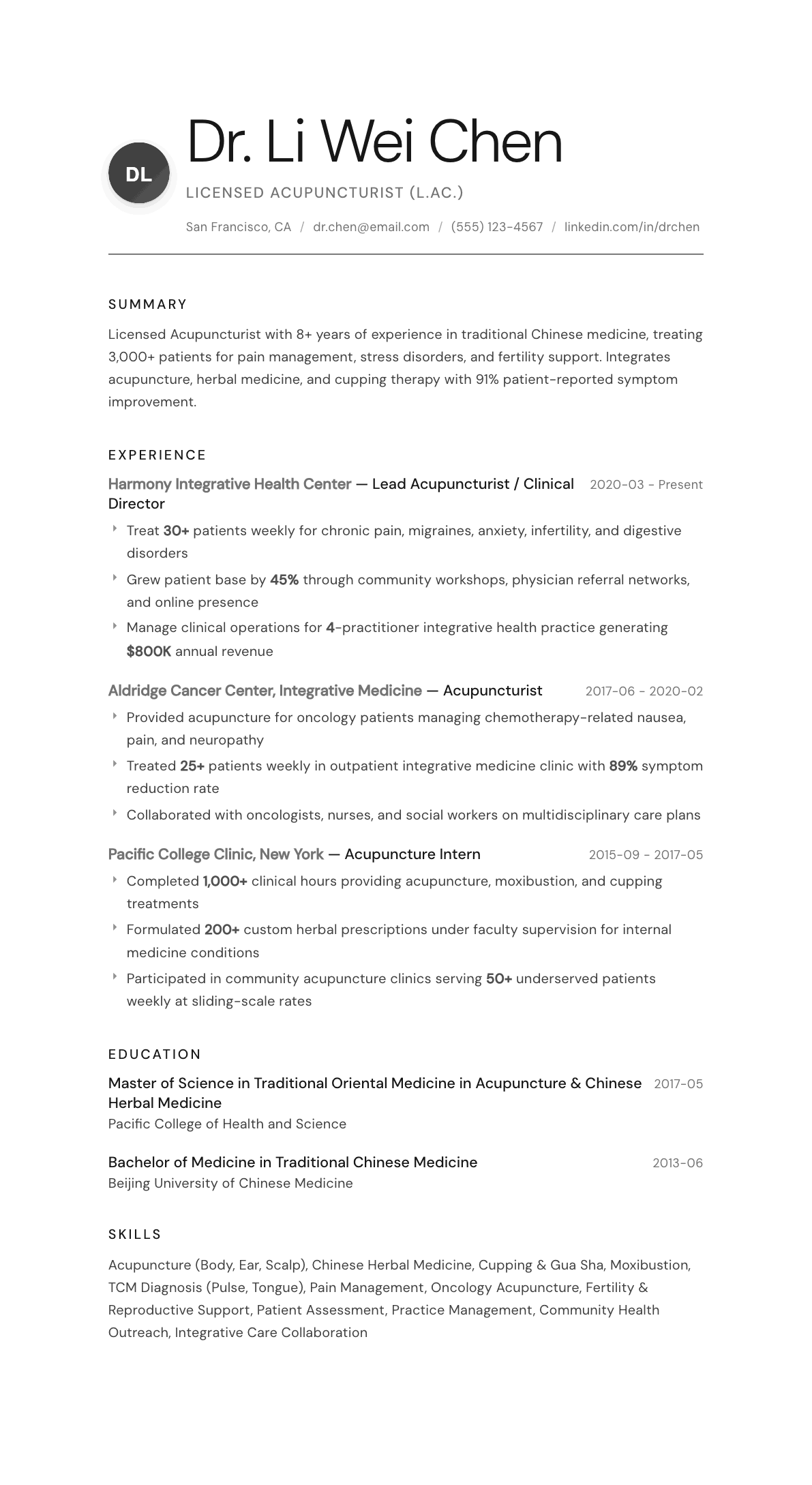
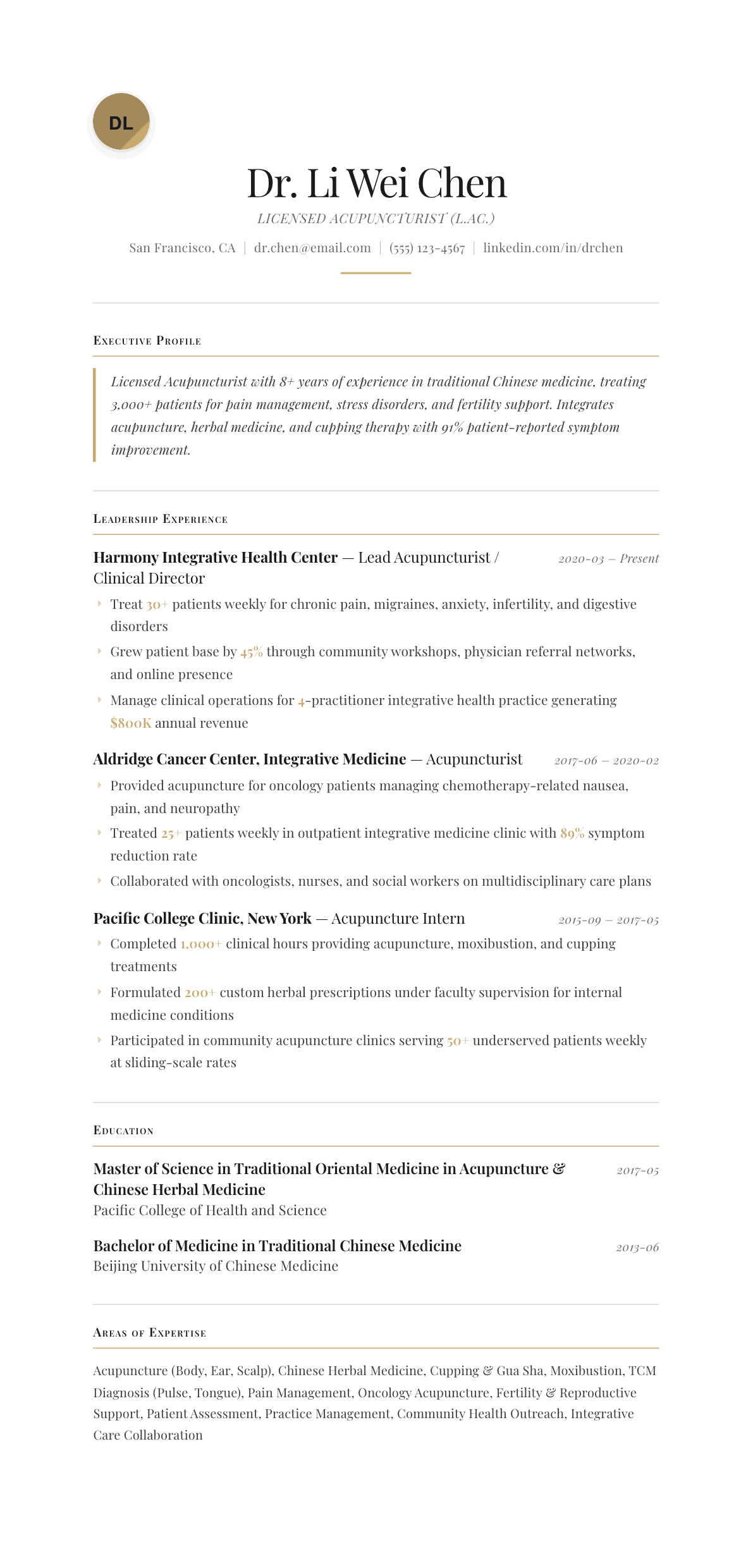
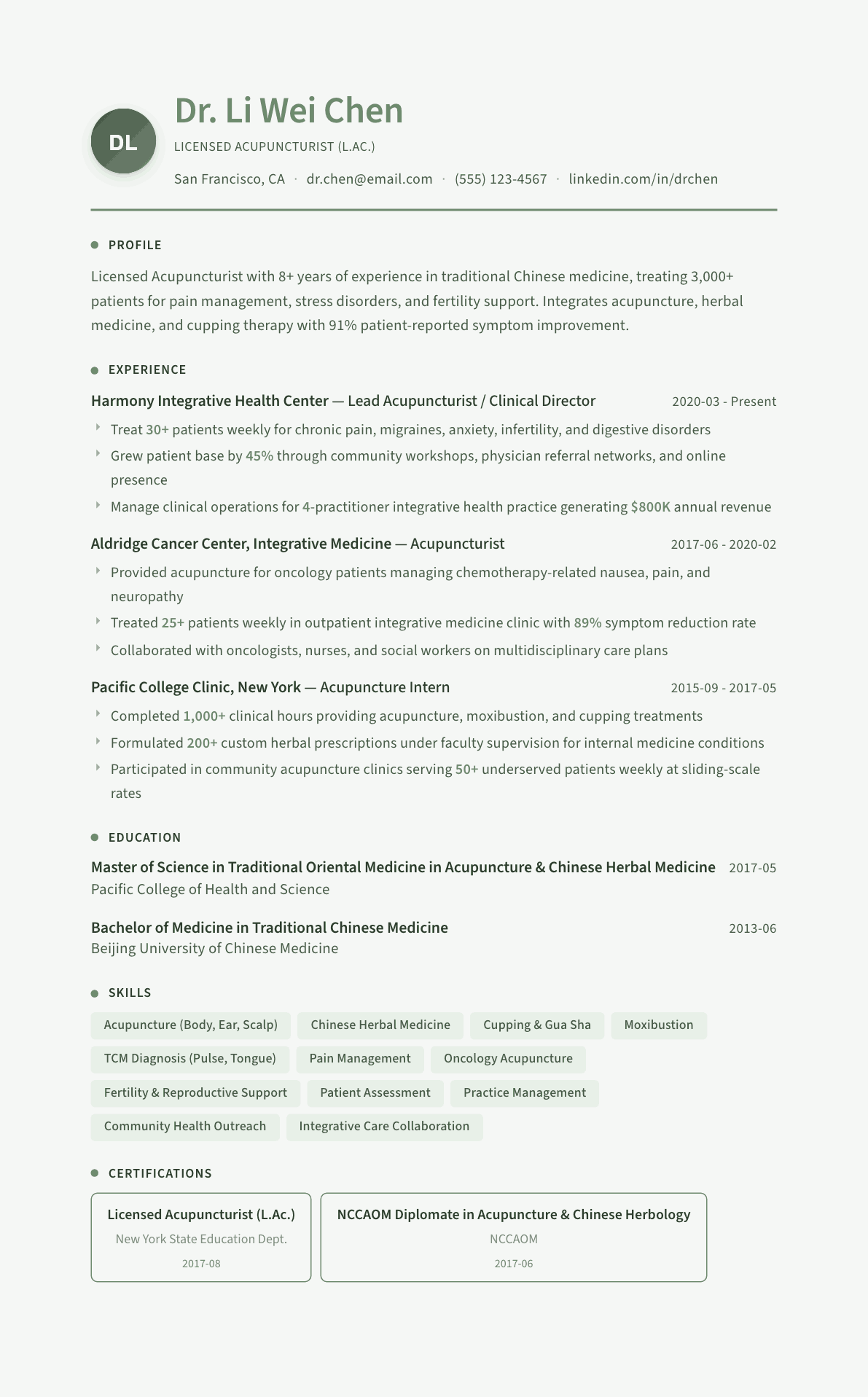
Example Acupuncturist summary
Licensed Acupuncturist with 8 years of experience treating 3,000+ patients across pain management, oncology support, and fertility. NCCAOM Diplomate achieving 91% patient symptom improvement through acupuncture, herbal medicine, and cupping.
Skills to list on a Acupuncturist resume
- Acupuncture (Body, Auricular, Scalp)
- Chinese Herbal Medicine
- Cupping & Gua Sha
- Moxibustion
- Electroacupuncture
- TCM Diagnosis
- Pain Management
- Oncology Support
- Fertility & Reproductive Health
- Patient Assessment
- Practice Management
- Integrative Medicine Collaboration
What actually gets this resume read
- Include your L.Ac. licensure and NCCAOM diplomate status prominently. Both are essential credentials.
- Specify your treatment specializations: pain, fertility, oncology, mental health, digestive, etc.
- Quantify patient volume and symptom improvement rates to demonstrate clinical effectiveness.
- Highlight additional modalities: herbal medicine, cupping, gua sha, moxibustion, electroacupuncture.
- If in an integrative setting, emphasize collaboration with MDs, nurses, and other practitioners.
How to write a acupuncturist resume
An acupuncturist resume has an unusual job: it has to satisfy a licensing check, a clinical credibility check and, very often, a business check at the same time. The person reading may be an integrative clinic director, a hospital department that has added acupuncture to a pain or oncology service, a group practice owner, or a chiropractor bringing acupuncture in house. Each of them starts at the same place, which is your license and your diplomate status.
After credentials they read for two things. First, the patient population you can treat competently from day one, because a practice built on fertility patients and one built on workers compensation musculoskeletal cases need different practitioners. Second, whether you can fill your own schedule, since in most private and group settings your compensation is tied to the panel you build.
This guide covers the section order this profession expects, how to describe treatment approach without overclaiming outcomes, three summaries by career stage, before and after bullets, and the questions acupuncturists ask when the resume has to work for both a hospital and a private clinic.
Format: credentials in the header, license section directly under the summary
Reverse chronological, one page for under eight years. Put your credentials after your name exactly as your state uses them, for example L.Ac. and Dipl. Ac. followed by your degree. A clinic director who cannot find the license in the first three seconds assumes it is a problem.
Follow the summary with a licensure and certification block: the state license type and number status, the NCCAOM diplomate designations you hold, clean needle technique training, and CPR certification. State whether you carry your own malpractice coverage, since group practices ask early.
- Header: name with L.Ac. and diplomate designations, city and state, phone, email.
- Order: summary, licensure and certifications, clinical experience, education, techniques and modalities.
- New graduates add a clinical training section with the teaching clinic, supervised hours and patient encounters.
Summary: population, setting, and modality range
Three lines. Name your license and diplomate status, the years, the settings you have practiced in, and the two or three patient populations you are strongest with. Pain and musculoskeletal, fertility and reproductive health, oncology supportive care, mental health and sleep, digestive conditions, and post surgical recovery are the categories clinics actually recruit against.
If you practice Chinese herbal medicine at diplomate level, put it here. A practitioner who can prescribe herbs is a different economic proposition to a clinic than one who needles only, and it is a separate NCCAOM credential that hiring managers look for by name.
Experience: setting, volume, and what you treat
For each position give the setting and the model: solo private practice, multidisciplinary clinic, community acupuncture on a sliding scale, hospital integrative service, or a sports medicine or rehabilitation group. Then the volume in patient visits per week, and the conditions that filled the schedule. Twenty five to thirty visits a week in a community clinic with distal needling on recliners is a very different practice from twelve individual hour long sessions.
Describe your diagnostic approach concretely. Traditional Chinese medicine pattern differentiation, tongue and pulse assessment, channel palpation, orthopedic testing where you use it, and the intake and reassessment tools you use to track change over a course of treatment. Naming a validated outcome measure you record, such as a numeric pain rating or a functional index, signals a practitioner who documents rather than one who only treats.
List the modalities you actually use in clinic and the ones you are trained in, kept separate: body, auricular and scalp acupuncture, electroacupuncture, moxibustion, cupping, gua sha, tui na, dry needling where your license permits it, herbal formulas, and dietary and lifestyle counseling.
Where you have worked alongside physicians, nurses or physical therapists, say what the collaboration actually looked like: referral pathways, shared charting in the electronic health record, case conferences, or a protocol you followed inside a pain program. Integrative employers screen for practitioners who can work inside a medical team and chart in a way the rest of that team can read.
Outcomes: report what you documented, not what you believe
Be careful here, because overclaiming is the fastest way to lose a serious clinical reader. Report retention and adherence figures you can support from your own records: return visit rate, average number of visits per course of care, percentage of patients completing a recommended course, and change on a documented outcome measure across a defined series.
Do not make disease treatment claims. Describing acupuncture as supportive care within a stated condition, alongside the patient's medical treatment, is both accurate and how a hospital integrative service expects a practitioner to write. It also protects you in states where advertising language is regulated.
The business half of the resume
Most acupuncture jobs involve building a panel. Say how you have done it: referral relationships with physicians and physical therapists, community talks, existing patient base if you can bring one, and retention practices. A clinic owner reading your resume is calculating whether you fill your own rooms.
If you have run a practice, include the operational side without turning the resume into a business plan: scheduling and practice management software, insurance verification and billing for the plans that cover acupuncture, superbills for out of network patients, herbal dispensary management, and supervision of front desk staff. These lines are the reason many practitioners get hired over equally skilled peers.
Acupuncturist resume summary examples
New graduate
Licensed acupuncturist and NCCAOM diplomate in acupuncture, newly licensed after a master's program with 900 supervised clinical hours and roughly 350 patient treatments in a teaching clinic. Trained in body, auricular and scalp needling, electroacupuncture, cupping and moxibustion. Seeking a multidisciplinary clinic position.
Six years in
Licensed acupuncturist with six years in a multidisciplinary pain and rehabilitation clinic, treating 28 patient visits a week with a focus on musculoskeletal pain, headache and post surgical recovery. Diplomate in Oriental medicine, prescribing herbal formulas and documenting outcomes with numeric pain and function measures.
Practice owner or lead practitioner
Licensed acupuncturist with 14 years in practice, the last seven owning a three practitioner clinic focused on fertility and reproductive health. Diplomate in Oriental medicine, manage the herbal dispensary, supervise two associate practitioners, and maintain referral relationships with four reproductive endocrinology practices.
Work experience bullets: before and after
Before: Treated patients with acupuncture.
After: Treated 28 patient visits a week in a multidisciplinary pain clinic, working primarily with chronic low back pain, cervical pain, headache and post surgical recovery referrals.
Weekly volume plus the actual conditions tell a clinic director whether your panel matches theirs.
Before: Used various treatment techniques.
After: Combined distal and local needling with electroacupuncture at low frequency for chronic pain, adding cupping and gua sha for myofascial restriction and moxibustion for cold pattern presentations.
Naming when and why each modality is used shows clinical reasoning rather than a menu of services.
Before: Kept good patient records.
After: Documented every visit in the clinic electronic health record with pattern differentiation, point prescription and a numeric pain rating, and reassessed formally at the fourth and eighth visits.
A stated reassessment schedule and a documented measure prove you track outcomes instead of asserting them.
Before: Worked with doctors and physical therapists.
After: Built referral pathways with three physical therapy practices and a sports medicine physician, charted in the shared record and joined monthly case conferences on complex pain patients.
Referral pathways and shared charting are what integrative employers mean by collaboration, and both are checkable.
Before: Grew my practice.
After: Built a solo practice from an empty schedule to 22 weekly visits over two years through physician referrals, monthly community talks and a return visit rate above 70%.
The starting point, the specific channels and the retention figure show a practitioner who can fill their own rooms.
Hard skills
- Traditional Chinese medicine pattern differentiation
- Tongue and pulse diagnosis
- Body, auricular and scalp acupuncture
- Electroacupuncture
- Moxibustion
- Cupping and gua sha
- Tui na
- Chinese herbal formula prescribing
- Clean needle technique
- Musculoskeletal and orthopedic assessment
- Outcome measure documentation
- Electronic health record charting
- Insurance verification and superbills
- Herbal dispensary management
Soft skills
- Patient education on a course of care
- Building referral relationships
- Working inside a medical team
- Cultural sensitivity in intake
- Boundaries with chronic pain patients
Certifications worth listing
- Diplomate of Acupuncture (Dipl. Ac.) (NCCAOM)
- Diplomate of Oriental Medicine (Dipl. O.M.) (NCCAOM)
- Diplomate of Chinese Herbology (Dipl. C.H.) (NCCAOM)
- Clean Needle Technique Certification (Council of Colleges of Acupuncture and Herbal Medicine)
- Basic Life Support (BLS) (American Heart Association)
Mistakes that cost acupuncturist candidates the interview
- Leaving the state license and NCCAOM diplomate status out of the top third of the page.
- Claiming that acupuncture treats or cures named diseases, which a clinical reader will reject and some states restrict.
- Listing every modality you were exposed to in school without separating what you use weekly in clinic.
- Omitting weekly patient volume, which is the number a clinic owner uses to judge whether you can carry a schedule.
- Saying nothing about referrals or panel building when most positions expect you to fill your own hours.
- Ignoring the administrative side: insurance verification, charting and dispensary work are real hiring criteria.
Acupuncturist resume questions
Where do I put my L.Ac. and NCCAOM credentials?
After your name in the header, then again in a licensure block directly under the summary with the state, the license status and each diplomate designation. Clinic directors check licensure first, and making them search for it slows your file down.
Should a new acupuncture graduate list clinical training hours?
Yes. Give the teaching clinic, the total supervised hours, the approximate number of patient treatments and the populations you saw. Keep this section for your first two or three years, then let paid practice experience replace it once you have a real caseload.
How do I write about treatment outcomes safely?
Report what your records support: return visit rates, course completion, and change on a documented measure such as a numeric pain rating. Frame acupuncture as supportive care alongside a patient's medical treatment rather than as treatment for a named disease.
Does herbal medicine certification matter to employers?
It matters a great deal in clinics that run a dispensary, and less in sports medicine or hospital settings that are needling only. The Chinese herbology and Oriental medicine diplomates are separate credentials, so name whichever you hold rather than implying both.
How do I write this resume for a hospital integrative program?
Lead with team based work: shared electronic charting, referral pathways, protocol adherence and documented outcome measures. Hospital programs screen for practitioners who communicate in medical language and work inside an existing care plan rather than around it.