Documentary Filmmaker Resume Examples: read this first
Create a Documentary Filmmaker Resume That Tells Your Story
By Mustafa Tarabya, founder of CVBooster · Published · Updated
Build a compelling documentary filmmaker resume showcasing festival selections, storytelling expertise, and production management for production companies and distributors.
Sample resumes for a documentary filmmaker
The same documentary filmmaker content laid out in three CVBooster templates, so you can see what the finished document looks like before you write a word.
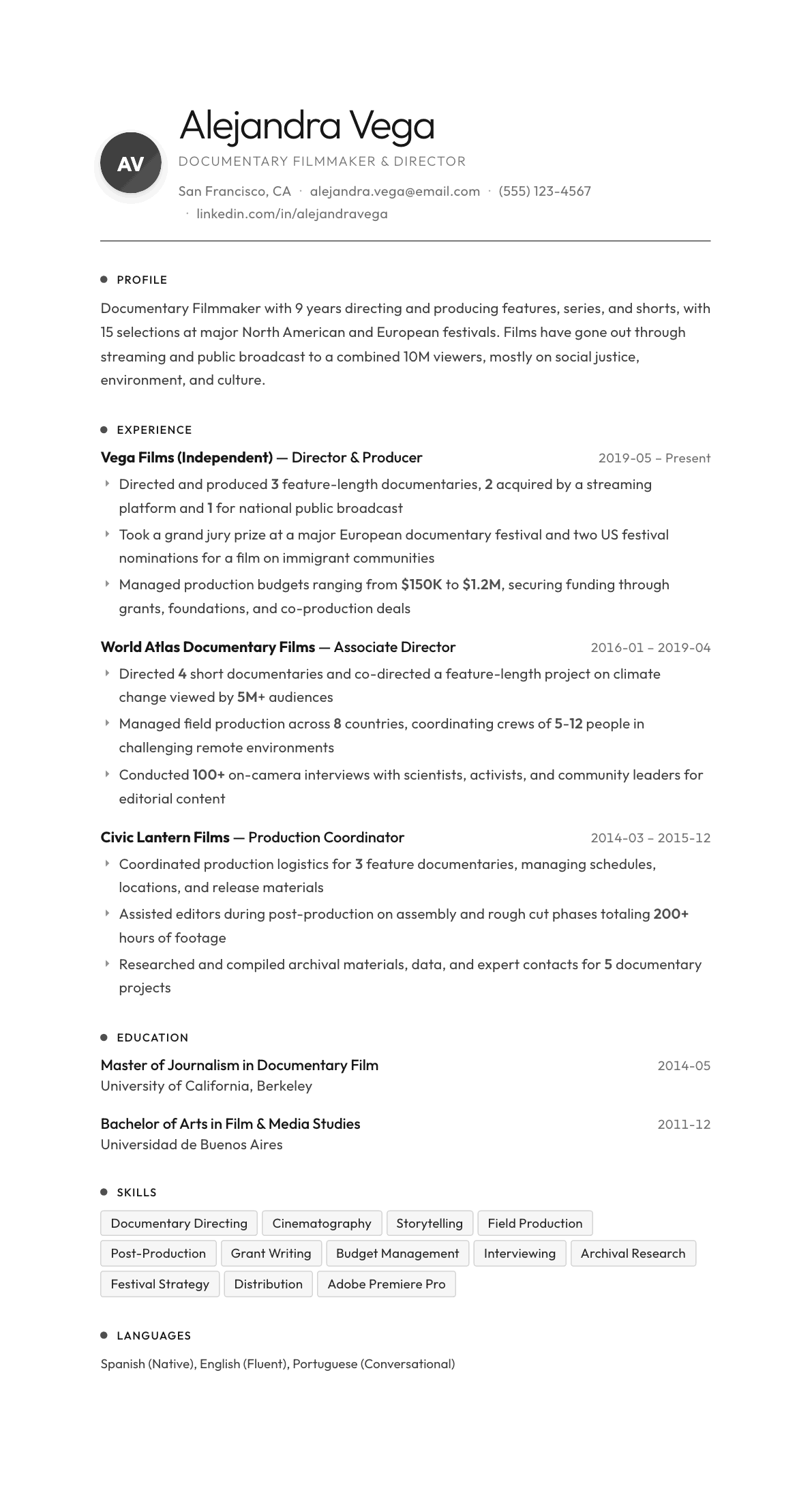
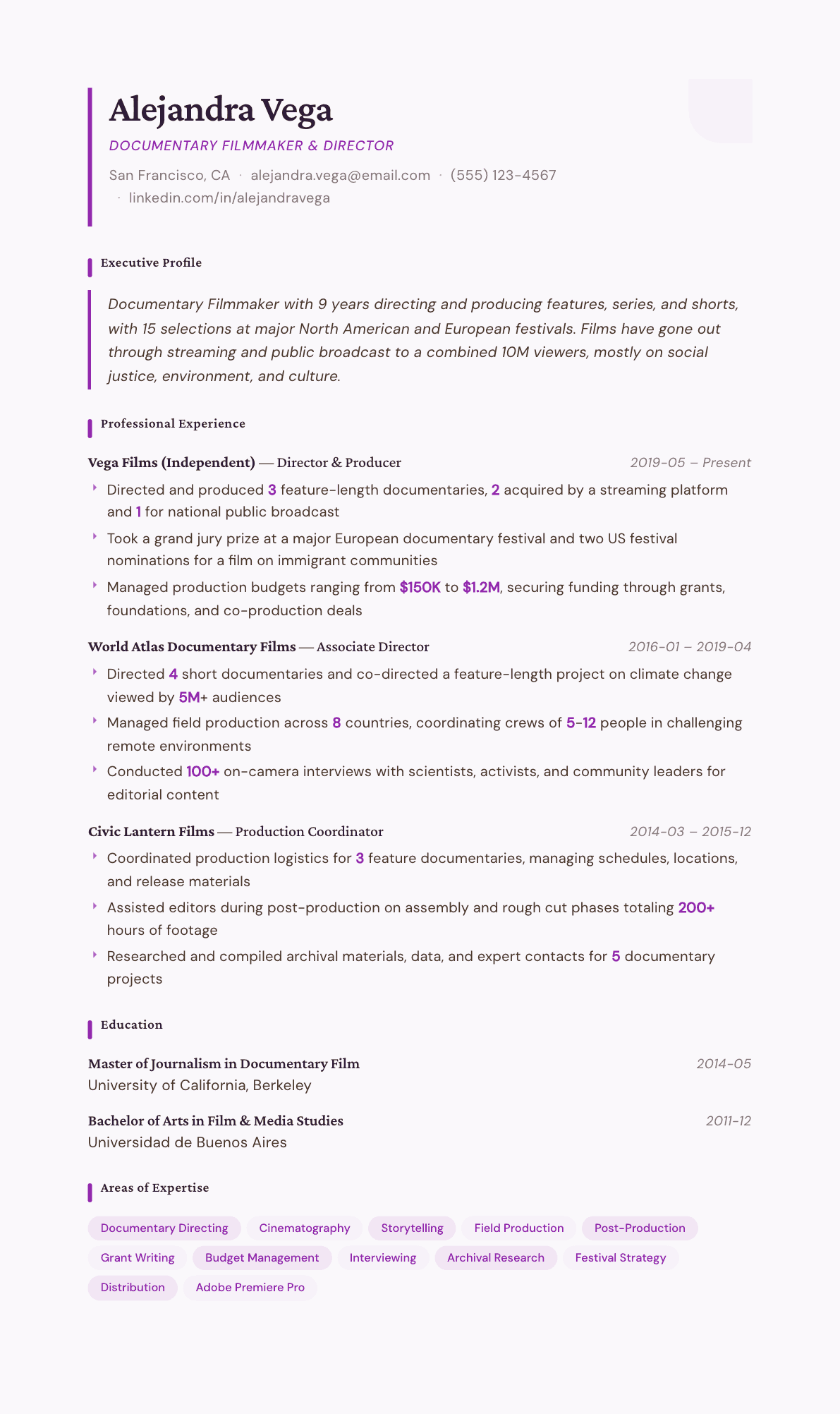
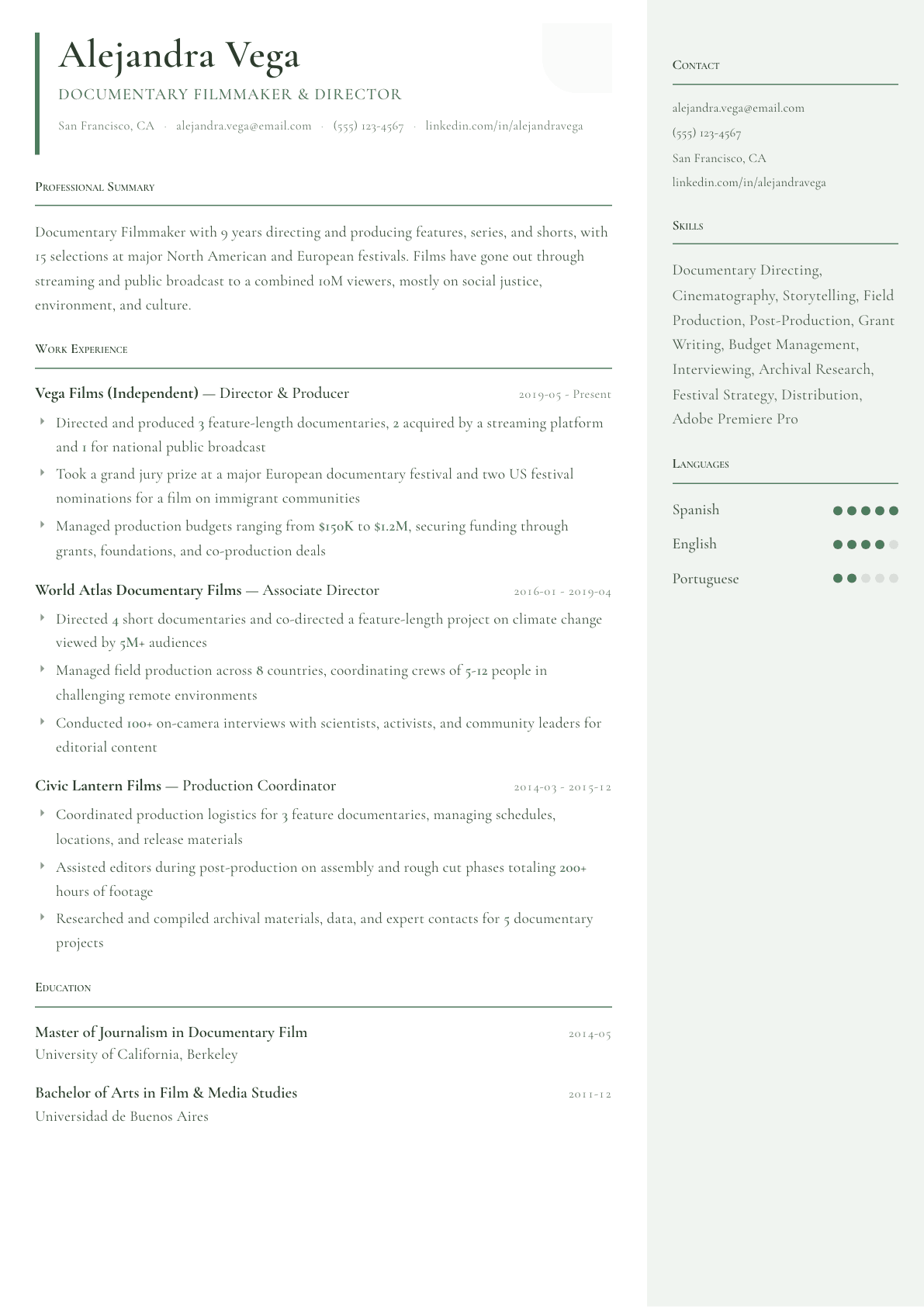
Example Documentary Filmmaker summary
Documentary Filmmaker, 9 years directing features, series, and shorts, with 15 festival selections and a grand jury prize. Work has gone out through streaming and public broadcast to 10M viewers. Raises the money as well as directs: budgets from $150K to $1.2M through grants, foundations, and co-productions.
Skills to list on a Documentary Filmmaker resume
- Documentary Directing
- Cinematography
- Narrative Storytelling
- Field Production
- Post-Production
- Grant Writing & Fundraising
- Budget Management
- Interviewing
- Archival Research
- Festival Strategy
- Distribution & Sales
- Adobe Creative Suite
What actually gets this resume read
- Lead with festival selections, awards, and distribution deals. These are the currency of documentary filmmaking.
- Highlight the subjects and themes you specialize in: social justice, environment, culture, or science.
- Include funding and budget management skills: grants, foundations, co-productions, and crowdfunding.
- Showcase technical abilities across directing, cinematography, and post-production.
- Link to your films, trailers, or Vimeo portfolio for immediate viewing.
How to write a documentary filmmaker resume
Documentary filmmakers write resumes for readers who almost never hire the way other industries do. A commissioning editor, a grant panel, a festival programmer and a production company all read the same page for different things: the films you have finished, where they played, what you can do with your own hands, and whether you can be trusted with access to somebody's real life.
Two things decide most of it. The first is a finished film, because the field is full of people with a compelling subject and no completed cut. The second is festival and distribution history, which is the only external validation documentary has. Everything else on the page supports those, including the crew roles you take on other people projects to pay for your own.
This guide covers how to structure a page that works for both a hiring producer and a funder, how to write the film credits section, how to present funding and ethics work that most filmmakers leave out, three summaries from first film through experienced director, before and after bullets, and the questions documentary filmmakers ask when they update their materials.
Format: films first, crew work second, one or two pages
Lead with your own films. Give each one the title, the running time and format, your role or roles, the year, and where it played or how it was distributed. Then a separate section for crew work you have done on other productions, since a hiring producer looking for a shooting director reads that section and a grant panel reads the first one.
Keep it to two pages at most, with the strongest and most recent films at the top. Under your name put your city, whether you travel and shoot internationally, your email, and a link to a site with your films or trailers. Documentary readers will follow that link, so make sure it opens to work and not to a landing page.
- Header: name, the role you are presenting as, city, email, website with films and trailers, and languages you work in.
- Sections: summary, films with festival and distribution history, crew credits, funding and grants, skills and equipment, teaching or speaking, education.
- Say which roles you take on other people projects: director, producer, cinematographer, editor, field producer, associate producer.
Films: title, length, role, and where it went
The credit line does the work. A feature length film that premiered at a competitive festival and was acquired reads differently than a short that screened locally, and both deserve to be on the page stated accurately. Give the festival names and whether the screening was a premiere, a selection or an award, since programmers and funders read those distinctions closely.
For distribution, say what actually happened: a broadcast on a named public or commercial channel, a streaming acquisition, educational distribution, an impact campaign with community screenings, or a self distributed release. Educational and impact distribution are legitimate outcomes and many filmmakers under report them because they are not glamorous.
Where you wore several hats, say so directly. Directed, produced, shot and edited on a small crew film is a real and useful description, and it tells a hiring producer exactly what you can do alone in a room or a field.
Craft: what you can actually do on the day
Producers hire documentary people for hands. Say what you shoot on and how you work: camera bodies and lens sets you own or are fluent with, whether you can operate handheld verite for long takes, how you run sound as a one person crew or with a mixer, interview lighting, and whether you can direct an interview yourself while operating.
Post skills matter as much. Editing software, how you handle assembly from a large unstructured rush volume, transcription and paper edit workflows, story structuring across a long timeline, archival research and rights clearance, and grading and mix supervision. Documentary editing is a writing job, and saying you can find a structure in two hundred hours of material is a genuine differentiator.
Add the field logistics that keep a shoot alive: media management and backup discipline, working with fixers and translators, filming permits, travel to difficult locations, and long term shooting relationships maintained over years. Access is the hardest resource in this work.
Funding, ethics and access
Funding is part of the craft in documentary and belongs on the resume. Name the grants and funds you have received, the labs and fellowships you have been selected for, whether you have run a crowdfunding campaign, and any co production or commissioning relationship. Do not list dollar figures. Name the funder and the stage, since panels and producers recognize those names immediately.
Ethics and participant care are increasingly what commissioners ask about. Say how you work with contributors: informed consent practice, how you handle sensitive or traumatic material, whether you show cuts back to participants, safety planning for people who may face consequences after release, and any trauma informed training you have taken. Filmmakers rarely put this on a resume and it stands out to any experienced commissioning editor.
Keywords, and writing for two readers at once
Production companies and broadcasters search for documentary director, field producer, shooting producer, self shooting director, story producer, documentary editor, archival producer, and the subject areas you specialize in. Grant panels read differently, looking for the subject, the access, the stage of the project and your track record of finishing.
The practical answer is one resume built on finished work and craft, plus a separate short filmmaker biography and a project one sheet for funding applications. Keep the resume factual and let the funding materials carry the story of the film you are trying to make.
Documentary Filmmaker resume summary examples
First films
Documentary filmmaker with two completed shorts, one selected for a regional festival, both directed, shot and cut alone. Works as an assistant editor and camera assistant on longer productions, and has been developing a feature on a local housing story for 2 years.
Working director
Documentary director and cinematographer with 8 years and one feature that premiered at a competitive festival before an educational release. Self shoots long form verite, works internationally with fixers and translators, and takes field producing and camera work on other productions between films.
Experienced director and producer
Documentary director and producer with 15 years, 3 features and a 4 part series broadcast on a public network. Has raised production budgets through grants, a co production and a broadcaster commission, and mentors emerging filmmakers through a regional documentary lab.
Work experience bullets: before and after
Before: Directed a documentary film about an important social issue.
After: Directed and shot a feature documentary following three families through a housing eviction process over 26 months, premiering in competition at a documentary festival and released for educational distribution.
The structure, the shooting period and the release path tell a reader what the film is and that it was actually finished.
Before: Worked as a camera operator on documentary shoots.
After: Shot handheld verite as a one person crew on location, running my own sound with a shotgun and lavalier setup and lighting interviews with a small portable kit in homes and workplaces.
Naming the shooting style and the sound and lighting responsibility tells a producer exactly what you can cover alone.
Before: Raised money for the film.
After: Funded production through two named documentary grants, a development fellowship and a crowdfunding campaign, then closed post production with a broadcaster license.
Naming the stages of the funding stack shows a producer who can assemble a real budget rather than hope for one.
Before: Edited hundreds of hours of footage.
After: Structured a feature cut from more than 200 hours of rushes, working from transcripts and a paper edit through five assemblies with a story consultant before locking.
The method and the number of passes show documentary editing as the writing process it actually is.
Before: Built trust with the people in the film.
After: Filmed with participants over three years with written consent at each stage, screened a rough cut back to each family before lock and adjusted two sequences after their concerns about identifying details.
A concrete consent and review practice demonstrates ethics that a commissioning editor can rely on rather than assert.
Hard skills
- Documentary directing
- Verite and observational shooting
- Interview direction
- Location sound recording
- Documentary editing and story structure
- Archival research and rights clearance
- Grant writing and funding applications
- Field producing and logistics
- Media management and backup workflow
- Working with fixers and translators
- Impact and community screening campaigns
- Post supervision through grade and mix
Soft skills
- Earning access and keeping it
- Patience across long shooting periods
- Listening in an interview
- Judgment about what not to film
- Persistence through funding rejection
Mistakes that cost documentary filmmaker candidates the interview
- Filling the page with projects in development while no finished film appears anywhere on it.
- Listing festivals without saying whether the film was a premiere, a selection or an award winner.
- Omitting educational, community and impact distribution, which are real outcomes that funders value.
- Hiding which roles you personally held on a film, so a producer cannot tell if you can shoot or cut.
- Leaving out funding history, when a documentary filmmaker who can raise money is far easier to back.
- Never mentioning consent and participant care, the first thing many commissioning editors now ask about.
Documentary Filmmaker resume questions
Should a documentary filmmaker have a resume or a biography?
Both, for different readers. A factual resume with films, credits and craft skills goes to production companies and broadcasters. A short biography and a project one sheet go to grant panels and festivals, where the story of the film and your relationship to it matters as much as the credit list.
How do I list a film that is still in production?
Put it under a section for work in progress with the working title, the format, the stage such as production or rough cut, and any funding or lab selection it has received. Keep completed films clearly separate so nobody mistakes an unfinished project for a delivered one.
What goes on the resume of a documentary filmmaker with no festival credits?
Finished work of any length, the crew roles you have held on other productions, the craft skills you can be hired for, and any commissioned or client documentary work. A completed short with no festival run still proves more than a feature that has been in development for years.
Do I list crew work on other people films?
Yes, in its own section. Camera, sound, editing, field producing and archival work show the hands a production company can hire tomorrow, and that work is often what pays while your own film is being made. Give the production, the director and your role.
How much should I say about the subjects of my films?
Enough for a reader to understand the story and the access you had, and no more. Avoid identifying details about participants that are not already public, especially where people face legal, immigration or safety consequences, since discretion on a resume is itself evidence of how you work.