Bank Teller Resume Examples: free ATS score and gap list
Write a Bank Teller Resume That Proves Accuracy and Trust
By Mustafa Tarabya, founder of CVBooster · Published · Updated
Bank teller resume examples with cash handling bullets, referral keywords and a guide to showing balancing accuracy and fraud awareness to branch managers.
Sample resumes for a bank teller
The same bank teller content laid out in three CVBooster templates, so you can see what the finished document looks like before you write a word.
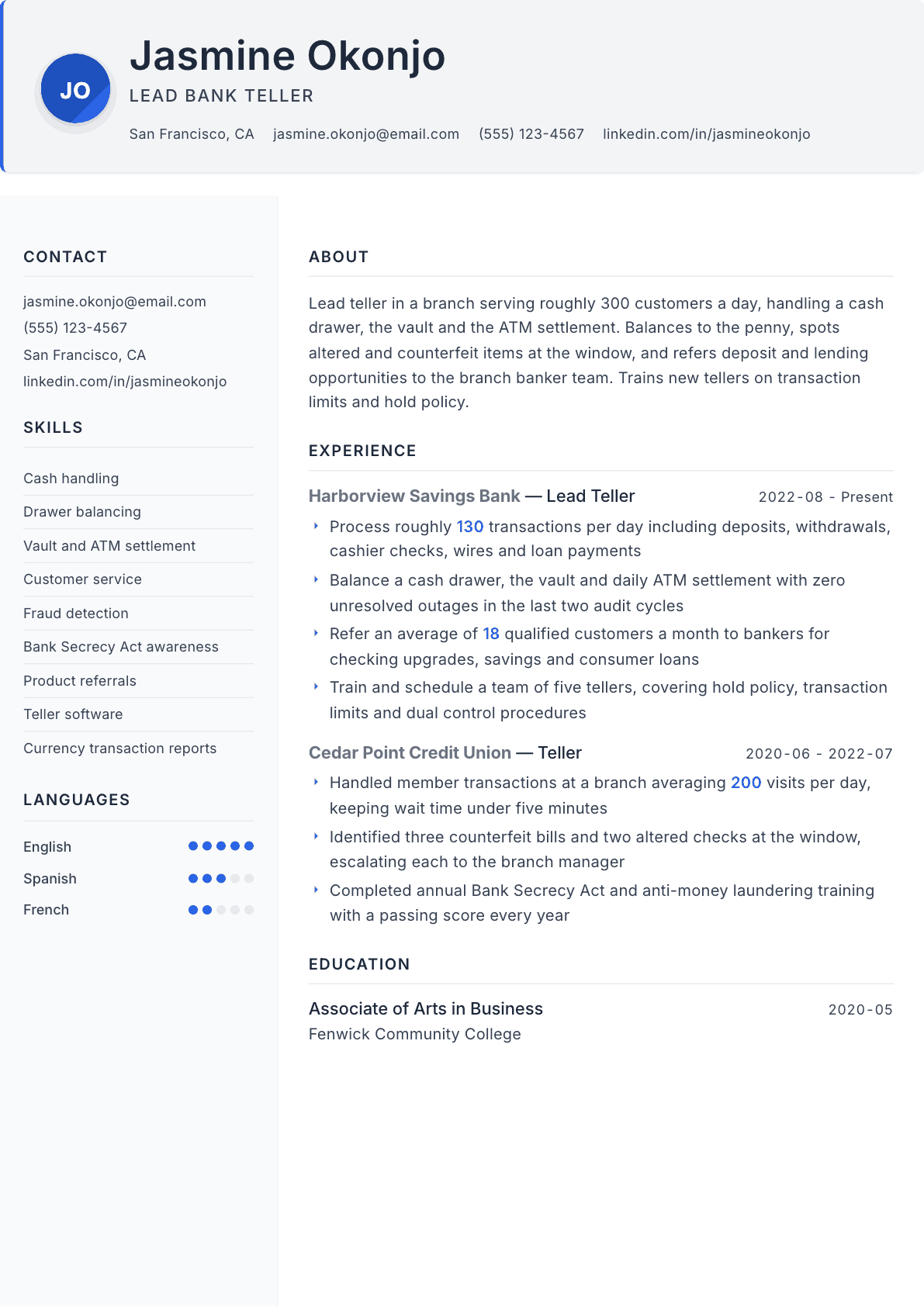
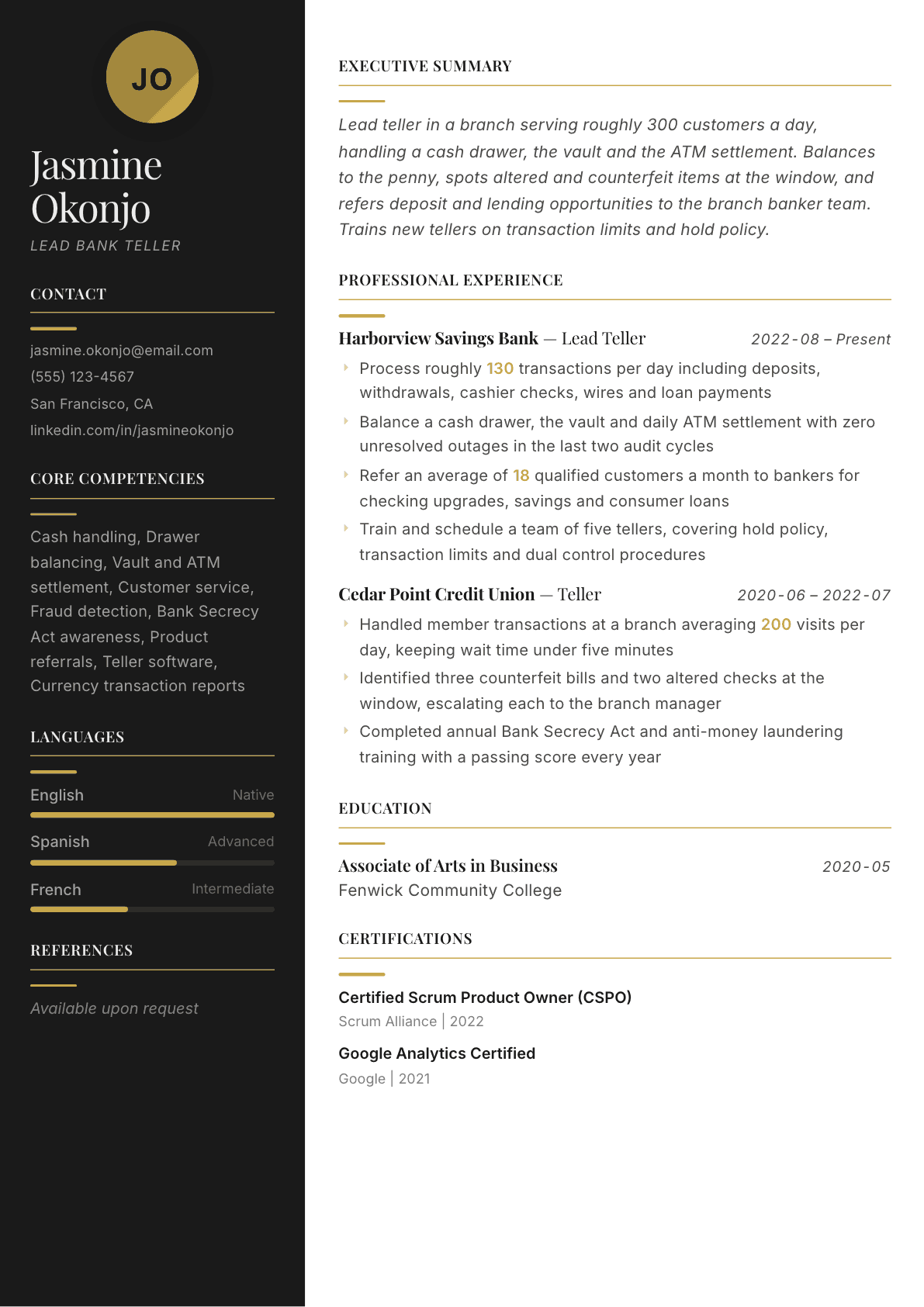
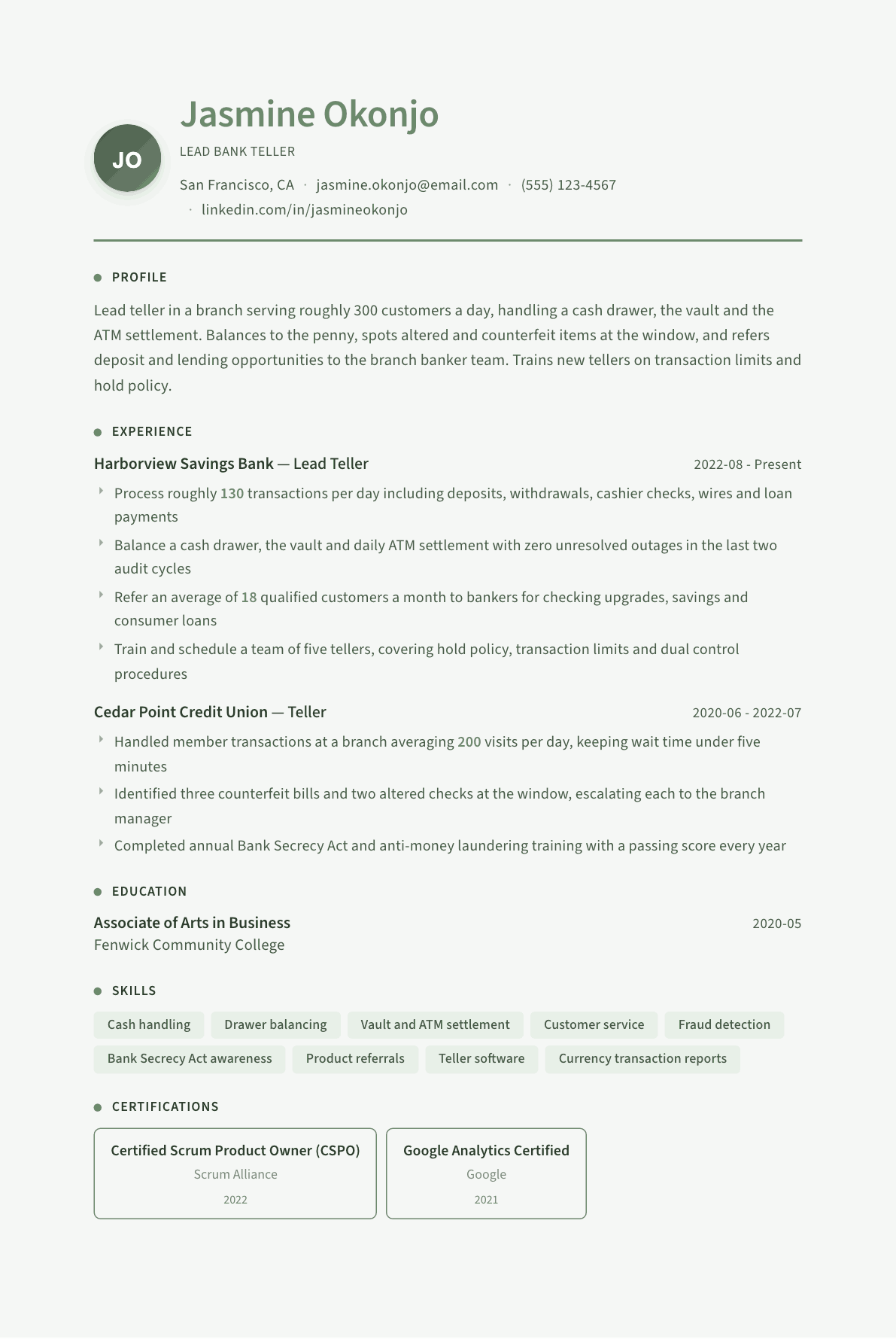
Example Bank Teller summary
Lead teller processing roughly 130 transactions a day in a branch that serves 300 customers, with responsibility for the vault and daily ATM settlement. Balanced with zero unresolved outages across the last two audit cycles and refers about 18 qualified customers a month to the banker team. Trains five tellers on hold policy and dual control. Ready for a personal banker or head teller role.
Skills to list on a Bank Teller resume
- Cash handling
- Drawer balancing
- Vault management
- ATM settlement
- Customer service
- Fraud detection
- Counterfeit identification
- Bank Secrecy Act
- Currency transaction reports
- Check holds
- Product referrals
- Teller platform software
- Cash recycler operation
- Dual control procedures
What actually gets this resume read
- Lead with transaction volume and balancing accuracy, because a branch manager screens for cash discipline first.
- Say what you were trusted with beyond the drawer: the vault, the ATM settlement, night deposit or dual control.
- Quantify referrals per month, since most banks now measure tellers on the accounts they send to bankers.
- Name the fraud items you caught, such as counterfeit currency, altered checks or an attempted account takeover.
- Show regulatory awareness by naming Bank Secrecy Act training and currency transaction report thresholds.
- Include the core banking or teller platform you used, and note any cash recycler experience the branch had.
How to write a bank teller resume
A bank teller resume is a trust document. The branch manager reading it is deciding whether to hand a stranger a cash drawer, and the two things that answer that question are balancing accuracy and how you have handled money before. Everything else on the page is supporting evidence.
The role has also changed. Branches now measure tellers on referrals as well as transactions, so the resume that gets a call shows both sides: the discipline to balance to the penny and the awareness to notice that a customer with a large idle balance should be talking to a banker.
This guide covers what to put first when you have little formal experience, how to quantify transaction volume and accuracy, how to show fraud awareness and regulatory training, and how to position a teller resume as the first step toward a banker seat.
Format: one page, accuracy and volume near the top
One page, reverse chronological, clean and conservative. Banks are traditional employers and a plain layout reads as appropriate rather than unimaginative.
If your work history is short, put a skills summary directly under the contact details covering cash handling, customer service and any point-of-sale or cash register experience. Retail and hospitality cash work is genuinely relevant and should not be buried.
- Order: summary, experience, education, skills, certifications and training.
- Under each employer: daily transaction volume, branch traffic and what you were trusted with.
- Include any bilingual ability, since branches value it in customer facing seats.
Summary: volume, accuracy, responsibility
Three short sentences. How many transactions you handle, how accurately you balance, and what beyond the drawer you are trusted with. A summary saying reliable team player with excellent customer service skills is invisible next to one that names a daily transaction count and a clean audit record.
If you are applying without banking experience, use the summary to translate. Cash handling in a busy retail environment, a register that balanced every shift, and experience de-escalating unhappy customers are all directly relevant and worth naming plainly.
Experience: cash, balancing, referrals, escalation
Cover four themes in every role. Transaction volume and type. Balancing accuracy, including the vault and the automated teller machine settlement if you handled them. Referrals to bankers or lending partners. Escalation, including any fraud or suspicious activity you caught.
Balancing is the bullet that decides the interview. A teller who can state that the drawer, vault and daily settlement balanced with no unresolved outages across a defined period has answered the manager's central concern with a checkable fact.
Referrals should be counted monthly. Most banks track this number formally, so giving it shows you understand how your performance was actually measured rather than only how it felt.
- Name the transaction types: deposits, withdrawals, official checks, wires, loan payments.
- Say whether you handled the vault, the night deposit, the coin machine or a cash recycler.
- Mention lead teller duties such as scheduling, overrides and training.
Fraud, compliance and the training banks expect
Banks are examined on their anti-money laundering program, so a teller who understands the reporting thresholds is valuable. Name the annual training you completed, the currency transaction reporting threshold work you handled, and any suspicious activity you escalated.
Fraud detection at the window is a concrete skill. Identifying counterfeit currency, spotting an altered or washed check, recognizing an elder financial exploitation pattern, or catching an attempted account takeover are all incidents worth naming, with the escalation you followed.
Also mention hold policy and funds availability. Applying holds correctly protects the bank against loss and is a routine source of new teller errors.
Positioning for the next step
If your goal is a personal banker or head teller seat, the resume should already show that direction. Referral counts, product knowledge, training others and any partial ownership of branch operations are the signals a manager promotes on.
Coursework, an associate degree in business, or a bank sponsored certification all help here, particularly for candidates who want to move toward lending or branch management rather than staying at the window.
Bank Teller resume summary examples
First banking role
Customer service professional with two years of high volume cash handling in retail, balancing a register every shift with no shortages. Comfortable with identification verification, refund policy and de-escalating frustrated customers. Seeking a bank teller position with a path toward consumer banking.
Two years at the window
Bank teller processing member transactions at a branch averaging 200 visits a day, keeping wait time under five minutes. Identified three counterfeit bills and two altered checks at the window and escalated each to the branch manager. Completed anti-money laundering training annually with a passing score.
Lead teller
Lead teller processing roughly 130 transactions a day with responsibility for the vault and daily automated teller machine settlement, balanced with no unresolved outages across two audit cycles. Refers about 18 qualified customers a month to bankers and trains a team of five on hold policy and dual control.
Work experience bullets: before and after
Before: Handled cash transactions for customers.
After: Process roughly 130 transactions a day including deposits, withdrawals, official checks, outgoing wires and loan payments at a branch serving 300 customers.
Volume and transaction type let a branch manager judge whether you can handle their window pace.
Before: Balanced my drawer each day.
After: Balance the cash drawer, the vault and the daily automated teller machine settlement with no unresolved outages across the last two audit cycles.
Adding the vault and settlement plus an audit period turns a basic duty into a record of trust.
Before: Referred customers to bankers when appropriate.
After: Refer an average of 18 qualified customers a month to bankers for checking upgrades, savings products and consumer loans based on account activity noticed at the window.
The count and the trigger show you understand the referral metric the branch is actually scored on.
Before: Followed bank security procedures.
After: Identified three counterfeit bills and two altered checks at the window and escalated each through the branch manager and the fraud reporting process.
Named incidents prove vigilance in a way that a statement about following procedure never can.
Before: Helped train new employees.
After: Train and schedule a team of five tellers, covering hold policy, transaction limits, dual control procedures and the escalation path for suspicious activity.
Listing what you teach demonstrates the depth of your own knowledge and signals readiness to lead.
Hard skills
- Cash handling and drawer balancing
- Vault and night deposit management
- Automated teller machine settlement
- Counterfeit and altered item detection
- Currency transaction reporting thresholds
- Anti-money laundering awareness
- Funds availability and hold policy
- Teller platform and core banking software
- Cash recycler operation
- Wire and official check processing
- Product referral identification
- Dual control procedures
Soft skills
- Accuracy under a queue
- Friendly, unhurried customer manner
- De-escalation
- Discretion with account information
- Reliability and punctuality
- Noticing what a customer has not said
Certifications worth listing
- Certified Bank Teller (American Bankers Association)
- Bank Secrecy Act and Anti-Money Laundering Training (American Bankers Association)
- Certificate in Customer Service (American Bankers Association)
Mistakes that cost bank teller candidates the interview
- Leaving out transaction volume, so the manager cannot tell whether you have worked a busy window.
- Saying you are detail oriented instead of stating a balancing record that proves it.
- Omitting retail or restaurant cash experience, which is the most transferable evidence a new applicant has.
- Ignoring referrals completely, when most branches score tellers on them.
- Skipping the regulatory training, which every bank has to document for its examiners.
- Listing personal customer details or account information in an example, which raises an immediate confidentiality concern.
Bank Teller resume questions
Can I become a bank teller with no banking experience?
Yes, and most tellers start that way. Lead with cash handling from retail, grocery or restaurant work, a register that balanced consistently, and customer service under pressure. Banks train the product knowledge and hire for reliability with money.
What should I say about a cash shortage I was involved in?
Do not put it on the resume, but be ready to describe it honestly in the interview along with what you changed. Managers know outages happen, and a candidate who explains the cause and the correction reads as trustworthy rather than careless.
How do I show referral ability if my branch did not track it?
Describe the behavior instead of a number. Explain what you noticed at the window that prompted a conversation, such as a large idle balance or repeated overdraft fees, and how you handed the customer to the right colleague.
Does a degree help for a teller position?
It is not required for the role itself, but an associate or bachelor degree in business helps when you want to move into banking, lending or branch management. List it, and pair it with any bank sponsored training you have completed.
How long should I stay a teller before moving up?
It varies by branch and by openings, but a year of clean balancing plus a steady referral record is usually the point where managers consider a promotion. Build the resume toward that seat from your first month rather than starting later.
Related resume examples
- Banker Resume example
- Personal Banker Resume example
- Bank Customer Service Representative Resume example
- Accounting Clerk Resume example
- Claims Adjuster Resume example
- Anti-Money Laundering Analyst Resume example