Personal Injury Attorney Resume Examples: free ATS score
Write a Personal Injury Attorney Resume Around Case Value
By Mustafa Tarabya, founder of CVBooster · Published · Updated
Personal injury attorney resume examples with settlement, liens and trial keywords, plus a guide to writing caseload and result lines.
Sample resumes for a personal injury attorney
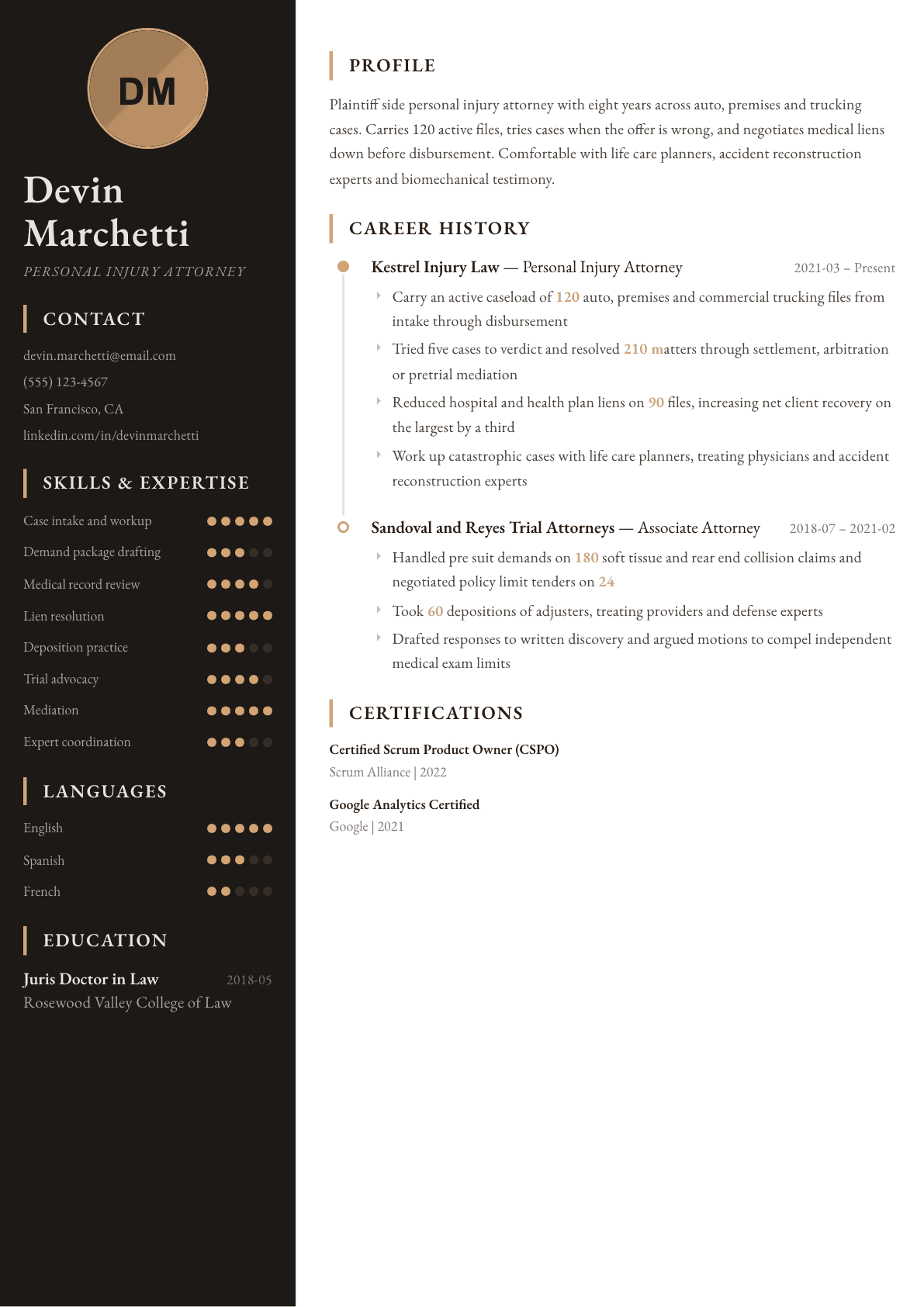
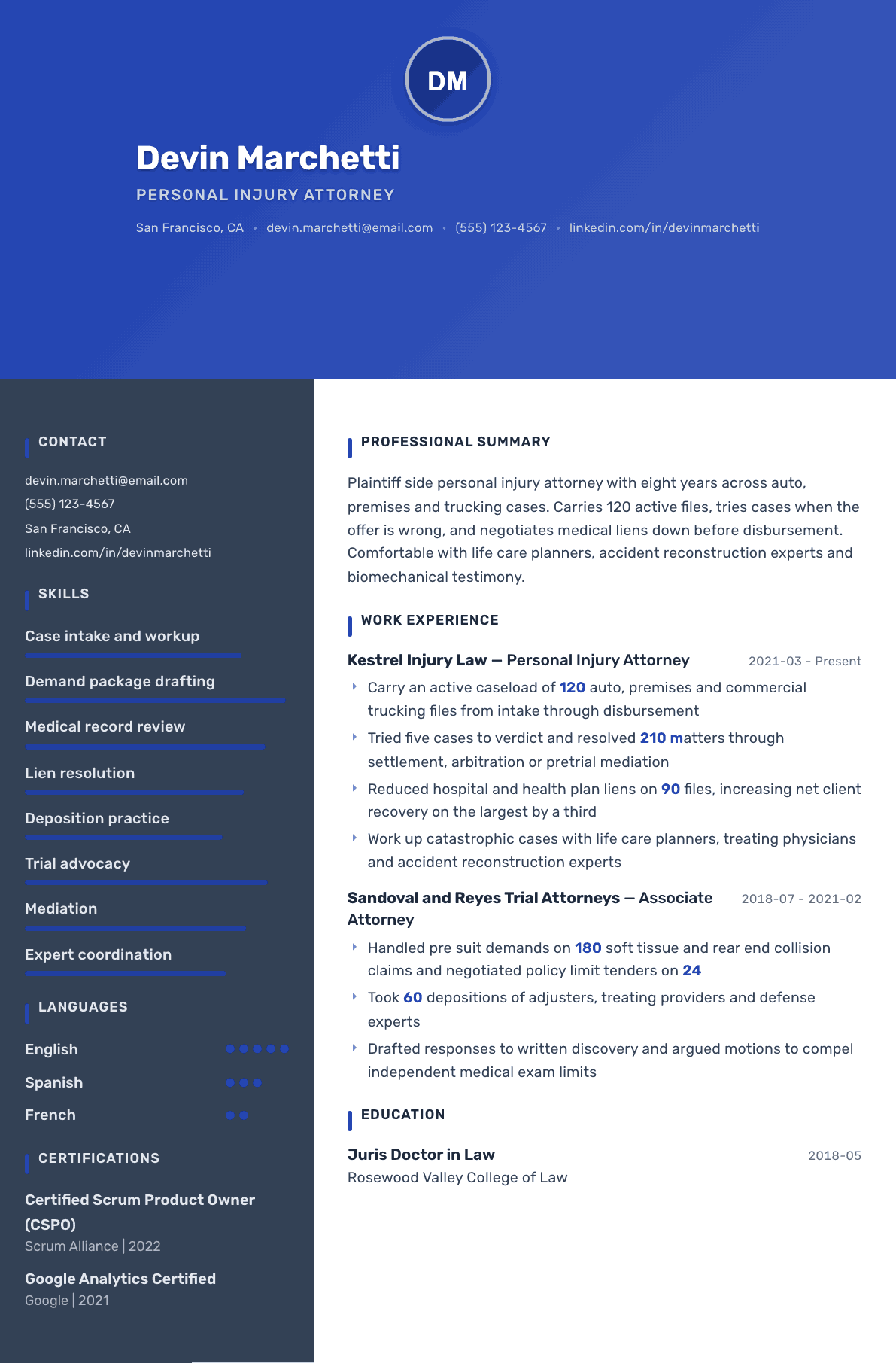
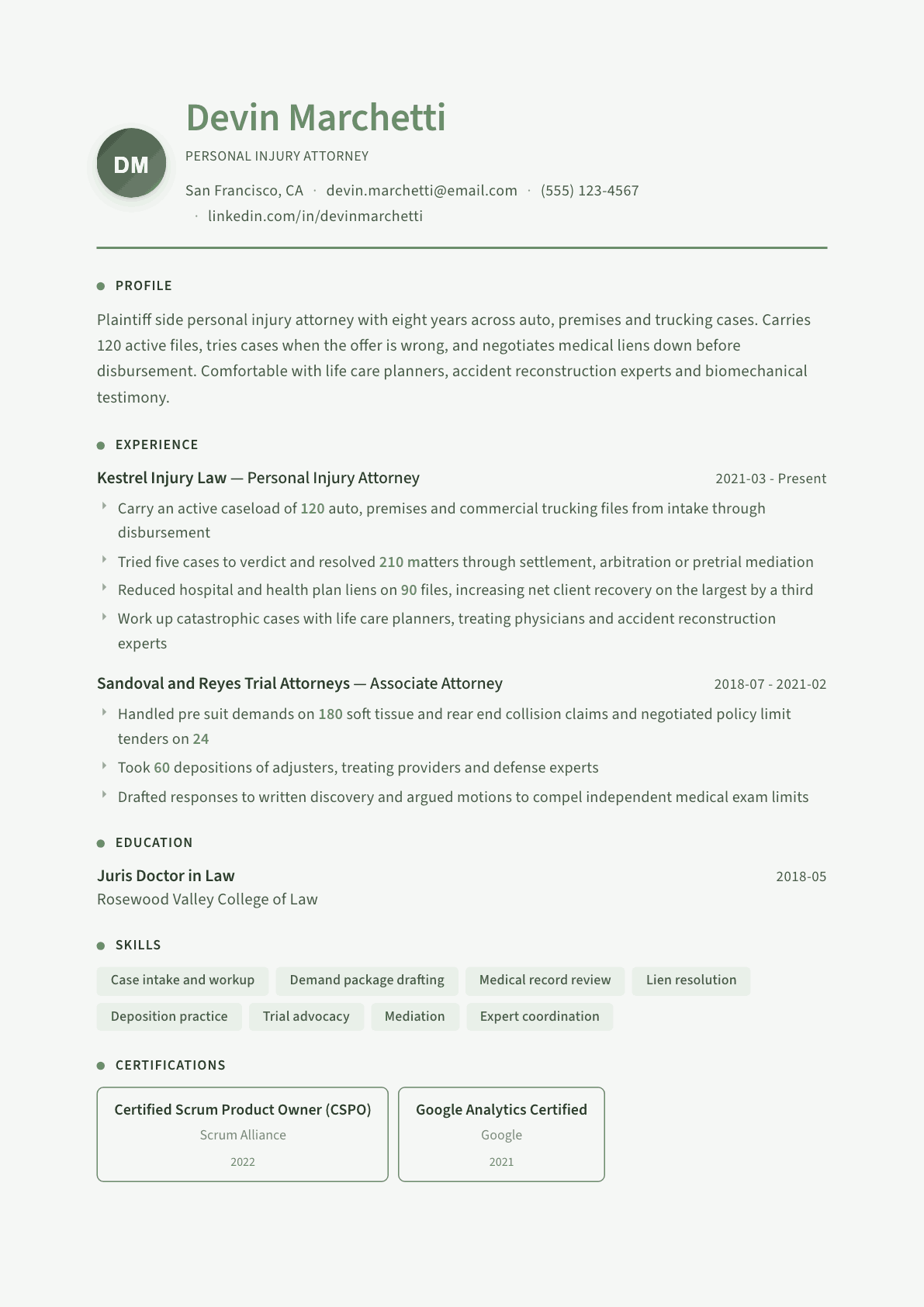
The same personal injury attorney content laid out in three CVBooster templates, so you can see what the finished document looks like before you write a word.
Example Personal Injury Attorney summary
Personal injury attorney with eight years on the plaintiff side handling auto, premises and commercial trucking claims. Carries an active caseload above one hundred files, has tried five cases to verdict, and works up catastrophic matters with life care planners and reconstruction experts. Negotiates hospital and health plan liens down before disbursement so clients keep more of the recovery.
Skills to list on a Personal Injury Attorney resume
- Plaintiff case intake
- Liability investigation
- Medical record and billing review
- Demand package drafting
- Insurance coverage analysis
- Policy limit demands
- Lien negotiation
- Deposition practice
- Expert workup
- Accident reconstruction coordination
- Mediation advocacy
- Trial advocacy
- Case management software
- Client communication
What actually gets this resume read
- State the case types you handle: auto, premises, trucking, product, medical negligence, and whether you work plaintiff or defense.
- Give the size of your active caseload, because a plaintiff firm is measuring whether you can carry their file volume.
- Show trial willingness with verdicts tried and arbitration hearings, since carriers price cases on that reputation.
- Describe lien resolution work explicitly; net client recovery is the number partners care about at disbursement.
- Name the experts you have worked up, such as life care planners, reconstructionists and treating physicians.
- Keep case results general enough to respect confidentiality while still showing the posture and the type of resolution.
How to write a personal injury attorney resume
A personal injury attorney resume is read by a managing partner who runs a contingency practice, which means the economics of the firm sit directly on top of your file handling. He is asking three things. How many files can you carry without them going stale. Do you know what a case is worth before the carrier tells you. And will you actually try one if the offer is insulting.
Plaintiff practice also has a side that defense resumes never mention: the client relationship. Injured people call constantly, treat inconsistently, and often make decisions that hurt their own case. A resume that shows you can manage medical treatment, lien holders and client expectations is describing the part of the job that determines net recovery.
This guide covers the caseload and results block, how to write case value honestly, how to present lien work and pre suit practice, and how to handle the difference between a plaintiff firm resume and a defense or carrier resume.
Say which side and which case types, in the first two lines
Plaintiff and defense are different jobs, and a resume that leaves it ambiguous gets read by neither side with enthusiasm. State your side in the summary and then list the case types you handle: motor vehicle, commercial trucking, premises liability, dog bite, product, dram shop, medical negligence, wrongful death.
Add the venues where you practice. Injury litigation is intensely local, because jury pools, damage caps, comparative fault rules and judicial practice differ county by county, and a firm hiring you is buying your familiarity with those courts.
- Side of the docket and the case types you have carried.
- Venues and courts where you appear regularly.
- Active caseload size and the split between pre suit and litigation files.
- Verdicts, arbitration awards and the resolution volume behind them.
Caseload size is the number partners read first
Contingency firms staff by file count. Give your active caseload and split it between pre suit and filed matters, because those two workflows demand different attention. An attorney carrying 120 files where 40 are in litigation is describing a very different week from one carrying 120 pre suit demand files.
Then show file movement. Files that sit are the disease of a plaintiff practice, and any evidence that you move them is valuable: average time from intake to demand, from demand to filing, or from filing to resolution. Even a rough figure signals that you have tracked it.
Case value, workup and the expert bench
Show that you can evaluate a case rather than react to an offer. Describe how you build value: liability investigation, scene and vehicle inspection, treatment history, future care needs, wage loss documentation, and the comparative fault exposure you priced in. That description is what a partner hears as judgment.
Name the experts you have worked up. Life care planners, vocational rehabilitation experts, accident reconstructionists, biomechanical engineers, economists and treating specialists. Catastrophic files live or die on the expert bench and on whether the attorney knows when to spend for one.
Be careful with dollar figures. Rather than listing recoveries in currency, describe the posture and the type of resolution, such as policy limit tenders obtained pre suit or a verdict above the last offer. It reads as more disciplined and avoids advertising rules that vary by state.
Liens and net recovery, the part most resumes skip
Gross settlement is a headline. Net recovery is the client outcome, and lien resolution is what separates the two. Say that you handle hospital liens, health plan reimbursement claims, medical payment subrogation and letters of protection, and give the volume of files where you negotiated reductions.
This work is unglamorous and enormously valuable, because it is where files die at the end. A partner who reads a resume showing lien discipline knows disbursement will not stall for months on your files.
Trial willingness and the pre suit engine
Carriers price cases partly on whether the firm tries them. Give the number of cases you have tried to verdict, the arbitration merits hearings you have handled, and any case you took to trial after a low offer. One tried case described honestly does more work on the page than a paragraph about being trial ready.
Balance it with the pre suit side, which is where most of the volume lives. Demand package quality, medical record and billing summaries, policy limit demand practice, and the underinsured motorist claims you have pursued after the liability tender.
Personal Injury Attorney resume summary examples
Pre suit attorney
Personal injury attorney in the second year of practice handling a pre suit caseload of 180 motor vehicle and premises files. Drafts demand packages from medical records and billing, negotiates with adjusters, and obtained policy limit tenders on 24 claims. Admitted in one state and covering hearings weekly.
Eight years in
Plaintiff personal injury attorney with eight years across auto, premises and commercial trucking cases, carrying 120 active files from intake through disbursement. Has tried five cases to verdict, works up catastrophic matters with life care planners and reconstruction experts, and negotiates hospital and health plan liens before disbursement.
Trial partner
Injury trial lawyer with eighteen years first chairing motor vehicle, trucking and premises cases to verdict. Supervises a team of associates and case managers on a shared docket, sets case value and litigation budgets, and handles the catastrophic and wrongful death files personally from intake forward.
Work experience bullets: before and after
Before: Handled personal injury cases for clients.
After: Carried an active caseload of 120 motor vehicle, premises and commercial trucking files from intake through disbursement, with 40 of them in active litigation.
Caseload size and the pre suit to litigation split tell a contingency partner exactly what you can absorb.
Before: Negotiated settlements with insurance companies.
After: Resolved 210 claims through pre suit negotiation, mediation and arbitration, including policy limit tenders on 24 files after time limited demands.
Naming the resolution channels and the limit tenders shows a working method, not a general activity.
Before: Worked to reduce medical bills for clients.
After: Negotiated hospital, health plan and medical payment liens on 90 files before disbursement, increasing net client recovery by roughly a third on the largest of them.
Lien work drives net recovery, and quantifying it shows the discipline that keeps disbursement moving.
Before: Prepared cases for trial.
After: Tried five cases to verdict and worked up catastrophic matters with life care planners, treating physicians and accident reconstruction experts.
Verdicts and a named expert bench signal that a low offer will actually be tested.
Before: Took depositions in injury cases.
After: Took 60 depositions of adjusters, treating providers and defense medical examiners, and moved to limit the scope of compelled examinations on eight matters.
Deponent types and the related motion practice show injury specific experience rather than generic discovery.
Hard skills
- Client intake and case screening
- Liability investigation
- Medical record and billing review
- Demand package drafting
- Insurance coverage analysis
- Time limited policy limit demands
- Underinsured motorist claims
- Lien and subrogation negotiation
- Deposition practice
- Expert workup and coordination
- Mediation and arbitration advocacy
- Trial advocacy
- Damages modeling for future care
- Contingency case management systems
Soft skills
- Client communication under stress
- Expectation setting on case value
- Negotiation with adjusters
- Empathy with injured clients
- File movement discipline
- Team supervision of case managers
Certifications worth listing
- State Bar Admission (State Bar Association)
- Board Certification in Civil Trial Law (National Board of Trial Advocacy)
- Board Certification in Personal Injury Trial Law (State Board of Legal Specialization)
- Trial Advocacy Training (National Institute for Trial Advocacy)
Mistakes that cost personal injury attorney candidates the interview
- Leaving the side of the docket unstated, so neither a plaintiff firm nor a defense firm reads the file as a match.
- Publishing recovery figures in currency, which invites state advertising rule problems and reads as promotional.
- Omitting the caseload size, which is the first number a contingency partner needs in order to staff you.
- Ignoring lien resolution even though it decides net client recovery and controls how fast files close.
- Claiming trial readiness without listing a single case tried to verdict or arbitration merits hearing.
- Describing case types generically instead of naming trucking, premises, product or medical negligence work.
Personal Injury Attorney resume questions
Should I list settlement amounts on a personal injury attorney resume?
Be cautious. State advertising rules restrict result claims, and figures read as promotional to a hiring partner. Describe the posture instead: policy limit tenders obtained pre suit, verdicts exceeding the final offer, or matters resolved at mediation on approved terms.
How many active files should I say I carry?
Give your real number and split it between pre suit and filed matters, because those workflows need different attention. A firm is deciding how much of its docket to hand you, and an honest number sized to your staffing support is more useful than a large one.
What does a plaintiff firm want that a defense resume usually lacks?
Intake judgment, case value evaluation, lien resolution and client management. Defense resumes emphasize billing discipline and carrier reporting, which matter less in a contingency practice than knowing when to invest in a file and when to decline it.
How do I show trial experience if my cases keep settling?
List arbitration merits hearings, evidentiary hearings and any trial that reached jury selection before resolving, and describe the last offer position at the time. A partner understands that carriers move when the file is genuinely ready.
Do I need to name the venues where I practice?
Yes, because injury practice is local. Jury pools, comparative fault standards and judicial preferences differ by county, and a firm hiring you is partly buying familiarity with the courts where its cases are filed.