Legal Nurse Consultant Resume Examples: read this first
Build a Legal Nurse Consultant Resume Attorneys Retain
By Mustafa Tarabya, founder of CVBooster · Published · Updated
Legal nurse consultant resume example with chronology and standard of care bullets, case type keywords, and tips for firm and independent work.
Sample resumes for a legal nurse consultant
The same legal nurse consultant content laid out in three CVBooster templates, so you can see what the finished document looks like before you write a word.
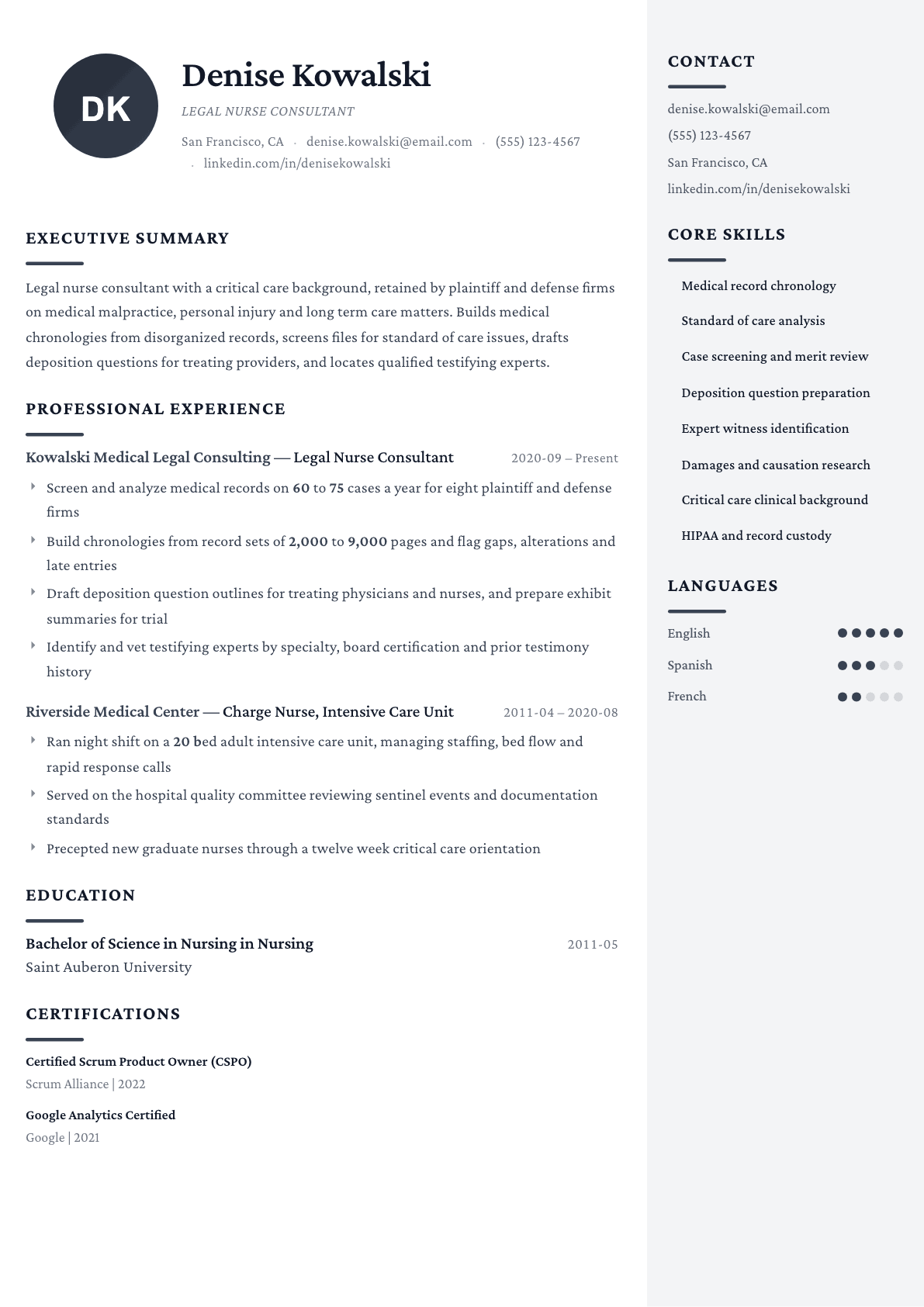
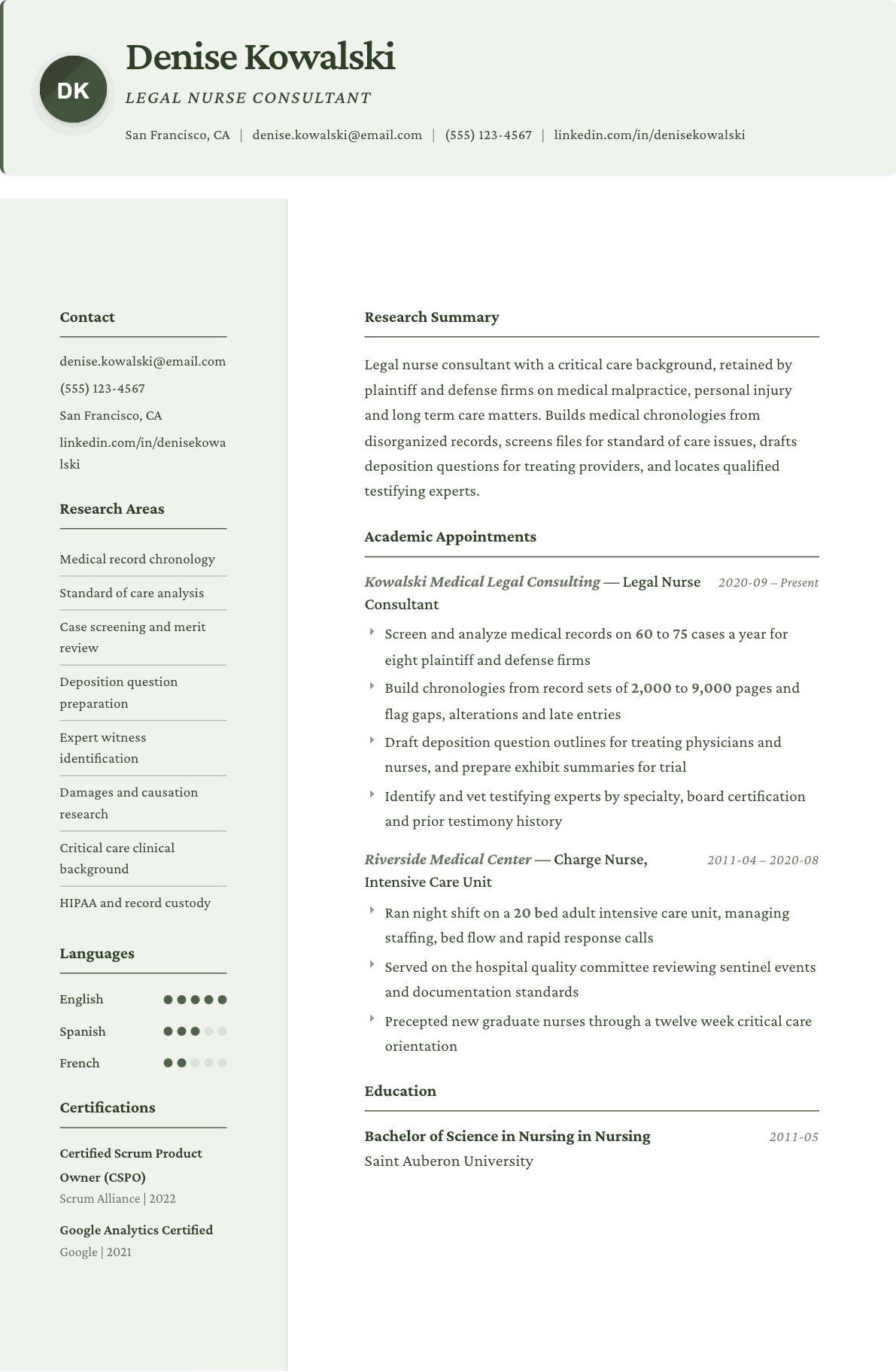
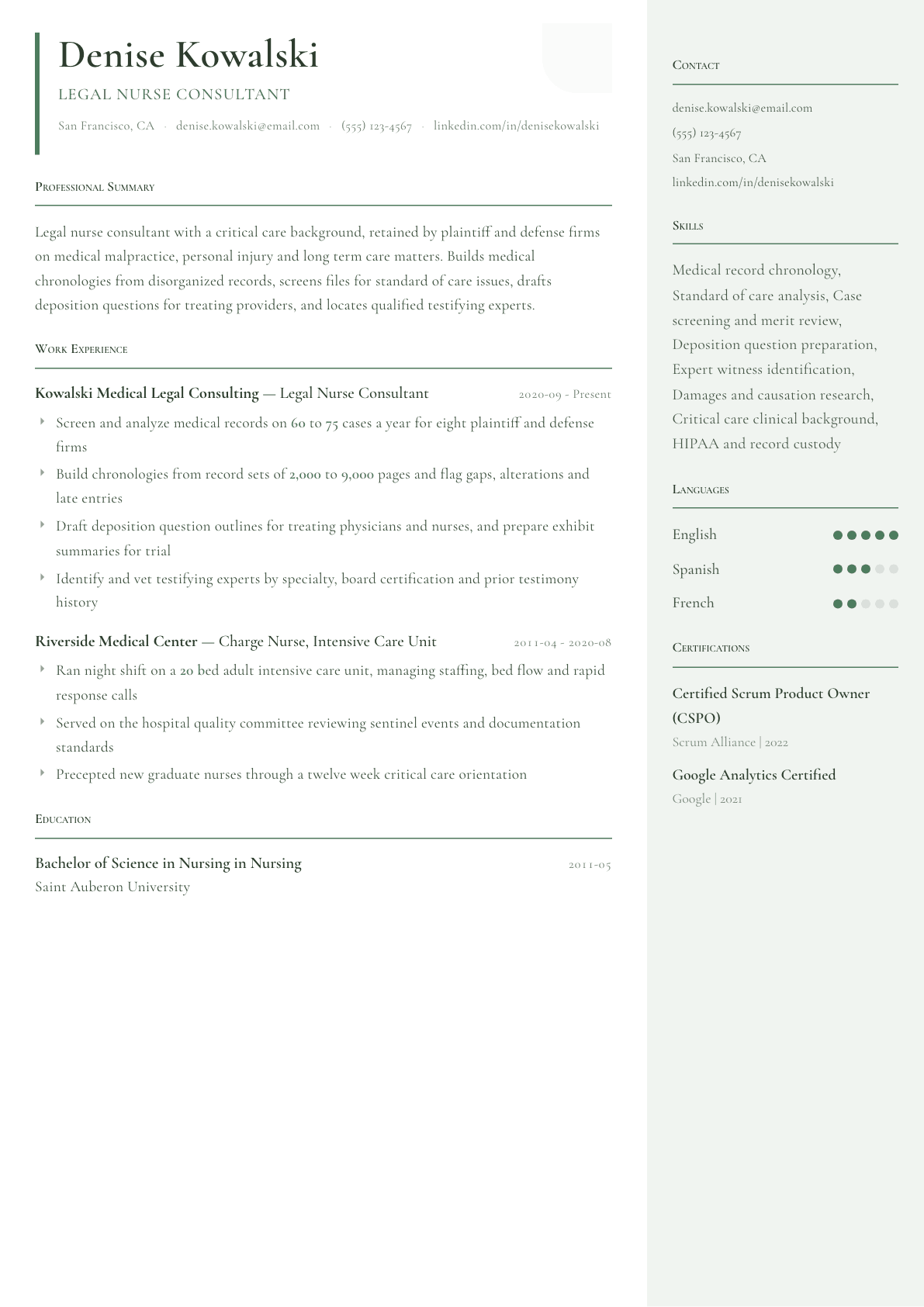
Example Legal Nurse Consultant summary
Legal nurse consultant and registered nurse with nine years of intensive care practice, now retained by plaintiff and defense firms on malpractice, injury and long term care files. Builds chronologies from large record sets, screens cases for merit, drafts deposition outlines for treating providers, and vets testifying experts. Seeking in house consulting work with a litigation group.
Skills to list on a Legal Nurse Consultant resume
- Medical record review
- Chronology and timeline building
- Standard of care analysis
- Causation and damages review
- Merit screening
- Deposition preparation support
- Expert witness sourcing
- Life care plan review
- Medical bill and cost audit
- Nursing documentation standards
- Medical terminology
- HIPAA compliance
- Trial exhibit preparation
- Independent medical exam coordination
What actually gets this resume read
- Keep your active nursing license and clinical specialty on the resume, because your clinical years are the product.
- Name the case types you consult on, from birth injury to nursing home neglect, since attorneys retain by subject.
- Quantify record volume in pages and cases per year, so a firm understands the size of file you can absorb.
- Show the deliverables you produce: chronologies, merit screening memos, deposition outlines and exhibit summaries.
- Separate consulting expert work from any testifying work, because the two roles carry different discovery exposure.
- Describe how you find and vet testifying experts, since that service is often what keeps a firm coming back.
How to write a legal nurse consultant resume
A legal nurse consultant is hired for clinical judgment, not for legal knowledge. The attorney reading your resume already has lawyers. What she does not have is somebody who can open a shipment of hospital records, recognize that a nursing flow sheet was completed after the fact, and explain why that matters to the case.
The resume that wins that work therefore leads with clinical credibility and follows with legal deliverables. Years at the bedside, the specialty, the license status, then the products you deliver to a firm: chronologies, merit screening memos, deposition outlines, expert searches.
This guide sets out that order, shows how to describe record review at a scale attorneys understand, and covers the distinction between consulting and testifying work that every firm will ask about.
Format: clinical first, deliverables second
One page if you are still mostly clinical, two once you have several years of case work. Under the header put your nursing credentials in the standard order, the state where your license is active, your clinical specialty and years, and the case types you consult on. An attorney scanning a stack of consultant resumes is looking for a specialty that matches her file.
Keep the layout conservative. Your resume may be forwarded to a client or attached to a retention email, so it should look like a professional document rather than a marketing flyer.
- Header: name, nursing credentials, licensure state, city and state, phone, email.
- Order: summary, clinical background, consulting experience and deliverables, education, certifications, skills.
- Nurses new to consulting keep the clinical section long and the consulting section honest.
Summary: specialty, years at the bedside, case types
Say what you practiced and for how long, because that is the asset. Intensive care, labor and delivery, emergency, operating room and long term care each map to different case types, and attorneys retain by that map.
Then name the case types you have worked: medical malpractice, nursing home neglect, personal injury, product liability involving devices, workers compensation, or medical billing disputes. Add whether you work for plaintiff firms, defense firms or both.
Consulting experience: name the deliverable
Attorneys buy documents. Structure your bullets around what you hand over: a medical chronology with sourced page citations, a merit screening memorandum with an opinion on standard of care, a deposition question outline for a treating physician, a summary of billing irregularities, a set of trial exhibits organized around the timeline.
Give the scale. Cases reviewed per year and record volume in pages tell a firm whether you can absorb a large file. Add turnaround, because a consultant who returns a chronology inside two weeks of a large record production is worth keeping.
Show what you catch. Missing vital signs, late entries, contradictions between the nursing narrative and the physician note, a medication administration record that does not match the order. Those specifics prove clinical reading rather than summarizing.
Consulting versus testifying, and how to say it
Firms care about this line because the work product of a consulting expert has different discovery treatment than that of a testifying witness. State which role you have held. If you have testified, say in what type of matter and whether by deposition or at trial.
Also describe expert sourcing if you do it. Identifying the right specialist, checking board certification and prior testimony, and preparing a briefing packet is a service many firms value as much as the record review itself.
Clinical section and the keywords a firm searches
Do not shorten the clinical history. Unit type, bed count, patient population, charge or leadership roles, committee work on documentation standards, and precepting all support your authority on what a reasonable nurse would have done.
For keywords, use the vocabulary of both worlds: medical record review, chronology, standard of care, causation, damages, merit screening, life care plan review, medical bill audit, independent medical examination, deposition summary, and the clinical terms of your specialty.
Legal Nurse Consultant resume summary examples
Nurse entering consulting
Registered nurse with 8 years in emergency and intensive care, now completing legal nurse consultant training and taking case screening work from 2 plaintiff firms. Builds chronologies from record sets of several thousand pages and identifies documentation gaps and late entries.
Independent consultant
Legal nurse consultant reviewing 60 to 75 cases a year for 8 plaintiff and defense firms across malpractice, personal injury and long term care matters. Produces sourced chronologies, merit screening memoranda and deposition question outlines, and vets testifying experts by specialty and prior testimony.
In house consultant
Senior legal nurse consultant embedded with a litigation group, screening intake for merit and managing case work with 3 contract nurses. Prepares trial timelines and exhibit summaries, reviews life care plans and billing audits, and has been deposed in 5 malpractice matters.
Work experience bullets: before and after
Before: Reviewed medical records for attorneys.
After: Reviewed record sets from two thousand to nine thousand pages and produced sourced chronologies citing the bates page for every clinical event on the timeline.
Record volume and page level sourcing describe a work product an attorney can use in a deposition.
Before: Told attorneys if a case had merit.
After: Screened 40 intake files a year for standard of care and causation issues, returning a written memorandum with the clinical basis for taking or declining each case.
The volume and the written memorandum turn an opinion into a documented service the firm relies on.
Before: Helped prepare for depositions.
After: Drafted question outlines for treating physicians and unit nurses, flagging contradictions between the nursing narrative and the medication administration record.
The named contradiction shows the clinical reading a lawyer cannot do without a nurse in the room.
Before: Found experts for cases.
After: Identified and vetted testifying experts by subspecialty, board certification and prior testimony history, then prepared briefing packets before the retention call.
Vetting criteria and a briefing packet describe a repeatable process instead of a contact list.
Before: Used my nursing experience to explain medical issues.
After: Translated ventilator settings, pressor titration and sepsis bundle timing into plain language memoranda the trial team used in opening preparation.
Specific clinical content makes the translation service concrete and shows the specialty behind it.
Hard skills
- Medical record analysis
- Chronology and timeline construction
- Standard of care evaluation
- Causation and damages review
- Case merit screening
- Deposition question development
- Expert witness identification and vetting
- Life care plan review
- Medical bill and coding audit
- Nursing documentation standards
- Medical terminology and pharmacology
- Trial exhibit and timeline preparation
Soft skills
- Objectivity on both sides of a case
- Plain language explanation
- Reading stamina across large files
- Discretion with protected information
- Working to a litigation calendar
Certifications worth listing
- Legal Nurse Consultant Certified (LNCC) (American Legal Nurse Consultant Certification Board)
- Registered Nurse License (State board of nursing)
- Certified Professional in Healthcare Risk Management (CPHRM) (American Hospital Association Certification Center)
Mistakes that cost legal nurse consultant candidates the interview
- Leading with legal vocabulary instead of the clinical specialty the attorney is actually retaining.
- Letting the nursing license lapse or leaving its status off, which undermines the authority the whole role rests on.
- Describing reviews without record volume or case counts, so a firm cannot judge the size of file you handle.
- Blurring consulting and testifying work, when the two carry different discovery consequences for the retaining firm.
- Offering legal conclusions about liability rather than clinical opinions about care, which is the boundary of the role.
- Dropping the bedside detail once consulting starts, removing the very experience that makes the opinion credible.
Legal Nurse Consultant resume questions
Do I need certification to work as a legal nurse consultant?
No. Attorneys retain on clinical specialty and demonstrated work product. A recognized certification helps with credibility and marketing, but an active license and relevant bedside years remain the qualification that decides the engagement.
How many years of clinical practice should I have first?
Enough that you can speak to what a reasonable nurse would do in your specialty, which usually means several years of direct care. Firms scrutinize this, because thin clinical experience is exposed quickly in a deposition prep session.
Can I list case outcomes on my resume?
Describe your contribution and the case type, not verdicts or settlements, and never the parties. Saying you screened a nursing home neglect file and identified a documentation gap is informative and keeps you inside the confidentiality you owe.
Should I keep working clinically while consulting?
Many consultants do, and it strengthens the resume because current practice is harder to challenge than experience that ended years ago. Show both concurrently rather than presenting the clinical role as finished.
What is the difference between this role and a testifying expert?
A consulting nurse supports the legal team behind the scenes, while a testifying expert offers opinions on the record and is subject to discovery and cross examination. Say which you have done, because firms plan their strategy around it.