Climbing Instructor Resume Examples: what gets the call
Write a Climbing Instructor Resume Gyms and Guide Services Trust
By Mustafa Tarabya, founder of CVBooster · Published · Updated
Climbing instructor resume examples with certification tracks, terrain taught, rescue skills and the safety keywords gym managers look for.
Sample resumes for a climbing instructor
The same climbing instructor content laid out in three CVBooster templates, so you can see what the finished document looks like before you write a word.
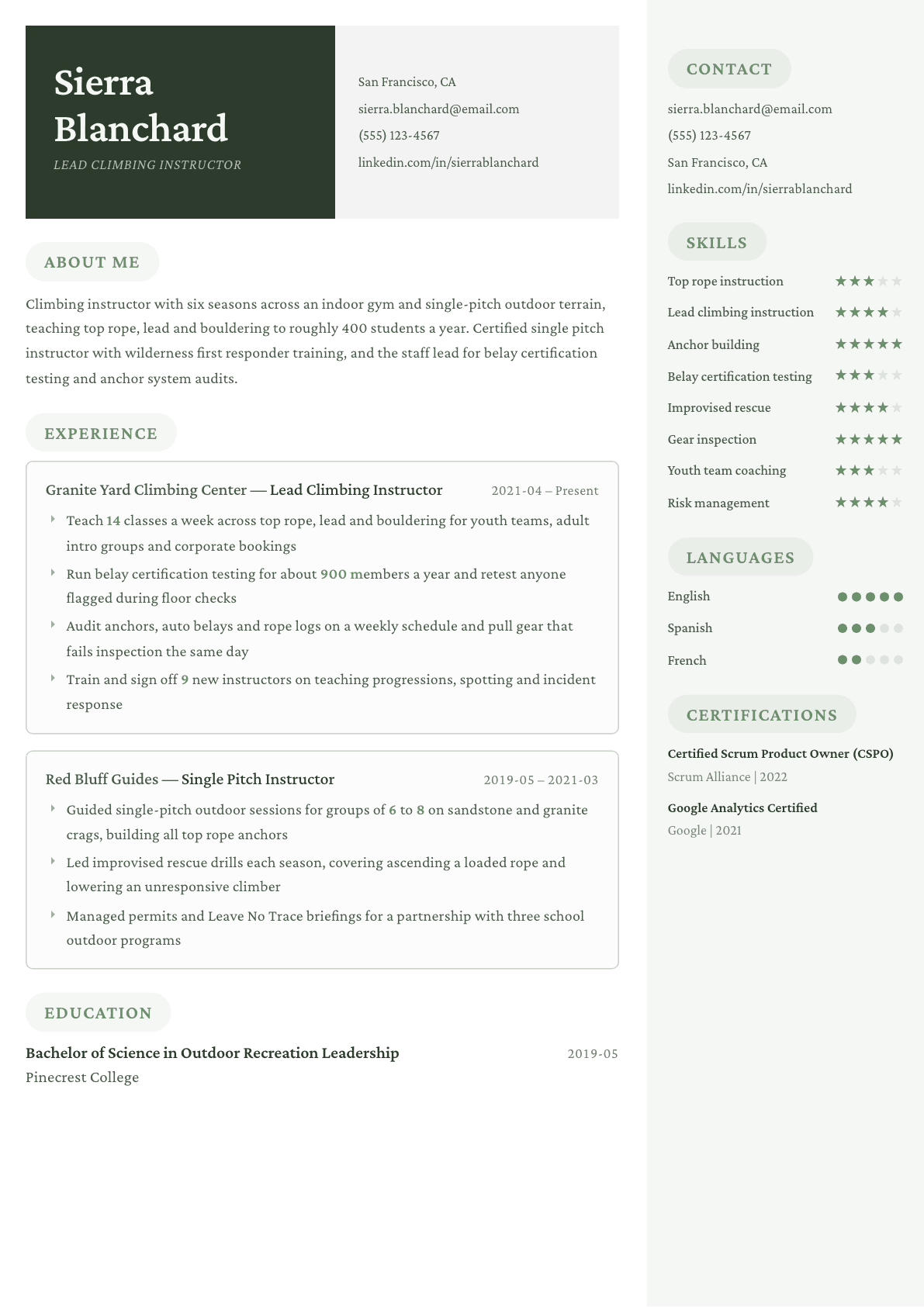
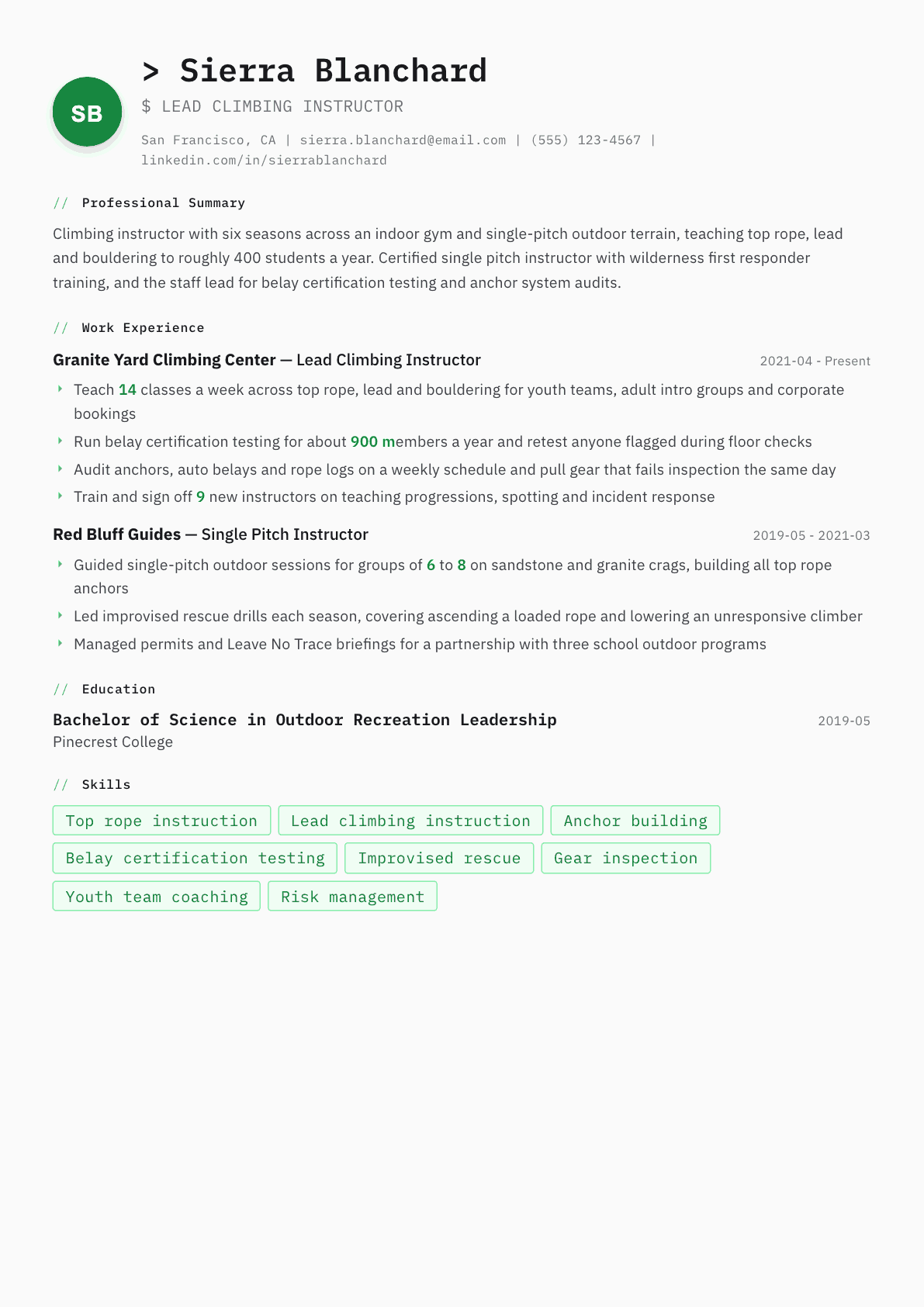
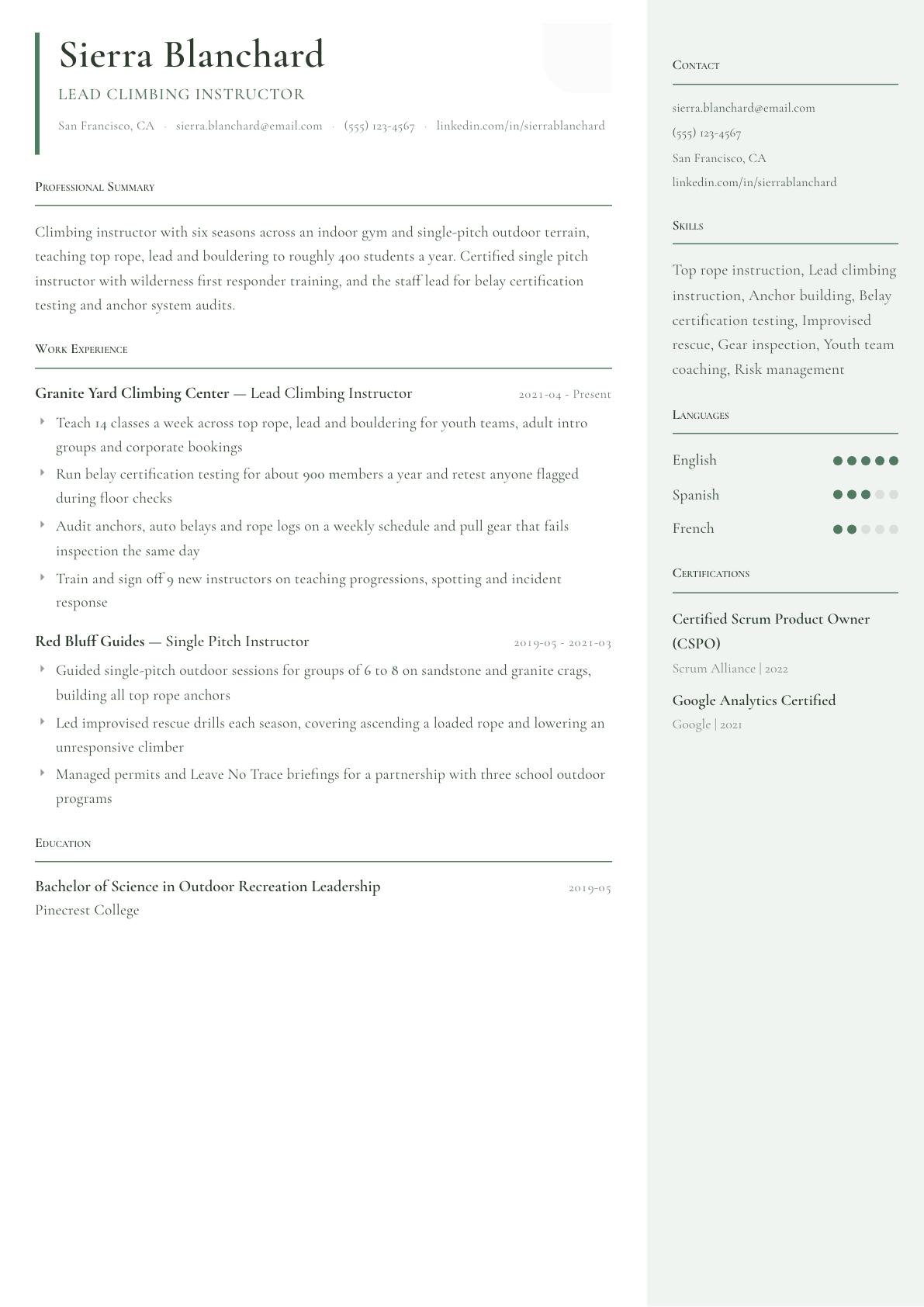
Example Climbing Instructor summary
Climbing instructor with six seasons teaching top rope, lead and bouldering to about 400 students a year across a commercial gym and single-pitch crags. Certified single pitch instructor with wilderness first responder training, responsible for belay testing, weekly anchor and auto belay audits and signing off new staff. Looking for a program lead position.
Skills to list on a Climbing Instructor resume
- Top rope instruction
- Lead climbing instruction
- Bouldering coaching
- Anchor building
- Belay certification testing
- Improvised rope rescue
- Gear and rope inspection
- Route setting support
- Youth climbing teams
- Risk management
- Incident reporting
- Group facilitation
- Leave No Trace instruction
- Staff training
What actually gets this resume read
- Name the terrain you teach on, because indoor bouldering, top rope and single-pitch outdoor are separate hiring lanes.
- List your instructor certification and first aid level together, since a gym cannot schedule you without both current.
- Give class counts and student numbers per season so a manager can see the teaching load you carry.
- Describe the gear and systems work you own, from auto belay inspections to rope retirement logs and anchor audits.
- Mention rescue skills explicitly, including ascending a loaded rope and lowering an injured climber from an anchor.
- Show who you have trained, because gyms promote instructors who can certify and sign off other staff.
How to write a climbing instructor resume
Hiring a climbing instructor is a risk decision before it is a teaching decision. The gym manager or guide service owner reading your resume is asking whether you can be left alone with strangers on a rope system, whether your certifications and medical training are current, and whether anything on your watch has gone wrong. Teaching charisma is the second filter, never the first.
That is why the strongest climbing instructor resumes read like an operations document with a personality. They name the terrain and angle you teach on, the systems you own, the inspections you run, the rescue skills you have practiced recently, and the number of students you moved through certification last season. A page full of adjectives about passion for the outdoors gets skipped.
Below is the structure a hiring manager reads, the numbers that carry weight in this trade, example summaries for a new instructor, a working staff instructor and a program lead, before and after bullets, and answers to the questions that come up when instructors move between gyms, guide services and outdoor education.
Format: certification and medical block first, terrain second
Directly under your contact details, list your instructor certifications with the awarding body, your wilderness or standard first aid level, and the expiry of each. A gym cannot roster you and a guide service cannot insure you without those dates, so they belong at the top rather than at the bottom under education.
Follow it with a terrain and discipline line: indoor top rope, indoor lead, bouldering, single-pitch outdoor, multipitch. These are separate hiring lanes and a manager filling an outdoor program will stop reading a page that only proves indoor teaching.
- Certification block: instructor award and body, medical certification and level, expiry for each.
- Terrain line: the disciplines and rock types you teach on, indoors and outdoors.
- Systems ownership: anchors, auto belays, rope logs, harness and hardware retirement.
- Populations taught: youth teams, adult intro classes, school groups, corporate bookings, adaptive climbers.
Summary: seasons, disciplines, student volume, staff role
Three lines. Name the seasons worked, the disciplines you teach, roughly how many students you take through in a year, and whether you carry a staff role such as lead instructor, belay tester or trainer of new staff. Volume is what tells a manager you can hold a class schedule rather than an occasional shift.
If you are moving from indoor to outdoor work, or from assistant to lead, say it in the summary and name the evidence: the single-pitch award you hold, the crags you have taught on, the rescue drills you run and the group sizes you have managed away from a building.
Experience: classes taught, systems owned, incidents handled
Open each role with the venue type, then write bullets around three themes: teaching load, systems work and safety events. Teaching load means classes per week, disciplines covered and the populations in the room. Systems work means anchors built, gear inspected, auto belays checked and ropes retired on a documented schedule.
Safety events are where honest specificity helps you. Managing a lowering error, a stuck climber, an auto belay that failed inspection, or an evacuation from a crag are the situations a manager wants to hear you have already met. Write what you did and what changed afterward, not the drama.
Belay certification testing is worth its own bullet in a commercial gym. It is the highest-consequence routine task on the floor, and giving the number of members you tested and how you handled retesting tells a manager exactly how you hold a standard under pressure.
Rescue, first aid and risk management
Rescue skills decay, so state when you last drilled them and what the drill covered. Ascending a loaded rope, transferring a load to an anchor, lowering an unresponsive climber, and escaping the belay are the four a single-pitch employer expects you to name without hesitating.
Add the paperwork side, because guide services and gyms live inside it. Waivers, incident reports, near-miss logs, permit compliance for outdoor venues, group ratios and weather call procedures are all part of the job, and a candidate who lists them is a candidate who has run a program rather than only taught in one.
- Rescue skills drilled, with the most recent season you practiced each one.
- Medical certification level and the remoteness it was designed for.
- Ratios you have run for youth, school and corporate groups on rock and indoors.
- Permit, land manager and Leave No Trace obligations you handled for outdoor sessions.
Keywords gyms and guide services search for
The recurring terms are concrete: top rope, lead climbing, bouldering, belay certification, anchor building, auto belay inspection, improvised rescue, single pitch, risk management, incident report, route setting support, youth team coaching. Use the ones that are true of you and attach each to a bullet that proves it.
Do not lean on grades as a substitute for teaching evidence. Personal climbing ability is worth one line, because a manager hires the person who can run a class safely rather than the strongest climber in the building.
Climbing Instructor resume summary examples
First season instructor
Climbing gym instructor in a first full season, teaching 6 intro top rope and bouldering classes a week and running belay checks on the floor. Wilderness first aid certified, trained on auto belay inspection and rope logs, working toward a single pitch instructor award.
Third season, indoor and outdoor
Instructor teaching 14 classes a week across top rope, lead and bouldering, plus single-pitch outdoor sessions for groups of 8. Certified single pitch instructor with wilderness first responder training, responsible for weekly anchor and auto belay audits and about 900 belay certifications a year.
Program lead
Program lead with nine seasons across a commercial gym and a guide service, running youth team programming, staff hiring and the instructor training pipeline. Owns the gear retirement standard, the incident review process and outdoor permits, and has signed off 20 instructors to teach independently.
Work experience bullets: before and after
Before: Taught climbing classes to beginners and kids.
After: Taught 14 classes a week across top rope, lead and bouldering for youth teams, adult intro groups and corporate bookings of up to 20 people.
Class count, disciplines and audiences show the teaching load a manager needs covered.
Before: Made sure the gym was safe.
After: Audited anchors, auto belays and rope logs weekly, pulled failed hardware from service the same day, and retired 30 ropes against a documented wear standard.
Named systems and a retirement standard prove ownership of safety rather than a general concern for it.
Before: Certified members to belay.
After: Ran belay certification testing for about 900 members a year and retested anyone flagged during floor checks, keeping a written log of failed attempts and coaching notes.
Volume plus the retest process shows you hold a standard consistently, which is the whole point of the task.
Before: Guided outdoor climbing trips.
After: Guided single-pitch sessions for groups of 6 to 8 on sandstone and granite, building every top rope anchor and briefing access, weather calls and Leave No Trace before leaving the trailhead.
Rock type, group size and the pre-trip briefing tell an outdoor employer you can run the day, not just climb it.
Before: Trained other staff members.
After: Trained and signed off 9 new instructors on teaching progressions, spotting, lowering technique and incident response, then shadowed their first three classes.
The topics covered and the shadowing period turn training into a verifiable process.
Hard skills
- Top rope instruction
- Lead climbing instruction
- Bouldering coaching
- Anchor building and evaluation
- Belay certification testing
- Improvised rope rescue
- Auto belay and hardware inspection
- Rope and gear retirement standards
- Youth team coaching
- Group ratio and risk management
- Incident and near-miss reporting
- Leave No Trace instruction
Soft skills
- Calm authority with nervous climbers
- Clear instruction to mixed ability groups
- Consistency in enforcing standards
- Parent and client communication
- Staff mentoring
- Decision making in changing weather
Certifications worth listing
- Single Pitch Instructor (SPI) (American Mountain Guides Association)
- Climbing Wall Instructor (CWI) (American Mountain Guides Association)
- Wilderness First Responder (NOLS Wilderness Medicine)
- Heartsaver CPR AED (American Heart Association)
Mistakes that cost climbing instructor candidates the interview
- Leading with personal climbing grades instead of teaching load, certifications and the systems you are trusted with.
- Leaving medical certification expiry off the page, which stalls the file while a manager emails to ask.
- Failing to separate indoor teaching from single-pitch outdoor work when the posting is clearly for one of them.
- Skipping belay testing volume, the routine task with the highest consequence in a commercial gym.
- Describing rescue skills without saying when you last drilled them, since those skills fade fast.
- Writing about a love of the outdoors in place of ratios, incident handling and gear inspection detail.
Climbing Instructor resume questions
Do I need a formal certification to be hired at a climbing gym?
Many gyms train in house and hire on aptitude, but a recognized instructor award plus a current first aid certification moves you ahead of untrained applicants and is usually required before you teach outdoors or supervise other staff.
How do I show experience if I have only ever climbed recreationally?
Lead with volunteer teaching, youth program assistance, university club instruction or scouting work, then quantify it: sessions run, group sizes, ages taught. Add any belay clinic or gear check duty you covered, and list your medical training.
Should climbing grades appear on the resume at all?
One line is enough, and only where it supports the role. Route setting and advanced coaching hiring cares about the grades you climb and set, while intro teaching and school program hiring cares about ratios, patience and safety systems.
How do I move from indoor instruction to guiding outdoors?
Get the single-pitch award and a wilderness level medical certification, then build a page that names crags taught on, anchors built, group sizes managed and rescue drills practiced. Outdoor employers need evidence you can manage a venue without a building around it.
What should I say about accidents or near misses?
Never name individuals, but do show that you handle and document them. A line stating you maintain incident and near-miss logs and have carried out evacuations or lowering corrections signals professionalism, since every venue has events and only some record them properly.
Related resume examples
- Personal Trainer Resume example
- Sports Coach Resume example
- Recreation Coordinator Resume example
- Martial Arts Instructor Resume example
- Scuba Instructor Resume example
- Swim Coach Resume example