Martial Arts Instructor Resume Examples: free ATS score
Write a Martial Arts Instructor Resume Schools Want to Read
By Mustafa Tarabya, founder of CVBooster · Published · Updated
Martial arts instructor resume sample with rank and lineage detail, class and retention numbers, keywords and a full writing guide.
Sample resumes for a martial arts instructor
The same martial arts instructor content laid out in three CVBooster templates, so you can see what the finished document looks like before you write a word.
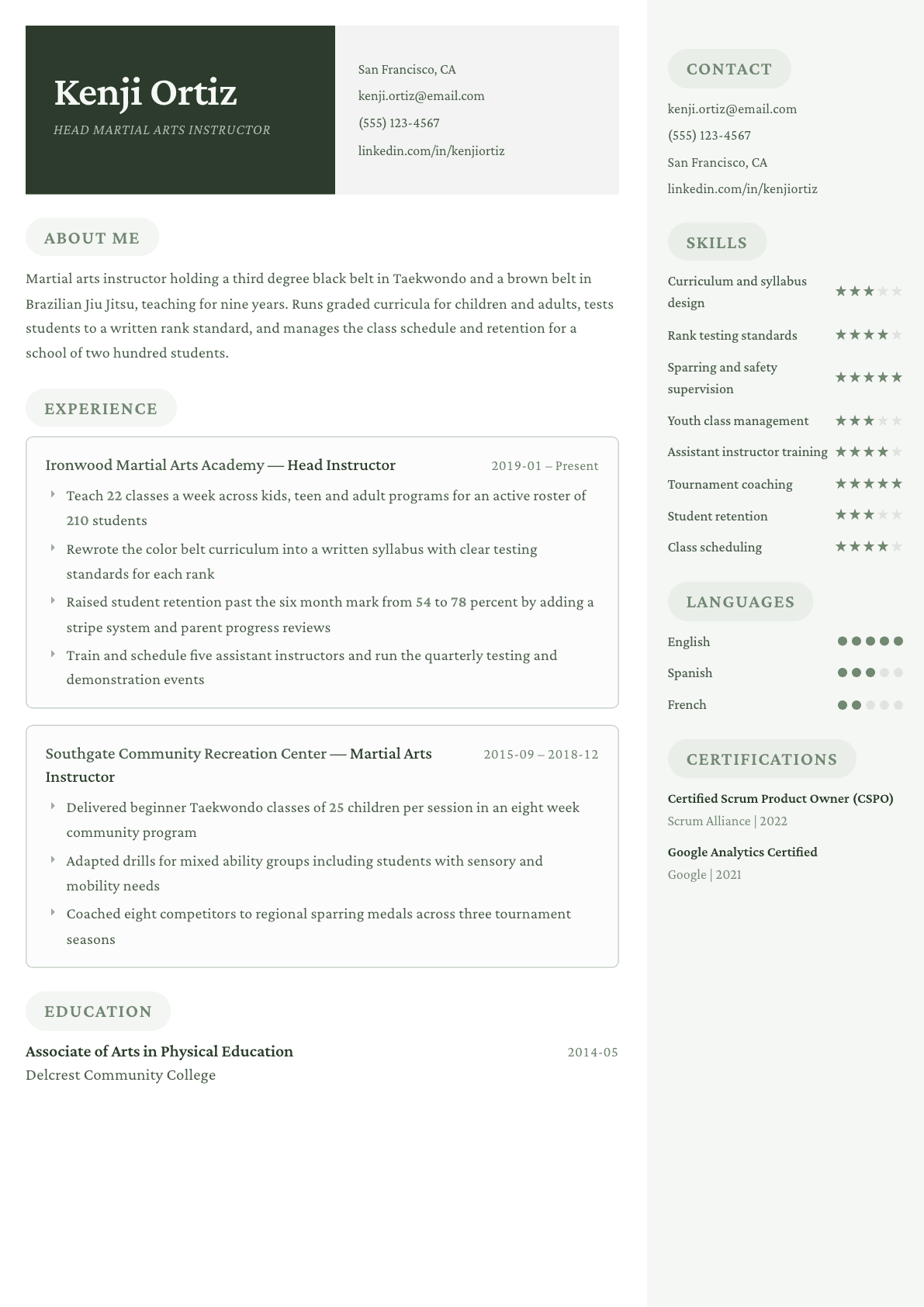
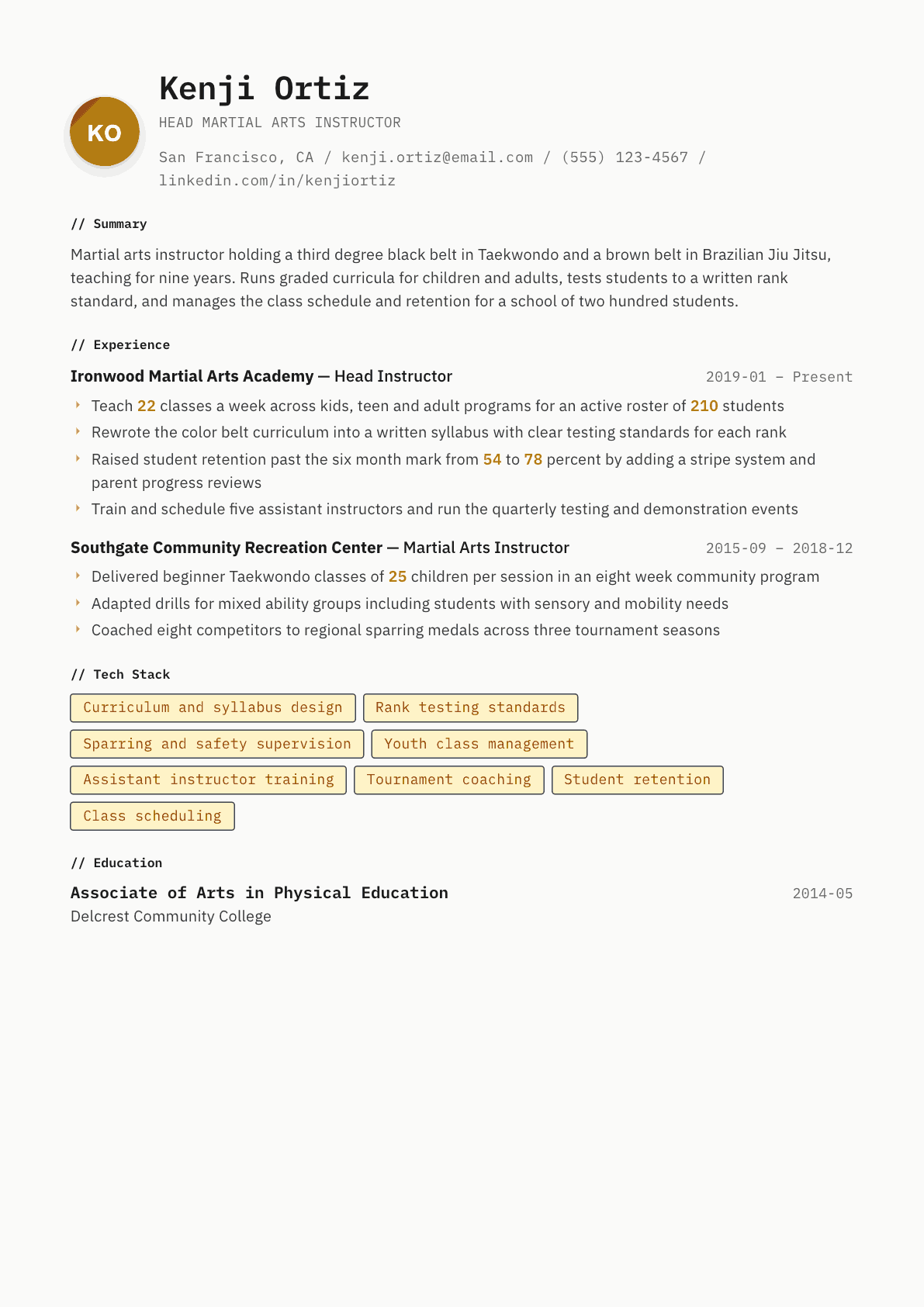

Example Martial Arts Instructor summary
Martial arts instructor with nine years of teaching and a third degree black belt in Taekwondo alongside a brown belt in Brazilian Jiu Jitsu. Teaches over twenty classes a week to children, teens and adults, rebuilt a color belt syllabus with written testing standards, and trains a team of assistant instructors. Focused on retention through clear progression and regular parent updates, and seeking a head instructor role at a growing school.
Skills to list on a Martial Arts Instructor resume
- Belt curriculum design
- Rank testing and grading
- Youth class instruction
- Adult class instruction
- Sparring supervision
- Self defense instruction
- Forms and technique coaching
- Conditioning and flexibility work
- Tournament preparation
- Assistant instructor development
- Student retention programs
- Class scheduling and mat management
- Parent communication
- Injury response and first aid
What actually gets this resume read
- State your art, rank, and the organization that issued it, because a black belt means nothing without the awarding body.
- Give class volume and roster size, since a school owner is hiring capacity as much as skill on the mat.
- Show the curriculum work you have done: written syllabus, stripe systems, testing standards, and how students progress.
- Put retention and enrollment numbers on the page, because a martial arts school lives on students who stay past month three.
- Name the safety practices you enforce for sparring, mat hygiene and injury response, since parents ask about all three.
- Keep competition results short and separate them from teaching results, as schools hire teachers more than competitors.
How to write a martial arts instructor resume
A martial arts instructor resume is usually read by a school owner whose business survives on students who stay. She wants technical credibility, because a rank that cannot be traced damages the school, and she wants retention, because a class of thirty beginners who all quit by month four leaves her worse off than before you arrived.
Rank is the first checkpoint. A black belt means something when the awarding organization is named and the promotion can be traced through an instructor lineage, and it means very little when it appears alone. Write the art, the rank, the awarding body and the years since promotion, and the credibility question is settled in one line.
This guide sets out the sections a school owner reads in order, three summaries for an assistant instructor, a full instructor and a head instructor, five before and after bullets, and the questions that come up when an instructor applies to a commercial school, a community center and a competition team.
Format: rank block, teaching history, business results
Reverse chronological, opening with a rank and credential block. Art, rank, awarding organization, and any instructor certification that sits alongside the rank. Then teaching positions, then the business outcomes you influenced.
One page is right for most instructors. A head instructor who has managed staff, curriculum and enrollment can justify a second page, but only for numbers a school owner cares about rather than a longer competition history.
- Rank block: art, rank, awarding organization, and instructor certification where one exists.
- Each teaching role: school, student roster size, classes taught per week, age groups covered.
- Curriculum work: syllabus written, testing standards set, stripe or grading systems built.
- Business results: enrollment, retention past a defined month, testing participation, event attendance.
Summary: art, rank, class load, what you built
Four lines. Name the art and rank with the awarding body, the years teaching, the class load you carry, and the program or curriculum you built. Owners hire for capacity and for the ability to run a class without supervision, so both belong in the opening block.
If you hold rank in more than one art, list the primary one first and the secondary one after, with its own awarding body. Cross training is attractive to schools running mixed programs, but only when each rank is stated separately and honestly.
Experience: classes taught, students held, ranks awarded
Give the class load in a unit the owner uses: classes per week, average class size, the age split across kids, teens and adults, and the total active roster. A school with two hundred students and twenty two classes a week runs on staffing math, and your resume should feed it.
Then show the teaching itself. How a beginner class is structured, how you break a technique into steps for a seven year old, how you run a mixed rank floor, and how you supervise sparring safely. Owners have watched skilled fighters fail as teachers, so the instructional detail is doing real work here.
Finish with the numbers a school lives on: enrollment change while you taught, retention past the three or six month mark, testing participation rate and how many students you promoted through each rank band.
Curriculum, grading and safety
Curriculum work separates an instructor from a class leader. Describe the syllabus you wrote or maintained, the requirements at each rank, how a stripe system marks progress between gradings, and how testing is scored so two examiners reach the same result.
Safety belongs on the page in writing. Sparring rules by age and rank, protective gear requirements, mat hygiene and cleaning schedule, injury response and the first aid credential you hold. Parents ask about every one of these before they enroll a child, and a school owner will be relieved to see the answers already written.
- Syllabus structure: technique, forms, sparring and terminology requirements by rank band.
- Grading process: who examines, what is scored, how a failed test is handled.
- Sparring policy: contact level by age and rank, gear list, supervision ratio.
- Facility care: mat cleaning schedule, equipment inspection, injury log and response plan.
Retention, events and the business side
Retention is the number that decides whether a martial arts school survives, so treat it as a coaching outcome rather than a marketing one. Describe what you actually do: parent progress reviews, stripe milestones between gradings, attendance follow up calls, and a written path from white belt to black belt that a family can see.
Events fill the calendar and hold the community together. Testings, demonstrations, in-house tournaments, board breaking nights, summer camps and belt graduation ceremonies. Say how many you have run, how many families attended and what you handled, from scheduling to certificates.
Keywords in martial arts teaching postings
School listings repeat a familiar vocabulary: class instruction, curriculum delivery, student retention, belt testing, youth program, self defense, and assistant instructor supervision. Place the exact phrasing once in the summary and once inside a teaching role.
Name the art with its usual spelling, and include the awarding organization by name, since owners and parents search for both and a tracking system will not connect a rank to the body that issued it on its own.
Martial Arts Instructor resume summary examples
Assistant instructor
First degree black belt assisting on the kids floor for two years, leading warm-ups and small group technique stations across eight classes a week. Certified in first aid and CPR, trained in the school stripe system and ready for a paid instructor role with classes of my own.
Full instructor
Second degree black belt teaching fifteen classes a week to children, teens and adults at a school of one hundred and forty students. Runs the beginner curriculum, prepares candidates for color belt testing and coaches a small sparring team through the regional circuit.
Head instructor
Head instructor with nine years of teaching, a third degree black belt in Taekwondo and a brown belt in Brazilian Jiu Jitsu. Teaches twenty two classes a week, rewrote the color belt syllabus with written testing standards, and trains and schedules five assistant instructors across a roster of 210 students.
Work experience bullets: before and after
Before: Taught martial arts classes to kids and adults.
After: Taught 22 classes a week across kids, teen and adult programs for an active roster of 210 students, covering technique, forms and supervised sparring.
Class load, age split and roster size give an owner the staffing math she needs.
Before: Improved student retention at the school.
After: Raised retention past the six month mark from 54% to 78% by introducing a stripe system between gradings and a short parent progress review every eight weeks.
The retention change is tied to two concrete program mechanisms rather than to effort.
Before: Updated the curriculum.
After: Rewrote the color belt curriculum into a written syllabus listing technique, form and terminology requirements per rank, so two examiners score a test the same way.
The deliverable and its purpose show curriculum work that outlives the instructor.
Before: Made sure classes were safe.
After: Set sparring rules by age and rank with a required gear list, kept a mat cleaning schedule after every session and logged every injury with the response taken.
Three named safety practices answer the questions parents ask before enrolling a child.
Before: Worked with students who competed.
After: Coached eight competitors to regional sparring medals across three tournament seasons, running a separate Saturday squad session on footwork and point timing.
Competition results with the training structure behind them show a coach, not a spectator.
Hard skills
- Belt curriculum design
- Rank testing and grading standards
- Youth class instruction
- Adult and teen class instruction
- Forms and technique breakdown
- Supervised sparring management
- Self defense program delivery
- Conditioning and flexibility programming
- Competition preparation and cornering
- Assistant instructor training
- Class scheduling and mat rotation
- Injury response and first aid
Soft skills
- Discipline without intimidation
- Explaining technique to young children
- Parent progress conversations
- Mentoring junior black belts
- De-escalation on the mat
- Community and event hosting
Certifications worth listing
- Kukkiwon Dan Certification (Kukkiwon)
- SafeSport Trained (U.S. Center for SafeSport)
- Adult and Pediatric First Aid, CPR and AED (American Red Cross)
Mistakes that cost martial arts instructor candidates the interview
- Listing a black belt with no awarding organization, which a school owner cannot verify or defend to a parent.
- Describing the art at length while never stating how many classes a week you can actually teach.
- Treating retention as marketing rather than as the outcome of a clear progression path.
- Leaving out the safety rules, when they are the first thing a parent asks about before enrolling a child.
- Filling the page with competition results while giving teaching a single line.
- Ignoring the administrative work: scheduling, testing paperwork, certificates and attendance records.
- Using terminology from your art with no explanation, which loses a reader who trained in a different style.
Martial Arts Instructor resume questions
How do I present my rank on a martial arts instructor resume?
Give the art, the rank, the awarding organization and your current instructor certification if the style issues one. A rank stated with its issuing body is verifiable, which is exactly what a school owner needs before putting you in front of paying families.
Should competition results be on the resume?
Keep them to a short block near the bottom with the level and the placing. Schools hire teachers, and a strong competitor who cannot hold the attention of eight year olds for forty five minutes is not the hire an owner is looking for.
What if I hold rank in more than one martial art?
List them separately, each with its own awarding body and rank, primary style first. Cross training is attractive to schools running mixed programs, but blending two ranks into one claim reads as an attempt to inflate the higher of them.
How do I show retention if the school never tracked it?
Use what was recorded: enrollment counts by term, testing participation, class attendance averages and how many students reached a given belt. If nothing was tracked, describe the progression system you built and say plainly that measurement started with you.
Do community center and after school martial arts jobs count?
Yes. They usually carry larger class sizes and wider ability ranges than a commercial school, which demonstrates classroom control. Give the program length, the headcount per session and how you adapted drills for mixed ability groups.
Related resume examples
- Personal Trainer Resume example
- Fitness Instructor Resume example
- Boxing Coach Resume example
- Sports Coach Resume example
- Tennis Coach Resume example
- Climbing Instructor Resume example