Swim Coach Resume Examples: free ATS score and gap list
Create a Swim Coach Resume for Club and School Teams
By Mustafa Tarabya, founder of CVBooster · Published · Updated
Swim coach resume example with practice set detail, meet management duties, safety certifications, keywords and a full writing guide.
Sample resumes for a swim coach
The same swim coach content laid out in three CVBooster templates, so you can see what the finished document looks like before you write a word.
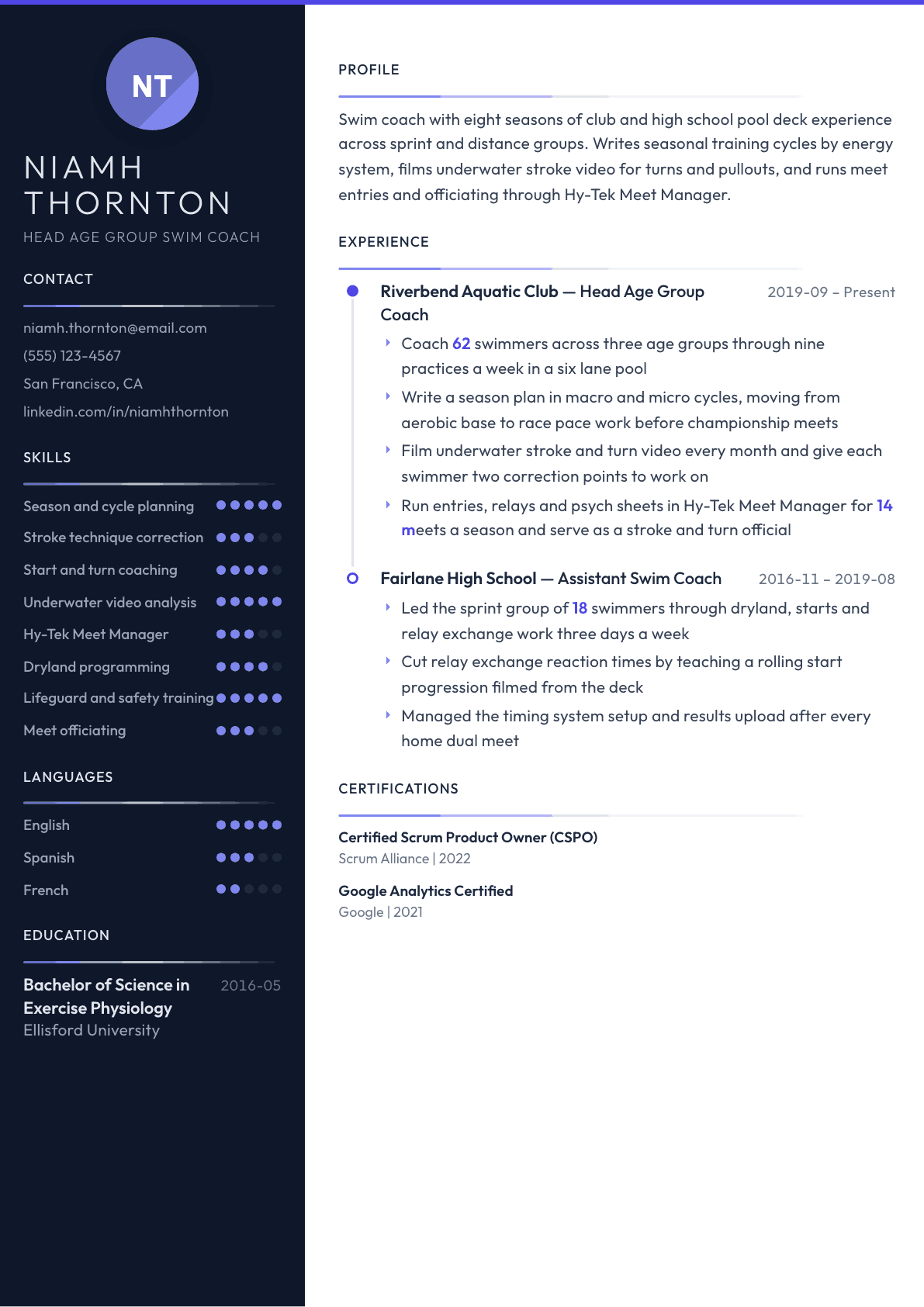
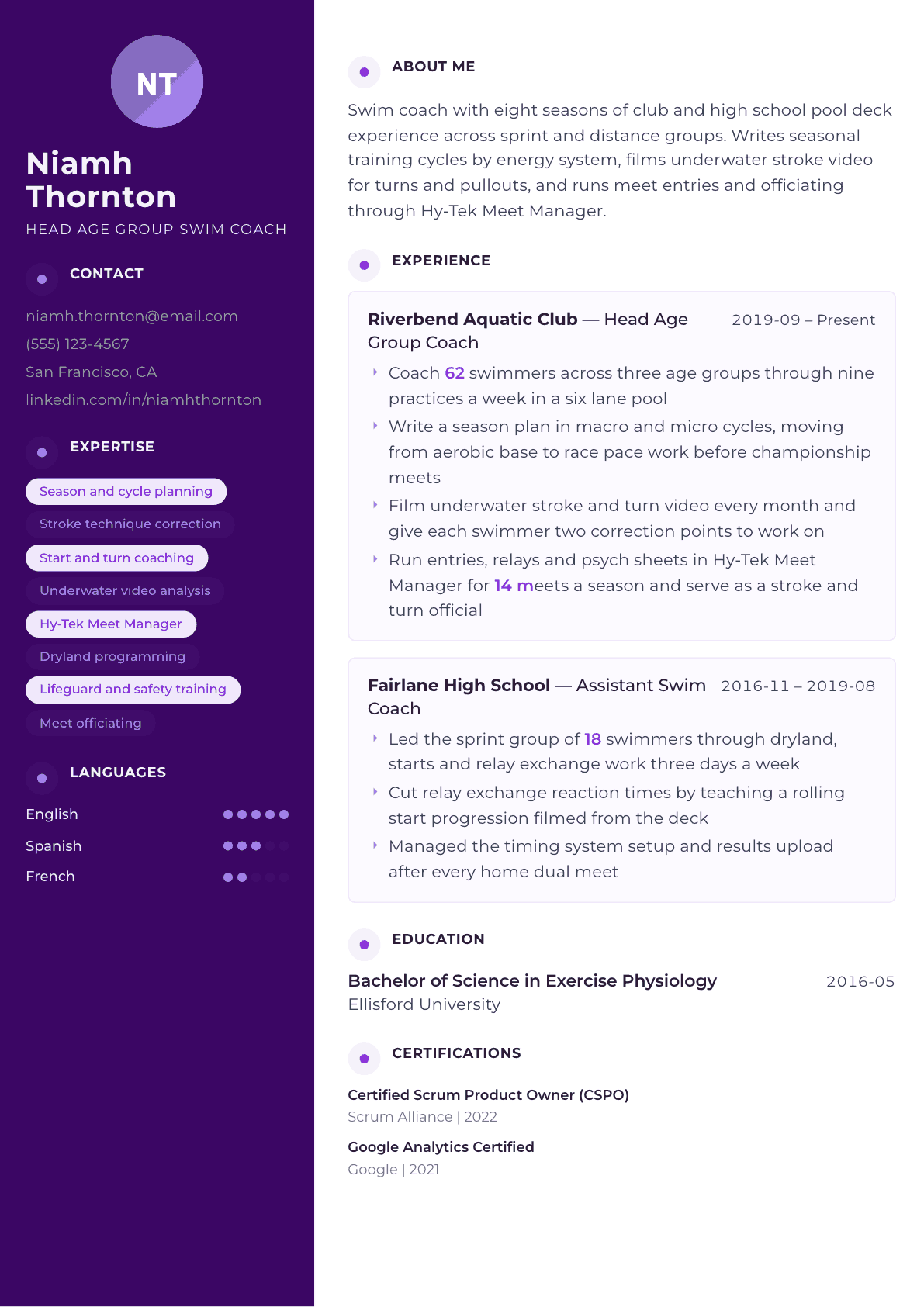
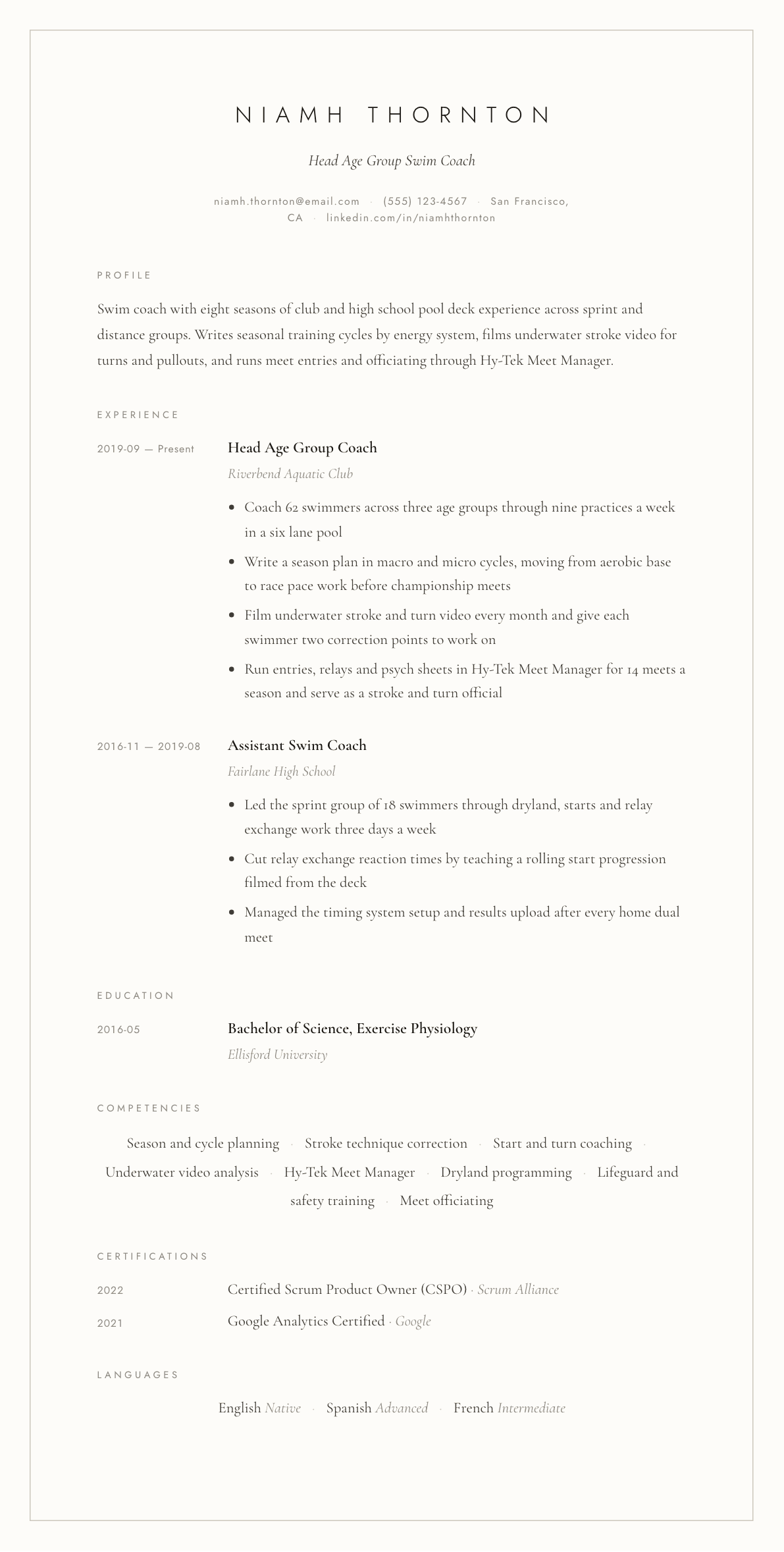
Example Swim Coach summary
Swim coach with eight seasons across club age group and high school programs, currently leading sixty swimmers through nine practices a week. Writes season plans that move from aerobic base to race pace, films underwater video for stroke and turn correction, and runs entries and relays in Hy-Tek Meet Manager. Holds current lifeguard, CPR and coaching certification and officiates as a stroke and turn judge.
Skills to list on a Swim Coach resume
- Season plan design
- Energy system training
- Stroke technique correction
- Start and turn instruction
- Underwater video analysis
- Relay exchange coaching
- Dryland and core programming
- Taper planning
- Meet entry management
- Hy-Tek Meet Manager
- Timing system operation
- Stroke and turn officiating
- Water safety and rescue
- Swimmer progress tracking
What actually gets this resume read
- Give the group you coach: age band, swimmer count, practices a week and lane space, so the workload is measurable.
- Describe your season plan in the language coaches use, from aerobic base through threshold to race pace taper.
- Put your safety certifications up front, since a pool deck job cannot be filled without current lifesaving credentials.
- Name the meet software you run and whether you officiate, because clubs need coaches who can handle entries and sessions.
- Show times, cuts and qualifiers as the outcome, since swimming records improvement more precisely than most sports.
- Include dryland, injury screening and shoulder care work, because shoulder problems drive most swimmer absences.
How to write a swim coach resume
Swimming keeps better records than any other sport a school or club runs, so a swim coach resume is unusually easy to check and unusually easy to write badly. Every athlete has a time, every time has a date, and a coach who claims improvement without naming an event or a cut invites a reader to wonder why the numbers were left out.
A head age group coach is also an operations manager. Lane space, practice slots, meet entries, relay orders, officials, timing equipment and the deck safety plan all sit on the coach. A hiring board wants to know that the person who writes a good set can also get a psych sheet out on deadline.
This guide walks through the sections a club board and an athletic director both read, three summaries for an assistant, an age group coach and a head coach, five rewritten bullets, and answers to the questions that come up when a coach applies to a club and a school in the same season.
Format: certifications on top, groups underneath
Open with a certification block, because nobody stands on a pool deck without current lifesaving and coach safety credentials. Then list positions in reverse chronological order, and give each one the group you coached rather than only the club name.
One page covers an assistant. Two pages suit a head coach carrying multiple groups, meet administration and officiating, provided the second page holds group profiles and meet work rather than a longer list of clinics attended.
- Certification block: coach membership, safety training for swim coaches, lifeguard, CPR and AED.
- Group profile per role: age band, swimmer count, practices per week, lane space, pool length.
- Meet work: entries managed, meets per season, officiating level, timing system operated.
- Then education, any competitive swimming background, and references from the club or school.
Summary: group, volume, training philosophy
Three lines. Which group you coach, how many swimmers and practices, and how you build a season. Clubs hire by group, so a coach who wants the senior group should say it, and a coach who is strongest with ten and unders should say that instead, because both jobs are usually open.
Add one detail that a competing application will not carry: an underwater video routine, a dryland shoulder care block, a written stroke progression, or the meet software you run. That single specific is what gets a resume set aside for a call.
Experience: the group, the season plan, the times
Start each role with the group profile: age band, swimmer count, practices a week, yardage or meterage range, lane space and pool length. A coach who has run nine practices a week for sixty swimmers in six lanes has a workload that a reader can picture immediately.
Then describe the season structure in the vocabulary coaches use: macro and micro cycles, aerobic base, threshold and lactate sets, race pace work, and taper into a championship meet. Say how you decide when to move from one phase to the next and what test set you use to check it.
Finish with outcomes measured the way swimming measures them: best times, qualifying cuts achieved, championship finals, relay placings and swimmers who moved up a group. These are auditable, which is exactly why they persuade.
Technique work, dryland and injury prevention
Technique is where a coach earns the group. Say what you film and how often, whether you shoot underwater, and what a swimmer receives afterward. Name the specific work: pullout timing in breaststroke, a two-beat kick in distance freestyle, breakout depth, back to breast turns, relay exchanges from a rolling start.
Then cover dryland and health. Shoulder care routines, core and hip work, land warm-up before an early practice, and how you screen for the shoulder pain that takes swimmers out of the water more than anything else. Add the ear, skin and hydration reminders that come with daily pool exposure.
- Video routine: what is filmed, how often, and the two corrections a swimmer leaves with.
- Test sets used to check aerobic and race pace progress across a cycle.
- Dryland: warm-up, shoulder care sequence, core block, and who supervises it.
- Absence and injury handling: what a swimmer with shoulder pain is given instead of the main set.
Meets, officiating and administration
Meet administration is a real skill and worth its own block. Entries and deadlines, relay construction, psych sheets and heat sheets, timing system setup, results upload, and coordination with officials and volunteers. Name the meet management software you use and how many meets a season you have run through it.
Officiating certification is a strong differentiator, because clubs must supply officials at every meet and a coach who can stand as a stroke and turn judge reduces a chronic staffing headache. List the officiating level and the association that certified you.
Keywords in swim coaching postings
Club and school listings repeat a small vocabulary: age group coaching, stroke technique, season planning, meet entries, swimmer development, deck supervision, and the safety credentials required. Mirror the exact phrases once high on the page and once inside a role.
Use event and course names precisely, since short course yards and long course meters are different jobs with different sets, and a club looking for a long course summer coach will search for exactly that phrase.
Swim Coach resume summary examples
Assistant coach
Assistant swim coach in a second season leading a sprint group of eighteen through dryland, starts and relay exchanges three days a week. Runs the deck timing setup at home dual meets and holds current lifeguard, CPR and coach safety certification.
Age group coach
Age group swim coach with six seasons, currently leading 62 swimmers across three groups through nine practices a week in a six lane pool. Writes season plans by cycle, films underwater stroke video monthly and produces entries and relays for fourteen meets a year.
Head coach
Head swim coach with twelve seasons across club and high school programs, overseeing four groups, a staff of five assistants and the club meet calendar. Built the dryland and shoulder care curriculum, runs the taper plan into championship meets and serves as a certified stroke and turn official.
Work experience bullets: before and after
Before: Coached swimmers and helped them improve their times.
After: Coached 62 swimmers across three age groups through nine practices a week, with 24 athletes achieving new championship qualifying cuts across the season.
Swimmer count, practice volume and cut achievements give a board figures it can verify.
Before: Planned the training season.
After: Wrote a season plan in macro and micro cycles moving from aerobic base through threshold work to race pace, using a repeat test set every four weeks to confirm the group was ready to progress.
The cycle structure and the test set show a coach who plans against evidence.
Before: Worked on stroke technique with the swimmers.
After: Filmed underwater stroke and turn video every month and sent each swimmer home with two correction points, focusing on breaststroke pullout timing and breakout depth.
A named routine and two named technical faults beat a general statement about technique.
Before: Handled meet entries for the team.
After: Produced entries, relay orders and psych sheets in Hy-Tek Meet Manager for fourteen meets a season and served on deck as a stroke and turn official.
Software, meet count and officiating together solve a staffing problem every club has.
Before: Improved the relay performance.
After: Cut relay exchange reaction times across four teams by teaching a rolling start progression filmed from the deck and rehearsed twice a week during the dual meet season.
The method and its rehearsal schedule explain how the improvement was produced.
Hard skills
- Season plan and cycle design
- Aerobic and race pace set writing
- Stroke technique correction
- Start, turn and breakout instruction
- Underwater video analysis
- Relay exchange coaching
- Taper planning
- Dryland and shoulder care programming
- Meet entry and relay construction
- Hy-Tek Meet Manager
- Timing system setup and results upload
- Stroke and turn officiating
Soft skills
- Deck supervision and safety awareness
- Motivating swimmers through long sets
- Parent communication about cuts
- Assistant coach mentoring
- Calm handling of disqualifications
- Volunteer coordination
Certifications worth listing
- Safety Training for Swim Coaches (American Red Cross)
- Lifeguarding with CPR and AED (American Red Cross)
- ASCA Level 1 Coach Certification (American Swimming Coaches Association)
- SafeSport Trained (U.S. Center for SafeSport)
Mistakes that cost swim coach candidates the interview
- Claiming swimmer improvement without naming an event, a cut or a championship final.
- Leaving out the group profile, so a board cannot tell a summer league squad from a year round senior group.
- Listing sets as yardage totals with no cycle structure behind them.
- Forgetting the meet administration, which is a large share of the work and a common reason clubs replace a coach.
- Omitting current lifesaving and coach safety certifications, which stops the application at the first check.
- Skipping dryland and shoulder care when shoulder pain is the most common reason a swimmer misses practice.
- Writing about a personal swimming career at length while giving the coaching groups a single line each.
Swim Coach resume questions
What certifications does a swim coach need on a resume?
Current coach membership with your governing body, safety training for swim coaches, lifeguard or equivalent water safety credential, CPR and AED, and background screening. List each with the issuing organization, because a club cannot register a coach without them.
How do I describe training volume without listing every set?
Give practices per week, session length, typical distance range and the phase of the season. That tells a reader the workload without turning the resume into a training log, and the interview is where specific sets get discussed.
Should a swim coach list swimmer times on the resume?
List achievements rather than raw times: qualifying cuts earned, championship finals reached, relay placings and swimmers who moved to a higher group. Raw times mean little without the course, the age and the event beside them.
Does officiating experience help a swim coaching application?
Yes, more than most coaches realize. Clubs owe officials at every meet and struggle to staff them, so a certified stroke and turn judge on the coaching staff removes a recurring problem from the board agenda.
How do I move from a summer league job to a year round club?
Show the parts of the year round job you already do: written season plans, technique video, meet entries and progression standards. Then say plainly that you are seeking a year round group, and name the age band you want to lead.
Related resume examples
- Sports Coach Resume example
- Athletic Trainer Resume example
- Swim Instructor Resume example
- Athletic Coach Resume example
- Climbing Instructor Resume example
- Referee Resume example