Scuba Instructor Resume Examples: the lines they read
Build a Scuba Instructor Resume Dive Centers Hire From
By Mustafa Tarabya, founder of CVBooster · Published · Updated
Scuba instructor resume examples with certification level, dive counts, specialty ratings and the safety keywords dive center managers check.
Sample resumes for a scuba instructor
The same scuba instructor content laid out in three CVBooster templates, so you can see what the finished document looks like before you write a word.
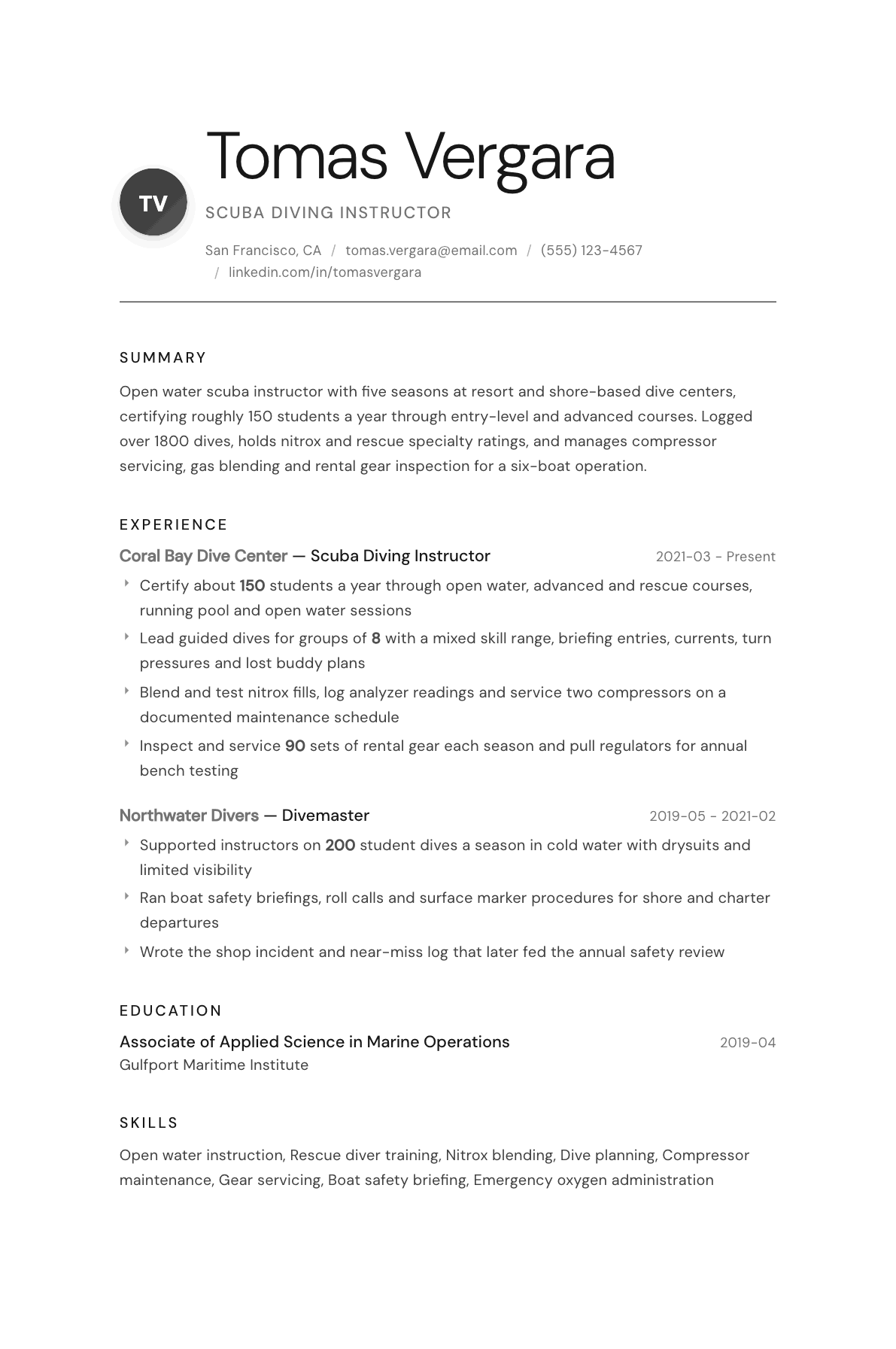
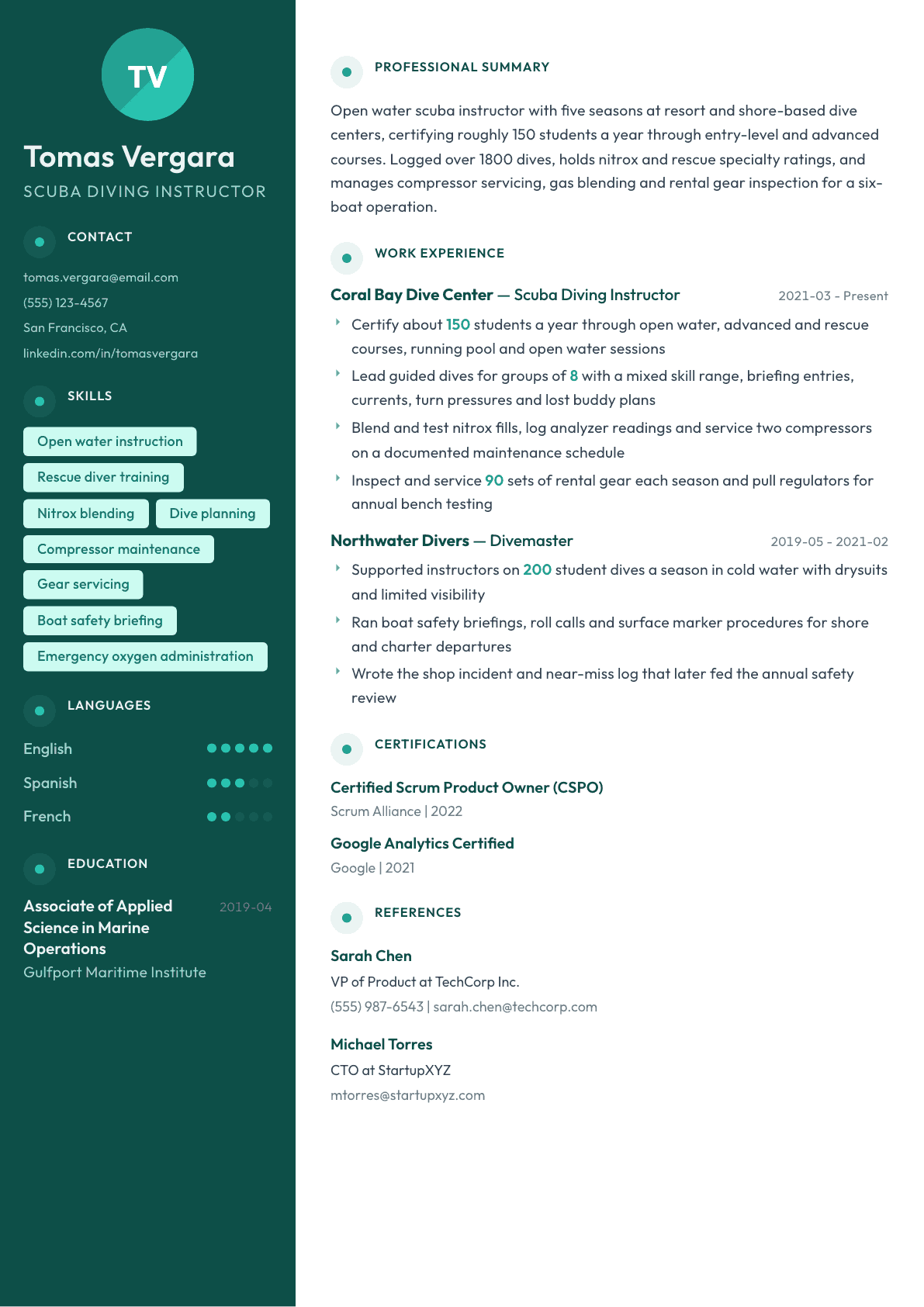
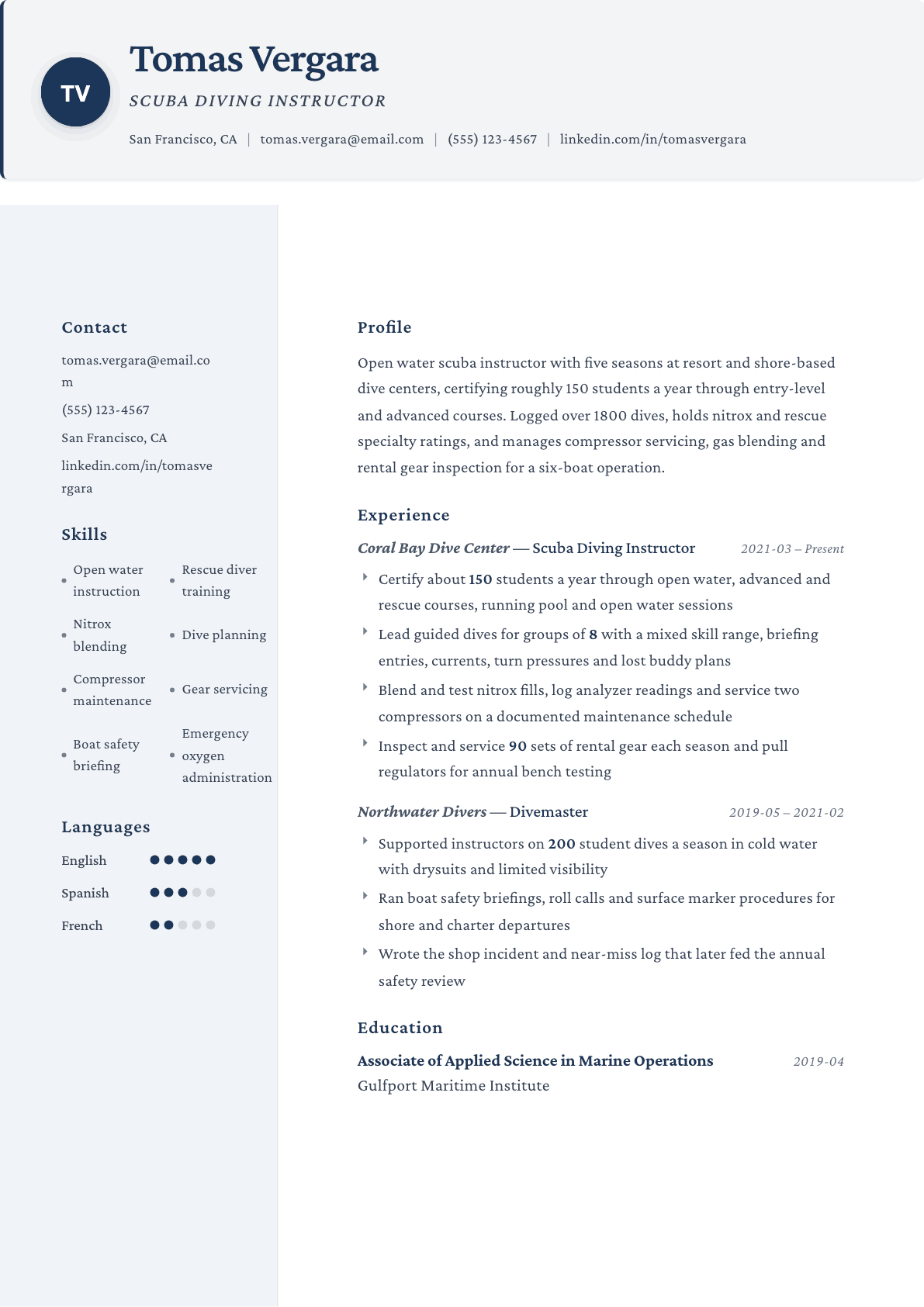
Example Scuba Instructor summary
Scuba instructor with five seasons at resort and shore-based centers, certifying about 150 students a year through open water, advanced and rescue courses. Logged more than 1800 dives, rated for nitrox instruction, and responsible for compressor servicing, gas blending and rental fleet inspection. Looking for a course director track at a year-round training facility.
Skills to list on a Scuba Instructor resume
- Open water instruction
- Advanced open water instruction
- Rescue diver training
- Enriched air nitrox
- Dive planning and briefing
- Boat and shore diving operations
- Compressor operation
- Gas blending and analysis
- Regulator and BCD servicing
- Emergency oxygen administration
- Student assessment
- Risk assessment
- Equipment inventory
- Customer service
What actually gets this resume read
- Lead with your instructor rating, the training agency and your instructor number, because dive centers verify it immediately.
- Give your logged dive count and the conditions you have worked, from warm reef to cold water and limited visibility.
- List every specialty rating you can teach, since a shop hires the instructor who covers the most course catalog.
- Show the technical side of the job: compressor servicing, gas blending, analyzer logs and regulator bench work.
- State your student certification numbers per season, because that is the revenue a dive center is buying.
- Include emergency oxygen provider and first aid credentials with expiry, since they gate you from teaching at all.
How to write a scuba instructor resume
A dive center owner hiring a scuba instructor is buying two things: certifications sold and problems avoided. He wants to know your instructor rating and agency, your instructor number so he can verify it, how many students you certified last season, which specialties you can teach, and whether you can keep a compressor, a fill station and a rental fleet running without being told.
That second half surprises applicants. Most instructor resumes are a list of course ratings and a warm sentence about a love of the ocean. The candidate who gets hired is the one who also handles nitrox blending, analyzer logs, regulator servicing schedules, boat briefings and the incident log, because in a small operation the instructor is also the person keeping the shop legal and safe.
This guide walks through the resume a dive center actually reads, the numbers worth putting on it, three summaries covering a fresh instructor, a working seasonal instructor and a staff instructor or course director candidate, before and after bullets, and the questions instructors ask when moving between resort, liveaboard and cold water work.
Format: rating, agency and instructor number in the header
Put your instructor rating, the training agency and your instructor number in the header, along with your medical clearance status and current first aid and oxygen provider credentials. A dive center verifies you in the agency database before it reads anything else, so make that easy.
Then a short teaching inventory: the courses and specialties you are rated to teach. Shops hire the instructor who covers the widest slice of the catalog, because every rating you hold is a course they can run without calling somebody in.
- Header: instructor rating, training agency, instructor number, renewal status.
- Teaching inventory: entry level, advanced, rescue and each specialty rating you hold.
- Dive log summary: total logged dives, and the conditions split between warm, cold, night and limited visibility.
- Medical, first aid and emergency oxygen provider credentials with expiry.
Summary: seasons, students certified, conditions worked
Three lines. Give the seasons you have worked, the type of operations, the number of students you certified last year, and the conditions you are comfortable in. An instructor who has only worked warm clear resort water is a different hire from one who has taught in a drysuit at low visibility, and both are valid, so be accurate.
Close with the technical or operational responsibilities you carry, because that is what separates candidates on paper. Compressor servicing, gas blending, fill station operation and rental fleet maintenance are the sentences a shop owner reads twice.
Experience: teaching load, guiding and shop operations
Structure each role in three bands. First teaching: courses run, students certified, pool and open water session counts, and how you handle nervous or struggling students. Second guiding: group sizes, briefing content, turn pressure discipline, lost buddy procedure and current or entry hazards specific to the site.
Third operations. Blending and analyzing nitrox, logging analyzer readings, servicing compressors on a documented schedule, inspecting cylinders for visual inspection dates, bench testing regulators and tracking rental inventory. Give volumes: sets serviced, fills made, boats supported.
Skip the bullets that describe diving. Everyone on the shortlist can dive. What varies is student throughput, safety record and whether the gear room falls apart when you are on shift.
Safety record and incident handling
Say plainly that you keep an incident and near-miss log and what you do with it. A shop that has been through a serious event knows the difference between an instructor who documents a bolted ascent and one who lets it pass. Describe the process rather than the story.
List the emergency skills you keep current: emergency oxygen administration, rescue scenario drills, surface marker deployment, missing diver procedure and boat recall protocol. Add how often the team rehearses them, because rehearsed procedure is what a manager is really buying when he checks your safety claims.
- Emergency oxygen and first aid credentials, with the last renewal cycle.
- Rescue and missing diver drills run with staff, and how often you schedule them.
- Incident and near-miss logging, plus the annual review it feeds.
- Student ratios you hold in confined water and open water for each course level.
Keywords dive centers scan for
The vocabulary repeats across job posts: open water instructor, advanced open water, rescue diver, enriched air nitrox, divemaster supervision, dive briefing, dive planning, gas blending, cylinder visual inspection, compressor operation, equipment servicing, boat operations, customer service. Use the ones you hold and put each next to the work that proves it.
Add languages spoken. Resort and liveaboard operations hire on language coverage almost as hard as on ratings, because a full course cannot run when the students and the instructor do not share one.
Scuba Instructor resume summary examples
First season instructor
Newly rated open water scuba instructor with 300 logged dives and a first season assisting on 60 student certifications. Trained in emergency oxygen administration and rescue scenarios, comfortable running confined water sessions, and experienced with rental gear servicing and fill station duties.
Fourth season
Scuba instructor certifying about 150 students a year through open water, advanced and rescue courses at a shore and boat based center. Logged more than 1800 dives across warm and cold water, blends and analyzes nitrox, and services a rental fleet of 90 sets each season.
Staff instructor
Staff instructor with nine seasons across resort and cold water operations, training divemaster candidates and mentoring three instructors through their first year. Owns compressor maintenance records, cylinder inspection tracking and the shop incident log, and runs the annual staff rescue drill cycle.
Work experience bullets: before and after
Before: Taught scuba diving courses to new divers.
After: Certified about 150 students a year through open water, advanced and rescue courses, running confined water sessions and four open water dives per entry-level group.
Student volume and course levels turn teaching into the throughput number a dive center budgets around.
Before: Led guided dives for customers.
After: Guided groups of 8 with mixed experience, briefing entry, current, turn pressure, maximum depth and lost buddy procedure before every dive and running a head count on surfacing.
The briefing content and the head count show the discipline that prevents the incidents a shop fears.
Before: Filled tanks and maintained equipment.
After: Blended and analyzed nitrox fills with logged analyzer readings, serviced two compressors on a documented schedule and tracked cylinder visual inspection dates for the rental fleet.
Naming the logs and the schedule proves compliance work rather than casual gear handling.
Before: Helped nervous students feel comfortable.
After: Rebuilt the confined water mask skill sequence into smaller steps for anxious students, cutting course extensions and repeat sessions across a full season.
A specific teaching change with an operational result is far stronger than a claim about patience.
Before: Followed safety procedures on the boat.
After: Ran boat safety briefings, roll calls and surface marker procedures for every departure and rehearsed the missing diver drill with crew at the start of each season.
Named procedures and a rehearsal cadence give a shop owner something he can verify with the crew.
Hard skills
- Open water and advanced instruction
- Rescue diver training
- Enriched air nitrox instruction
- Dive planning and briefing
- Confined water skill development
- Emergency oxygen administration
- Gas blending and analyzer logging
- Compressor operation and maintenance
- Cylinder visual inspection tracking
- Regulator and buoyancy device servicing
- Boat and shore diving operations
- Student assessment and record keeping
Soft skills
- Patience with anxious students
- Clear briefing delivery
- Group management in water
- Crew coordination
- Customer service in a retail setting
- Multilingual instruction
Certifications worth listing
- Open Water Scuba Instructor (PADI)
- Enriched Air Nitrox Instructor (PADI)
- Emergency First Response Instructor (Emergency First Response)
- Emergency Oxygen for Scuba Diving Injuries (Divers Alert Network)
- Open Water Scuba Instructor (SSI)
Mistakes that cost scuba instructor candidates the interview
- Omitting the instructor number and agency, which forces a shop to chase verification before it can shortlist you.
- Listing course ratings without saying how many students you actually certified in a season.
- Ignoring gear room and fill station duties, which is half the work in a small dive operation.
- Claiming comfort in all conditions without naming cold water, night, drysuit or low visibility experience separately.
- Leaving off languages when resort and liveaboard hiring is driven by the languages a course can run in.
- Filling the page with a love of the ocean instead of ratios, briefing content and safety documentation.
Scuba Instructor resume questions
How many logged dives should a scuba instructor put on a resume?
Give the total and split it by condition, such as warm water, cold water, night and limited visibility. A shop reads the split rather than the total, because an instructor with varied conditions needs less supervision on unfamiliar sites.
Do I list every specialty rating I hold?
List them all, grouped by course level. Every rating is a course the center can run without hiring extra staff, so a wide teaching inventory is a direct commercial argument for hiring you over an equally experienced candidate.
What if my ratings are with a different agency than the shop uses?
Say so plainly and note whether you have crossover experience or are willing to complete a crossover. Many centers accept crossovers, but they will not guess, and a resume that hides the agency gets set aside quickly.
Should I mention maintenance and fill station work?
Yes, and give it real space. Compressor servicing, gas blending, analyzer logs, cylinder inspection tracking and regulator bench schedules are compliance tasks, and an instructor who owns them saves the operation both money and risk.
How do I get hired for a seasonal position overseas?
Lead with student certification volume, languages spoken, your visa or work eligibility position and your availability window. Seasonal hiring is decided on those four points long before anyone discusses your favorite dive site.
Related resume examples
- Personal Trainer Resume example
- Sports Coach Resume example
- Recreation Coordinator Resume example
- Swim Coach Resume example
- Fitness Manager Resume example
- Baseball Coach Resume example