Clinic Manager Resume Examples: the lines they read
Write a Clinic Manager Resume That Proves You Run the Practice
By Mustafa Tarabya, founder of CVBooster · Published · Updated
Build a clinic manager resume with a full example, the operations metrics practice owners check, ATS keywords and a step-by-step writing guide.
Sample resumes for a clinic manager
The same clinic manager content laid out in three CVBooster templates, so you can see what the finished document looks like before you write a word.
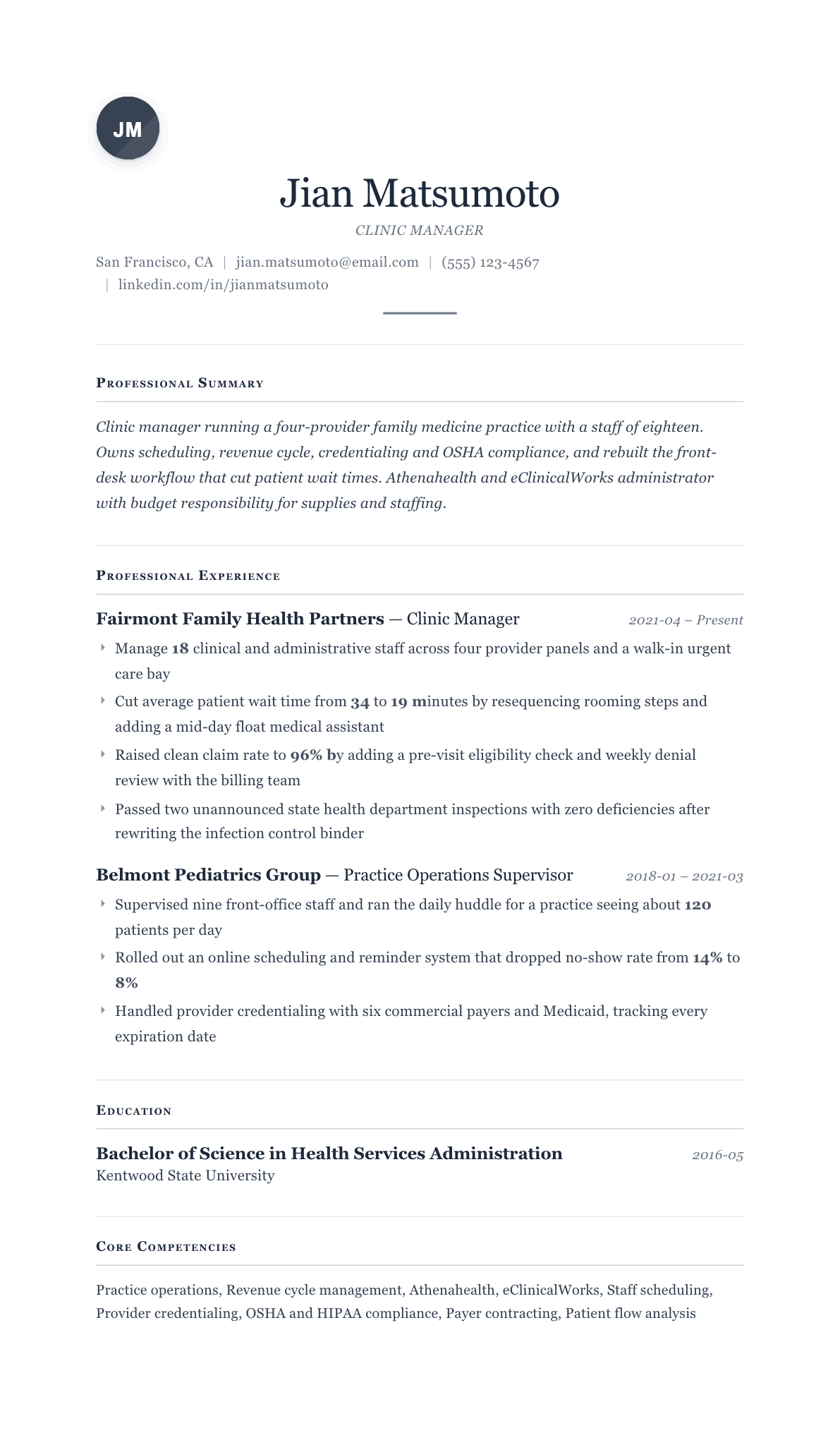
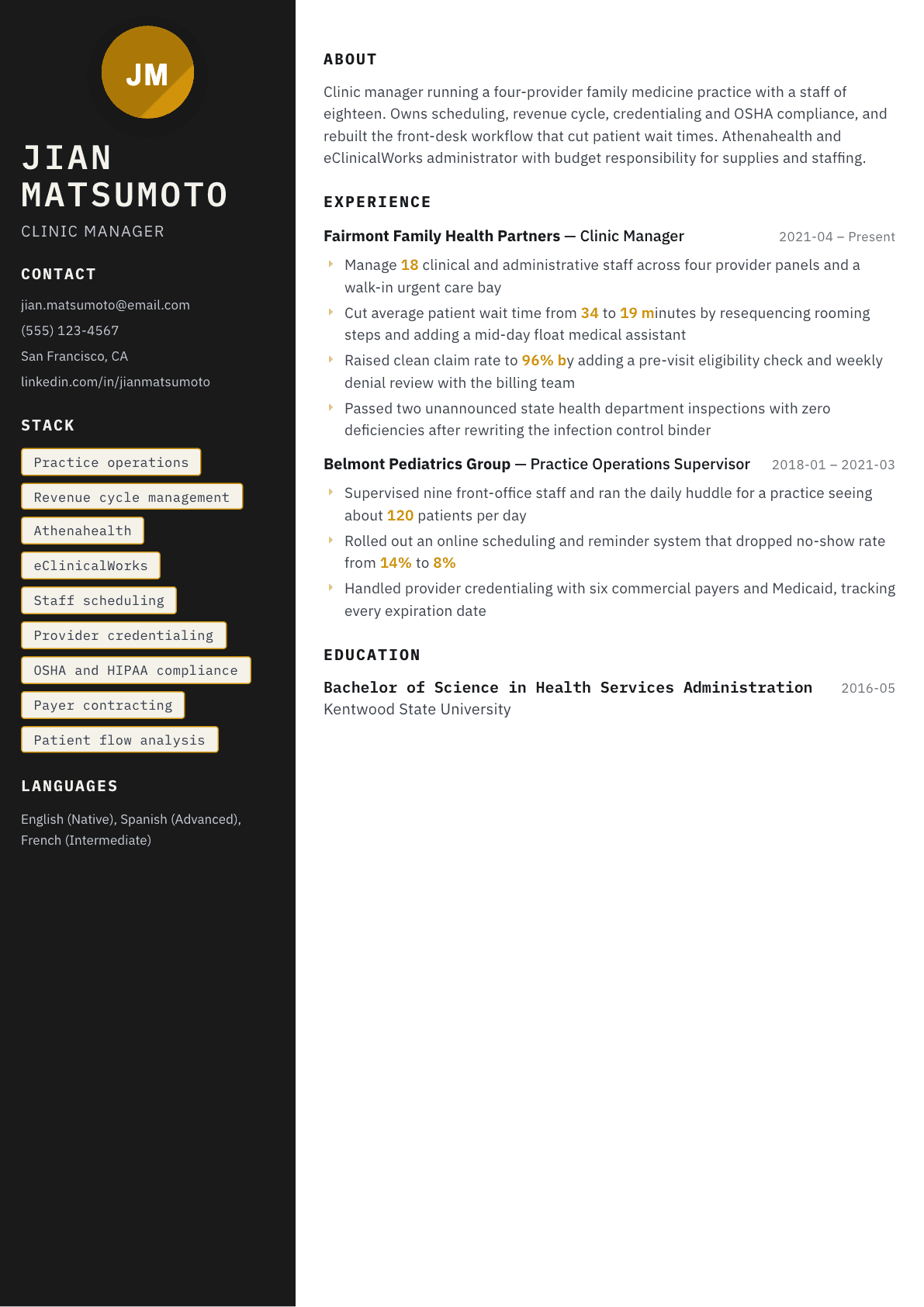
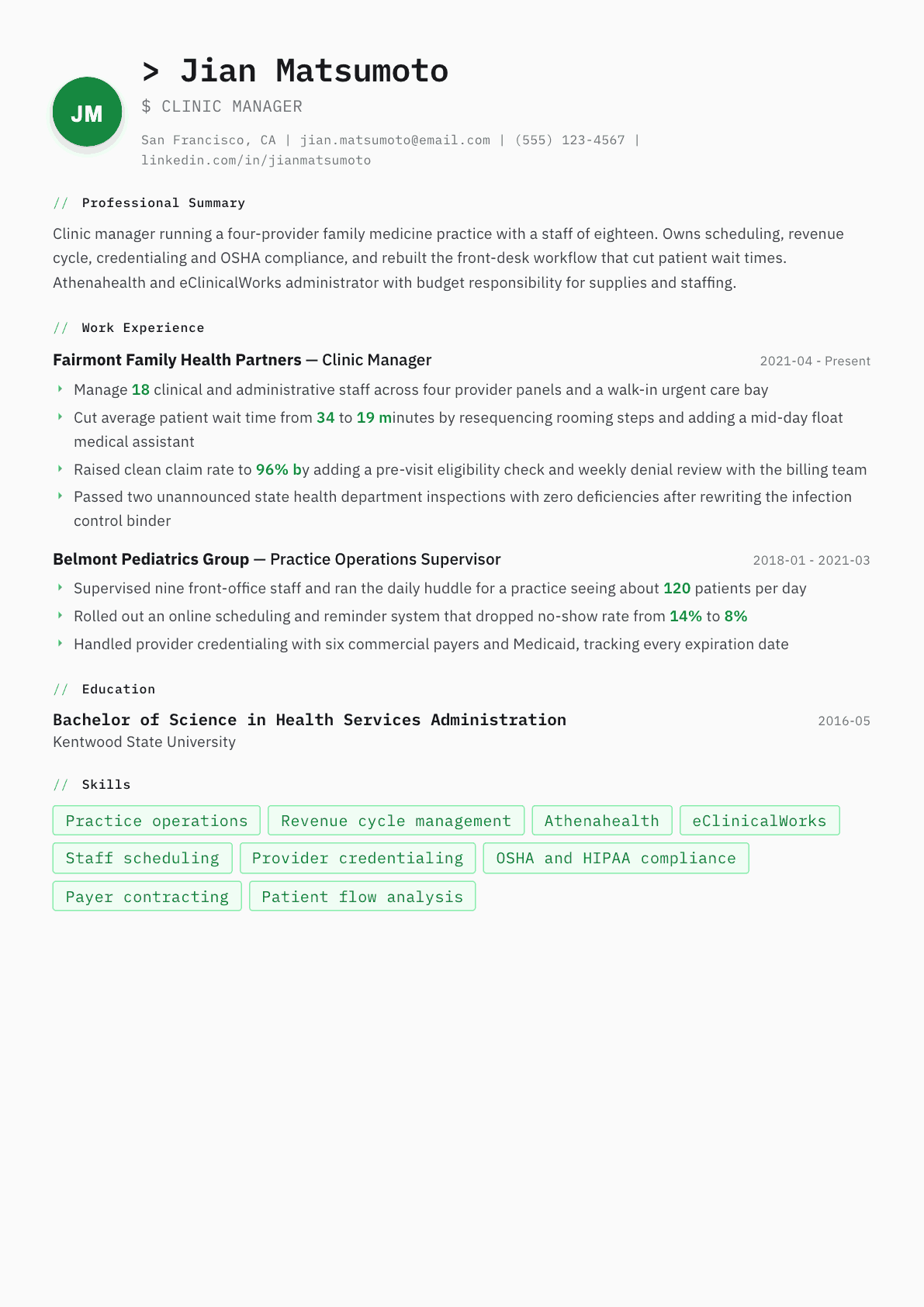
Example Clinic Manager summary
Clinic manager with seven years running multi-provider outpatient practices, most recently an eighteen-person family medicine clinic with an urgent care bay. Rebuilt patient flow to cut wait times by nearly half, lifted clean claim rate to 96%, and carried the practice through two state inspections without a deficiency. Fluent in Athenahealth, payer credentialing and OSHA requirements.
Skills to list on a Clinic Manager resume
- Practice management
- Revenue cycle management
- Patient scheduling
- Staff supervision
- Provider credentialing
- HIPAA compliance
- OSHA compliance
- Electronic health records
- Payer contracts
- Prior authorization
- Budget management
- Patient satisfaction
- Quality reporting
- Inventory and supply control
- Conflict resolution
What actually gets this resume read
- Open every job with the specialty, the number of providers and the staff headcount you managed, because that is the size signal a practice owner reads first.
- Quantify the revenue cycle: clean claim rate, days in accounts receivable, denial rate and collections at time of service.
- Name the practice management and electronic health record systems by name, since most clinic postings screen on the exact platform.
- Show compliance work explicitly: OSHA logs, HIPAA training, CLIA waived testing oversight and any survey or inspection you passed.
- Include hiring and retention figures, because turnover among medical assistants and front-desk staff is the pain most owners are trying to solve.
- Separate operations from clinical duties so a reader can tell whether you carry a license or manage people who do.
How to write a clinic manager resume
A clinic manager resume is usually read by the physician owner or the regional director of operations, and both are looking for the same thing: evidence that the practice ran better while you were in the chair. They want the size of the operation, the systems you administered, and the numbers that moved. A resume built out of duty statements gives them none of that.
The job sits on three legs: people, money and compliance. You hire and schedule the staff, you own the revenue cycle from eligibility check to denial appeal, and you keep the practice ready for an OSHA visit or a payer audit. A resume that covers only the friendly front-office half reads as a lead receptionist file, not a manager file.
This guide walks through the sections in the order a practice owner reads them, with example summaries for a first-time manager, a mid-career manager and a multi-site director, before-and-after bullets built from real practice metrics, and the questions clinic managers ask when they open a blank page.
Format: one page under eight years, two pages once you have multiple sites
Reverse chronological, single column, no icons. Small practices often run a basic applicant tracking system bolted onto a job board, and two-column layouts scramble the dates. Put city and state in the header because commute distance decides more clinic hires than candidates expect.
Order the sections so the operational scope lands first: summary, then a short practice profile block if you have managed more than one site, then experience, then systems, then education and certifications.
- Header: name, credential if you hold one, city and state, phone, email.
- Every job heading carries specialty, provider count and staff headcount.
- Group electronic health record and practice management systems into their own line so a screener can find them in one pass.
Summary: specialty, size, and the operational problem you solve
Four lines at most. Name the specialty, the number of providers, the staff you supervise and the one lever you are best at pulling: patient throughput, collections, staff retention or survey readiness. An owner hiring for a bleeding revenue cycle wants to see revenue cycle language in your first sentence.
If you are moving between specialties, name the transferable operations rather than the clinical content. Scheduling templates, referral workflow and payer credentialing look much the same in dermatology and orthopedics, and saying so removes the objection before it forms.
Experience: scope line first, then results
Start each job with a single scope line that states specialty, provider count, staff count, daily patient volume and the sites you covered. A reader who sees "four physicians, two nurse practitioners, eighteen staff, about 120 visits per day" knows instantly whether you have run something their size.
Then three to five bullets that carry numbers. The metrics an owner tracks are days in accounts receivable, clean claim rate, denial rate, no-show rate, average wait time, staff turnover and patient satisfaction scores. Pick the ones you actually moved and say by how much and how.
Drop the bullets that describe management in general. Everyone in the pile supervised staff and ordered supplies. What separates files is the credentialing backlog you cleared, the schedule template you rebuilt, or the inspection you passed after rewriting the infection control binder.
Systems and compliance: the section that survives the keyword filter
List the electronic health record and practice management platforms with the exact product names: Athenahealth, eClinicalWorks, NextGen, Epic ambulatory, Kareo, Elation. Add the clearinghouse, the patient engagement tool and the payroll or scheduling software. Postings are written from the software the practice already owns, so exact matches matter more here than in most fields.
Compliance belongs in the same neighborhood. Name HIPAA privacy officer duties, OSHA bloodborne pathogen training, CLIA waived testing oversight, controlled substance log audits and any accreditation survey you have carried, such as AAAHC or a state health department inspection.
- Practice management and electronic health record platforms, named exactly.
- Revenue cycle tools: clearinghouse, eligibility checker, patient payment platform.
- Compliance: HIPAA, OSHA, CLIA waived testing, controlled substance logs, survey readiness.
Keywords a practice screener is matching against
Clinic postings recycle a short vocabulary: practice operations, patient flow, revenue cycle, prior authorization, credentialing, staff scheduling, patient satisfaction, budget management and regulatory compliance. Use each phrase once in the summary or systems line and again inside a bullet where you can prove it. Repetition without proof reads hollow to the human who follows the software.
Clinic Manager resume summary examples
First manager role
Lead medical office coordinator stepping into practice management, with three years running front desk operations for a two-physician internal medicine clinic. Rebuilt the scheduling template, trained four staff on eligibility checks, and cut no-show rate through automated reminders. Working knowledge of eClinicalWorks, prior authorization workflow and OSHA training records.
Six years managing
Clinic manager for a four-provider family medicine practice with eighteen staff and an urgent care bay. Owns hiring, scheduling, revenue cycle and compliance. Cut average wait time from 34 to 19 minutes, lifted clean claim rate to 96%, and passed two unannounced state inspections without a deficiency.
Multi-site director
Director of clinic operations for five outpatient sites, ninety staff and twenty-two providers across primary care and two specialties. Standardized scheduling templates and credentialing across all locations, reduced days in accounts receivable from 51 to 34, and held annual staff turnover under 15% in a market with heavy competition.
Work experience bullets: before and after
Before: Responsible for daily operations of a medical clinic.
After: Ran daily operations for a four-provider family medicine clinic with eighteen staff and about 120 visits per day, covering scheduling, staffing and supply budget.
Provider count, headcount and daily volume let the reader size the job instead of guessing at it.
Before: Improved billing processes.
After: Raised clean claim rate to 96% by adding a pre-visit eligibility check and a weekly denial review with the billing team, cutting rework on returned claims.
A named metric plus the two changes behind it turns a claim into a method someone can repeat.
Before: Handled staff scheduling and hiring.
After: Hired and onboarded nine medical assistants and front-desk staff over two years and held voluntary turnover under 15% by moving to a published four-week rotating schedule.
Hiring volume, a retention figure and the specific scheduling change make the people work verifiable.
Before: Made sure the clinic followed regulations.
After: Rewrote the infection control and bloodborne pathogen binder, ran quarterly OSHA training for all clinical staff, and passed two unannounced state health department inspections with zero deficiencies.
Naming the documents, the training cadence and the inspection outcome proves compliance rather than asserting it.
Before: Worked to reduce patient wait times.
After: Cut average patient wait from 34 to 19 minutes by resequencing rooming steps, adding a mid-day float medical assistant and moving intake paperwork to the patient portal.
The before and after numbers plus three concrete levers show operational thinking, not good intentions.
Hard skills
- Practice operations management
- Revenue cycle management
- Provider credentialing and enrollment
- Staff scheduling and payroll
- Prior authorization workflow
- Denial management and appeals
- Electronic health record administration
- HIPAA privacy compliance
- OSHA and infection control
- Budget and supply management
- Patient satisfaction reporting
- Payer contract review
Soft skills
- Staff coaching
- Conflict resolution
- Physician communication
- Change management
- Patient service recovery
- Vendor negotiation
Certifications worth listing
- Certified Medical Practice Executive (CMPE) (American College of Medical Practice Executives)
- Certified Medical Manager (CMM) (Professional Association of Health Care Office Management)
- Certified Professional Coder (CPC) (AAPC)
- Certified Professional Biller (CPB) (AAPC)
- Certified in Healthcare Compliance (CHC) (Compliance Certification Board)
Mistakes that cost clinic manager candidates the interview
- Writing the resume as a list of duties when the owner is buying results: wait times, collections, retention and survey outcomes.
- Leaving out provider count and staff headcount, so a reader cannot tell a solo practice from a five-site group.
- Naming no software at all, which drops the file out of every posting written around a specific practice management system.
- Burying revenue cycle work under general administration when it is often the reason the position opened.
- Claiming compliance responsibility without a single inspection, audit or training program to point at.
- Using a decorative two-column template that scrambles employment dates in the small parsers many private practices use.
Clinic Manager resume questions
Do I need a clinical background to be a clinic manager?
Not usually. Many practices hire from the business side and rely on the lead nurse for clinical judgment. What they will not overlook is revenue cycle knowledge, staffing skill and comfort with regulatory requirements, so put those in front if you have never worked at the bedside.
Which metrics belong on a clinic manager resume?
Days in accounts receivable, clean claim rate, denial rate, collections at time of service, no-show rate, average patient wait, staff turnover and patient satisfaction scores. Choose four you personally moved, give the before and after, and explain the change that caused it.
How do I move from medical office manager to clinic manager?
Show the parts of the job you already own beyond the front desk: budget input, hiring decisions, credentialing, compliance training and payer communication. Then name the scope you are ready for, since the difference between the two titles is mostly financial and staffing authority.
Should I list certifications if I am still studying for them?
Yes, with the honest status. Write the credential name, the awarding body and the phrase in progress with your expected exam window. Practices respect a candidate who is midway through a recognized program, but they will not forgive a credential implied and not held.
How much detail should I give about the electronic health record?
Name every platform you have administered, and say what level of access you held: template building, user provisioning, report writing or vendor escalation. A manager who can build a schedule template and pull a productivity report is worth far more than one who only charted in the system.