CV Examples: What a Good One Shows You
By Mustafa Tarabya, founder of CVBooster · Published · Updated
12 min read
A CV example is worth looking at for three things: the order of its sections, what sits in the top block, and how long it runs. All three change by country. That is why an unlabelled CV example is a document of unknown nationality, and the internet is full of them, each one confidently formatted for a country it does not name.
Which document you should be sending in the first place, and what the word CV even means in your country, is a separate question with a clean answer, and it is answered in CV vs resume. This page assumes you have settled that and are now looking at examples, trying to work out which of them you can learn anything from.
What should a CV example actually show you?
Three things, and none of them are the candidate's achievements.
- The top block. Everything between the top of the page and the first job entry: what the header contains, whether there is a photo, whether there is a personal details section, whether there is a profile paragraph. This is the part that differs most between markets and the part people get wrong most often when they apply abroad.
- The section order and what the sections are called. Whether education sits above or below employment, whether languages get their own section, whether there is a referees block on the document itself.
- The length and the density. Whether the document is one page, two, or eleven, and how much detail sits under each entry. A market's length convention is almost impossible to describe usefully in prose and immediately obvious from a document.
What a CV example cannot show you is whether it worked, who read it, or whether the person got the job. Treat the content the way you would treat any example: the container transfers, the contents do not. That split, and the specific damage done by copying numbers and phrasing, is worked through in how to use resume examples. Applying in marketing, the marketing covering letter examples show the letter that goes with the CV.
How do you tell which market an example is from?
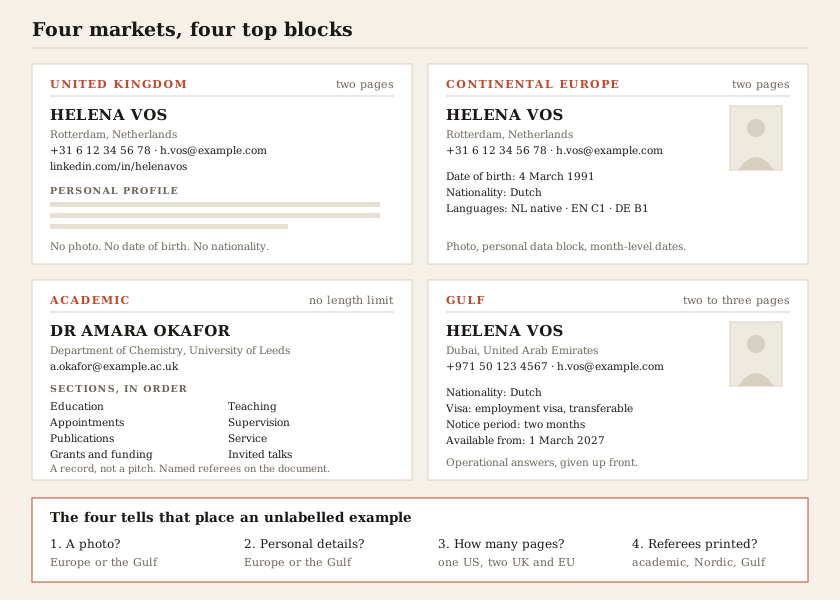
Four tells, readable in about five seconds without knowing anything about the field. Run them before you learn anything from a document.
- Is there a photo? A photo places the example in continental Europe, the Gulf, or parts of South Asia. No photo places it in the UK, Ireland or North America, or in a European market that has moved away from the convention.
- Is there a date of birth, a nationality or a marital status? A personal details block containing any of those is continental European, Gulf or South Asian. Its absence points to the UK, Ireland or North America.
- How long is it? One page is North American. Two pages is British, Irish and most of continental Europe. Anything past four pages, with a publication list, is academic and belongs to no country in particular.
- Are named referees printed on the document with phone numbers? That is academic, Nordic, or Gulf. "References available on request" is British. Nothing at all is North American.
Run those four and an unlabelled example resolves itself. If they contradict each other, the example was assembled by someone who was not thinking about a market, which is a reason to stop reading it rather than a puzzle to solve.
What does a good UK CV example show?
A UK CV example should look almost exactly like a US resume with an extra page, and that similarity is the trap, because the differences are small enough to be missed and specific enough to be noticed.
The top block is a name, a city, a phone number, an email address and a LinkedIn URL. Nothing else. Then a personal profile of three or four lines, which is a British convention rather than a universal one and which sits where an American resume would put a summary. No photo, no date of birth, no marital status, no nationality unless your right to work is genuinely in question.
Two pages is the expectation, not a concession. An example that squeezes a fifteen-year career onto one page is showing you an American document with British spelling. Dates are written day-first, so an example showing 03/06/2026 means the third of June, and an example that uses the American ordering is not a UK example. For a technical field, our engineer curriculum vitae example page has six complete UK engineering CVs from placement student to chartered engineer.
The one thing a good UK example still carries that surprises people is a line about references, usually the phrase "references available on request" at the foot of page two. It is doing no work and it is entirely conventional, which is a fair summary of a lot of CV convention. What belongs on a UK CV and what does not is covered in more detail in what not to include on a UK CV. If you are applying to a law firm or chambers, the law CV example page has six finished legal CVs, from vacation scheme to solicitor. For shop work, the retail assistant CV example page covers six UK retail CVs, from a Saturday job to a key holder.
What does a good continental European CV example show?
The distinguishing feature is the top block, and a good example makes its contents obvious rather than making you guess.
Expect a personal data section: name, city, phone with an international dialling code, email, and usually a date of birth. A photo is common in German-speaking countries, France, Spain, Italy and Portugal, and less common in the Netherlands and the Nordics. A useful example will show you which of those it is, and will not present a photo as universally European, because it is not.
Two other features tell you the example is serious. The first is dating precision: a good continental example dates every entry to the month, because month-level dates are read for gaps in several of these markets and years-only dating reads as concealment. The second is a languages section with levels expressed on the Common European Framework scale, the A1 to C2 ladder, rather than the vague English-language phrasing of "fluent" or "conversational".
There is a specific example type worth knowing about because it is often the thing people find first when they search. Europass is the European Commission's own CV builder, described on its site as one of the best-known CV formats in Europe, and it produces a uniform document in 31 languages. Europass is genuinely correct when a posting names it, and it is a poor default otherwise, because every Europass CV looks identical and the format buries your strongest three lines under structure. The country-by-country detail behind all of this is in the European CV vs the American resume.
What does a good academic CV example show?
An academic CV is a different genre wearing the same name, and a good example makes that obvious within one screen: there are more section headings than there is prose, and the document does not try to persuade anyone of anything.
What you are looking for in an academic example is the section list and its order, because that is the entire skill. A conventional order runs education, appointments, publications, grants and funding, teaching, supervision, service and administration, invited talks, and professional memberships. The variations between fields are real and an example from your own discipline settles them: whether preprints are listed, whether conference proceedings sit with articles or separately, whether datasets and software get their own heading, whether authorship position is marked.
Two structural things a good example teaches that no written rule conveys. First, that publications are formatted in the discipline's citation style, consistently, with your own name emphasised, and that this consistency is itself part of what is being assessed. Second, that there is no length limit and no attempt at one: an academic CV is a record rather than a pitch, and a hiring committee reads it against a set of published criteria rather than skimming it for a hook.
The failure mode a bad academic example teaches you is compression. If you find an academic CV example that fits on two pages, it is either an early-career document or a commercial resume with a publications heading bolted on. Neither will show you how to structure the real thing.
What does a good Gulf CV example show?
Gulf examples carry a block of information that reads as strange in London or Chicago and is entirely practical in Dubai, Doha or Riyadh, because it answers the questions an employer there will actually have to resolve before they can hire you.
Expect nationality, visa or residency status, notice period, and a date of availability, alongside the ordinary contact details. A photo is common and its absence is not read as a statement either way. Marital status still appears frequently, though it is doing less work than it used to.
The reason those items are there is worth understanding rather than memorising, because it tells you which of them matter in your case. A large share of hiring in these markets involves sponsorship and work permits, and your current visa status determines how long it takes and how much it costs to bring you on. An example that includes those lines is not being nosy. It is answering an operational question, and a candidate who omits it makes the employer ask.
Two or three pages is unremarkable. Detailed responsibilities under each role are more common than the tight outcome-only bullets favoured in the UK and the US, and an example from the region will show you a fuller entry than you may be used to writing.
What does every good example have, whatever the market?
Strip out the market conventions and what remains is the same everywhere, which is a useful thing to notice because it tells you how much of your document you can carry across borders unchanged.
- Reverse chronological employment, most recent first, with dates that run continuously and are formatted the same way throughout.
- One line per role naming the employer, your title, the location and the dates, before any bullets. A reader should be able to reconstruct your career from those lines alone.
- Entries that get shorter as they get older. A good example spends most of its detail on the last two roles and reduces a job from twelve years ago to a line.
- Evidence rather than duties. The difference between a strong and weak entry is the same in every language.
- A consistent visual system: one heading treatment, one date position, one bullet style, used throughout without exception.
That is roughly eighty per cent of the document. It means the honest version of localising a CV is not rewriting it, it is swapping the top block, adjusting the length, and deciding about a photo. Which is a twenty-minute job, not an evening's.
What makes a CV example useless?
Four things, and any one of them is enough to close the tab.
- It does not say which country it is for. You cannot use what you cannot place, and guessing from the spelling is not enough because plenty of examples are written in British English for an American layout.
- The four tells contradict each other: a photo and a UK phone number, or a personal data block and a strict one page. Assembled rather than observed.
- It is an image with no readable structure, or a gallery thumbnail small enough that you are learning its colour scheme rather than its section order.
- Everything in it is impressive and nothing in it is ordinary. Real CVs contain a two-year role that was fine, a qualification that turned out not to matter, and a job title nobody understands. An example with none of those is showing you a fantasy career rather than a document.
Tip: If you are applying into a market you have never worked in, the most valuable example is not on a resume site. Look at how people currently in that role present themselves publicly, and look at the company's own careers pages and staff profiles. That is the local convention observed rather than reconstructed.
One candidate, four documents
To make the split concrete, here is the same invented person rendered four ways. She is a logistics manager with eleven years of experience, three employers, Dutch and English at a professional level, and a supply chain postgraduate qualification.
The UK version: two pages, name and city, four-line profile, eleven years across three roles with the current one carrying five bullets, education at the foot of page two, no photo, no birth date, a references line at the bottom.
The continental version: same two pages, same jobs, same bullets. Added at the top is a photo, a birth year and a nationality. Added near the bottom is a languages section reading Dutch, native speaker; English, C1; German, B1. Every date now carries a month. Nothing in the experience section changed at all.
The Gulf version: same body again, with nationality, visa status, notice period and availability date in the top block, and slightly fuller responsibilities under each role.
The academic version does not exist, because she is not an academic. That is the last thing a set of examples should teach you: an academic CV is not a longer commercial CV, and no amount of expanding the one produces the other.
What to do next
Decide the market first, then go looking. Searching for a CV example before you have decided which country's conventions you are applying under produces a document that is slightly foreign everywhere, which is the worst available outcome because it signals that you did not know there were rules.
Then build one master document with everything in it, including the photo, the birth date, the referees and the languages, and keep it private. Every market version is that document with things deleted, which takes minutes. Reconstructing a deleted detail six months later when you apply somewhere else does not.
When the structure is settled, the resume format guide covers the format underneath it, and the resume review is the read-through to run before you send anything. Doctors have their own section order, shown in five complete UK examples in our medical CV template. Two fields have conventions of their own: the CV for accountancy examples show where AAT, ACCA and ACA status goes, and the CV for a dancer uses a casting layout with a headshot.
Related articles
- Accounting Executive Resume: 5 Examples by Career Level
- Administration Resume Examples: 8 Samples, Entry to Manager
- Aged Care Resume: 6 Australian Examples and a Template
- Another Word for Resume: CV, Bio and 10 More Options
More articles
- CV Examples No Work Experience: 6 UK CVs Written Out
- CV Format for Engineers: Layout, Sections and 6 Examples
- CV Icons: Which Symbols to Use, With 6 CV Header Examples
Looking for a worked example for your job title? Browse the resume examples by job title.