Child Support Officer Resume Examples: read this first
Build a Child Support Officer Resume Around Caseload and Collections
By Mustafa Tarabya, founder of CVBooster · Published · Updated
Child support officer resume example with enforcement keywords, caseload and collection rate tips, and a guide to establishment and modification work.
Sample resumes for a child support officer
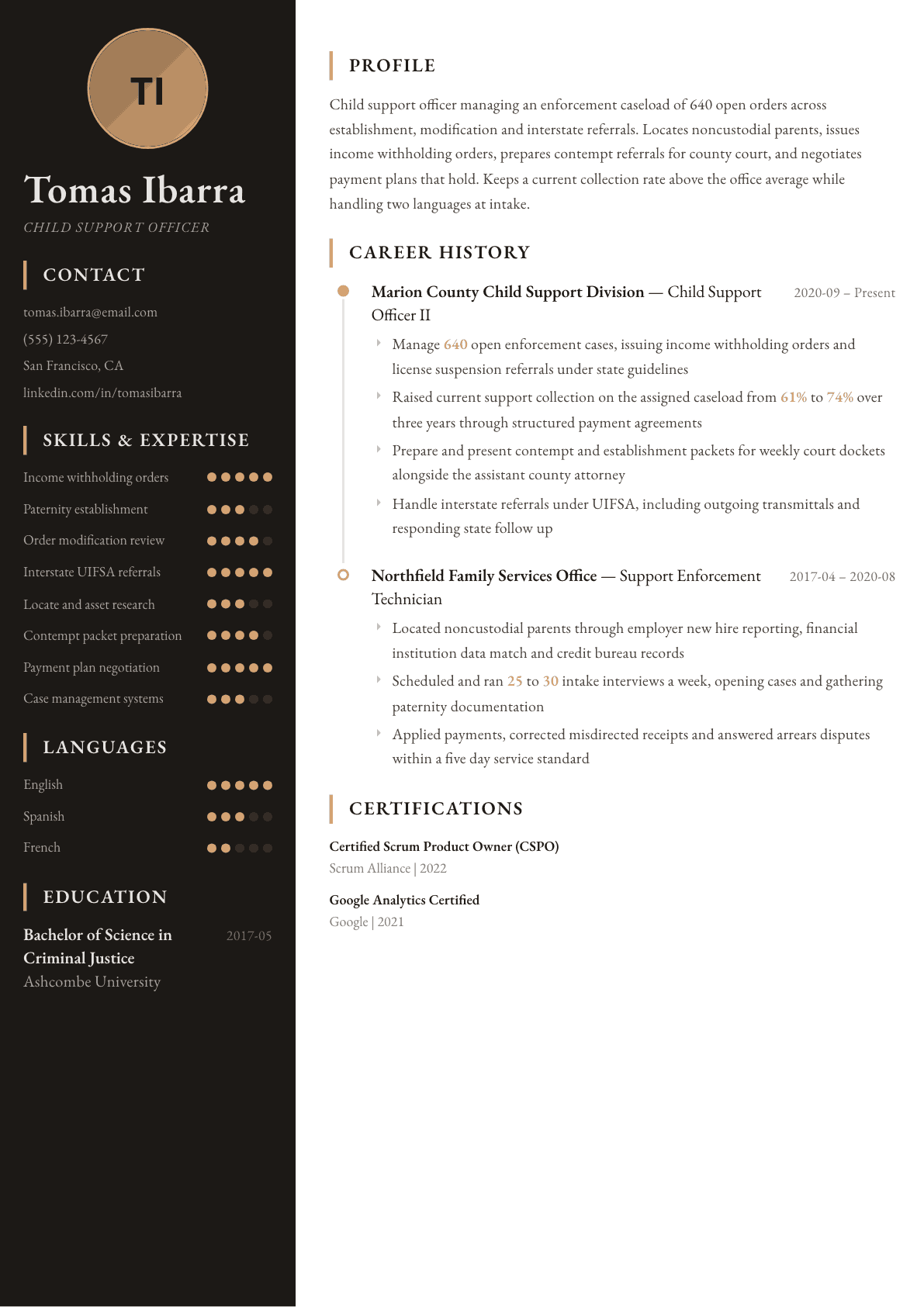
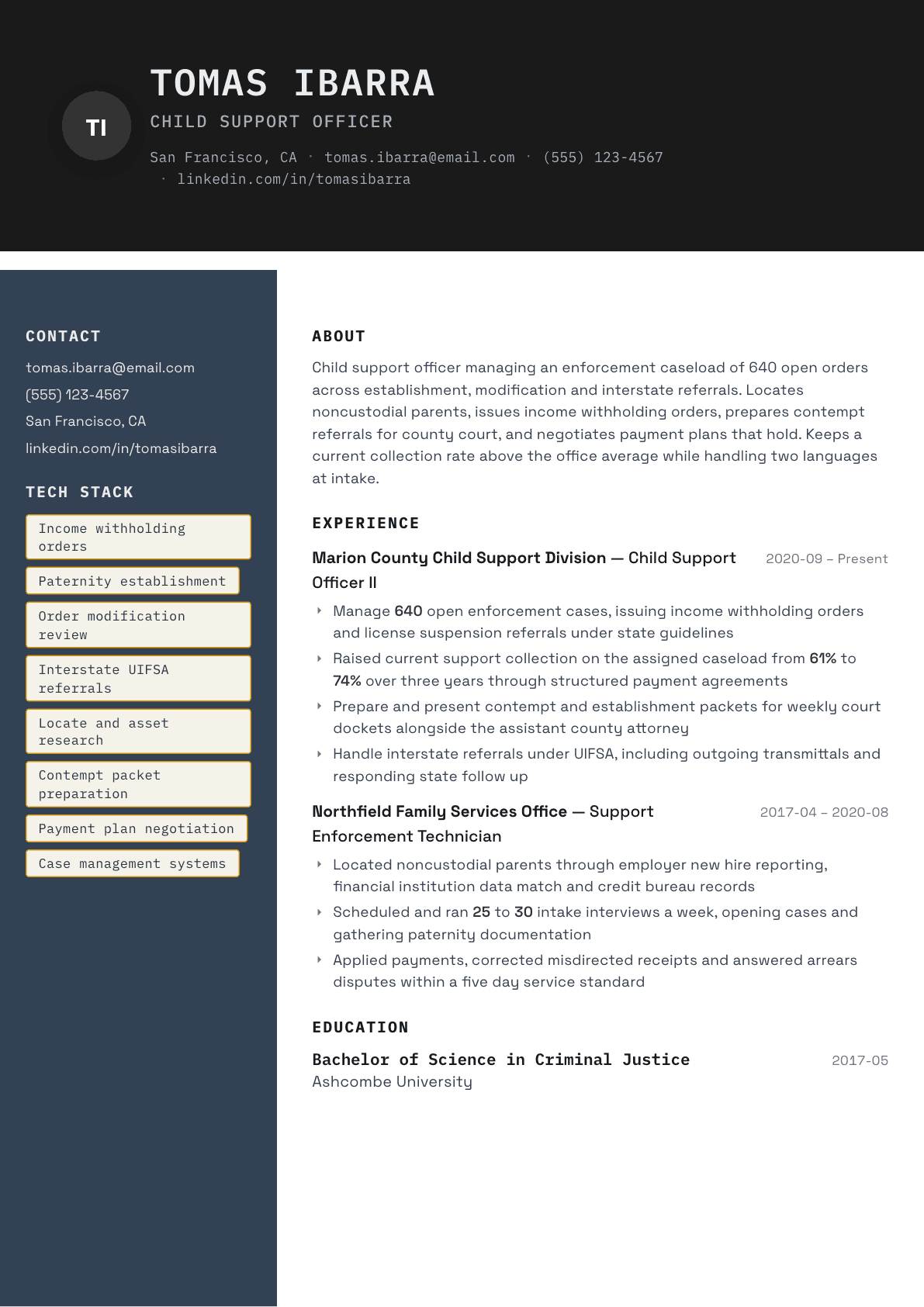
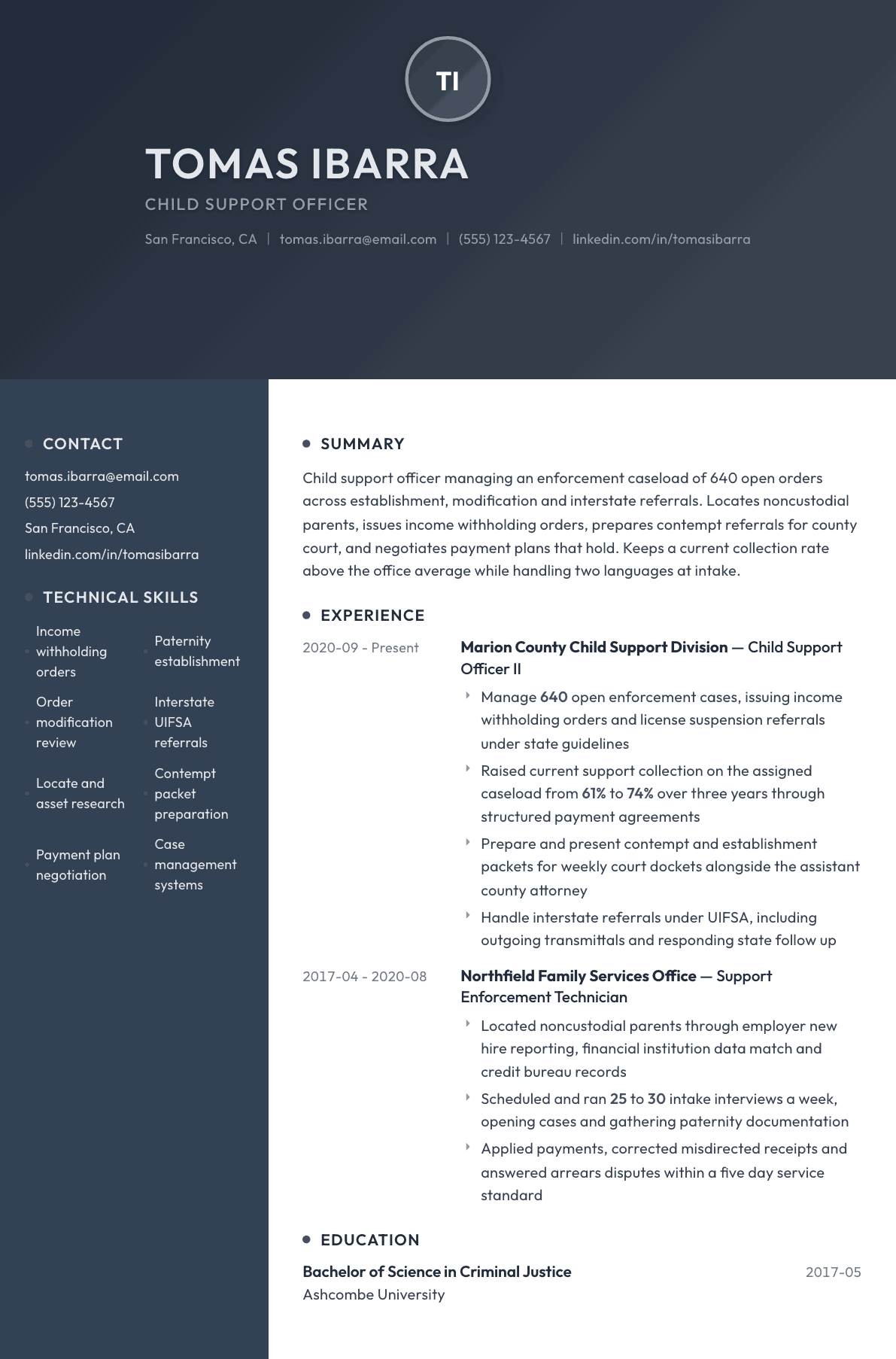
The same child support officer content laid out in three CVBooster templates, so you can see what the finished document looks like before you write a word.
Example Child Support Officer summary
Child support officer carrying an enforcement caseload of more than 600 open orders across establishment, modification and interstate referrals. Issues income withholding orders, builds contempt packets for the weekly docket, and negotiates payment agreements that survive the first missed paycheck. Locates parents through new hire reporting and financial data match, and raised current support collection on the assigned caseload by 13 points across three years.
Skills to list on a Child Support Officer resume
- Child support enforcement
- Order establishment
- Paternity acknowledgment processing
- Income withholding orders
- Arrears calculation
- Modification review
- Interstate case processing
- Locate and asset research
- Contempt referral preparation
- Court docket preparation
- Payment plan negotiation
- Case documentation standards
- Confidentiality and records handling
- Conflict de-escalation
- Bilingual intake interviewing
What actually gets this resume read
- State your caseload size and whether it is establishment, enforcement, modification or a mixed queue, because the work differs.
- Give a collection figure with the basis, such as current support collected or cases with a payment in the last quarter.
- Name the enforcement tools you actually use: income withholding, tax offset, license suspension, liens and contempt referral.
- Say how often you appear in court and whether you present your own packets or hand them to a county attorney.
- Describe your locate work, from new hire reporting and financial data match down to the calls that find a current employer.
- Show how you de-escalate at the counter, because parents arrive angry and a calm officer keeps a case moving.
- List the statewide case management system by name, since agencies hire around the system they already run.
How to write a child support officer resume
A child support officer sits between a court docket and a phone that rings all day. The supervisor reading your resume is trying to work out two things: whether you can carry several hundred open cases without losing the ones that need action this week, and whether you can sit across from an angry parent, explain an arrears balance, and keep the conversation from becoming an incident report.
Most applications for this job fail on vagueness. They say the candidate provided case management services to families and maintained accurate records. That describes half the public sector. What a division director wants is the caseload number, the queue type, the enforcement tools you have actually pulled, how often you stand in court, and whether the money moved. Collections are the metric the office is judged on, so a resume that never mentions them is asking her to guess.
This guide covers how to structure the page for an enforcement office, how to write establishment, modification and interstate work, what to say about court appearances and locate research, and the questions officers ask when they move from one state system to another or come in from social services.
Format: caseload and queue type before anything else
Reverse chronological, one page under about ten years. Under your job title, put the caseload and what kind of queue it was, because establishment, enforcement, modification and interstate are four different jobs sharing one title. An officer who has spent five years building paternity and order establishment cases has a court skill set. An officer who has spent five years on enforcement has a locate and collections skill set. Say which you are before the reader has to infer it.
Put the statewide case management system next. Every state runs its own automated system, and a hiring supervisor is quietly calculating training weeks. If you have worked in more than one state system, list both, because that is rare and it signals you learn a platform rather than memorizing screens.
- Caseload in open cases, with the queue type named: establishment, enforcement, modification, interstate or mixed.
- The statewide automated case management system, plus any document assembly or imaging tool you use daily.
- Court exposure: docket frequency, whether you present your own packets, and which court hears your cases.
- A collections line: current support collected on the caseload, or cases with a payment inside the quarter.
- Language skills, since intake counters and phone queues run bilingual in most offices.
Summary: caseload, tools, court, and whether the money moves
Four facts in three lines. What you carry, what enforcement remedies you use, how often you appear before a judge or magistrate, and one collection figure with its basis. An officer who writes that she manages 640 enforcement cases, issues withholding orders and license referrals, presents contempt packets on a weekly docket, and lifted current support collection over three years has told a director everything the first screen needs.
A collection figure needs a basis attached or it means nothing, because offices measure differently. Say whether it is current support collected against current support owed, the share of cases with a payment in the quarter, or arrears collected. Naming the denominator is what makes the number credible.
Experience: establishment, enforcement and the cases that stall
Write the case lifecycle in the order it moves. Intake interview and application, locate work, service of process, genetic testing scheduling and paternity acknowledgment, order establishment with the guideline calculation, income withholding, then the long tail of enforcement: tax refund offset, financial institution data match, license suspension referral, passport denial, liens, and contempt. Name the remedies you have personally initiated, not the ones your state offers.
Locate work deserves its own bullets because it is where an officer either finds the parent or does not. Employer new hire reporting, quarterly wage records, credit bureau data, jail and prison records, unemployment claims, and the plain calls to a last known employer or relative. Say how many cases a month you move from unlocatable to served, since that number is the difference between an active caseload and a dormant one.
Then write the cases that stall, because a supervisor knows those consume most of the week. Self employed and cash paid obligors, incarcerated parents and order modification while inside, disability and unearned income, arrears only cases where the child is grown, and parents with orders in three states. An officer who describes how she handles those sounds experienced in a way no adjective achieves.
Court, interstate and the compliance a division director worries about
Court work belongs in its own cluster. Give the docket rhythm, who drafts the petitions and affidavits, whether you testify, and how you prepare a payment history exhibit that survives challenge. An officer who has had a contempt finding vacated because of a bad arrears calculation understands why the exhibit matters, and the resume should show that discipline rather than claim attention to detail.
Interstate work under the uniform act is worth naming explicitly. Outgoing transmittals, responding state cases, controlling order determinations and registration for enforcement are slow, technical and unpopular, so an officer who can do them is a scarce hire. Add tribal or international cases if you have handled them.
Finally, the compliance frame. Confidentiality rules in this program are strict, address safeguarding matters when family violence is on file, and record disclosure is a real risk. One line showing you understand safeguarding indicators and how they change your contact routine says more about your judgment than a paragraph about integrity.
- Petitions, affidavits and payment history exhibits prepared, and whether you testify to them.
- Contempt referrals filed with the outcome, including purge amounts negotiated before a hearing.
- Interstate transmittals sent and received, plus controlling order determinations.
- Family violence indicator handling and address safeguarding on affected cases.
- Overpayment corrections, misdirected receipts and how quickly you resolve a payment dispute.
Skills and the words an enforcement office screens for
The vocabulary is narrow and it repeats across postings: obligor, obligee, arrears, current support, guideline calculation, income withholding, judicial and administrative process, genetic testing, acknowledgment of paternity, offset, data match, license suspension, contempt, purge, and the uniform interstate act. Use the terms your target state uses, because an administrative process state and a judicial process state are not looking for the same officer.
Soft skills only count here when they are written as behavior. Instead of claiming strong communication, describe the intake interview where you take an application from a parent who has been told three different balances by three different people, and the call where you explain why a withholding order reached the employer before the parent knew about it.
Child Support Officer resume summary examples
New to the program
Criminal justice graduate with two years as a support enforcement technician, running 25 intake interviews a week, gathering paternity documentation and applying payments. Trained on locate research through new hire reporting and data match. Seeking a full officer caseload with establishment and court responsibility.
Five years in
Child support officer carrying 640 open enforcement cases, issuing income withholding orders, license referrals and offset requests, and presenting contempt packets on a weekly docket. Raised current support collection on the caseload from 61% to 74% across three years through payment agreements that account for actual pay cycles.
Senior officer and interstate lead
Senior child support officer with 12 years across establishment, enforcement and interstate work, handling the office controlling order determinations and mentoring four officers. Rebuilt the arrears exhibit template after a vacated contempt finding, and has since presented more than 90 payment histories without a successful challenge.
Work experience bullets: before and after
Before: Managed a large caseload of child support cases.
After: Managed 640 open enforcement cases, triaging weekly by payment status so every case with no payment in 60 days received an action before the month closed.
The number plus the triage rule shows how the caseload is worked, not just that it exists.
Before: Used enforcement tools to collect support payments.
After: Issued 210 income withholding orders in a year and escalated 34 nonpaying cases through license suspension referral and financial institution data match levy.
Naming the specific remedies and counts proves you have pulled the levers rather than read about them.
Before: Attended court hearings for child support cases.
After: Prepared and presented contempt and establishment packets on a weekly docket of 18 to 25 cases, testifying to payment history exhibits alongside the assistant county attorney.
Docket size and your actual role in the hearing tell a supervisor whether you can be sent unsupervised.
Before: Located parents to establish child support orders.
After: Located and served 30 to 40 noncustodial parents a month using new hire reporting, quarterly wage data, credit bureau records and employer callbacks, moving cases out of a dormant queue.
The sources and the monthly rate turn locate work into a measurable pipeline.
Before: Provided good customer service to parents.
After: Handled 45 counter and phone contacts a week, including arrears disputes, and resolved misapplied payments within a five day service standard with no complaint escalations.
A contact volume, a standard and an escalation count replace an opinion with a record.
Hard skills
- Order establishment and guideline calculation
- Paternity acknowledgment and genetic testing scheduling
- Income withholding orders
- Arrears calculation and payment history exhibits
- Tax refund offset and financial institution data match
- License suspension and passport denial referrals
- Contempt referral and purge negotiation
- Modification review and downward adjustment
- Interstate case processing under the uniform act
- Locate research through new hire and wage records
- Statewide automated case management systems
- Payment application and misdirected receipt correction
- Confidentiality and family violence safeguarding
Soft skills
- Staying level with a parent who arrives furious about a balance
- Explaining a guideline calculation in plain language
- Holding the neutral position between two parents
- Triage judgment when every case has a deadline
- Testimony composure under cross examination
Certifications worth listing
- Certified Public Manager (National Certified Public Manager Consortium)
- Adult Mental Health First Aid (National Council for Mental Wellbeing)
Mistakes that cost child support officer candidates the interview
- Describing the caseload as large or heavy instead of giving the open case count and the queue type.
- Listing enforcement remedies your state offers rather than the ones you have personally initiated.
- Quoting a collection figure with no denominator, so the reader cannot tell what was measured.
- Leaving out court exposure, which is the single fact that decides whether a supervisor can send you alone.
- Ignoring interstate work when you have done it, since responding state cases are the ones offices struggle to staff.
- Writing about custodial and noncustodial parents in language that takes a side, which reads as a neutrality risk.
- Naming the statewide system nowhere on the page, leaving the supervisor to budget training you do not need.
Child Support Officer resume questions
How do I move into child support from a social services caseworker job?
Translate your work into the enforcement vocabulary. Intake interviewing, eligibility documentation, benefit calculations and court paperwork all map across, so name the caseload you carried and the volume of documentation you produced under deadline.
Does my collection rate belong on the resume?
Yes, with the basis stated. Say whether it is current support collected against current support owed or the share of cases paying inside a quarter, and give the period, because a bare figure invites doubt instead of interest.
What if I worked in a different state system?
List both systems and say plainly whether the state ran an administrative or judicial process. Supervisors know the systems differ, and an officer who has already crossed once is evidence that you learn a platform instead of relying on muscle memory.
Should I mention difficult or hostile parent interactions?
Describe the volume and the routine rather than a story. Contacts a week, how you handle an arrears dispute at the counter, and any de-escalation training you hold. Never identify a case or repeat a threat in detail on the page.
How long should a child support officer resume be?
One page for most applicants, two once you have court, interstate and lead responsibilities across more than a decade. Public sector applications often also require an experience questionnaire, so keep the resume tight and let that form carry the detail.
Related resume examples
- Caseworker Resume example
- Probation Officer Resume example
- Court Clerk Resume example
- Social Worker Resume example
- Eligibility Worker Resume example
- Veterans Service Officer Resume example