Marketing Intern Resume Examples: the lines they read
Write a Marketing Intern Resume With No Full Time Experience
By Mustafa Tarabya, founder of CVBooster · Published · Updated
A marketing intern resume example built from coursework, clubs and freelance projects, plus keywords, tips and a full writing guide.
Sample resumes for a marketing intern
The same marketing intern content laid out in three CVBooster templates, so you can see what the finished document looks like before you write a word.
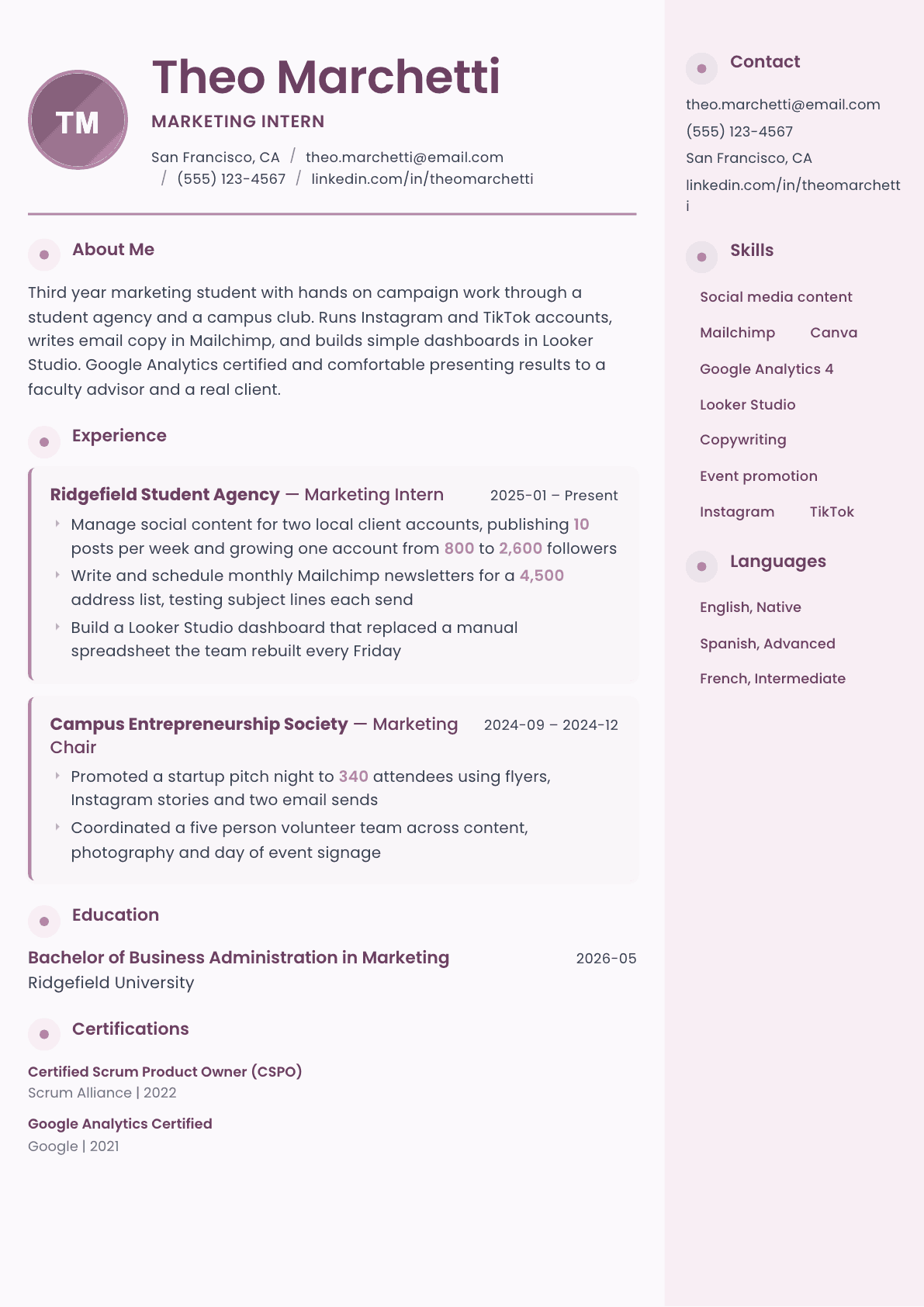
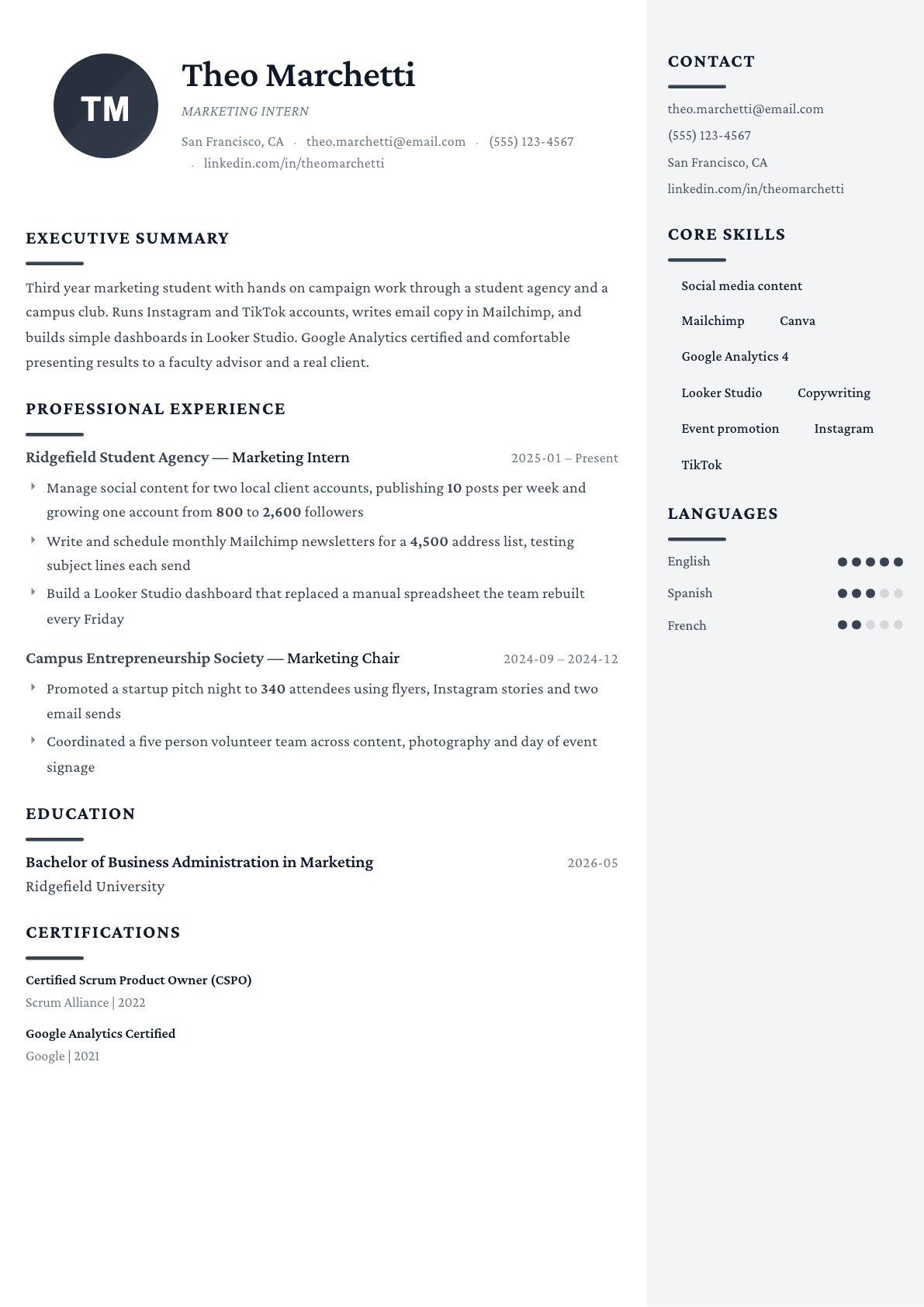
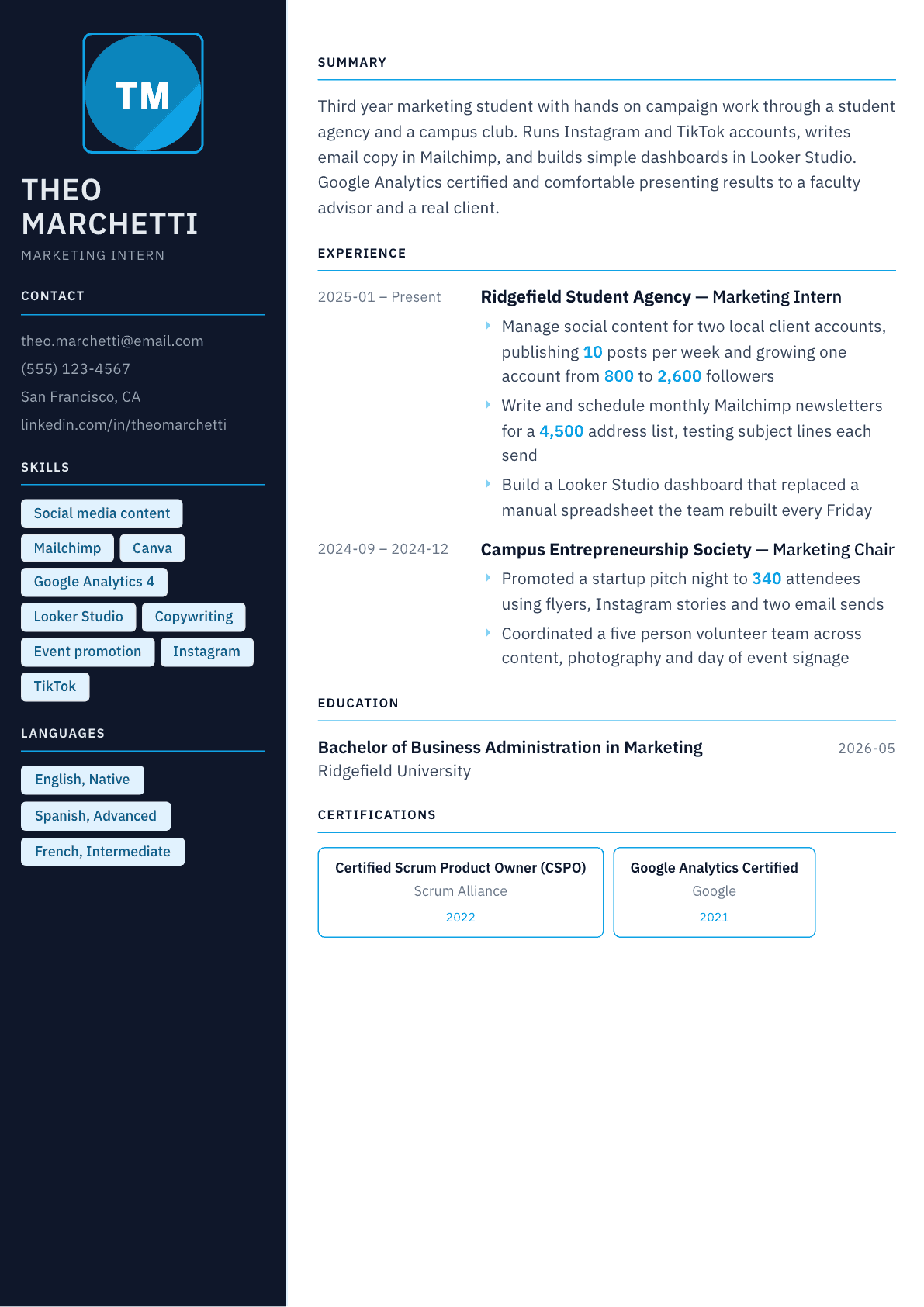
Example Marketing Intern summary
Third year marketing student seeking a summer internship in content or lifecycle marketing. Runs two client social accounts through a student agency, writes monthly email campaigns in Mailchimp, and built a Looker Studio dashboard that replaced a weekly manual report. Google Analytics certified, comfortable presenting results, and looking for a team where an intern writes and ships real work.
Skills to list on a Marketing Intern resume
- Social media content
- Copywriting
- Canva
- Mailchimp
- Google Analytics 4
- Looker Studio
- Market research
- Content calendar management
- TikTok
- Presentation design
- Event promotion
What actually gets this resume read
- Treat club roles, class projects and freelance gigs as real experience with a company name, dates and result bullets.
- Put education at the top with relevant coursework, then a projects section that shows what you actually produced.
- Add free credentials you genuinely hold, such as the Google Analytics certification, in a short certifications block.
- Link a small portfolio of the posts, emails or decks you made, because an intern is hired on evidence of taste and effort.
- Quantify small numbers honestly; 800 to 2,600 followers on a campus account is more persuasive than a vague growth claim.
- Say which team you want to join, since content, paid media and events hire for different signals in the same posting.
How to write a marketing intern resume
Marketing internship applications are read in bulk, often by a coordinator or a manager who has fifteen minutes between meetings and two hundred files. Nobody expects a student to have run a paid budget. What the reader is looking for is proof that you have made something and watched what happened to it, because an intern who has never published anything needs supervision on every task, and an intern who has published fifty captions needs supervision on the first two.
The second thing the reader checks is fit with a specific team. Marketing internships are posted under one title and split into completely different jobs once you arrive: content, social, events, paid media, research, product marketing. A resume that names the lane you want and shows one artifact from it beats a general resume that lists every marketing course on the transcript.
This guide covers how to build an internship resume when the work was unpaid or academic, where education goes, how to write summaries at three stages of a degree, and the questions students ask when a posting asks for experience they have not been allowed to get yet.
Format: one page, education first, projects doing the heavy lifting
One page, single column, no photo. Education sits at the top with your program, expected graduation, and a short relevant coursework line naming four or five courses that map to the internship: consumer behavior, marketing analytics, digital advertising, brand management.
Below education, put experience and projects. If your strongest marketing work came from a club or a freelance client, put that block first and title it experience anyway. Nothing in the rules says experience must be salaried, and a campus agency role formatted like a job reads like a job.
- Header: name, city, phone, university email, and a link to a portfolio or a public account you ran.
- Sections: education, experience and projects, skills and tools, certifications, activities.
- Include your grade point average only when it is strong and the posting asks for it.
Summary: the lane you want and the evidence you already have
Two or three lines. Name your program and year, the specific area of marketing you are aiming at, the tools you can already use, and one piece of work with a number attached. Ambition without evidence reads as filler; evidence without direction leaves the reader unsure which team to route you to.
A student summary should also say what you want from the internship in practical terms. Wanting to write, to work on paid media, or to sit close to customers tells a manager where you will be motivated, and motivated interns are the ones who get return offers.
Turning coursework and clubs into real bullets
A class project becomes credible when you write it as work: the client or brief, what you produced, what you used, and what the outcome or recommendation was. A semester long marketing plan for a local business is a genuine deliverable if you say who it was for and what you recommended.
Club work should carry the same structure. Give the organization, your role title, the dates, and bullets with counts: posts published, attendees at an event you promoted, emails sent, sponsors contacted, dollars raised through a campaign you ran.
Freelance and family business work counts and is frequently the strongest item on a student resume, because it is real money and real consequences. Name the business type rather than leaving it anonymous, and describe what changed after you took the channel over.
- Every project entry needs an outcome line, even when the outcome is a recommendation rather than a result.
- Prefer one deep project with real numbers to a list of four course titles.
- Say which parts were yours when the project was a group assignment.
Tools and certifications an intern can genuinely claim
List only tools you have actually used to produce something, and expect to be asked to describe the last thing you built in each one. A short tools line is enough: a design tool, an email platform, a scheduler, an analytics tool, a spreadsheet, and a presentation tool.
Free certifications are worth real points at this stage because they are verifiable and they cost effort rather than money. The Google Analytics certification, the HubSpot inbound and email certifications, and the Meta digital marketing associate credential all name an issuing body. Put them in their own short block so they are not mistaken for coursework.
The application itself
Internship postings frequently ask for a portfolio or a writing sample, and most applicants skip it. Attaching three artifacts, a short article, a set of social posts and a one page campaign recap, moves you ahead of a large part of the pile on effort alone.
Tailor the summary line to each company and change the coursework list to match the posting. It takes four minutes and it is visible, because a resume that names the same channel mix as the job description reads as written for that team rather than mailed to two hundred of them.
Marketing Intern resume summary examples
First or second year student
Second year marketing student seeking a summer internship in content or social. Runs the Instagram account for a campus entrepreneurship club, publishing three posts a week and promoting an event that drew 340 attendees. Comfortable in Canva and Later, and completing the Google Analytics certification this term.
Third year with agency work
Third year marketing student with two semesters at a student run agency handling social and email for local clients. Publishes ten posts a week, writes monthly newsletters in Mailchimp to a 4,500 address list, and built a Looker Studio dashboard that replaced a weekly manual spreadsheet report.
Final year, returning intern
Final year marketing student returning from a summer internship on a lifecycle team, where I wrote and built eleven email campaigns and ran a subject line test across four sends. Seeking a fall internship in lifecycle or content marketing with a team that lets interns publish.
Work experience bullets: before and after
Before: Managed social media for a student club.
After: Ran the Instagram and TikTok accounts for a 200 member entrepreneurship club, publishing three posts a week and growing followers from 400 to 1,900 across two semesters.
Membership size, cadence and a start to finish follower number make a club role measurable.
Before: Completed a marketing plan for a class project.
After: Wrote a semester marketing plan for a neighborhood bakery, including a customer survey of 60 respondents, a competitor pricing review and a paid social recommendation the owner adopted.
The client, the research method and the adopted recommendation turn coursework into consulting.
Before: Helped with email newsletters.
After: Wrote and scheduled monthly Mailchimp newsletters to a 4,500 address list, testing two subject lines per send and summarizing the results for the account lead.
Naming the platform, the audience size and the testing habit shows process rather than button pressing.
Before: Made reports for the team.
After: Built a Looker Studio dashboard pulling social and email metrics into one weekly view, replacing a spreadsheet the team rebuilt by hand every Friday.
Framing the report as a process you removed is far stronger than saying you produced one.
Before: Volunteered at a campus event.
After: Promoted a startup pitch night to 340 attendees through flyers, two email sends and a week of Instagram stories, and coordinated five volunteers on signage and photography the day of the event.
Attendance, channels used and the team you coordinated give a volunteer shift the shape of a campaign.
Hard skills
- Social media content creation
- Copywriting
- Canva
- Mailchimp
- Google Analytics 4
- Looker Studio
- Market research and surveys
- Content calendar management
- Presentation design
- Spreadsheet analysis
Soft skills
- Curiosity about customers
- Reliability on deadlines
- Willingness to take edits
- Clear written updates
- Initiative without supervision
Certifications worth listing
- Google Analytics Certification (Google Skillshop)
- HubSpot Inbound Marketing Certification (HubSpot Academy)
- Meta Certified Digital Marketing Associate (Meta)
- Google Ads Search Certification (Google Skillshop)
Mistakes that cost marketing intern candidates the interview
- Filling a page with course titles instead of one project described the way a real deliverable would be.
- Writing an objective that says you want to learn, when the reader is deciding whether you can already produce.
- Applying to every internship with one generic file, which is visible the moment the channels do not match the posting.
- Listing tools you have only watched a tutorial on, since a five minute interview question exposes it immediately.
- Leaving out the portfolio link when the whole difficulty at this stage is proving you have made something.
- Burying a paid freelance client under activities where it reads as a hobby rather than as commercial work.
Marketing Intern resume questions
What goes on a marketing intern resume if I have never had a job?
Coursework projects, club roles, volunteer promotion work and anything freelance, all formatted like jobs with dates and result bullets. Part time work outside marketing still belongs on the page because it shows reliability and customer contact.
Should education go above experience on an intern resume?
Yes, while you are still enrolled. Put the program, expected graduation date and a short relevant coursework line at the top, then move education below experience once you have finished a degree and completed one internship.
Are free marketing certifications worth listing?
They are, because they are verifiable, they name a real issuing body, and very few applicants finish them. Give them a dedicated block rather than mixing them into skills so the reader sees the credential and the issuer together.
How do I write a resume for a marketing internship in a specific channel?
Name the channel in your summary, reorder your bullets so the closest work comes first, and adjust the coursework line. An application aimed at a paid media team should lead with analytics and advertising work, not with event volunteering.
Does a marketing intern resume need a cover letter?
When the posting allows one, write it. Three short paragraphs naming the company, one thing you noticed about its marketing, and the piece of your own work most relevant to the team. It is the cheapest way to stand out in a very large pile.