Facilities Manager Resume Examples: the lines they read
Resume for a Facility Manager: Facilities Manager Examples
By Mustafa Tarabya, founder of CVBooster · Published · Updated
Resume for a facility manager with examples: a full facilities manager resume, summaries from coordinator to director and the numbers to lead with.
Sample resumes for a facilities manager
The same facilities manager content laid out in three CVBooster templates, so you can see what the finished document looks like before you write a word.
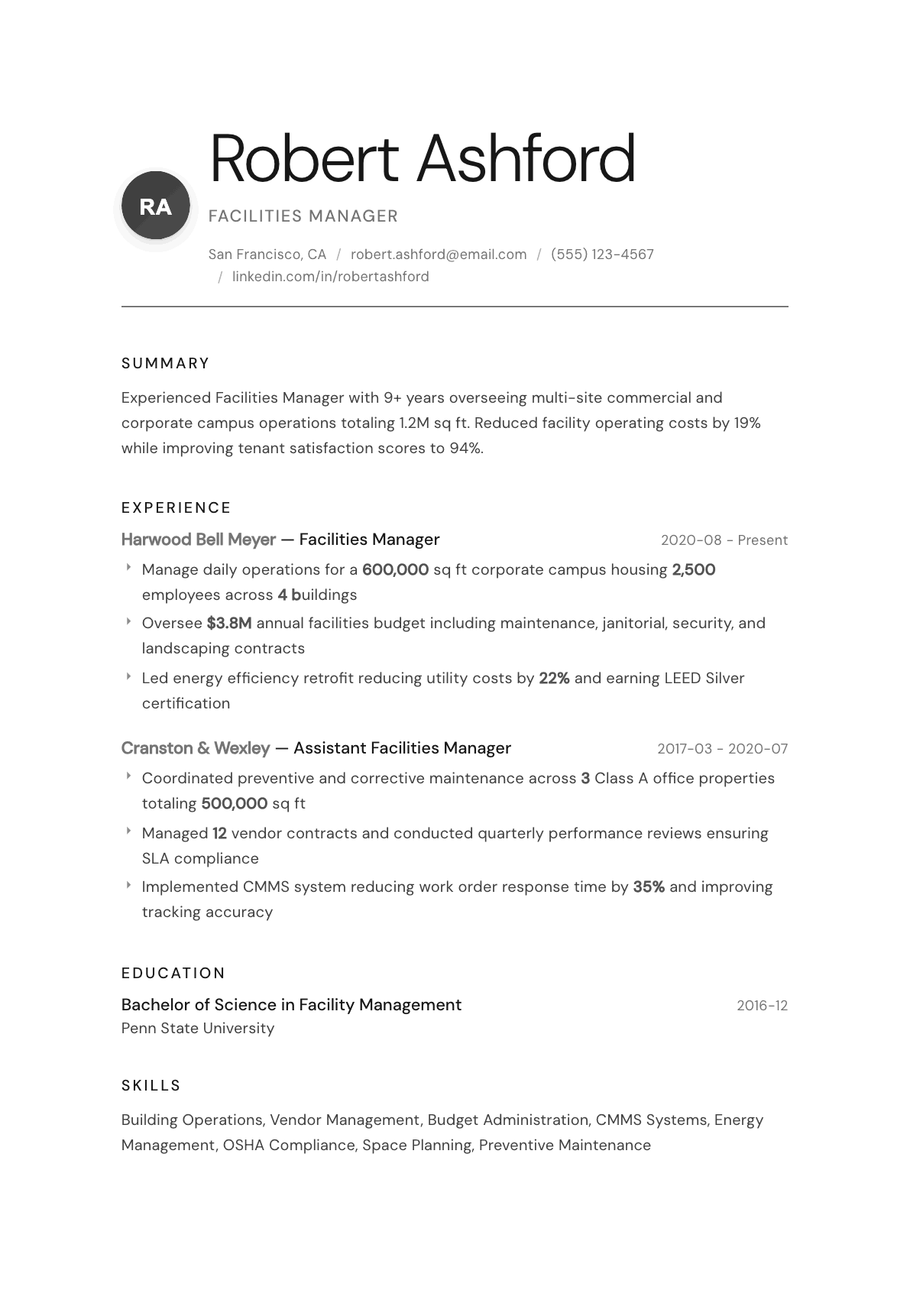
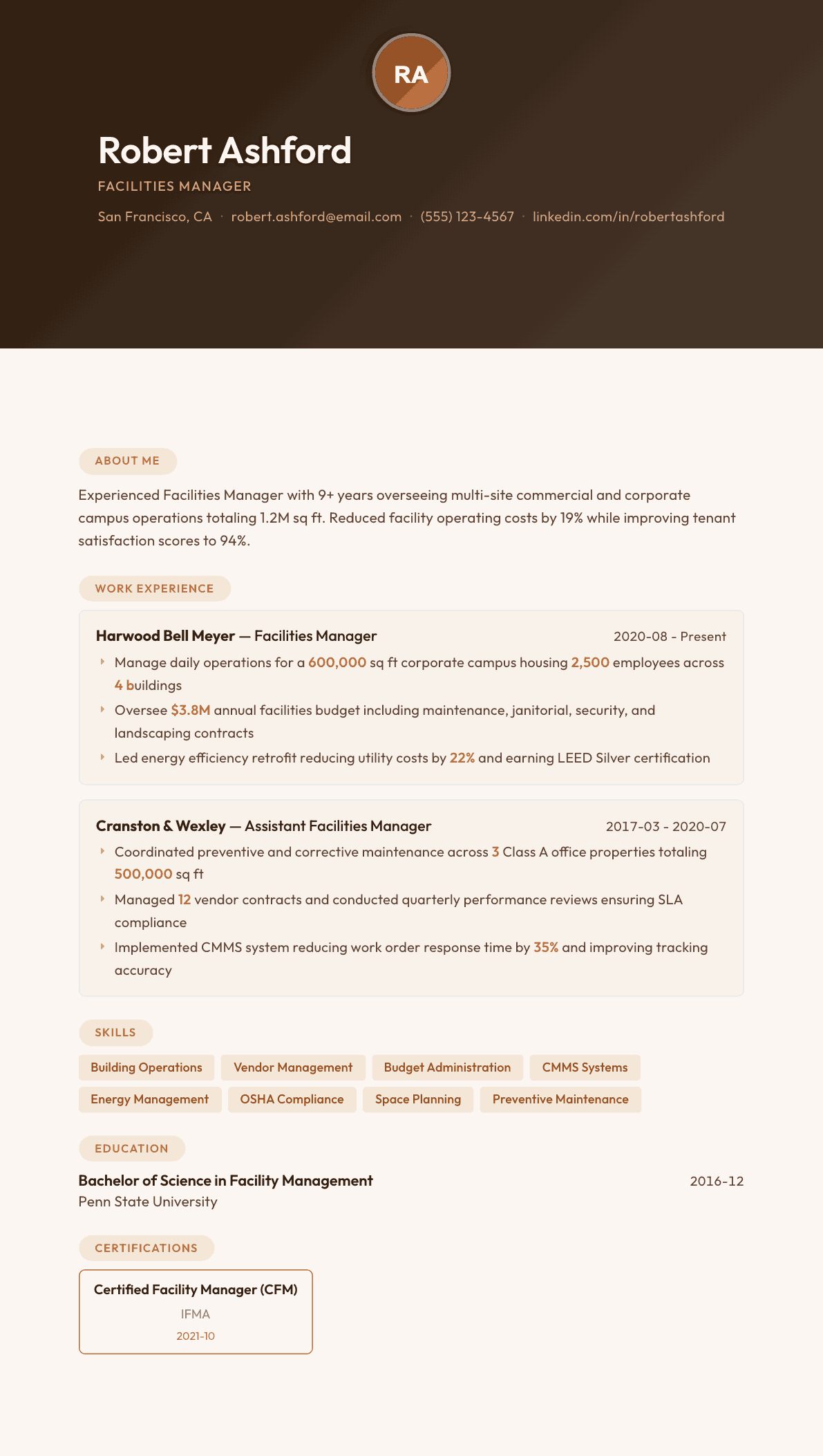
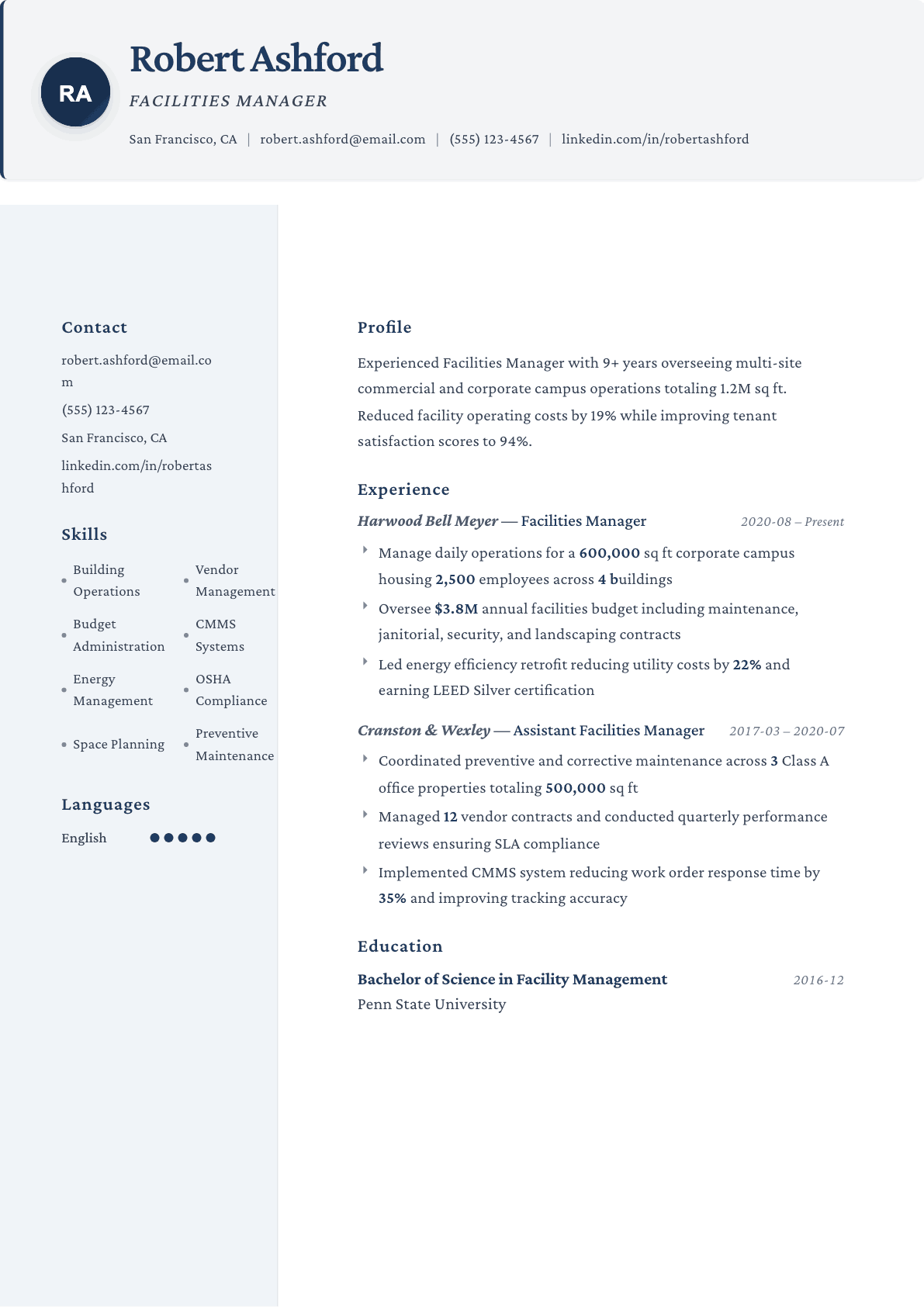
Example Facilities Manager summary
Facilities Manager with 9 years overseeing 1.2M sq ft of commercial and corporate properties. Reduced operating costs by 19%, achieved LEED certification, and maintained 94% tenant satisfaction across multi-site portfolios.
Skills to list on a Facilities Manager resume
- Building Operations
- Vendor & Contract Management
- Budget Management
- CMMS / CAFM Systems
- Energy & Sustainability
- OSHA & Life Safety Compliance
- Space Planning
- Preventive Maintenance
- Capital Project Management
- Tenant Relations
What actually gets this resume read
- Quantify square footage managed, number of sites, and employee populations served.
- Highlight cost savings from energy programs, vendor negotiations, or process improvements.
- Include CMMS or facility management software experience like FM:Systems, Archibus, or ServiceNow.
- Showcase sustainability achievements such as LEED certifications or energy reduction metrics.
How to write a facilities manager resume
A facilities manager resume is sized before it is read. The person hiring, usually a director of real estate, a chief operating officer or a property owner, wants three numbers in the first few lines: how much space you have run, across how many buildings, and how large a budget you controlled. Everything else is interpretation, and without those numbers there is nothing to interpret.
The second question is what kind of building. A corporate campus with a helpdesk and a moves, adds and changes program is a different job from a manufacturing site with critical utilities, a hospital under joint commission oversight, or a portfolio of leased offices where you are managing landlords rather than assets. Say which one, because the mechanical systems, the compliance regime and the vendor set all change with it.
This guide covers the structure facilities employers read, three summaries from coordinator to director, before-and-after bullets built on uptime, cost and vendor performance, a complete resume for a facility manager written out section by section, and the questions facilities managers ask when moving between building types. Postings use facility manager and facilities manager for the same job, so match whichever spelling the advert uses in your title line.
Format: a portfolio line under every role
Reverse chronological, two pages once you have run multiple sites. Under each title, give the portfolio: number of buildings, total square footage, occupant population, building class or type, the annual operating budget you owned, and the in-house headcount plus contracted vendor staff you directed. This is the scope line, and it should be the most concrete sentence in the whole document.
Add a systems and compliance block near the top listing the building systems you have owned and the codes and inspections you have managed. Facilities recruiters filter on those terms because they map directly to the risk the employer is trying to cover.
- Header: name, city and state, phone, email, and credentials such as a facility management certification or a trades license.
- Order: summary, portfolio and systems snapshot, experience with a portfolio line per role, certifications, education.
- Coordinators moving up should show work order volume, vendor coordination and any budget line they controlled.
Summary: space, sites, budget, and one saving
Two or three sentences. Total space managed and the number of sites, the occupant population, the budget, and one cost or service outcome. An energy retrofit, a vendor consolidation, a preventive maintenance program that cut emergency calls, or a service level agreement you brought back into compliance are all specific enough to be credible.
Facilities work is judged on avoided problems, which are invisible unless you name them. Say the building stayed open through a chiller failure, that the fire inspection passed with no correction, that the elevator contract was renegotiated. Nobody notices those from the outside, which is exactly why they belong on the page.
Operations: the systems, the maintenance program, the work orders
Name the systems you have actually managed: heating, ventilation and air conditioning plants including chillers, boilers and air handling units, building automation and controls, electrical distribution and switchgear, emergency generators and uninterruptible power supplies, fire alarm and suppression, plumbing, elevators, roofing and envelope, and access control and video surveillance.
Then the program. Preventive maintenance schedule compliance, work order volume and average response and completion time, deferred maintenance backlog and how you reduced it, capital replacement planning against asset age, and the after hours and emergency response arrangement. A computerized maintenance management system is the tool; the numbers it produces are the evidence.
Regulatory and life safety work belongs in its own bullets: fire and sprinkler inspections, backflow and water testing, elevator certification, occupational safety compliance, indoor air quality, and any inspection regime specific to your building type.
Money: budget, vendors and capital projects
Facilities managers control real spend, so show how you controlled it. Operating budget ownership and variance, utility cost and consumption, contract renegotiation, vendor consolidation, and the request for proposal processes you ran for janitorial, security, landscaping, mechanical and elevator services. Give the number of contracts and how you held vendors to their service level agreements.
Capital projects are the other half. Tenant improvements and fit-outs, mechanical replacements, roof and envelope work, lighting and controls retrofits, and moves and restacks. Give the scope, the schedule and whether it landed on budget, plus any occupancy impact you avoided by phasing the work.
Software, sustainability and the keyword block
Name the platforms. The maintenance management or integrated workplace management system in use, the building automation platform, the space planning tool, and the energy monitoring system. Employers standardized on one of these shorten onboarding for a candidate who already knows it.
Sustainability is now a hiring criterion rather than a nice extra. Energy reduction programs, building certification work, waste diversion, and utility benchmarking all belong on the page with the mechanism named, not just the label.
A complete resume for a facility manager, written out
Here is a full resume for an invented site facility manager at a corporate campus, in the order a director of real estate reads it. Copy the structure and replace every detail with your own portfolio, systems and numbers.
- Header: Marcus Bell, Facility Manager, Charlotte, NC, phone, email, Certified Facility Manager (CFM).
- Summary: Facility manager with 8 years running corporate office space, currently a 3-building campus of more than half a million square feet and 1,900 occupants. Owns the campus operating budget, 9 in-house technicians and 14 service contracts, and reduced emergency work orders by rebuilding the preventive maintenance program.
- Portfolio and systems: 3 Class A office buildings, central chiller plant, 2 emergency generators, building automation system, fire alarm and sprinkler systems, 6 elevators, access control.
- Facility Manager, Northpoint Financial campus, current role, five years: runs operations, maintenance and vendors for the campus; moved all preventive tasks into the maintenance management system; rebid janitorial and security contracts and held both to quarterly service reviews; delivered a 2-floor restack for 300 employees over 4 weekends with no lost workdays.
- Assistant Facility Manager, Carolina Medical Offices, previous role, three years: supported 5 leased clinic buildings, coordinated landlord repairs and fire inspections, and managed the work order queue of about 200 requests a month.
- Certifications and education: Certified Facility Manager (CFM), OSHA 30-hour general industry card, BS in Construction Management.
Facilities Manager resume summary examples
Facilities coordinator
Facilities coordinator with 3 years supporting 2 office buildings and roughly 800 occupants, dispatching around 120 work orders a month and coordinating janitorial, landscaping and mechanical vendors. Owns the preventive maintenance calendar in the maintenance management system and the badge and access request queue.
Site facilities manager
Facilities manager with 9 years running a corporate campus of 4 buildings housing 2,500 employees, owning a multi-million dollar operating budget covering maintenance, janitorial, security and landscaping. Led a lighting and controls retrofit that cut utility consumption by 22% and earned a building certification.
Regional facilities director
Regional facilities director with 15 years across corporate, industrial and leased portfolios totaling more than a million square feet in 11 sites. Manages 6 facilities managers and 40 contracted staff, runs the capital replacement plan, and consolidated 30 service contracts into 8 regional agreements.
Work experience bullets: before and after
Before: Managed daily operations of a corporate office building.
After: Ran daily operations for a 4-building corporate campus housing 2,500 employees, covering mechanical plant, janitorial, security, landscaping and space moves.
Building count, occupant population and the service scope give the reader the size of the job immediately.
Before: Reduced facility operating costs.
After: Cut utility consumption by 22% through a lighting and controls retrofit and a rebuilt building automation schedule, with the payback verified against monthly meter data.
The mechanism and the verification method turn a savings claim into an auditable project.
Before: Managed vendors and service contracts.
After: Held 12 service contracts to their agreed response times through quarterly performance reviews, and rebid janitorial and mechanical services when two vendors missed targets twice running.
Naming the review cadence and the consequence shows vendor management rather than vendor administration.
Before: Implemented a work order system.
After: Rolled out a maintenance management system across 3 properties, moved all preventive tasks onto scheduled work orders, and brought average response time down by 35% with full asset history tracking.
The rollout scope and the response time result show the system produced an operational change.
Before: Handled building emergencies when they happened.
After: Kept the campus fully occupied through a chiller failure by staging rental cooling within 6 hours, and rewrote the emergency response plan and vendor call tree afterward.
A named incident with a response time and a follow-up action is the clearest proof of facilities judgment.
Hard skills
- Building operations and maintenance
- HVAC and mechanical plant management
- Building automation systems
- Preventive maintenance programs
- Maintenance management software
- Operating budget management
- Vendor and contract management
- Capital project delivery
- Life safety and fire systems compliance
- Space planning and moves management
- Energy management and utility benchmarking
- Occupational safety compliance
Soft skills
- Calm incident response
- Negotiation with contractors
- Occupant and tenant communication
- Prioritizing competing requests
- Supervising trades and contracted staff
- Planning around occupied buildings
Certifications worth listing
- Certified Facility Manager (CFM) (International Facility Management Association)
- Facility Management Professional (FMP) (International Facility Management Association)
- Sustainability Facility Professional (SFP) (International Facility Management Association)
- Real Property Administrator (RPA) (BOMI International)
- Certified Property Manager (CPM) (Institute of Real Estate Management)
- LEED Accredited Professional (Green Business Certification Inc. (GBCI))
Mistakes that cost facilities manager candidates the interview
- Omitting square footage, site count and occupant population, which are the three numbers that size the role for the reader.
- Never stating the operating budget you controlled, which is how employers separate a coordinator from a manager.
- Listing building systems generically instead of naming the plant, the controls platform and the life safety equipment you owned.
- Leaving out compliance and inspection work, which is the risk the employer is hiring you to carry.
- Writing cost savings with no mechanism, so the reader cannot tell a negotiated contract from a deferred repair.
- Skipping the maintenance management software, which recruiters filter on and which shapes the entire daily workflow.
Facilities Manager resume questions
What numbers should a resume for a facility manager include?
Square footage and number of sites, occupant population, operating budget owned, in-house and contracted headcount directed, work order volume and response time, preventive maintenance compliance, and utility or cost reductions with the mechanism attached.
Does building type matter when applying for facilities roles?
It matters a great deal. Corporate offices, industrial sites, healthcare buildings and leased portfolios carry different systems, compliance regimes and vendor sets. Name your building types clearly and lead with the one closest to the posting.
How do I show value when nothing broke?
Name the avoided failures. Preventive maintenance compliance, a reduction in emergency call-outs, inspections passed with no correction, a deferred maintenance backlog you cleared, and incidents you contained before they affected occupancy are all measurable and specific.
Are facilities certifications worth listing?
Yes, when they come from a recognized body. A facility management or property administration credential signals a formal grounding in building systems, finance and compliance, and some employers filter on them directly for manager and director positions.
How do I move from a trades role into facilities management?
Lead with the supervisory and planning work rather than the tool time: preventive maintenance scheduling, contractor coordination, budget input, compliance inspections and emergency response. Keep your trade license visible, because technical credibility is an advantage in this field.
Related resume examples
- Property Management Resume example
- Maintenance Technician Resume example
- Operations Manager Resume example
- Commercial Property Manager Resume example
- Regional Property Manager Resume example
- Residential Property Manager Resume example